
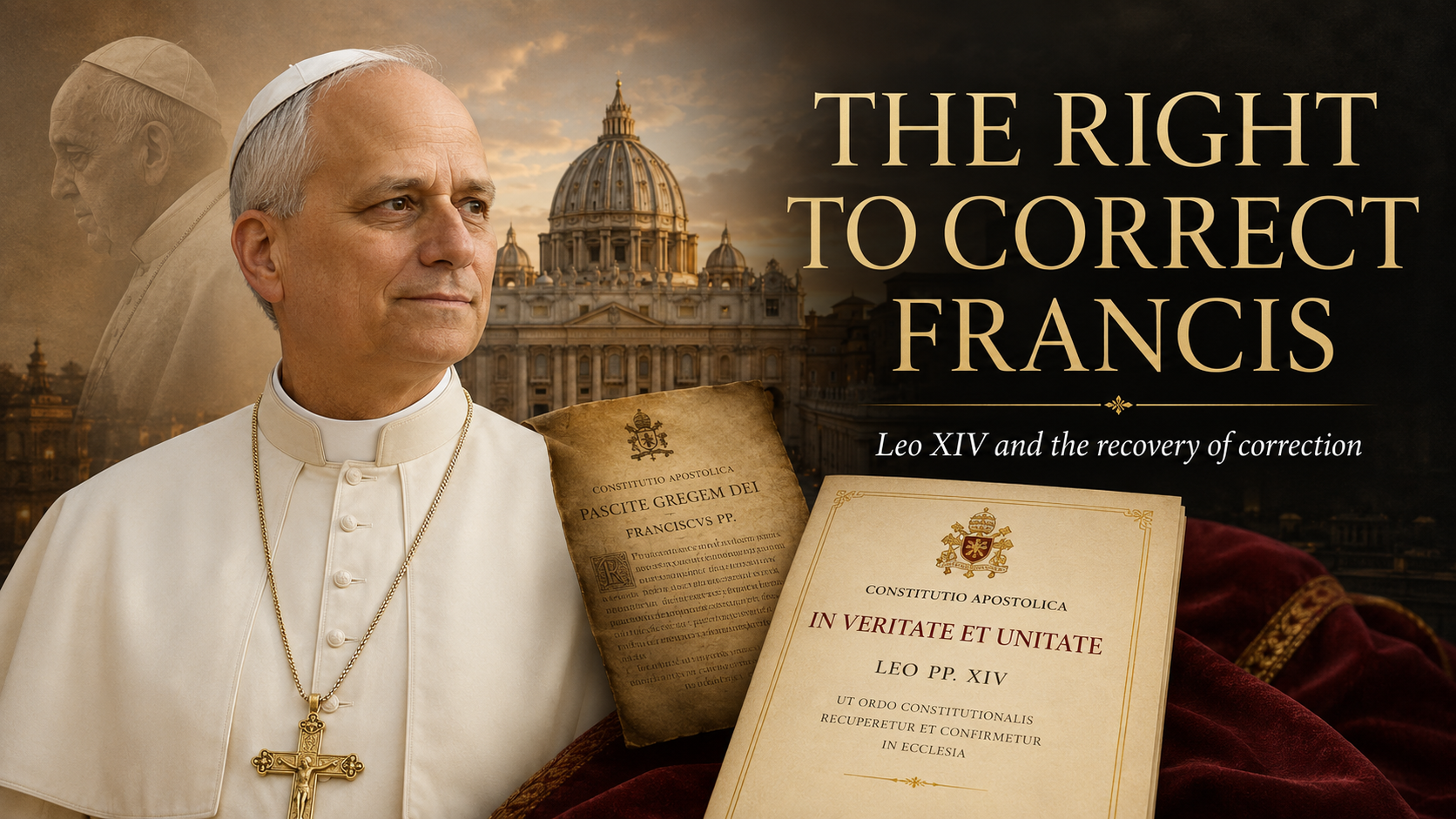
THE RIGHT TO CORRECT FRANCIS
Leo XIV has quietly reversed a Francis-era constitutional innovation which leading Vatican scholars describe as historically and theologically defective. The immediate question concerns Vatican sovereignty. The larger principle is far more consequential: a papal innovation does not become irreversible merely because a Pope introduced it.

Sometimes an apparently technical change reveals far more than its authors need say explicitly. On 31 July 2026 Pope Leo XIV promulgated a new Fundamental Law of Vatican City State. It did not merely amend the law issued by Pope Francis in 2023: it replaced it in its entirety. More significantly, Leo removed from the constitutional foundation of the State a theological proposition which Francis had introduced only three years earlier. Francis had begun his 2023 Fundamental Law by declaring that he was called to exercise sovereign powers over Vatican City State “by virtue of the Petrine munus” — in forza del munus petrino. The implication was unmistakable. The Pope’s temporal sovereignty over Vatican City was being connected directly with the supernatural office he holds as successor of St Peter.¹
Leo XIV has removed that proposition and, in its place, returned to the older constitutional logic established by the Lateran settlement. Vatican City State exists as an instrument established to secure the Holy See’s “absolute and visible independence” and to guarantee its sovereignty in the international sphere. The Pope certainly remains sovereign of Vatican City and possesses legislative, executive and judicial authority there, but the temporal sovereignty of the State is no longer presented as though it flowed theologically from the munus Petrinum itself.²
That distinction matters. Christ entrusted to Peter the keys of the Kingdom and the government of His Church. He did not establish a European microstate. The Pope’s spiritual primacy belongs by divine institution to the Petrine office; Vatican territorial sovereignty arose within history as a juridical means of protecting the liberty and independence necessary for the Apostolic See to fulfil its supernatural mission. That was precisely the logic of the Lateran Treaty of 1929. The treaty recognised the sovereignty of the Holy See in the international sphere as belonging to its nature and mission, while establishing Vatican City so that the Holy See might possess the visible and practical independence necessary to exercise that mission without dependence upon any secular government. St John Paul II retained the same understanding in the Fundamental Law of 2000: Vatican City existed to guarantee the liberty of the Apostolic See and the real and visible independence of the Roman Pontiff in carrying out his mission in the world.³
Francis subtly changed that order. Leo has restored it. Nor is this merely the interpretation of traditional Catholics searching for another criticism of the previous pontificate. Giovanni Maria Vian, historian of Christianity, former editor of L’Osservatore Romano and professor of patristic philology at Rome’s Sapienza University, has described Francis’s formulation as an “anomaly” and an unprecedented innovation. According to Vian, Francis’s text made the Pope’s authority over Vatican City derive directly from his status as Peter’s successor, resulting in what he called a “theocratic arrangement without precedent” in the long history of the Apostolic See. Fr Roberto Regoli, president of the Joseph Ratzinger–Benedict XVI Vatican Foundation and a specialist in modern ecclesiastical history and diplomacy, was no less direct. He judged Francis’s discarded assertion neither historically nor theologically adequate, correct or precise. Vian’s conclusion is more striking still: **Leo XIV has “repaired an unprecedented break.”**⁴
Those words deserve to be allowed their proper weight. An innovation, an anomaly, an unprecedented break, a formulation judged historically and theologically defective — and the remedy was not another elaborate attempt to explain how Francis had really meant the same thing as his predecessors. There was no demand that Catholics discover an invisible continuity between materially different formulations. There was no insistence that, because a Pope had introduced a novelty, the Church was henceforth obliged to preserve it. Leo simply removed it.
That is the real significance of what has happened. Pope Leo XIV has not issued a formal judgment upon the Francis pontificate, and it would be irresponsible to pretend that this constitutional revision amounts to a wholesale repudiation of his predecessor. But in practice Leo has demonstrated something which should never have become controversial: a Pope can introduce an innovation; the innovation can be mistaken; a successor can recognise the problem; and the Catholic remedy can be restoration rather than rationalisation.
Nothing about this weakens the papacy. Quite the contrary. The First Vatican Council defined both the supreme jurisdiction of the Roman Pontiff and the precise circumstances in which his teaching enjoys the charism of infallibility. It did not teach that every prudential decision, disciplinary act, constitutional provision or theological formulation of every Pope is irreformable. Indeed, Pastor Aeternus explains that the Holy Ghost was promised to Peter’s successors not so that they might reveal new doctrine, but so that they might faithfully guard and expound the Revelation handed down through the Apostles.⁵ That is authentic Roman doctrine. The Pope is guardian of the Deposit, not its proprietor; servant of Tradition, not its inventor; successor of Peter, not successor of Christ.
Yet during the Francis pontificate an unhealthy mentality frequently appeared to operate according to a different principle. Previous papal teaching or discipline could be revised, overturned or described as superseded, while Francis’s own innovations were remarkably quickly presented as though they possessed an almost eschatological irreversibility. John Paul II could be moved beyond. Benedict XVI could be reversed. Centuries of liturgical inheritance could be restricted. Long-standing formulations of Catholic moral teaching could be rewritten. But to suggest that some later Pope might reverse Francis was treated in certain quarters almost as an attack upon the Petrine office itself.
Leo has now demonstrated the absurdity of that mentality, and the most obvious test is Traditionis Custodes. In 2007 Benedict XVI stated explicitly that the older Roman Missal “was never juridically abrogated and, consequently, in principle, was always permitted.” He went further in explaining the theological principle which underlay his juridical settlement: what earlier generations held as sacred remains sacred and great for us also and cannot suddenly become entirely forbidden or considered harmful.⁶ It was an extraordinarily important principle because it located papal liturgical authority within continuity rather than above it.
Francis overturned that settlement in 2021. Traditionis Custodes declared the liturgical books promulgated by Paul VI and John Paul II to be the “unique expression of the lex orandi of the Roman Rite.” In the accompanying letter to the bishops Francis stated his firm decision to abrogate preceding norms, permissions and customs.⁷ What Benedict had sought to reconcile Francis deliberately restricted; what Benedict said had never been juridically abrogated Francis placed beneath an increasingly constrictive regime.
Whatever view one takes of Francis’s motives, no coherent doctrine of papal authority can make this a one-way street. If Francis possessed authority to reverse Benedict, Leo possesses authority to reverse Francis. If a papal disciplinary decision becomes inviolable merely because it is the most recent one, then Summorum Pontificum should itself have been untouchable in 2021. It plainly was not. Indeed, the new Fundamental Law offers Leo a striking methodological precedent for dealing with Traditionis Custodes: examine the innovation against what preceded it, distinguish genuine necessity from ideological novelty, recognise where discontinuity has occurred, and restore the earlier settlement where that better expresses the received tradition of the Church.
The question of the death penalty reaches more deeply because Francis deliberately presented his alteration as doctrinal development. In 2018 Catechism §2267 was rewritten to state that capital punishment is “inadmissible because it is an attack on the inviolability and dignity of the person.” The accompanying letter of the Congregation for the Doctrine of the Faith described the new position as an “authentic development of doctrine” supposedly not contradicting prior Magisterium.⁸ Yet this is precisely where the unresolved theological difficulty lies. The Church did not merely tolerate capital punishment through historical embarrassment. Sacred Scripture recognises the coercive authority of legitimate government; Fathers and Doctors acknowledged the principle; St Thomas Aquinas defended its legitimacy under appropriate authority and conditions; and the previous Catechism itself accepted recourse to capital punishment in principle while judging the occasions requiring it in contemporary societies to be exceedingly rare.
One may prudentially oppose executions. One may conclude that modern penal systems render them unnecessary. One may advocate universal abolition as a political judgment. But none of those propositions is identical to saying that capital punishment is in itself an attack upon the inviolability and dignity of the human person. A future correction need not advocate a single execution. It would need only to recover a distinction obscured in 2018: the distinction between the intrinsic moral legitimacy of a penalty in principle and a prudential judgment about whether circumstances justify its use. That distinction would permit the Church vigorously to oppose unnecessary executions without appearing to condemn as morally inadmissible something which her own previous teaching had recognised as permissible.
Then there is Amoris Laetitia. Here the controversy was never simply about whether sinners should be accompanied pastorally. Of course they should. Nor was it about whether subjective culpability can be diminished by circumstances. Catholic moral theology has always known that. The question was whether persons objectively living in a sexual relationship contrary to an existing sacramental marriage might, without a commitment to continence, nevertheless be admitted in certain circumstances to sacramental absolution and Holy Communion.
St John Paul II had answered the practical question unequivocally in Familiaris Consortio. While insisting that divorced and remarried Catholics remain objects of the Church’s pastoral solicitude and continue to participate in her life, he reaffirmed the Church’s practice, founded upon Sacred Scripture, of not admitting them to Eucharistic Communion while their state of life objectively contradicts the nuptial union between Christ and His Church signified by the Eucharist. Where serious reasons prevented separation, access to the sacraments required the undertaking to live in complete continence. Benedict XVI reaffirmed that discipline in Sacramentum Caritatis.⁹
After Amoris Laetitia, however, the bishops of the Buenos Aires pastoral region issued guidelines stating that where continence was judged not feasible and mitigating circumstances were discerned, access to Reconciliation and the Eucharist could in some cases be possible. Francis did not distance himself from this interpretation. He wrote that their text “fully explains the meaning of Chapter VIII” and added the unmistakable sentence: “There are no other interpretations.”*¹⁰ Whatever pastoral qualifications are attached to that approach, the doctrinal tension is obvious. Sacramental absolution presupposes contrition and purpose of amendment. Christian mercy does not merely console us within sin; grace calls and enables us to abandon it. Circumstances may diminish culpability for an objectively evil act, but they do not transform the act itself into something good, nor can pastoral discernment suspend the commandments.
Leo XIV need not “abolish” Amoris Laetitia. Much of the exhortation is pastorally unobjectionable. He could instead do what Popes have often done when confusion has followed an earlier text: clarify it authoritatively. He could reaffirm Familiaris Consortio, Sacramentum Caritatis and the traditional conditions for sacramental absolution; distinguish diminished subjective imputability from the objective moral character of acts; and settle a controversy which has divided dioceses, episcopal conferences, theologians and faithful for a decade.
It is important not to overstate what Leo has done. The new Fundamental Law is not a manifesto against the Francis pontificate. Indeed, it retains and regularises other institutional developments associated with the previous period. The significance lies not in constructing a fictional programme of wholesale restoration from one constitutional act, but in recognising the principle which the act demonstrates: continuity sometimes requires reversal.
That sentence should not be controversial. The history of the Church contains disciplinary experiments abandoned, legal arrangements superseded, prudential judgments reconsidered and theological expressions clarified. What Catholic ecclesiology cannot accept is a theory according to which Tradition is endlessly revisable by the present Pope while the present Pope’s innovations become instantaneously irreversible for his successors. Such a theory would not be Catholic ultramontanism. It would be papal positivism.
Worse still, it ultimately weakens the papacy by requiring Catholics to pretend that contradiction cannot exist. If Pope A teaches or legislates one thing, Pope B reverses him, and Pope C is nevertheless forbidden even to consider returning to Pope A because Pope B represents an irreversible “development,” the faithful are not being taught the Catholic doctrine of authority. They are being asked to absolutise chronology: the newest proposition wins because it is newest. Tradition works in precisely the opposite direction. Novelty must justify itself before what has been received.
Leo’s reform is especially instructive because the very error being corrected concerned an exaggerated understanding of papal power. Francis had connected the Pope’s sovereignty over Vatican City to the munus Petrinum itself. Leo has disentangled them. The Pope remains sovereign of Vatican City, but the microstate exists in service of the Apostolic See’s freedom; temporal sovereignty is not another sacramental power mysteriously contained inside the keys given to Peter at Caesarea Philippi.
There is a lesson here for ecclesiology far beyond Vatican constitutional law. A Pope possesses real and supreme authority over ecclesiastical discipline, but that does not mean the traditional Roman liturgy becomes spiritually dangerous because he restricts it. A Pope possesses supreme teaching authority, but that does not mean the word “development” can convert contradiction into continuity. A Pope possesses the keys, but that does not mean pastoral authority can dispense Christians from the moral law which those keys exist to serve. And a Pope can make mistakes without the papacy ceasing to be true.
Traditional Catholics have sometimes been accused of diminishing the Petrine office by making precisely these distinctions. In fact, these distinctions protect the Petrine office. The alternative is an impossible papacy in which every pontificate must retrospectively rewrite the Church in order to accommodate the novelties of the last. The Church needs something better than that. She needs the humility to recognise that not every change constitutes progress, not every novelty constitutes development, not every restriction constitutes reform, and not every papal decision deserves perpetuation by the next Pope.
On 31 July 2026, Leo XIV encountered a Francis-era innovation and removed it. Leading Catholic scholars have subsequently said publicly what, concerning other controversies of the previous pontificate, many Catholics were repeatedly told they ought not say: the innovation was historically wrong, theologically inadequate and a rupture with what preceded it. The Church did not collapse when they said it. The papacy did not collapse when Leo corrected it. On the contrary, something healthier became visible: the distinction between loyalty to the Petrine office and compulsory defence of every decision made by the man temporarily occupying it.
That is why this apparently obscure constitutional revision matters. Leo XIV has recovered the category of correction. The obvious question now is whether he will have the courage to use it where the consequences are considerably more serious than the constitutional theory of Vatican City State. Traditionis Custodes can be reversed. The 2018 death-penalty formulation can be clarified. The sacramental ambiguity unleashed through Amoris Laetitia can be resolved.
None of this requires denying that Francis was Pope. None requires denying papal primacy. None requires undermining the authority of Leo XIV. What it requires is the opposite: a properly Catholic understanding of the papacy in which the successor of Peter is strong enough to correct what needs correcting because he knows that his first obligation is not to preserve the reputation of his predecessor but to confirm his brethren in the Faith.
Leo has already shown, quietly but unmistakably, that a Francis-era departure is not untouchable merely because Francis made it. Now the principle should be followed to its conclusion. Sometimes fidelity to a predecessor requires preserving what he handed on. Sometimes charity requires overlooking what was merely imperfect. And sometimes the most authentically Petrine act a Pope can perform is to say, by word or deed: this was wrong; we are going back.
¹ Francis, Legge Fondamentale dello Stato della Città del Vaticano, 13 May 2023, Preamble.
² Leo XIV, Legge Fondamentale dello Stato della Città del Vaticano, 31 July 2026, Preamble, Arts 1–2, 25.
³ Lateran Treaty between the Holy See and Italy, 11 February 1929, Preamble and Arts 2–4; John Paul II, Legge Fondamentale dello Stato della Città del Vaticano, 26 November 2000.
⁴ Victoria Cardiel, “New Vatican constitution corrects Francis-era ‘anomaly,’ experts say,” EWTN News/ACI Prensa, 6 August 2026.
⁵ First Vatican Council, Dogmatic Constitution Pastor Aeternus, 18 July 1870, ch. IV.
⁶ Benedict XVI, Letter to the Bishops accompanying Summorum Pontificum, 7 July 2007.
⁷ Francis, Traditionis Custodes, 16 July 2021, Art. 1; Letter to the Bishops accompanying the motu proprio, 16 July 2021.
⁸ Congregation for the Doctrine of the Faith, Letter to the Bishops regarding the new revision of number 2267 of the Catechism of the Catholic Church on the death penalty, 1 August 2018.
⁹ John Paul II, Familiaris Consortio, 22 November 1981, n. 84; Benedict XVI, Sacramentum Caritatis, 22 February 2007, n. 29.
¹⁰ Francis, Letter approving the Buenos Aires pastoral criteria for Chapter VIII of Amoris Laetitia, 5 September 2016.
RELATED ARTiCLES


LATEST ARTICLES
- Today’s Mass: October 16 St Hedwig of SilesiaHedwig of Silesia, a member of the Bavarian comital House of Andechs, was Duchess of Silesia from 1201 and of Greater Poland from 1231 as well as High Duchess consort of Poland from 1232 until 1238. She was canonized by the Catholic Church in 1267 by Pope Clement IV.
- Today’s Mass: October 15 St Teresa of AvilaSaint Teresa of Avila, born in 1515, was the reformer of the Carmelite Order and founded the Discalced Carmelites. Renowned for her mystical writings, she faced opposition while establishing numerous convents. Teresa’s deep spiritual insights and experiences led to her canonisation in 1622, and her feast is celebrated on 15 October.
- Today’s Mass: October 14 St Callistus, Bishop of Rome & MartyrCallistus was born to a Christian slave who had a Christian master in second-century Rome. He was placed in charge of a Christian bank which went broke. He fled the city, but was caught and sentenced to the treadmill, then later to the tin mines. He was later ransomed and returned to Rome…
- Sermon for St. WilfridToday marks the feast of St. Wilfrid, who was pivotal in establishing the Roman Christian tradition in England over the Irish. Born in 634 in Northumbria, he travelled to France and Italy, eventually becoming bishop of York. Despite conflicts with kings and church leaders, he successfully evangelised Sussex and laid foundations for future missions, showcasing both determination and a contentious spirit. St. Wilfrid passed away in 709, leaving a complex legacy of leadership and zeal for evangelism.
- THE GENERATION THAT WAS TOLD TO MOVE ON Is Rediscovering What the Church Left BehindArchbishop Salvatore Cordileone’s interview highlights the challenge of reconciling Catholic Tradition with contemporary practices, warning that restrictions like Traditionis custodes may deepen existing divisions. He notes younger Catholics are rediscovering traditional worship, which contrasts with the Church’s modern adjustments and emphasizes the need for reflective continuity in liturgical development.
CURRENT EDITION


Today’s Mass Propers
- Today’s Mass: October 16 St Hedwig of Silesia
 Hedwig of Silesia, a member of the Bavarian comital House of Andechs, was Duchess of Silesia from 1201 and of Greater Poland from 1231 as well as High Duchess consort of Poland from 1232 until 1238. She was canonized by the Catholic Church in 1267 by Pope Clement IV.

Leave a Reply