
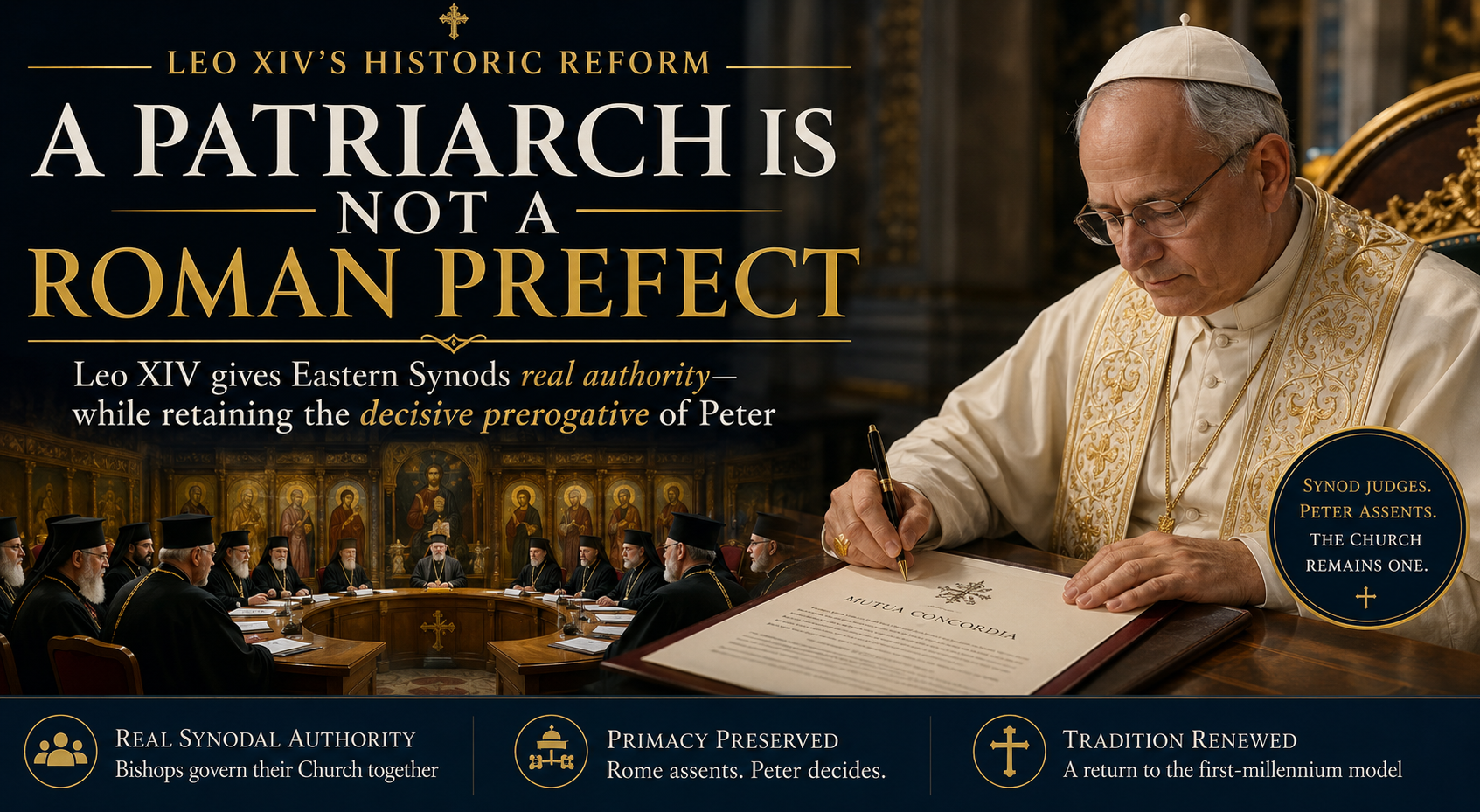
A PATRIARCH IS NOT A ROMAN PREFECT: Leo XIV gives Eastern Synods real authority — while retaining the decisive prerogative of Peter

There are moments when a change of canon law reveals something larger than its immediate subject. Pope Leo XIV’s motu proprio Mutua Concordia, promulgated on 29 August 2026, is one of them. By establishing an orderly procedure by which the Synod of Bishops of an Eastern Catholic Church may remove its Patriarch for grave cause, Leo has done more than close a juridical lacuna. He has given concrete form to a principle often asserted but much less often practised: an Eastern Catholic Church sui iuris is not an administrative province of the Roman Curia, and its Patriarch is not a papal prefect governing it on Rome’s behalf.¹
The distinction matters. Catholic doctrine does not require every act of ecclesiastical government to originate in Rome. Still less does it require the ancient patriarchates to be treated as enlarged dioceses whose internal life is naturally supervised by Roman dicasteries. The constitution of the ancient Church was more differentiated. Patriarchs governed with synods; bishops possessed real jurisdiction; metropolitans exercised real authority; and the primacy of the Roman Pontiff existed within, not instead of, that ordered communion.
Mutua Concordia begins precisely there. Leo describes the relationship between the Patriarch as Pater et Caput — Father and Head — and the bishops of his Synod as constitutive of the life of the patriarchal Church. The Patriarch is not merely the chairman of a committee. Leo says he is “constitutively First and not merely President.”¹ Yet neither are the bishops merely advisers gathered around an ecclesiastical monarch. Their synodal office is real, their jurisdiction is real, and their responsibility for the governance of their Church is real.
This is where the reform becomes significant. It rejects two distortions at once. It rejects the reduction of primacy to chairmanship, but it also rejects the reduction of episcopal collegiality to consultation. The Patriarch possesses genuine primatial authority; the Synod possesses genuine juridical authority. Neither office is made unreal in order to protect the other.
Professor Ines Murzaku has characterised the reform as an important sign of Leo XIV’s movement toward a first-millennium model of primacy and synodality. That description is persuasive, provided one retains Leo’s own insistence that the Patriarch is not merely a primus inter pares in the weak modern sense. The first millennium did not know a flat ecclesiology of interchangeable bishops governed by consensus. It knew ordered primacies, real jurisdictions and synods capable of governing because the bishops who composed them possessed sacred office.²
The new law addresses the exceptional situation in which the communion between Patriarch and Synod has broken down gravely and irreparably. Previously, the Eastern Code contemplated vacancy of the patriarchal see by death or resignation but lacked a developed procedure for removal.³ Leo has supplied one — and, significantly, he has not simply reserved the whole matter to Rome.
The Synod itself determines whether grave cause exists. It may ask the Patriarch to resign. If he refuses, the bishop senior by episcopal ordination arranges for the Synod to elect another President so that the Patriarch does not preside over proceedings concerning his own removal. The Patriarch must be afforded a full defence. The vote is secret and requires the support of at least two-thirds of all members possessing a deliberative vote. Only after that judgment is reached is the decision submitted to the Roman Pontiff.¹
Leo has also prevented a Patriarch from paralysing the process by refusing to convoke the Synod. The amended Canon 106 permits the bishop senior by episcopal ordination to summon it where the Patriarch fails in that duty; if that bishop refuses, the faculty passes successively to the next senior bishops willing to act.¹ The law therefore recognises that the head of a Church cannot be allowed to make himself effectively irremovable by controlling the machinery through which he might be judged.
Yet Rome remains decisive. Leo reserves to the Roman Pontiff what he calls “only the granting of assent to the synodal decision.”¹ The word “only” should not obscure the juridical reality. Without papal assent, the Patriarch has not been removed and the patriarchal see has not become vacant.
That is precisely the point.
The Synod judges. Peter assents.
The Pope does not conduct the proceedings from Rome, nor does a Roman dicastery substitute itself for the hierarchy of the particular Church. Yet neither does the patriarchal Church become a self-contained ecclesiastical sovereignty independent of the universal Church. The new law thus distinguishes rather than confuses two things: proper patriarchal government and universal Roman primacy.
There is something refreshingly concrete about this. Contemporary Catholic discourse has used “synodality” so indiscriminately that the word can mean almost anything: consultation, questionnaires, facilitated conversations, listening sessions, pastoral assemblies or managed consensus-building. Mutua Concordia is different. Here synodality is juridical. Bishops are not merely invited to contribute opinions. They are required to exercise office, judgment and responsibility.
That is much closer to the traditional constitution of the Eastern Churches than the bureaucratic simulation of collegiality sometimes encountered in the modern Latin Church. An Eastern Synod is not a pastoral council. It is not an advisory body whose conclusions acquire significance only when validated by an administrative superior. It is a governing body because its bishops possess governing office.
The historical principle is old. The Second Vatican Council’s decree Orientalium Ecclesiarum did not invent patriarchal autonomy. It explicitly appealed to ancient tradition, affirming the proper rights and privileges of Eastern Patriarchs and acknowledging that Patriarchs with their Synods constituted the superior authority for the affairs of their patriarchates, always without prejudice to the primacy of the Roman Pontiff.⁴ Whatever criticisms may rightly be made of subsequent appeals to “the spirit of Vatican II,” this particular principle was presented as restoration, not innovation.
Leo makes the ecumenical implication explicit. He says that the strengthening of Eastern Synods should be considered also in light of “the theological sensibility and practice of the Orthodox Churches.”¹ That sentence is important. Rome is plainly signalling that communion with the Successor of Peter need not entail the absorption of every ancient patriarchal prerogative into Roman bureaucracy.
There is nothing inherently un-Catholic in that objective. The Orthodox critique of Rome has often been intensified by the impression that communion with the Pope means practical administrative absorption. Catholic doctrine requires no such thing. The Roman Pontiff need not govern instead of Patriarchs in order truly to possess universal primacy.
But the ecumenical argument has limits, and Leo preserves them. The practice of the Orthodox Churches may be illuminating; it cannot determine Catholic ecclesiology. The Synod may judge that its Patriarch should be removed, but it cannot make that judgment juridically effective without the assent of the Roman Pontiff. Patriarchal autonomy therefore remains autonomy within communion, not sovereignty outside it.
The Roman reservation is also a safeguard. Eastern Catholic Churches frequently exist amid powerful political, ethnic and social pressures. Leo explicitly presents papal assent as a protection against improper internal or external influence upon the Synod.¹ A supermajority is an important protection, but no majority is incapable of manipulation. Rome remains the final point at which the universal Church may ask whether justice has in fact been done.
There are questions which only experience will answer. “Grave cause” is broad. The motu proprio does not attempt an exhaustive catalogue of circumstances justifying removal. Nor could such a short procedural law anticipate every evidential, canonical or political complication that a contested patriarchal deposition might produce. Future cases will inevitably create jurisprudence.
The legislation nevertheless establishes a clear principle: the ordinary locus of judgment is the patriarchal Church itself.
That principle becomes more interesting when Mutua Concordia is placed alongside Leo XIV’s other recent constitutional decisions. Murzaku has drawn attention to his 16 July 2026 reform of the Fundamental Law of Vatican City State. The juridical subject is different, but the governing instinct may be similar: to distinguish more carefully between what requires the personal exercise of papal authority and what can legitimately be entrusted to other competent organs.²
Taken together, these acts begin to suggest the outlines of a recognisably Leonine conception of primacy: not a diminution of papal authority, but a more precise articulation of it.
That deserves attention because modern Catholics too easily confuse Roman primacy with administrative centralisation. They are not identical.
The nineteenth and twentieth centuries saw a substantial growth in practical centralisation around Rome, often for understandable historical reasons. But one must not mistake historical centralisation for the immutable content of Catholic doctrine. The first millennium knew a far more articulated ecclesial order. Rome possessed a unique primacy. Patriarchs possessed real patriarchal authority. Metropolitans governed provinces. Bishops governed dioceses. Synods judged, legislated and disciplined.
Universal primacy did not require universal administration.
Traditional Catholics should be especially careful here. The defence of Pastor Aeternus against Gallicanism, conciliarism and the denial of Vatican I does not oblige us to regard every decentralised exercise of legitimate ecclesiastical authority as a subtraction from papal power. Vatican I defined the Pope’s universal and immediate jurisdiction. It did not abolish the real jurisdiction of bishops, suppress patriarchal government or transform every office in the Church into an administrative delegation from Rome.⁵
Here lies the most significant implication of Mutua Concordia: primacy does not become weaker when subordinate authority is permitted to be genuine authority.
That principle also raises an uncomfortable question for the Latin Church.
Traditionis Custodes represented an extraordinary centralisation of liturgical authority. It constrained diocesan bishops in their regulation of the traditional Roman Mass and subjected important aspects of that government to Roman control. Whatever arguments are made in defence of those measures, they sit uneasily beside an ecclesiological instinct which now asks whether authority should ordinarily be exercised at the level to which it properly belongs.
The comparison must be made carefully. An Eastern Patriarch and Synod are not juridically identical to a Latin diocesan bishop, and Mutua Concordia says nothing whatever about the traditional Roman liturgy. It would be irresponsible to claim that Leo is therefore preparing to repeal Traditionis Custodes.
But the question cannot simply be dismissed.
If an Eastern Synod can be entrusted with the extraordinary responsibility of determining whether its own Pater et Caput should be removed from office, why should a diocesan bishop be regarded as incapable of judging whether faithful Catholics within his own diocese may worship according to a Roman liturgical form sanctified by centuries of use?
That is not an argument against papal primacy.
It is an argument about what papal primacy is for.
The strongest exercise of supreme authority is not necessarily the exercise which decides the greatest number of things directly. Sometimes the strength of primacy is shown precisely in recognising the authority which legitimately belongs elsewhere.
Peter need not become every Patriarch in order to remain Peter.
He need not become every diocesan bishop either.
For traditional Catholics, the lesson is worth recovering. Tradition is not synonymous with maximum centralisation. Ultramontane excess and conciliar decentralisation are not the only alternatives available to the Church. Catholic Tradition contains both a real, divinely instituted Roman primacy and real patriarchal and episcopal authority. The task is not to choose one against the other, but to preserve their proper order.
On that measure, Mutua Concordia deserves careful and provisionally favourable attention. It introduces no democratic principle into the Church. It diminishes no prerogative of the Roman Pontiff. What it does is recognise that an Eastern Patriarch is genuinely the Father and Head of a Church, that his bishops are genuinely bishops rather than advisers, and that the government of that Church should ordinarily be exercised by those to whom that government properly belongs.
If Murzaku is correct that Leo XIV is moving toward a more first-millennium conception of primacy and synodality, the development deserves very close scrutiny. The test will not be the vocabulary of “synodality,” but whether Leo consistently distinguishes the unique authority of Peter from an unnecessarily centralised exercise of ecclesiastical administration.
For if that distinction is sound in the East, it cannot become unintelligible merely because one crosses into the Latin Church.
A Patriarch is not a Roman prefect.
Neither is a diocesan bishop.
And Peter does not cease to be Peter because both are permitted truly to govern.
That is not less Catholic because it is less bureaucratically Roman.
It may, in fact, be considerably more Roman in the ancient sense.
¹ Leo XIV, Apostolic Letter issued motu proprio, Mutua Concordia, 29 August 2026, especially the amendments to CCEO cann. 106 and 126.
² Ines Angeli Murzaku, public commentary on Mutua Concordia, 29 August 2026, and her wider discussion of primacy and synodality.
³ Codex Canonum Ecclesiarum Orientalium, can. 126 in its previous formulation.
⁴ Second Vatican Council, Orientalium Ecclesiarum, nn. 7–10, 21 November 1964.
⁵ First Vatican Council, Dogmatic Constitution Pastor Aeternus, especially chapter III, on the power and nature of the primacy of the Roman Pontiff.
RELATED ARTiCLES


LATEST ARTICLES
- Today’s Mass: October 16 St Hedwig of SilesiaHedwig of Silesia, a member of the Bavarian comital House of Andechs, was Duchess of Silesia from 1201 and of Greater Poland from 1231 as well as High Duchess consort of Poland from 1232 until 1238. She was canonized by the Catholic Church in 1267 by Pope Clement IV.
- Today’s Mass: October 15 St Teresa of AvilaSaint Teresa of Avila, born in 1515, was the reformer of the Carmelite Order and founded the Discalced Carmelites. Renowned for her mystical writings, she faced opposition while establishing numerous convents. Teresa’s deep spiritual insights and experiences led to her canonisation in 1622, and her feast is celebrated on 15 October.
- Today’s Mass: October 14 St Callistus, Bishop of Rome & MartyrCallistus was born to a Christian slave who had a Christian master in second-century Rome. He was placed in charge of a Christian bank which went broke. He fled the city, but was caught and sentenced to the treadmill, then later to the tin mines. He was later ransomed and returned to Rome…
- Sermon for St. WilfridToday marks the feast of St. Wilfrid, who was pivotal in establishing the Roman Christian tradition in England over the Irish. Born in 634 in Northumbria, he travelled to France and Italy, eventually becoming bishop of York. Despite conflicts with kings and church leaders, he successfully evangelised Sussex and laid foundations for future missions, showcasing both determination and a contentious spirit. St. Wilfrid passed away in 709, leaving a complex legacy of leadership and zeal for evangelism.
- THE GENERATION THAT WAS TOLD TO MOVE ON Is Rediscovering What the Church Left BehindArchbishop Salvatore Cordileone’s interview highlights the challenge of reconciling Catholic Tradition with contemporary practices, warning that restrictions like Traditionis custodes may deepen existing divisions. He notes younger Catholics are rediscovering traditional worship, which contrasts with the Church’s modern adjustments and emphasizes the need for reflective continuity in liturgical development.
CURRENT EDITION


Today’s Mass Propers
- Today’s Mass: October 16 St Hedwig of Silesia
 Hedwig of Silesia, a member of the Bavarian comital House of Andechs, was Duchess of Silesia from 1201 and of Greater Poland from 1231 as well as High Duchess consort of Poland from 1232 until 1238. She was canonized by the Catholic Church in 1267 by Pope Clement IV.

Leave a Reply