
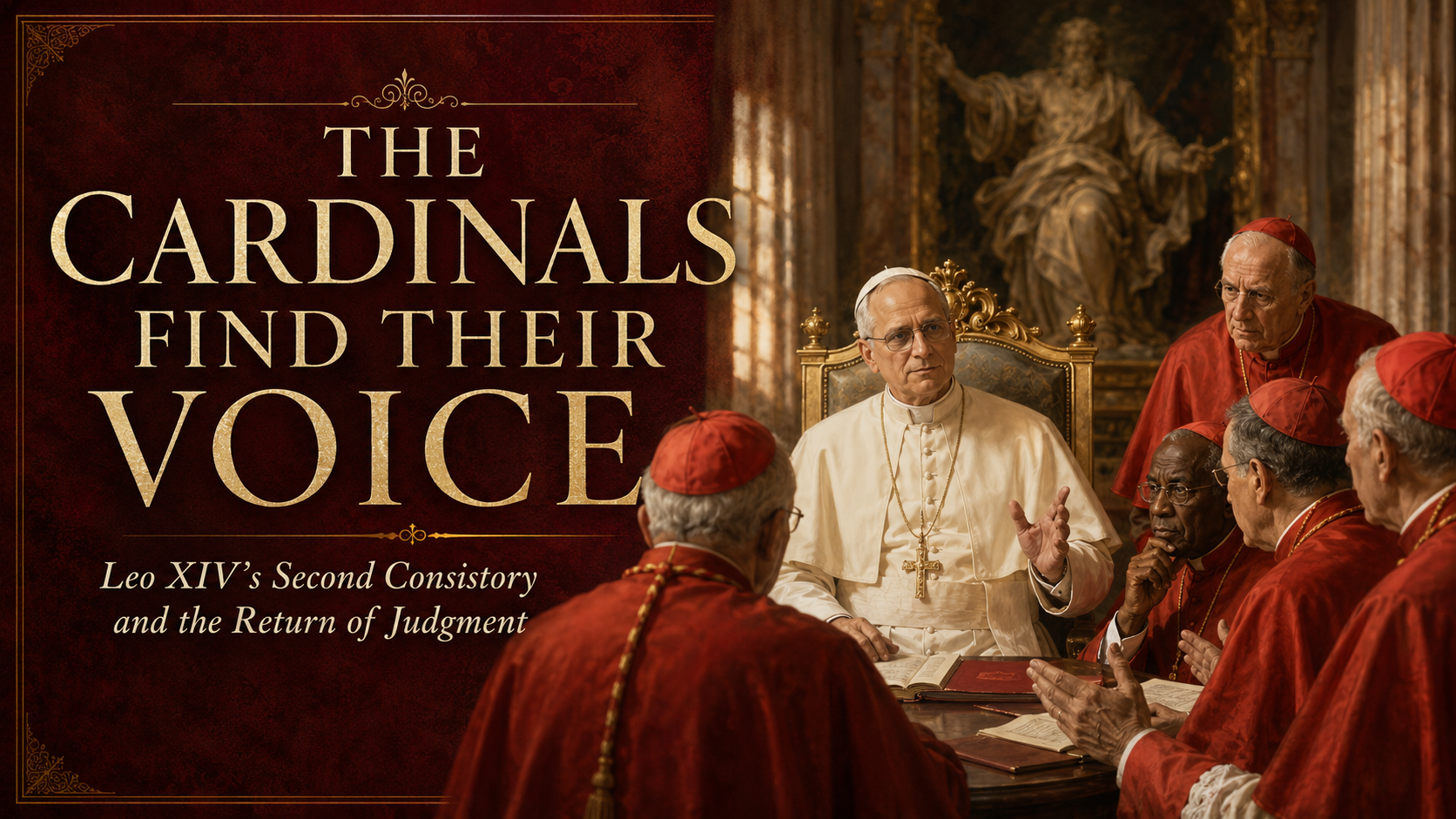
THE CARDINALS FIND THEIR VOICE: Leo XIV’s Second Consistory and the Return of JudgEment

Nearly two months after Pope Leo XIV’s second Extraordinary Consistory, its significance is becoming clearer. What initially appeared to be another carefully managed exercise in the vocabulary and methodology of synodality has yielded something rather more consequential. Accounts from cardinals who were actually inside the room, subsequently published interventions, statements by participants and the fuller testimony assembled by Niwa Limbu for AdVaticanum reveal a College of Cardinals considerably less homogeneous than official summaries suggested. The arguments touched the nature of synodality itself, episcopal authority, Catholic moral teaching, the Society of Saint Pius X, liturgical disorder and, significantly, the continuing attraction of younger Catholics to the traditional Roman liturgy.¹
For readers of Nuntiatoria, much of this should sound familiar. The significance of Leo XIV’s consistories has been followed here from the beginning, and the evidence now available allows earlier judgments to be tested. On 7 January, as Leo’s first Extraordinary Consistory opened, Nuntiatoria identified synodality and the traditional Roman liturgy as two decisive tests of the new pontificate. It welcomed the revival of genuine consultation with the Sacred College, while warning that the crucial question was whether synodality would be re-anchored within recognisably Catholic structures of episcopal counsel under Peter, or allowed to become a permanent governing process in its own right.² What June demonstrated is that this question is no longer being asked only outside the walls of the Vatican. It is now being asked by cardinals within the College itself.
The warning signs had appeared already in January. When the cardinals chose synodality and mission for concentrated discussion while setting liturgy aside, Nuntiatoria argued that the Church risked misdiagnosing her own crisis. Worship could not sensibly be treated as a secondary internal interest while mission, governance and secularisation were discussed as though liturgy were unrelated to them. Lex orandi, lex credendi means that worship forms belief, belief forms life, and deformation in one eventually appears in the others. To separate the Church’s doctrinal and missionary crisis from the manner in which she worships is therefore to separate effects from causes.³
Cardinal Joseph Zen’s intervention sharpened the issue further. He attacked not merely a particular synodal conclusion but the machinery by which conclusions were being produced, describing the methodology in severe terms and questioning whether bishops were really being permitted to perform the tasks proper to their office — disputation and judgment — or whether judgment was being dissolved into controlled discussion, table reports and synthesis.⁴ His criticism mattered because it was not the protest of someone rejecting communion with Rome. It was the protest of a cardinal insisting that bishops should be permitted to act as bishops.
By April, when Cardinal Giovanni Battista Re formally announced the second Consistory for 26–27 June, Nuntiatoria therefore described the gathering as a test of whether Leo XIV could move “from consultation to resolution.” The deferred questions remained conspicuous. The liturgy had not ceased to matter because January had failed to settle it. Neither had the accumulating crisis around the SSPX. A Pope may convene cardinals repeatedly; the real test is whether counsel leads eventually to judgment.⁵
On the morning the June Consistory began, Nuntiatoria returned to the same concern in “When Process Replaces Judgment: Cardinal Zen’s Warning, the Synodal Consistory, and the Crisis Rome Refuses to Confront.” Leo had asked the cardinals for “freedom”, “frankness” and “loyalty”, yet the meeting again relied heavily upon small-group discussion, restricted individual interventions, secretarial summaries and plenary reports. The objection was not to small groups as such. It was that a body whose canonical purpose is to advise the Roman Pontiff on questions of major importance was being organised in a manner capable of converting disagreement into synthesis before the whole College had even heard the disagreement.⁶
The later testimony gathered by AdVaticanum now substantially confirms that this concern was not imaginary. Cardinal Gerhard Müller argued that carefully prepared interventions and serious plenary discussion should receive greater priority. Cardinal Raymond Burke subsequently criticised a method in which an important minority opinion can effectively disappear when a secretary records only those conclusions upon which a group can agree. Other cardinals privately expressed dissatisfaction with the procedures under which they were deliberating. Zen’s January objection was therefore not an isolated complaint. By June, cardinals of markedly different temperaments were confronting the same institutional problem: a College cannot adequately advise the Pope as a College if the College rarely hears itself deliberate.
That distinction goes to the nature of the cardinalate. Canon law does not conceive cardinals principally as honoured ecclesiastics summoned periodically to confirm a programme already devised elsewhere. It states that they assist the Roman Pontiff collegially when convoked to deal with questions of major importance. A consistory is therefore not an ecclesiastical focus group. Cardinals are not demographic representatives invited to contribute perspectives towards a facilitated consensus. Each bears personal responsibility for the counsel he gives. A serious objection does not become less serious because nine other men sitting at the same table cannot agree with it. Indeed, the value of a cardinal may consist precisely in his seeing something which the majority has failed to see.
This is the weakness inherent in synthesis as a governing instinct. A contradiction can become a “tension”. An accusation of doctrinal error can become a “concern”. A demand for correction can become a request for “further discernment”. Nothing need be dishonestly falsified. The method itself naturally privileges what can be collectively restated over what must be individually defended. As Nuntiatoria observed in June, “what began as argument arrives in the plenary as synthesis.” That is not always consultation. Sometimes it is filtration.⁶
Yet the most revealing feature of the June Consistory was that the filtration did not entirely succeed. Cardinal Müller used his free intervention to raise the SSPX crisis directly. His timing was obvious. The Society’s intended episcopal consecrations were only days away. Rome faced the prospect of an act it considered gravely illicit and potentially schismatic, yet the matter was not a principal item of the formal programme. Müller refused to pretend that an impending rupture involving bishops, priests and large numbers of faithful was somehow less worthy of cardinalitial attention than the subjects selected beforehand. He called for a clear doctrinal response and proposed the establishment of a new pontifical structure broadly analogous to the former Ecclesia Dei Commission.⁷
Some cardinals thought Müller had gone off on a tangent. Others welcomed his intervention precisely because the official agenda had failed to confront the crisis. That division proves why his speaking mattered. A consistory worth convening must contain the possibility that a cardinal will tell the Pope that the agenda itself has missed the point.
Nuntiatoria had made precisely that argument before the meeting. The cardinals were being asked which voices the Church had failed to hear while one of the gravest internal confrontations in contemporary Catholicism approached its climax without formal discussion. They were asked to consider reconciliation in the world while Rome and Écône moved towards confrontation. They were being told to practise listening while the most difficult Traditionalist arguments remained institutionally peripheral. The episcopal consecrations of 1 July and the DDF decree of 2 July demonstrated that the question deferred by the Consistory did not disappear. It simply returned in a more dangerous juridical form.⁸
Müller’s intervention also exposes the inadequacy of one of the laziest categories in contemporary ecclesiastical debate. Here was a cardinal strongly critical of current synodal structures who was simultaneously insisting upon papal authority against episcopal consecrations undertaken without pontifical mandate. Traditional criticism of synodality cannot therefore simply be equated with anti-Romanism. Müller’s premise was thoroughly Roman: because papal government matters, the Pope requires candid and intelligent counsellors.
His subsequent observation that “the best kings were always those who had the best counsellors” deserves more attention than it has received. Catholic doctrine does not understand the Pope as a sacramentalised autocrat supplied with supernatural prudence in every administrative decision. Papal primacy is real, supreme and divinely instituted; papal omniscience is not. The stronger one’s doctrine of papal authority, the greater the importance of ensuring that the man exercising it receives honest, learned and sometimes uncomfortable counsel.
The controversy surrounding Cardinal Mario Grech’s presentation exposed the deeper ecclesiological problem. Grech presented synodality not as a temporary programme but as an enduring dimension of Catholic life, speaking of the Church entering a “new stage in the reception of the Second Vatican Council”. Leo himself has repeatedly spoken of synodality as a way of listening, discerning and assuming responsibility together, and the Consistory was explicitly presented as an opportunity to learn synodality by practising it.⁹
Here precision is essential. The Church has never lacked consultation. Popes have consulted cardinals, Roman congregations and theologians; bishops have consulted chapters, presbyterates and advisers; religious superiors have consulted councils and communities. The ancient Church possessed councils and synods long before anyone established a Secretariat for Synodality. The Catholic objection is not to counsel.
The novelty lies in treating synodality itself as a permanent ecclesiological paradigm, complete with specialised vocabulary, implementation structures, facilitators, listening exercises, synthesis teams, continental stages and experts trained in interpreting the process. As Nuntiatoria argued in July in “Synodality for the Initiated: How Collegiality Became Permanent Process,” the Synod of Bishops established by Paul VI remained recognisably episcopal, consultative, episodic and directly subordinate to the Roman Pontiff. Contemporary synodality has progressively widened the subject from bishops advising the Pope to the whole People of God participating in a permanent apparatus of managed discernment.¹⁰
The distinction is not semantic. Vatican II encouraged episcopal collegiality and consultation, but the Nota explicativa praevia attached to Lumen gentium was specifically designed to prevent the episcopal college from being interpreted as a permanently governing body parallel to or restrictive of the Roman Pontiff. Paul VI’s Synod of Bishops met episodically. Its members performed their function for the assembly to which they had been summoned. They did not constitute an ecclesiastical parliament permanently in session.
The contemporary structure is altogether more expansive. Diocesan processes feed national processes; national syntheses feed continental syntheses; continental work feeds Roman assemblies; Roman documents are returned for implementation; implementation produces further evaluation; specialists are appointed to guide the implementation of conclusions reached through earlier stages of the same process. The Church is no longer simply holding synods. She is increasingly being organised around synodality.¹⁰
This is why Cardinal Antonio María Rouco Varela’s criticism matters. According to accounts from those present, Rouco distinguished the traditional canonical reality of synods from the contemporary tendency to treat “synodality” as an essential mark or permanent mode of ecclesial existence. That is not to deny communion, consultation or episcopal cooperation. It is to demand that theological vocabulary remain proportionate to revealed ecclesiology.
The International Theological Commission itself acknowledged in 2018 that the modern systematic use of “synodality” represents a linguistic novelty and that neither the term nor the fully developed contemporary concept appears explicitly in Vatican II.¹¹ That does not make the concept illegitimate. Theology develops terminology. “Transubstantiation” does not appear in Scripture; neither does “hypostatic union”. But legitimate theological development clarifies realities already contained in Revelation. It cannot merely elevate a recently elaborated governing methodology into something “constitutive” and thereby make criticism of its prudential forms appear criticism of the Church herself.
That concern became sharper still when Cardinal Burke addressed Study Group 9. Burke reportedly concentrated upon its treatment of moral and pastoral questions surrounding homosexuality and upon its language concerning a proposed “paradigm shift”. The Study Group material does not formally declare Catholic moral doctrine changed, and that distinction must be maintained. Yet the materials it published include testimonies from Catholics in same-sex relationships who interpret those relationships positively, including criticism of the Courage apostolate. Official publication does not equal magisterial approval, but neither is it ecclesially meaningless. Such testimonies were deliberately placed within a process of theological and pastoral discernment.¹²
The question therefore becomes methodological before it becomes moral: does experience stand beneath Revelation and receive judgment from it, or can experience itself become a source through which settled moral teaching is reinterpreted? Nuntiatoria had already identified this danger in its reporting on Study Group 9 before the Consistory.¹³
Catholic pastoral theology must listen to persons. It must understand circumstances, wounds, failures and the actual lives of those it seeks to shepherd. But the Church does not listen in order to discover whether adultery has become virtuous, whether sacramental marriage has altered its nature, whether homosexual acts have ceased to be objectively disordered or whether the moral law now means the opposite of what it once meant. She listens in order to discern how eternal truth may be taught faithfully, applied justly and lived amid human weakness. The order cannot be reversed: Revelation judges experience; experience does not judge Revelation.
Burke’s invocation of Veritatis Splendor therefore went directly to the heart of the dispute. Saint John Paul II defended the reality of intrinsically evil acts precisely because no intention, circumstance, cultural development or subjective experience can transform an intrinsically disordered moral object into something good. A synodal methodology which cannot preserve that boundary will eventually cease to be a method of pastoral discernment and become a mechanism of doctrinal mutation.
The reported sympathy for Burke’s intervention among some cardinals not normally associated with traditionalist positions is therefore important. The unease is wider than a predictable conservative faction. One cardinal complained that no satisfactory definition of synodality had yet been supplied. Another distinguished it sharply from the classical Synod of Bishops. The argument has moved beyond traditional Catholic journalism into the deliberations of the Sacred College itself.
And then, despite its absence from the formal programme, the liturgy returned. AdVaticanum reports that North American cardinals referred to the notable presence of younger Catholics in churches celebrating the older Roman liturgy, while Cardinal William Goh of Singapore spoke in its defence. Other conversations addressed liturgical abuse and the excessive liberty by which individual celebrants substitute personal preference for the Church’s rubrics.¹
That development is particularly striking because Nuntiatoria had warned in January that sidelining liturgy would not make the issue disappear, warned again in April that the deferred question would return, and observed on the opening day of the June Consistory that liturgy remained one of the obvious unresolved questions of Leo’s pontificate.³ ⁵ ⁶
It returned because the pastoral facts have become increasingly difficult to dismiss. The traditional Roman liturgy cannot plausibly be treated simply as the devotional preference of an ageing remnant. Large traditional pilgrimages attract striking numbers of younger Catholics, while survey evidence in the United States shows that experience of the older rite extends well beyond elderly congregations.¹⁴ None of this proves that the traditional liturgy is about to become the majority form of Catholic worship, nor need it. It establishes something more modest but highly significant: the older Roman liturgy continues to attract younger Catholics despite years of official restriction.
That fact demands explanation. If younger Catholics were appearing in comparable numbers around a new Vatican pastoral initiative, studies would be commissioned, conferences convened and the phenomenon celebrated as evidence of ecclesial vitality. When they instead kneel before an altar, encounter silence, hierarchy, sacrifice and transcendence, and attach themselves to a rite substantially inherited from generations before them, their attraction is too often explained away as nostalgia. But young Catholics cannot sensibly be nostalgic for an ecclesiastical childhood they never had. Something more substantial is drawing them.
Cardinal Rouco has since spoken favourably of Summorum Pontificum as a broad attempt to resolve the liturgical conflict. Cardinal Burke has called for greater freedom for the traditional liturgy and for some renewed Roman structure capable of caring for those attached to it. Cardinal Arthur Roche, by contrast, continues to defend the restrictive trajectory inherited from Francis. The disagreement therefore runs through the hierarchy itself. The June Consistory did not settle the question, but it established something important: the traditional Mass remains a live issue within the College of Cardinals.
This places Leo XIV in a more interesting position than either admirers or critics sometimes allow. It would be premature to depict him as a covert Traditionalist preparing to reverse the Francis settlement. He has repeatedly affirmed synodality and continues to support its implementation. His silence while Müller, Burke and others spoke cannot honestly be converted into agreement with them. A Pope who listens is not necessarily a Pope who assents.
But listening still matters. Nuntiatoria began the year cautiously welcoming Leo’s restoration of regular consistories because the College of Cardinals had too often ceased to function as a genuine body of collective counsel.² The evidence now suggests that something has indeed changed. Cardinals who previously felt constrained in articulating certain criticisms appear increasingly willing to make them. One participant told AdVaticanum that under the new Pope “everybody feels free”. That may prove more important than any particular slogan attached to the Consistory.
Freedom in the Church is not freedom to invent doctrine. It is the freedom required to defend it. A cardinal who thinks a Vatican programme mistaken should be able to say so. A bishop who believes a liturgical policy is damaging souls should be able to explain why. A theologian who sees ambiguity should be able to identify it. A priest who observes pastoral failure should not have to translate his concern into the approved vocabulary of process before anyone will hear him. A Pope who possesses supreme authority has nothing to fear from such candour, because disagreement cannot diminish authority ordered to truth; it can help authority exercise itself more prudently.
The irony of Leo XIV’s second Consistory is therefore almost complete. A gathering intended partly to advance synodality became the place where cardinals questioned synodality. Liturgy was omitted from the principal programme, yet the traditional liturgy was raised. The SSPX crisis was not selected as a central subject, yet Müller brought Écône directly into the room. A methodology built around tables and synthesis produced criticisms of tables and synthesis. A Pope who asked for frank counsel received some.
That does not make the Consistory a failure. It may be its most valuable achievement.
Nuntiatoria warned in June that **“the Church does not lack conversations. What she increasingly lacks is the willingness to let a conversation end in judgment.”**⁶ That remains the test of Leo XIV’s experiment. January exposed the problem. June confirmed it. The subjects that managed process attempted to defer — liturgy, Tradition, ecclesial authority and the SSPX — forced themselves back into the discussion because unresolved realities do not disappear merely because they are absent from an agenda.
The Church cannot live permanently in process. She did not receive a commission to journey indefinitely towards truths already revealed. She received a deposit of Faith, sacraments instituted by Christ, a divinely constituted hierarchy, a moral law that does not become provisional when contradicted by modern experience, and a liturgical inheritance which cannot be treated merely as the disposable property of an ecclesiastical administration.
Consultation, listening and discernment all have their proper place. But they are ordered towards judgment, and judgment is ordered towards truth.
Leo XIV has achieved something worthwhile if the cardinals are again finding the courage to speak. His greater test is now whether the Church’s revived conversation will be permitted to reach conclusions.
The cardinals are finding their voice.
Peter must now decide whether he intends merely to hear them — or to govern with what they are telling him.
¹ Niwa Limbu, “Inside the Consistory: What cardinals made of Leo XIV’s second gathering”, AdVaticanum, 29 June 2026; Holy See Press Office and Vatican News, coverage of the Extraordinary Consistory, 26–27 June 2026.
² Nuntiatoria, “Holding the Centre: The Extraordinary Consistory, Synodality, and the Unresolved Legacy of Francis”, 7 January 2026.
³ Nuntiatoria, “Extraordinary Consistory: Misdiagnosing the Crisis in the Church”, 9 January 2026.
⁴ Nuntiatoria, “Cardinal Zen and the Crisis of Synodality: Authority, Manipulation, and the Future of the Church”, 10 January 2026; “Cardinal Zen, Synodality, and the Constitutional Crisis of the Church”, 22 May 2026.
⁵ Nuntiatoria, “The June Consistory of Pope Leo XIV: Structure, Signal, and the Return of the Deferred Questions”, 13 April 2026.
⁶ Nuntiatoria, “When Process Replaces Judgment: Cardinal Zen’s Warning, the Synodal Consistory, and the Crisis Rome Refuses to Confront”, 26 June 2026.
⁷ Gerhard Cardinal Müller, intervention at the Extraordinary Consistory, 26–27 June 2026.
⁸ Nuntiatoria, “Leo XIV Can Stop the SSPX Schism — If He Chooses To”, 29 June 2026; subsequent Nuntiatoria reporting on the SSPX episcopal consecrations and DDF decree of 1–2 July 2026.
⁹ Mario Cardinal Grech, presentation to the Extraordinary Consistory, June 2026; Pope Leo XIV, opening address to the Consistory, 26 June 2026.
¹⁰ Nuntiatoria, “Synodality for the Initiated: How Collegiality Became Permanent Process”, 14 July 2026; “Experts in Synodality: Leo XIV and the Rise of the Church of Process”, 14 August 2026.
¹¹ International Theological Commission, Synodality in the Life and Mission of the Church, 2018.
¹² Study Group 9, Final Report and supporting materials; Raymond Cardinal Burke, intervention at the Extraordinary Consistory, June 2026.
¹³ Nuntiatoria, “Synodality or Stage Management? Fr James Martin, Study Group 9, and the Manufactured Consensus Crisis”, 15 May 2026; “The Synod and the Revolt Against Revelation: Bishop Schneider’s Warning and the Crisis of Catholic Identity”, 15 May 2026.
¹⁴ Pew Research Center, national survey data concerning participation in the Traditional Latin Mass; contemporary reporting on the 2026 Paris–Chartres pilgrimage.
RELATED ARTiCLES


LATEST ARTICLES
- Today’s Mass: October 16 St Hedwig of SilesiaHedwig of Silesia, a member of the Bavarian comital House of Andechs, was Duchess of Silesia from 1201 and of Greater Poland from 1231 as well as High Duchess consort of Poland from 1232 until 1238. She was canonized by the Catholic Church in 1267 by Pope Clement IV.
- Today’s Mass: October 15 St Teresa of AvilaSaint Teresa of Avila, born in 1515, was the reformer of the Carmelite Order and founded the Discalced Carmelites. Renowned for her mystical writings, she faced opposition while establishing numerous convents. Teresa’s deep spiritual insights and experiences led to her canonisation in 1622, and her feast is celebrated on 15 October.
- Today’s Mass: October 14 St Callistus, Bishop of Rome & MartyrCallistus was born to a Christian slave who had a Christian master in second-century Rome. He was placed in charge of a Christian bank which went broke. He fled the city, but was caught and sentenced to the treadmill, then later to the tin mines. He was later ransomed and returned to Rome…
- Sermon for St. WilfridToday marks the feast of St. Wilfrid, who was pivotal in establishing the Roman Christian tradition in England over the Irish. Born in 634 in Northumbria, he travelled to France and Italy, eventually becoming bishop of York. Despite conflicts with kings and church leaders, he successfully evangelised Sussex and laid foundations for future missions, showcasing both determination and a contentious spirit. St. Wilfrid passed away in 709, leaving a complex legacy of leadership and zeal for evangelism.
- THE GENERATION THAT WAS TOLD TO MOVE ON Is Rediscovering What the Church Left BehindArchbishop Salvatore Cordileone’s interview highlights the challenge of reconciling Catholic Tradition with contemporary practices, warning that restrictions like Traditionis custodes may deepen existing divisions. He notes younger Catholics are rediscovering traditional worship, which contrasts with the Church’s modern adjustments and emphasizes the need for reflective continuity in liturgical development.
CURRENT EDITION


Today’s Mass Propers
- Today’s Mass: October 16 St Hedwig of Silesia
 Hedwig of Silesia, a member of the Bavarian comital House of Andechs, was Duchess of Silesia from 1201 and of Greater Poland from 1231 as well as High Duchess consort of Poland from 1232 until 1238. She was canonized by the Catholic Church in 1267 by Pope Clement IV.

Leave a Reply