
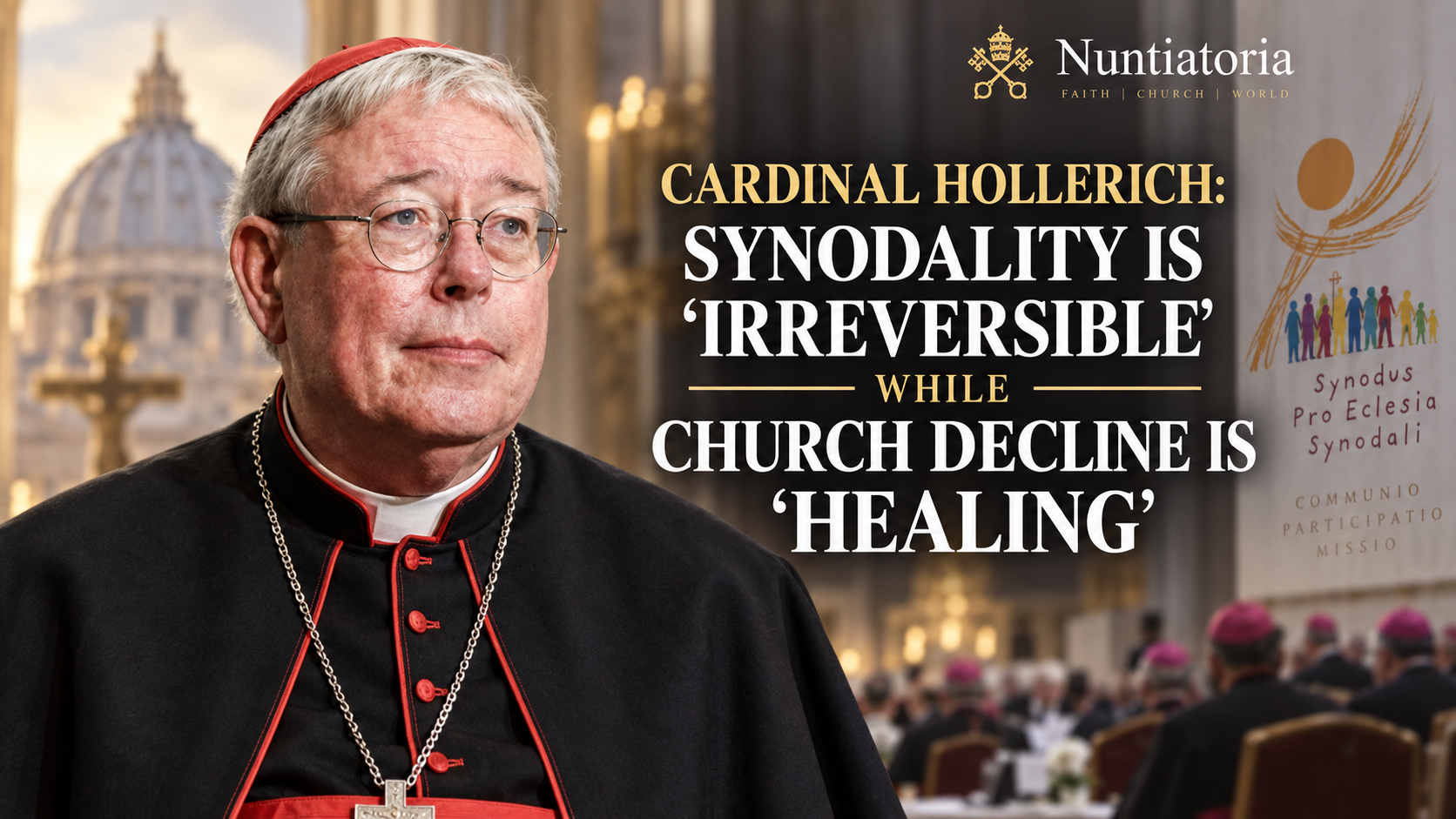
Cardinal Jean-Claude Hollerich says the synodal process begun under Pope Francis can no longer be reversed and describes the decline of Catholic practice as also a process of “healing”. The difficulty is not that the Church may sometimes be purified through loss, but that a pastoral programme becomes impossible to test when its continuation is assumed and even contraction can be interpreted as evidence of health.
Cardinal Jean-Claude Hollerich has supplied, perhaps unintentionally, one of the clearest questions yet about the future of the synodal project. Speaking after the European gathering Shaping Synodality in Europe, held at Schloss Puchberg in Austria from 14–17 September, the former General Relator of the Synod on Synodality said that the process initiated under Pope Francis was “no longer reversible”. The Church, he argued, is undergoing a long-term change of mentality, moving away from a model operating “from above” towards one in which Christians assume responsibility and are heard. “We need a Church of the Christians, where I, as a bishop, am among the Christians,” he said.¹
There is nothing intrinsically startling about a bishop describing himself as being among the baptised. He is. Nor is listening to clergy and faithful some invention of the twenty-first century. Councils, provincial synods, cathedral chapters, religious chapters, presbyteral counsel, theological consultation and the sensus fidelium belong in various forms to the long government and discernment of the Church. Catholic ecclesiology has never required bishops to behave as isolated autocrats, still less the Pope. The difficulty begins when an historically particular programme of meetings, methodologies, institutions and ecclesiological vocabulary is spoken of as though its direction has acquired an inevitability beyond ordinary judgement.
“Irreversible” is therefore a word requiring care. If Cardinal Hollerich means merely that the experience of the Francis pontificate has altered habits of consultation which cannot simply be erased from memory, the observation is largely descriptive. History cannot be un-lived. If, however, “irreversible” means that the particular assumptions, structures and direction of the synodal process may no longer themselves be questioned, corrected or abandoned where experience suggests that they are failing, then a pastoral method is being granted an immunity which Catholicism does not grant to pastoral methods.
Dogma is irreformable because it expresses revealed truth definitively taught. The constitution of the Church is not available for reinvention because Christ gave His Church an apostolic and hierarchical form. But programmes, secretariats, consultative mechanisms, pastoral strategies, administrative fashions and preferred vocabularies are not articles of faith. They exist to serve the supernatural mission of the Church. Their legitimacy does not dispense them from judgement by their fidelity to that mission.
That makes Hollerich’s second reported observation considerably more important. Asked about the documented decline in Catholic attendance and religious practice, he described a “process of decline that is also a process of healing”.² Kathpress records the same interview making another remarkable admission: the Cardinal said it was “frightening” that more people had attended Sunday Mass than actually believed in the Resurrection, pointing to a religious practice which did not necessarily correspond to personal faith.¹
There is a serious point here which should not be caricatured. Numerical strength is not proof of doctrinal truth. A crowded church can contain lukewarm Catholics; a smaller congregation can possess vigorous faith. Christianity was not false when the Apostles fitted into an upper room, nor necessarily healthier whenever princes, populations and civil institutions professed it. The loss of privilege can expose complacency. Nominal Christianity can conceal unbelief. Periods of persecution or cultural retreat have sometimes produced saints precisely because Christianity ceased to be socially convenient.
That understanding was explicitly present at Puchberg. The theologian Tomáš Halík described European secularisation as ambivalent: damaging the transmission of faith, but also loosening the historic alliance between religion and political power. Vatican News reported his suggestion that the loss of social privilege might serve as a process of purification and lead Christians towards a different presence within pluralist society.³ Taken in that sense, there can indeed be a purification hidden within decline.
But purification and decline are not the same thing.
If a forest is pruned so that it produces stronger growth, pruning may be medicinal. If the branches continue dying, no new shoots appear and the roots themselves begin to wither, it becomes increasingly eccentric to describe the disappearance of the tree as successful pruning. A Church purified of nominal adherence should eventually reveal the fruits of purification: stronger belief, more intentional discipleship, conversions, vocations, marriages, baptisms, sacramental practice, missionary confidence and the transmission of faith to children. Otherwise “purification” risks becoming a consoling name for institutional exhaustion.
Europe now provides enough evidence for that question to be unavoidable.
Only days before Hollerich’s remarks, the Holy See released forty-four years of statistics on Catholicism in France. Between 1980 and 2024, the number of priests fell from 38,876 to 12,590. Parishes fell from 38,391 to 10,925. Baptisms fell from 513,501 to 186,165. Catholic marriages fell from 217,479 to 40,678. The number of professed women religious collapsed from 87,044 to 17,452.⁴ As Nuntiatoria observed in “France Before Leo XIV: The Numbers Rome Must Face”, these figures record not merely administrative rationalisation but the retreat of an entire sacramental culture.⁵
Germany tells a related story. The German bishops reported 19.2 million registered Catholics in 2025, yet average worship attendance stood at only 6.8 per cent. Baptisms fell again to 109,028 and Catholic marriages to 19,478; 307,117 people formally left the Church during the year, while only twenty-five priests were ordained for the dioceses of Germany.⁶ One may argue about causes, and one should. What cannot seriously be maintained is that the ordinary transmission of Catholic life across much of Western Europe is flourishing.
It is precisely here that the language of “healing” becomes dangerous if it is not accompanied by some identifiable criterion of recovery. Healing from what, towards what, and demonstrable by what signs?
The Church herself supplies the answer. Our Lord did not command the Apostles merely to accompany the world through its religious disaffiliation. He commanded them: “Going therefore, teach ye all nations; baptizing them in the name of the Father, and of the Son, and of the Holy Ghost.” The missionary command concludes not in perpetual discussion but in conversion, baptism, teaching and obedience to Christ. Saint Paul VI expressed the same truth with admirable simplicity in Evangelii Nuntiandi: evangelisation is the Church’s “grace and vocation”, her “deepest identity”; “she exists in order to evangelize”.⁷
This does not reduce evangelisation to statistics. Grace cannot be entered onto a spreadsheet. Sanctity cannot be counted by a chancery. But neither can Catholic theology render visible consequences irrelevant. Baptisms concern actual souls. Vocations concern the availability of the sacraments. Marriages concern the Christian family through which belief is ordinarily transmitted. Mass attendance concerns the fulfilment of a grave obligation and participation in the Sacrifice of Christ. Belief in the Resurrection concerns Christianity itself. These are not corporate performance indicators imported from a commercial boardroom. They are signs connected directly with the mission Christ entrusted to His Church.
A pastoral programme therefore has to remain capable of being judged.
That principle applies equally to every side in the present ecclesial disputes. Traditional Catholics cannot point to every small flourishing chapel and declare the entire question settled. Bishops cannot attribute every collapse to secularisation without examining their own decisions. Liturgical reform cannot be made solely responsible for sixty years of Western social transformation; but neither can worship be excluded from scrutiny when Catholic belief and practice have declined during the very decades in which the Church’s inherited liturgical culture was transformed beyond recognition. Synodality cannot be blamed mechanically for a crisis which substantially predates the present Synod; but neither may its proponents declare their programme permanently established while explaining continuing decline as evidence of purification.
That last asymmetry matters.
For decades almost everything inherited in Western Catholic life has been open to reassessment. The traditional Roman liturgy could be reformed, replaced in ordinary parish life and eventually subjected to restrictions. Seminaries were restructured. Religious habits disappeared. devotional cultures were dismantled or allowed to decay. Communion disciplines altered. Sacred architecture was reordered. Latin disappeared from most parishes despite the Council’s own insistence upon its preservation. Modes of catechesis were repeatedly reinvented. Forms of authority, clerical formation and parish organisation were subjected to almost continuous experimentation. All of this was defended, in one way or another, as necessary adaptation to changing pastoral circumstances.
Yet the new structures produced by that age of adaptation are increasingly spoken of as though they alone may never be reversed.
That is not discernment. Discernment requires the possibility of judging that a road has been wrongly taken.
Nuntiatoria has already argued, in its coverage of Pope Leo XIV’s consistories, that the decisive issue is not whether consultation continues but whether synodality is re-anchored within recognisably Catholic structures of episcopal and papal governance, ordered towards doctrine, worship and mission rather than becoming a permanent process whose continuation supplies its own justification.⁸ Leo himself has so far used language which permits precisely that distinction.
At the January Extraordinary Consistory, Pope Leo described synodality “not as an organizational technique” but as a means of growing in listening and relationships, and then immediately placed Christ and the proclamation of the Gospel at the centre of the Church’s mission. He called synodality “a path of communion orientated to the mission”.⁹ Addressing the Italian bishops in May, he said that the synodal journey should become a permanent way of life, but added that participation must respect “the specific role of the Bishop”.¹⁰ Whatever eventual judgement is made concerning the shape of the Leo pontificate, those qualifications matter. Synodality is placed at the service of communion and mission; participation exists within differentiated vocations and offices; and the bishop remains bishop.
There is consequently no need to pretend that Cardinal Hollerich’s formulation is already the settled interpretation of Pope Leo XIV. Leo has continued the synodal implementation process and the preparations for the 2028 ecclesial assembly. He has not, however, made Hollerich’s language about decline being healing into a criterion for assessing the Church’s condition.
Nor should he.
The crucial question confronting European Catholicism is no longer whether change has occurred. It plainly has. The question is whether the changes of the last several generations have handed on the Faith more effectively. In much of Western Europe, the evidence is severe enough that institutional self-congratulation should have become impossible.
There may indeed be healing in the collapse of merely conventional Catholic identity. A man who attends Mass without believing in the Resurrection is not the desired end of evangelisation. But the answer to unbelieving practice is believing practice, not the disappearance of practice. The answer to nominal Catholicism is conversion, not empty churches. The answer to a culturally inherited Christianity without conviction is Christianity with conviction. If purification leaves behind neither believers nor children to whom belief is transmitted, the process has ceased to resemble purification and begun to resemble extinction.
That is also why the liturgical question cannot be separated indefinitely from the missionary one. Worship forms belief because worship embodies belief. A generation that no longer possesses a Catholic culture outside the church building needs the sacred liturgy to disclose rather more, not less, of the supernatural reality of Catholicism. Nuntiatoria’s recent examination of France made precisely this point: the transformation of Catholic worship cannot be presented as the sole explanation for French decline, but neither can an honest enquiry into transmission pretend that what Catholics experienced every Sunday had no formative consequences.⁵
The irony is hard to avoid. A Church repeatedly instructed to “listen” must also listen to the evidence of her own decline. A Church committed to “discernment” must allow the possibility that some recent pastoral assumptions require reconsideration. A Church speaking of “accompaniment” must still know where she is accompanying souls. A Church anxious about clericalism should not replace clerical commands with bureaucratic processes that become equally immune from criticism.
And a process cannot meaningfully be called synodal if the one conclusion excluded in advance is that the process itself may need correction.
Francis famously declared in 2015 that “it is precisely this path of synodality which God expects of the Church of the third millennium”.¹¹ That sentence subsequently became almost a charter text for the synodal project. But even Francis repeatedly insisted that the purpose of ecclesial reform was evangelisation rather than institutional self-preservation. The measure therefore cannot finally be the multiplication of listening sessions, continental assemblies, facilitators, reports, working groups or “roadmaps”. The measure must remain whether men and women encounter Jesus Christ, receive the Faith, enter His Church, live the sacramental life, hand that Faith to their children and die within the hope of the Resurrection.
That is why Hollerich’s two remarks belong together. If synodality is “irreversible” and decline can simultaneously be regarded as “healing”, a question arises which no ecclesiastical process should be permitted to evade: what conceivable evidence would demonstrate that the programme had failed?
If the answer is none, then we are no longer speaking about discernment.
We are speaking about an assumption.
And assumptions, unlike the Faith once delivered to the saints, are very far from irreversible.
¹ Kathpress, “Kardinal Hollerich: Synodalität nicht mehr rückgängig zu machen”, 20 September 2026.
² Michael Haynes, Catholic Herald, “Cardinals praise ‘irreversible’ synodality and ‘healing’ nature of Church decline”, 21 September 2026.
³ Gudrun Sailer, Vatican News, “European Synodality Conference ends: Baptism, listening and leadership on the roadmap”, 17 September 2026.
⁴ Holy See Press Office, “Apostolic Journey of His Holiness Pope Leo XIV in France and Visit to the Headquarters of UNESCO — Statistics”, 18 September 2026.
⁵ Nuntiatoria, “France Before Leo XIV: The Numbers Rome Must Face”, 20 September 2026.
⁶ German Bishops’ Conference, “Kirchenstatistik 2025”, 16 March 2026.
⁷ Pope St Paul VI, Evangelii Nuntiandi, 8 December 1975, §14.
⁸ Nuntiatoria, “The Cardinals Find Their Voice: Leo XIV’s Second Consistory and the Return of Judgement”, 28 August 2026.
⁹ Pope Leo XIV, Conclusion of the Extraordinary Consistory, 8 January 2026.
¹⁰ Pope Leo XIV, Address to the Bishops of the Italian Episcopal Conference, 28 May 2026.
¹¹ Pope Francis, Address commemorating the Fiftieth Anniversary of the Institution of the Synod of Bishops, 17 October 2015.



Leave a Reply