
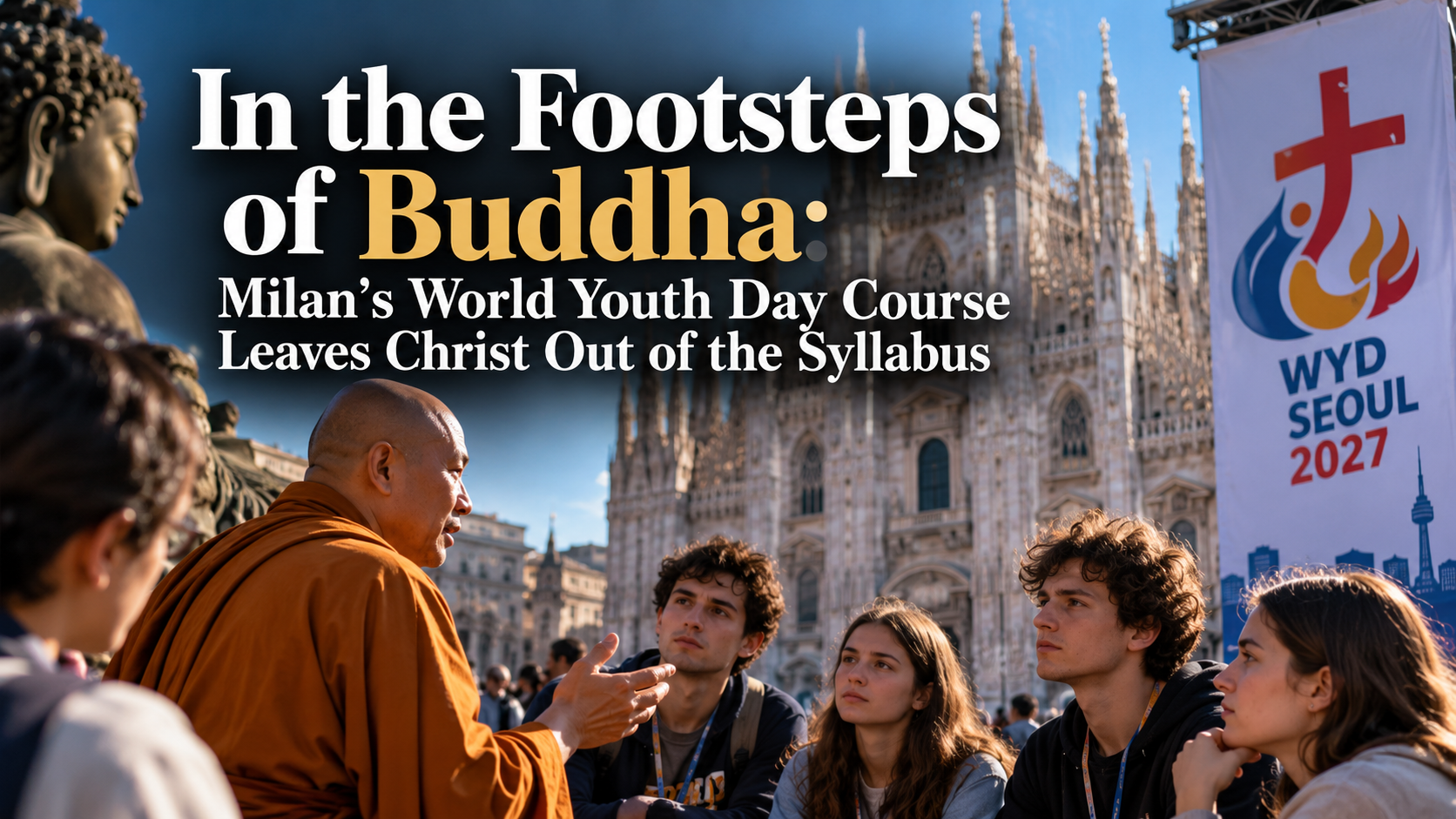
The Archdiocese of Milan is promoting five lectures on Buddhism as preparation for World Youth Day 2027. The course explores suffering, happiness and the meaning of existence without an advertised presentation of the Christian answers. What does this reveal about the priorities of contemporary Catholic formation?
A Catholic archdiocese preparing young people for an international celebration of faith in Jesus Christ has approved a programme devoted entirely to the study of Buddhism. There is nothing objectionable about understanding another religion. The difficulty arises when the Church’s own revelation becomes incidental to an educational initiative conducted in her name. Milan’s programme raises a question that goes far beyond five university lectures: has interreligious understanding become easier for ecclesiastical institutions to promote than the distinctive claims of the Gospel?
The Archdiocese of Milan has found an unusual way to prepare young Catholics for World Youth Day 2027 in Seoul: five lessons on Buddhism, including instruction by a Buddhist monk, with academic recognition available to those who complete the programme. The course, entitled Sui passi del Buddha — In the Footsteps of Buddha — runs from 26 October to 23 November 2026 and is promoted by the Carlo Maria Martini Centre in collaboration with the University of Milano-Bicocca. The diocesan announcement explicitly places the initiative among Milan’s preparations for the international Catholic gathering in South Korea next August.¹
The syllabus is carefully organised. Participants will study the origins of Buddhism, the Theravāda tradition, Mahāyāna Buddhism, Zen and Korean Buddhism. Among the lecturers are university academics, a representative of the Pontifical Institute for Foreign Missions and Tetsugen Serra, a Buddhist monk. Each session lasts two hours. Those attending at least four of the five lectures and passing an assessment may receive an Open Badge, while eligible university students can request academic credits. The subjects identified in the course description include the meaning of existence, the experience of suffering, the pursuit of happiness, the ethics of coexistence and the relationship between interior life and the world.¹
One searches the published programme in vain for a lecture on Jesus Christ. There is no scheduled consideration of His Incarnation, Passion or Resurrection; no announced comparison between Buddhist liberation and Christian salvation; no exposition of the Catholic understanding of suffering, grace or eternal life. The programme is an introduction to Buddhism, conducted with the apparent seriousness of an academic religious-studies course. Its connection with World Youth Day is expressly asserted, but the specifically Christian purpose of that connection is left unexplained.
This requires precision. The published syllabus cannot establish everything that individual lecturers may say, nor should it be suggested that the Archdiocese of Milan has omitted Christ from its wider preparations for Seoul. Other diocesan initiatives explicitly include Scripture, prayer, catechesis and missionary formation.² The criticism concerns this particular course and the purposes publicly assigned to it. Milan has advertised a programme exploring some of the most fundamental questions of human existence through Buddhist thought without indicating how Catholic revelation is to inform the participants’ understanding of those questions. That is sufficiently significant without exaggerating the evidence.
The problem is not that Catholics are studying Buddhism. A missionary who does not understand the religious convictions of those to whom he preaches is poorly equipped for his work. The Church has historically produced scholars of extraordinary competence in the languages, philosophies and religious traditions of Asia. Serious knowledge of another religion is entirely compatible with doctrinal conviction; indeed, where genuine evangelisation is intended, it may be indispensable. What requires examination is the relationship between such knowledge and the purpose for which the Church exists.
A university may reasonably teach Buddhism without reference to Christianity. Its object may be historical, philosophical or anthropological. A Catholic archdiocese, however, does not cease to have a supernatural mission when it enters into an academic partnership. When it adopts an educational initiative as preparation for World Youth Day, the obvious question is what that initiative is intended to contribute to the faith of those participating. If its purpose is to help young Catholics understand Korea’s religious environment, that is intelligible. But understanding a religious environment and understanding the Catholic faith within that environment are two different educational objectives. The former cannot be presumed to accomplish the latter.
Two different answers to the human condition
The contrast becomes especially important because Milan’s course addresses questions upon which Buddhism and Christianity offer profoundly different answers. Suffering, desire, happiness, contemplation and liberation are not peripheral subjects in either tradition. They lie close to the centre of their respective understandings of human existence. To discuss them without making clear the differences between those understandings risks leaving students with the impression that religions are principally alternative methods of approaching the same spiritual destination.
Buddhist traditions differ considerably in their philosophy, practice and understanding of ultimate reality. It would be inaccurate to reduce Theravāda, Mahāyāna and Zen to a single undifferentiated doctrine. Nevertheless, the Buddhist understanding of suffering, impermanence, attachment and liberation cannot simply be identified with the Catholic account of creation, original sin, redemption and supernatural beatitude. Classical Buddhist teaching does not profess the Christian doctrine of a personal Creator, the Incarnation of the Eternal Word, or the resurrection of the body. Its accounts of liberation and the cessation of suffering belong to a religious framework fundamentally distinct from the Christian economy of salvation.
Christianity teaches that man has been created by God for the knowledge and love of God, that sin has wounded human nature, and that reconciliation with the Father has been accomplished through the Incarnation, Passion, death and Resurrection of His only-begotten Son. Man’s final end is not liberation understood apart from the Creator, but the beatific vision: the direct possession of God as the fulfilment of the supernatural destiny to which man is called. Detachment from created things is necessary, not because creation is an obstacle to be escaped, but because disordered attachment prevents the soul from loving the Creator above all things.
The Christian understanding of suffering is equally distinctive. Our Lord did not merely instruct mankind in a technique for overcoming suffering. He entered into the human condition, endured the Passion and conquered death. Through grace, the sufferings of the faithful may be united to His sacrifice and become occasions of supernatural merit. The Cross is not an illustration of a general spiritual principle that might equally be discovered elsewhere. It is the historical instrument of redemption, inseparable from the divine Person who suffered upon it.
St Paul expressed the distinction with characteristic directness: “For we preach Christ crucified, unto the Jews indeed a stumblingblock, and unto the Gentiles foolishness: But unto them that are called, both Jews and Greeks, Christ the power of God, and the wisdom of God” (1 Corinthians 1:23–24). The Apostle was thoroughly acquainted with the intellectual world of his listeners. His address at the Areopagus demonstrates an ability to engage with Greek religious and philosophical assumptions, even citing their poets. Yet he did not conclude by inviting his audience into an indefinite exchange of spiritual insights. He proclaimed repentance, divine judgement and the Resurrection of Christ (Acts 17:22–31).
That is the distinction upon which Catholic engagement with other religions must depend. Understanding is a means; the proclamation of revealed truth remains the end. Where the means begins to obscure the end, an activity may retain its academic respectability while losing the clarity of its ecclesiastical purpose.
What the Church actually teaches
The principle is neither a recent invention nor an exclusively traditionalist objection to modern pastoral practice. Pope Pius XI’s 1928 encyclical Mortalium Animos rejected the assumption that doctrinal differences could be subordinated to the pursuit of a religious unity detached from revealed truth. Although the encyclical principally addresses relations between Christian confessions, its underlying insistence that the integrity of divine revelation cannot be sacrificed for religious agreement remains relevant to the distinction between respectful engagement and indifferentism.³
Even the Second Vatican Council’s declaration Nostra aetate, frequently invoked as the foundation of contemporary interreligious dialogue, does not teach that religions are equivalent paths to salvation. Having acknowledged elements of truth and holiness in non-Christian traditions, the declaration expressly maintains the Church’s duty to proclaim Christ, in whom the fullness of religious life is found.⁴ Whatever legitimate criticisms may be made of subsequent interpretations or applications of that document, it cannot properly be cited as authorising the disappearance of Christian doctrine from Catholic religious formation.
The Congregation for the Doctrine of the Faith made the distinction still more explicit in Dominus Iesus in 2000. The declaration states that the equality presupposed by interreligious dialogue concerns the personal dignity of those participating, not the equality of their religious doctrines or the status of Christ relative to other religious founders.⁵ This is a fundamental clarification. Catholics owe Buddhists the respect due to every human person; they do not thereby acquire an obligation to regard Buddhist doctrines as possessing the same authority as the revelation entrusted to the Church.
There is particular significance in the Holy See’s September 2026 Note A Journey of Hope, issued to mark sixty years of interreligious dialogue following Nostra aetate. Its treatment of dialogue includes formulations inviting serious theological scrutiny, particularly its description of interreligious encounter as a theological locus in which the Holy Spirit wishes to be heard. Yet the document also insists that dialogue does not replace the explicit proclamation of Christ and that participants must retain a clear understanding of their own religious identity.⁶ Those assurances ought to have practical consequences. If ecclesiastical institutions are convinced that dialogue and proclamation belong together, their educational programmes should make that relationship visible rather than leaving it to be inferred.
Milan’s initiative is revealing because it illustrates how the formal preservation of doctrinal principles can coexist with their absence from a particular pastoral presentation. No one need explicitly deny the uniqueness of Christ for His significance to become less apparent in the activities undertaken by institutions established to proclaim Him. An ecclesiastical document may affirm the duty of evangelisation, while a programme promoted in the Church’s name concentrates upon religious encounter without explaining how that encounter serves the Church’s evangelical mission.
It would be unfair to conclude from one course that Milan’s ecclesiastical authorities have abandoned that mission. But it is entirely reasonable to ask whether the same organisational energy devoted to presenting Buddhist philosophy is being employed to explain the Christian doctrines with which it differs. Academic recognition for knowledge of Buddhism is not in itself problematic. The difficulty arises when Catholic formation is no longer visibly governed by the theological truths which ought to supply its purpose and direction.
Korea’s martyrs offer a different lesson
The destination of World Youth Day makes the omission particularly striking. Korea possesses one of the most remarkable histories of Catholic evangelisation. Christianity developed there in unusual circumstances, initially through the intellectual and religious interest of Korean laymen who encountered Catholic writings brought from China. The Church subsequently endured prolonged persecutions in which bishops, priests, catechists and ordinary believers suffered imprisonment, torture and death rather than renounce their faith.
The Korean martyrs did not regard Christianity as an additional spiritual resource to be incorporated into an existing religious culture. They accepted a revelation which made claims upon their understanding, conduct and allegiance. Their conversion did not require them to despise their civilisation, but it did require them to distinguish the worship of the true God from religious obligations incompatible with their new faith. Their witness demonstrates that the Gospel can take root within a culture without surrendering the distinctive truths for which it exists.
Among the most celebrated are St Andrew Kim Taegon, the first Korean-born Catholic priest, and St Paul Chong Hasang, a lay catechist. They stand among the 103 Korean martyrs canonised by Pope John Paul II in Seoul in 1984.⁷ Their lives make an obvious foundation for preparing young Catholics to visit Korea. Through them, pilgrims can learn about the country’s religious and social history while discovering why Christianity attracted converts despite terrible persecution, and what those converts believed sufficiently important to justify the sacrifice of their lives.
Such a programme would not exclude the study of Buddhism. On the contrary, a serious understanding of the religious environment in which Korean Christianity developed could deepen appreciation of the choices made by its first believers. But the history of those believers would establish the proper relationship between cultural knowledge and Christian conviction. The religions encountered by the missionaries and converts would be studied in the light of the Gospel, rather than the Gospel remaining an unspoken assumption behind a course devoted to those religions.
The theme selected for World Youth Day 2027 makes the point unavoidable: “Have confidence, I have overcome the world” (John 16:33, Douay-Rheims). These are Christ’s own words to His disciples, spoken before His Passion. They concern the victory He was about to accomplish through His death and Resurrection. The Vatican’s explanation of the theme explicitly connects it with the Paschal Mystery, Christian witness and the courage arising from Christ’s triumph.⁸ It is difficult to imagine a clearer foundation for an educational programme about suffering, hope and the ultimate destiny of mankind.
The contrast with Milan’s advertised syllabus is consequently more than rhetorical. World Youth Day proposes Christ’s victory as the source of Christian courage, while the course chosen as one element of preparation examines suffering and the pursuit of happiness through Buddhist teaching without a corresponding scheduled presentation of that victory. The juxtaposition is not evidence of formal doctrinal error, but it is an unmistakable question of pastoral emphasis.
The Church’s responsibility is to form Catholics
This question has particular urgency because Catholic young people cannot be presumed to possess a sufficiently developed understanding of their own faith to place unfamiliar religious ideas within a coherent theological framework. A student may complete five academically demanding lectures on Buddhism and still be unable to explain the difference between natural contemplation and infused contemplation, between philosophical detachment and Christian mortification, or between the cessation of suffering and the supernatural happiness of heaven.
The Church possesses a formidable intellectual and spiritual tradition addressing every one of these questions. St Augustine’s treatment of the restless human heart, St Thomas Aquinas’s account of beatitude, St John of the Cross’s doctrine of detachment and purification, and St Teresa of Avila’s teaching on prayer provide more than sufficient material for a demanding course in Christian anthropology and spiritual theology. These writers are not merely Catholic counterparts to Asian spiritual teachers. They proceed from the revelation of God in Jesus Christ and explain the supernatural life made possible by grace.
If young Catholics have not received serious instruction in these doctrines, their encounter with Buddhism may be intellectually stimulating but religiously confusing. The problem is not that Buddhist teaching possesses some peculiar power to undermine Christianity. It is that an insufficiently instructed Catholic may lack the knowledge required to recognise where the two traditions agree on questions accessible to natural reason and where they make irreconcilable claims concerning ultimate truth.
That is why the bishop’s teaching office cannot be reduced to providing opportunities for religious literacy. Bishops are successors of the Apostles, entrusted with the guardianship and transmission of the deposit of faith. Their task is not merely to ensure that young Catholics encounter other religious traditions respectfully, but to furnish them with the doctrinal understanding required to remain faithful to Christ in those encounters. The integrity of that responsibility cannot be measured simply by the number of educational initiatives, the qualifications of their lecturers or the certificates issued upon completion.
Nor is the solution an anxious retreat from religious dialogue. A Catholic confident in the truth of his religion need not fear accurate information about Buddhism, Islam, Hinduism or any other tradition. He should be capable of recognising what is philosophically serious, appreciating what is morally admirable and identifying what is theologically false. But that confidence cannot be manufactured through generic appeals to openness. It must arise from knowledge of the faith, cultivated through sound catechesis, worship, prayer and the disciplined exercise of reason.
There is also a profound difference between charitable engagement with those who do not know Christ and a reluctance to propose Christ for fear of disturbing such engagement. The former fulfils a Christian obligation; the latter risks withholding what Christianity understands to be mankind’s greatest good. The Church does not serve her neighbours adequately by assisting them towards temporal harmony while obscuring the supernatural destiny for which God created them. Respect for another person’s conscience does not require silence concerning revealed truth. Charity requires that truth be proposed without coercion, contempt or deception.
This is where the contemporary preference for interreligious encounter can become pastorally misleading. Dialogue is readily presented in terms of mutual respect, common aspirations and social cooperation. These are comprehensible and attractive objectives. Evangelisation, however, necessarily introduces the possibility of disagreement, conversion and a change of religious allegiance. It involves claims which cannot be accepted without rejecting other claims. A Church increasingly uncomfortable with that consequence may find itself exceptionally accomplished at organising conversations about religion while becoming hesitant to explain why anyone should become a Catholic.
Milan’s course does not prove that such hesitation motivated its organisers. Their intentions cannot be determined from the announcement. What can be examined is the educational programme they have published. In that programme, Buddhist thought receives a clear sequence of lessons, named specialists, an examination and academic accreditation. Catholic doctrine appears nowhere as a stated component of the course. The contrast is sufficiently substantial to merit an explanation from an archdiocese preparing young people for a gathering centred upon the profession of faith in Jesus Christ.
The question is not whether another religion deserves to be understood. It is whether the Church still regards the transmission of her own faith as the governing purpose of the educational activities she promotes. The difference between those priorities is not academic. It determines whether religious knowledge becomes an instrument of evangelisation or an end which gradually takes its place.
There is something particularly incongruous about the prospect of European Catholic pilgrims arriving in Korea better acquainted with the terminology of Zen than with the convictions of the Korean martyrs. Those martyrs did not suffer for a general appreciation of humanity’s spiritual aspirations. They suffered because they believed Jesus Christ to be the Incarnate Son of God, the Redeemer of mankind and the only Saviour through whom man receives eternal life. Their witness has considerably more to teach young Catholics about the meaning of World Youth Day than a programme which leaves that confession outside its stated syllabus.
The Archdiocese of Milan has every reason to encourage knowledge of Korea’s religious traditions. It has even greater reason to ensure that young Catholics understand what distinguishes the faith they are travelling there to celebrate. To study Buddhism in preparation for Seoul may be useful. To do so without explicitly situating that study within the truth of Catholic revelation is a missed opportunity, particularly when the subject matter concerns the very questions to which Christianity professes to give the definitive answer.
World Youth Day is not a congress of comparative religion. Its purpose is to strengthen young Catholics in their faith and renew their commitment to the mission entrusted to the Church. Respectful understanding of other religions can contribute to that purpose, provided it remains subordinate to it. The task of the Church is not to produce pilgrims who know something about every spiritual tradition except the supernatural claims of their own.
The Korean martyrs did not die because they had discovered another interesting account of suffering and happiness. They died because they had found Jesus Christ. If Milan wishes to prepare its young people for Seoul, that is where the journey ought to begin.
¹ Archdiocese of Milan, Youth Ministry, Verso la GMG a Seoul: cinque lezioni online per conoscere la storia, il pensiero, e le tradizioni del Buddhismo, October–November 2026.
² Archdiocese of Milan, I giovani ambrosiani verso Seoul 2027, diocesan programme of preparation for World Youth Day.
³ Pope Pius XI, Mortalium Animos, 6 January 1928, especially §§2, 6–9.
⁴ Second Vatican Council, Nostra Aetate, 28 October 1965, §2.
⁵ Congregation for the Doctrine of the Faith, Dominus Iesus, 6 August 2000, especially §22.
⁶ Dicastery for the Doctrine of the Faith, Dicastery for Promoting Christian Unity and Dicastery for Interreligious Dialogue, A Journey of Hope: Sixty Years of Interreligious Dialogue and Fraternity in the Light of the Conciliar Declaration Nostra Aetate, 16 September 2026, especially §§22, 51.
⁷ Pope John Paul II, Homily at the Canonisation of the Korean Martyrs, Seoul, 6 May 1984.
⁸ Holy See Press Office, Press Conference: Towards World Youth Day Seoul 2027, 24 September 2024.



Leave a Reply