
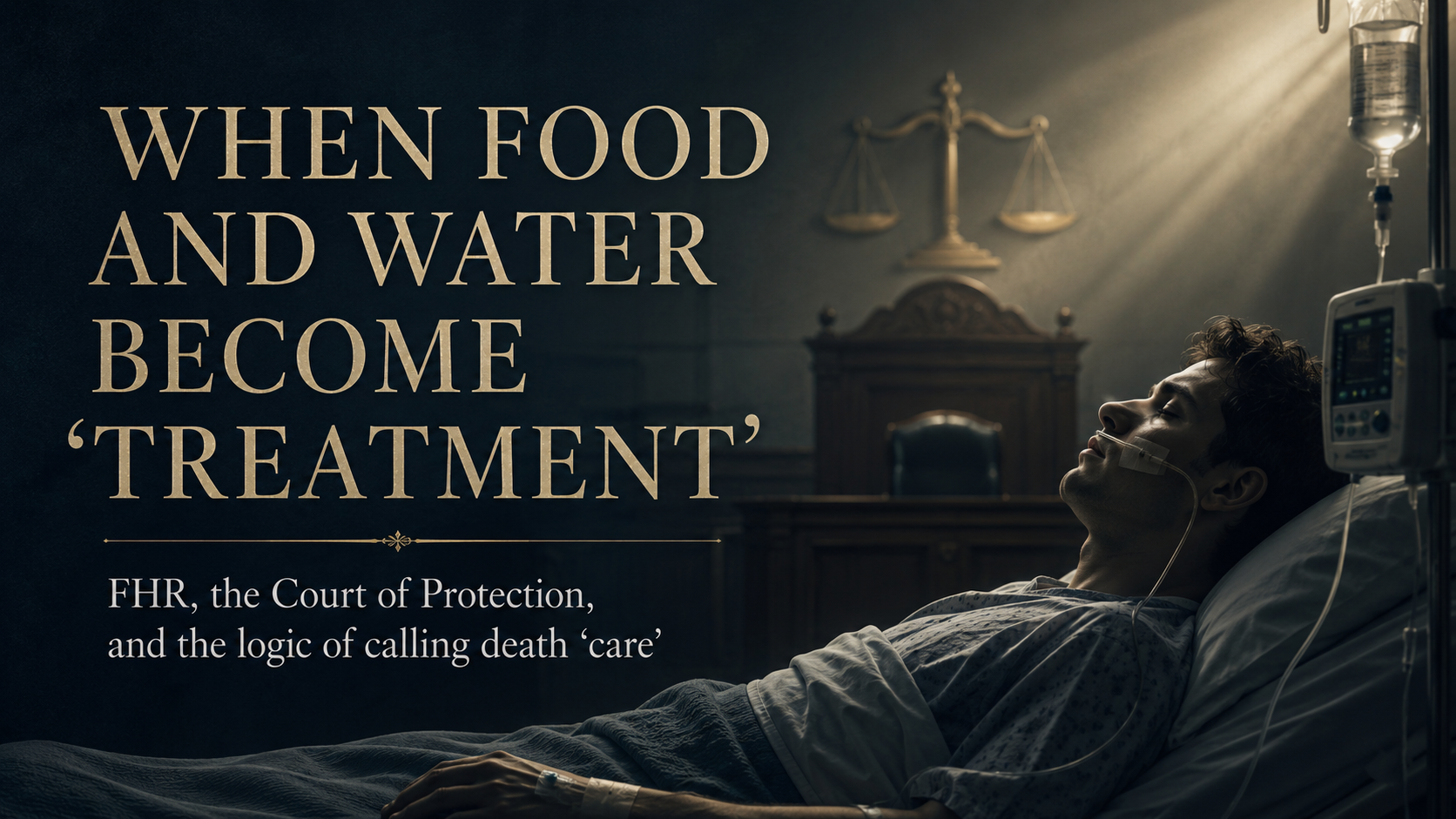
WHEN FOOD AND WATER BECOME “TREATMENT”
FHR, the Court of Protection, and the terrible logic of a culture learning to call death “care”

Some judgments resolve disputes. Others expose the assumptions by which a society has begun to live. The decision of the Court of Protection in NHS North East London ICB v FHR & Ors, handed down on 26 August 2026, belongs firmly to the latter category. Mr Justice McKendrick authorised the withdrawal of clinically assisted nutrition and hydration from a profoundly disabled 28-year-old man known only as FHR. Once food and water are withdrawn, the judgment anticipates a dying process of approximately one to three weeks, involving dehydration, renal failure and other metabolic disturbances before death.¹
We should be precise. FHR has not been “sentenced to death” in the legal sense. He committed no crime, and this was not a criminal proceeding. Nor was the judgment secretly delivered: it was handed down publicly, although stringent anonymity and reporting restrictions remain in force.
But precision does not require euphemism.
The court authorised the deliberate cessation of the nutrition and hydration presently keeping a living man alive, knowing that his death will follow. English law calls this the withdrawal of medical treatment. The moral question is whether changing the vocabulary changes the nature of what is being done.
FHR suffered a catastrophic hypoxic brain injury in January 2020 and has since lived with a prolonged disorder of consciousness. He is mostly paralysed, probably blind, dependent upon others for every aspect of his care, fed through a PEG tube and reliant upon a tracheostomy requiring frequent suctioning. His condition is grievous. Nobody should romanticise it. His care is demanding; some interventions cause pain; his prognosis is bleak.
Catholic moral teaching has never required the indefinite use of every technologically possible means of prolonging biological life. Pope Pius XII articulated the traditional distinction with characteristic clarity in 1957: there is normally an obligation to employ ordinary means of preserving life, but not extraordinary means imposing a grave or disproportionate burden.²
That distinction is essential. Otherwise, opposition to euthanasia is caricatured as an insistence that every machine must remain switched on for ever. It is nothing of the sort. A ventilator that has become futile, an operation offering no proportionate benefit, or aggressive treatment prolonging the agony of an imminently dying person may legitimately be refused or withdrawn.
Allowing somebody to die is not necessarily the same as making somebody die.
But food and water introduce a radically different moral question.
The judgment explicitly states that English law regards clinically assisted nutrition and hydration as “medical treatment, not basic care.”³ That legal classification is the hinge upon which cases such as this turn. Once nourishment is categorised simply as treatment, the court may weigh its continuation against a judicial assessment of the patient’s burdens, pleasures, prognosis and hypothetical preferences. Feeding thereby becomes analogous to chemotherapy, ventilation or surgery: something that may be discontinued when continued existence is judged no longer to be in the patient’s “best interests”.
Yet food does not treat FHR’s damaged brain. Water does not cure his paralysis. Their immediate purpose is precisely what food and water ordinarily do: they nourish and hydrate a living human body.
The distinction is not semantic.
It is moral.
St John Paul II addressed this question directly in 2004. Speaking about patients in a persistent vegetative state, he insisted that supplying food and water, even artificially, is in principle a natural means of preserving life rather than a medical act, and remains ordinary and proportionate so long as it succeeds in nourishing the patient. He went further: where withdrawal brings about death through starvation or dehydration, deliberately interrupting such basic care can amount to “euthanasia by omission.”⁴
The Congregation for the Doctrine of the Faith subsequently answered the question formally in 2007. May artificial food and water be withdrawn from a patient in a permanent vegetative state merely because doctors are morally certain that consciousness will never return?
No.
Nutrition and hydration remain, in principle, ordinary and proportionate care for as long as the body can receive them and they achieve their purpose.⁵ Samaritanus Bonus reiterated the same doctrine in 2020: feeding and hydration may cease when the patient’s organism can no longer absorb or metabolise them, or when their administration itself becomes excessively burdensome. They may not simply be withdrawn because the life they sustain is judged burdensome.⁶
That qualification matters enormously in FHR’s case.
The judgment identifies serious burdens in his life: painful suctioning, worsening contractures, recurrent infections, catheterisation, bowel care, total dependency and the prospect of many further years of profound disability. These are real considerations and deserve humane treatment. But they are not the same as demonstrating that his body cannot assimilate nutrition or hydration. Indeed, the judgment records that FHR is being fed through his PEG tube and does not appear to establish that the provision of nourishment itself has ceased to fulfil its nutritive purpose.¹
This creates the central moral difficulty. The burdens of FHR’s condition and of other elements of his care regime are effectively placed in the balance against the benefit of CANH, the benefit being that it keeps him alive. One expert put the matter with startling candour: the benefit of CANH is that it keeps FHR alive and respects the sanctity of life and probably his religious beliefs; nevertheless, the surrounding burdens were said to outweigh that benefit.¹
But once being kept alive is itself placed on one side of a utilitarian balance, something profound has changed.
The question is no longer merely whether a particular treatment is excessively burdensome. It becomes whether this life is sufficiently beneficial to justify continuing the ordinary means by which it is sustained.
That is perilously close to making the value of life contingent upon its experienced quality.
The controversy surrounding FHR’s consciousness makes the case more unsettling still. The court ultimately preferred the evidence that he remains in a persistent vegetative state. Yet there was genuine professional disagreement. Evidence had been presented of smiles, tears and apparent responses; later assessment generated evidence compatible with a minimally conscious state. The judge concluded that these reactions were probably reflexive rather than conscious.
That conclusion may be clinically defensible. What is morally disturbing, however, is what follows if it is wrong.
The judgment says that even if FHR is minimally conscious, this might actually strengthen the argument against continuing nutrition and hydration, because greater consciousness could mean greater awareness of pain and of what the judgment calls the “futility of his existence”.¹
Consider the inversion.
If he is unaware, his life is said to contain insufficient conscious benefit.
If he is aware, his awareness may make his life worse because he can experience his suffering.
Thus evidence of consciousness does not necessarily strengthen the presumption in favour of preserving him. It can be transformed into evidence against doing so.
That ought to trouble anyone concerned about where modern “best interests” jurisprudence may lead.
There is another striking feature. In March 2026, a formal multidisciplinary best-interests meeting concluded that it was in FHR’s interests to continue life-sustaining treatment, including nutrition and hydration, and that he should be cared for at home. That conclusion was subsequently challenged; further evidence was obtained; and by the final hearing the Integrated Care Board, the jointly instructed best-interests expert and the Official Solicitor supported withdrawal.
The earlier decision was therefore not the last clinical word. Nor was the eventual conclusion the uncomplicated consensus sometimes implied by the language of medical inevitability.¹
The family remained opposed. They believe they have witnessed responses that professionals have discounted. The judgment comments that their profound love and optimism may cause them to perceive meaningful responses where none exist and concludes: “Their love largely dictates their evaluation of what they see and hear.”¹
Of course love can impair objectivity. So can professional habituation. So can institutional pressure. So can a theoretical commitment to a particular understanding of disability and quality of life.
Families can see what clinicians wish were there. Clinicians can also fail to recognise what families, after thousands of hours beside a patient’s bed, have learnt to recognise.
Love should not automatically trump medical evidence. Neither should it be treated almost instinctively as an evidential disability.
FHR’s religious convictions add another extraordinary dimension. He is Muslim. The court accepted that his faith mattered to him and that he would wish his life and death to take place within Islamic teaching. A religious ruling submitted in evidence stated that intentionally withdrawing nutrition and hydration where this would directly cause his death was impermissible and that food and water should continue where beneficial. The judge nevertheless concluded that it was impossible to know whether FHR himself, confronted with his present condition, would have wished his life sustained.¹
There is an uncomfortable paradox here. The court accepted the importance of FHR’s religion while reaching the very decision that the religious principle placed before it prohibited.
Catholics should recognise the significance immediately, because on this question Catholic and Islamic moral reasoning substantially converge: human dignity is inherent in the person and does not disappear with consciousness, independence, productivity or pleasure.
The disabled person does not possess less human dignity because he cannot demonstrate enjoyment.
The unconscious man does not become less human because he cannot demand his rights.
Nor does dependency reduce personhood. Every one of us began life radically dependent upon another for food, warmth, cleanliness and protection. Many will end it the same way. A civilisation is judged not by how efficiently it eliminates dependence, but by how faithfully it accompanies the dependent.
FHR’s mother, FN, has made serious allegations concerning the way her son and family have been treated. Those allegations should remain attributed as allegations unless independently established. The judgment itself nevertheless records prolonged conflict over contact with her son and says that in-person contact had at one stage been restricted. By the conclusion of the case, the judge was explicitly insisting upon the importance of contact between mother and son.
Christian Concern, whose Christian Legal Centre is supporting FN, reports her saying simply: “All I wanted was for my kid to be allowed to live naturally and to die naturally.”⁷
There is something almost unbearably elemental about that sentence.
Not cure him.
Not demand a miracle.
Not insist upon endless experimental treatment.
Feed him. Give him water. Control his pain. Let his family love him. And when the pathology that injured him finally takes his life, permit him to die from that pathology rather than from the intentional removal of nourishment.
This case arrives at an especially grave moment. On 11 September 2026, the House of Commons is scheduled to consider at Second Reading the newly introduced Terminally Ill Adults (End of Life) Bill, legislation intended to legalise assisted suicide for qualifying adults.⁸ FHR would not fall within that Bill’s proposed autonomous-request framework.
That is precisely why his case matters.
The transformation of medicine does not begin only when doctors are authorised to administer lethal substances at a patient’s request. It begins whenever the governing moral principle shifts from “How shall we care for this person while he lives?” to “Does continuing this person’s life remain worthwhile?”
Assisted suicide speaks the language of autonomy.
Withdrawal cases speak the language of best interests.
The vocabularies are different, but the underlying temptation can become the same: to measure the value of continued life against suffering, dependency, cost, consciousness and perceived quality.
Christian civilisation constructed a very different moral architecture. It did not pretend suffering was good. It founded hospitals to alleviate it. It developed medicine to cure disease and palliative care to relieve pain. It permitted burdensome and futile treatment to cease. But it drew a line between ceasing to struggle unsuccessfully against death and withdrawing the ordinary necessities of life so that death will occur.
That line matters.
FHR may never recover. He may never speak again. He may experience pain. He may be profoundly unconscious. None of those propositions answers the prior question:
What is he?
He is not a diagnosis.
He is not a collection of neurological responses.
He is not a projected quality-of-life score.
He is not the financial or emotional burden generated by his care.
He is a living human being.
Christian moral reasoning begins there because human dignity begins there.
The terrible danger exposed by this judgment is not that British judges are monsters or physicians malicious. Such caricatures prevent serious thought. The danger is far deeper: compassionate people working within an increasingly utilitarian moral framework can sincerely come to regard causing death by withdrawing ordinary sustenance as an act performed for the patient’s own good.
That is how moral boundaries disappear: not usually through cruelty, but through the redefinition of compassion.
Food becomes “medical treatment”.
Continued life becomes a “burden”.
Death by dehydration becomes “palliation”.
And the decision not to feed a man is described as respecting his dignity.
Words matter because words train consciences.
The Catholic answer must therefore be both compassionate and uncompromising. Nobody is obliged to pursue futile medicine. Nobody must endure disproportionate treatment merely to postpone an inevitable death for hours or days. Pain must be relieved, families supported and the dying accompanied with tenderness.
But we may never solve suffering by eliminating the sufferer.
And if food and water can still nourish a living human body without themselves imposing an excessive burden, the moral presumption could scarcely be clearer:
feed the hungry; give drink to the thirsty; comfort the afflicted; accompany the dying — but do not make death the treatment.
¹ NHS North East London ICB v FHR & Ors [2026] EWCOP 43 (T3), judgment of Mr Justice McKendrick, 26 August 2026, particularly paras 1, 19, 109, 116–18, 131–58. (Courts and Tribunals Judiciary)
² Pius XII, Address to the International Congress of Anesthesiologists, 24 November 1957, on the distinction between ordinary and extraordinary means of preserving life. (Vatican)
³ FHR, para. 36, following Airedale NHS Trust v Bland [1993] AC 789 and An NHS Trust v Y [2018] UKSC 46. (Hassan Kohen Law)
⁴ St John Paul II, Address to the International Congress on Life-Sustaining Treatments and Vegetative State: Scientific Advances and Ethical Dilemmas, 20 March 2004. (Vatican)
⁵ Congregation for the Doctrine of the Faith, Responses to Certain Questions Concerning Artificial Nutrition and Hydration, 1 August 2007, approved by Benedict XVI. (Vatican)
⁶ Congregation for the Doctrine of the Faith, Samaritanus Bonus: On the Care of Persons in the Critical and Terminal Phases of Life, 14 July 2020, especially V.3 and V.8. (Vatican)
⁷ Christian Concern, “Judge orders withdrawal of food and water from 28-year-old left unconscious after a brain injury”, 26 August 2026; see also its earlier report concerning FN’s contact with her son and the Transparency Order. (Christian Concern)
⁸ UK Parliament, Terminally Ill Adults (End of Life) Bill 2026–27. The Bill was introduced by Lauren Edwards MP on 17 June 2026 and is scheduled for Second Reading in the House of Commons on 11 September 2026. (House of Commons Library)


latest
- Today’s Mass: October 17 St Gall, Confessor;Saint Gall, born in Ireland in the sixth century, became a notable confessor after accompanying Saint Columban to France and later Switzerland, where he preached and converted idolaters. Despite his significant contributions, he humbly declined the position of bishop of Constance. He died in 646, leaving a lasting legacy.
- 18.10.26 Nuntiatoria CXXVIII: NON POTEST VERITAS SUBDI POTESTATIThis editorial asserts that truth should not be subjugated to authority, emphasising that legitimate power derives from truth rather than mandates it. It critiques contemporary tendencies in both ecclesiastical and societal contexts where authority prioritises institutional credibility over accountability. Ultimately, it calls for a return to truth as the foundation of authority, urging faithful adherence to moral principles.
- THE DEBTOR AT HIS BROTHER’S THROAT: The Twenty-First Sunday after PentecostThe Twenty-First Sunday after Pentecost highlights the danger of receiving divine mercy and failing to extend the same to others, exemplified by the parable of the unforgiving servant. The Church emphasises the need for genuine charity, justice without vengeance, and the importance of faith in guiding interpersonal conduct amidst spiritual struggle.
- The Roman Provenance of MonsignorThe title “Monsignor” is often misunderstood as an ecclesiastical rank or honour, whereas it is merely a style of address linked to specific ecclesiastical offices. The distinction between substantive dignity and its verbal expression is crucial. Various regulations historically defined these roles, ensuring accurate representation of ecclesiastical authority and honour.
- THE CATHOLICOS IS NOT THE PRIME MINISTER’S TO DISMISSArmenia’s government aims to remove Catholicos Karekin II, head of the Armenian Apostolic Church, amidst allegations of misconduct, leading to possible imprisonment. This interference poses significant questions regarding ecclesiastical autonomy and religious freedom under Armenia’s constitution, while the EU’s support for Armenia faces scrutiny regarding its commitment to these principles.




Leave a Reply