
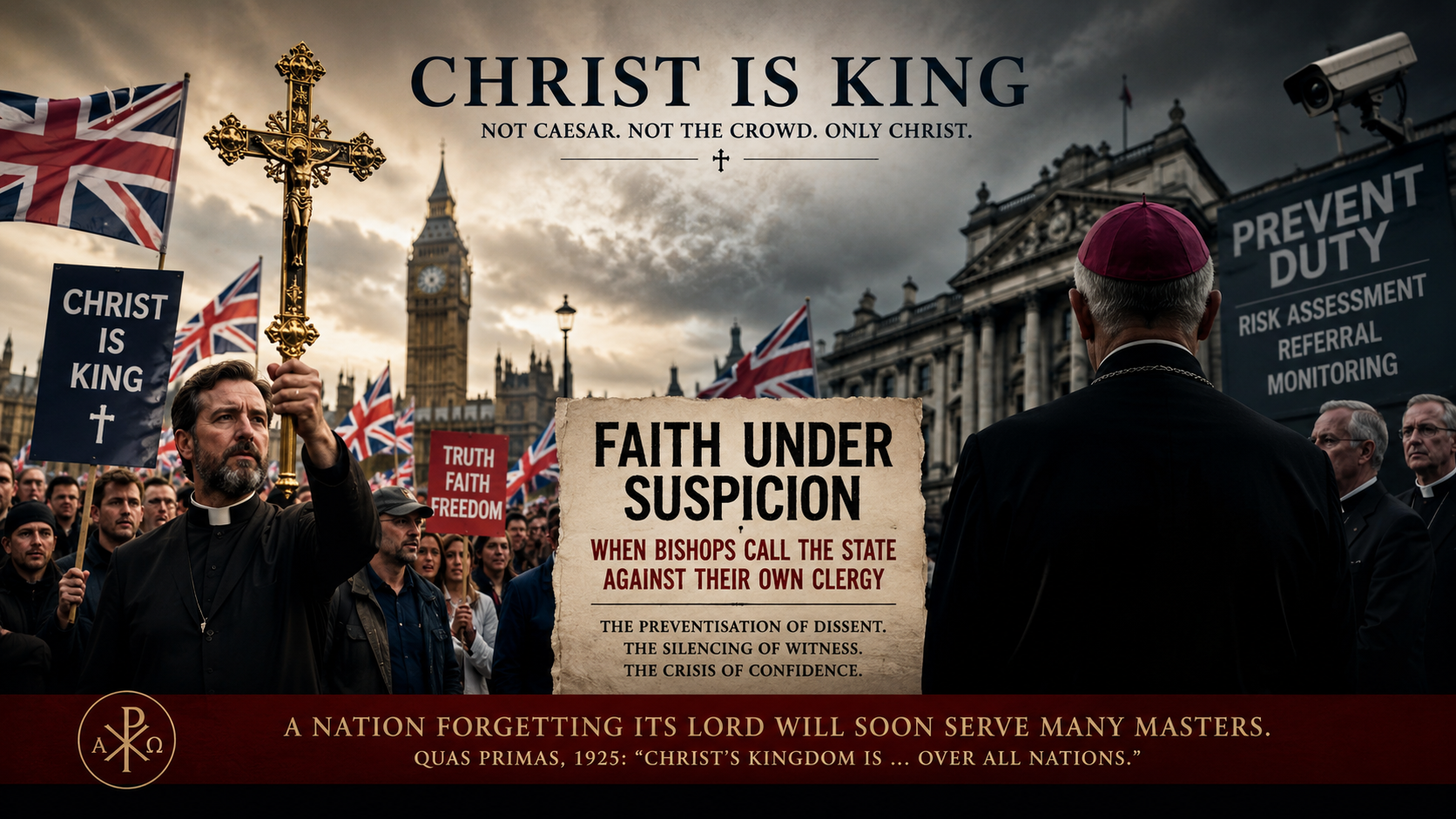
When Bishops Call the State: The Preventisation of Ecclesiastical Dissent and the Crisis of Christian Witness in Britain

There are controversies which illuminate, and there are controversies which expose. The recent resurfacing of remarks by Bishop Matthew Firth of the Free Church of England—calling for the UK’s Prevent counter-extremism programme and safeguarding authorities to investigate clergy attending the “Unite the Kingdom” protests—belongs decisively to the latter category. What stands revealed is not merely a disagreement about a protest movement, nor even a dispute over the propriety of Christian symbolism in public demonstrations, but something far more unsettling: the visible collapse of ecclesiastical confidence, the fragmentation of clerical fraternity, and the creeping instinct to translate theological disagreement into the language of risk, safeguarding, and state oversight.
On 5 October 2025, responding to reporting on expanded police powers to restrict repeated protests, Bishop Firth wrote publicly that it would be “wise for Prevent & the relevant LADO to investigate those disturbing cases where clergy attended the rallies,” adding that such clergy “are working with vulnerable people at risk of radicalisation.”¹ The rallies in question were those associated with Tommy Robinson’s “Unite the Kingdom” movement—demonstrations combining themes of national identity, immigration, law and order, and an overtly Christian symbolic presence, including clergy participation, public prayer, and the proclamation “Christ is King.”
At first glance, the statement may be read as a prudential safeguarding concern. Yet such a reading becomes untenable once placed within its proper context. Bishop Firth’s remarks did not emerge in a vacuum of pastoral reflection, but within an ongoing and increasingly public antagonism with Reverend Canon Brett Murphy, a priest associated with the Confessing Anglican Church and a visible supporter of the Unite the Kingdom movement. Murphy has been among those clergy willing to stand publicly at such demonstrations, presenting himself as part of a broader effort to reclaim Christian and national identity amid what he perceives as cultural decline. His response to Firth—denouncing the remarks as “repugnant” and warning of “ungodly clergy” aligned with political elites—was predictably forceful.²
Thus the affair is not merely theological, nor merely political. It is ecclesiastical—and, more precisely, it is symptomatic. For when a bishop publicly invokes the machinery of counter-extremism in relation to clergy with whom he is already in dispute, the boundary between principled concern and factional escalation becomes dangerously blurred. The invocation of Prevent is not rhetorical flourish. It is an appeal to a statutory framework created under the Counter-Terrorism and Security Act 2015, which imposes a duty upon public authorities to have “due regard to the need to prevent people from being drawn into terrorism.”³ Local Authority Designated Officers (LADOs), meanwhile, exist to oversee allegations concerning individuals working with children or vulnerable persons.⁴ To suggest that clergy attending lawful protests fall within the ambit of such mechanisms is therefore to raise questions of extraordinary gravity.
What precisely is being alleged? That the presence of clergy at a public demonstration constitutes a safeguarding concern? That the proclamation of Christian doctrine in a politically charged context risks radicalisation? Or that certain political sympathies, when combined with religious authority, should be subject to monitoring by the state?
These questions cannot be evaded, for they cut to the heart of the relationship between Church, State, and conscience.
The deeper significance of this controversy lies in the transformation of categories. Where once theological disagreement was answered with theological argument, we now witness a growing tendency to translate dissent into the idiom of harm. Where once bishops contended with priests by appeal to Scripture, tradition, and reason, there is now an observable temptation to appeal instead to institutional frameworks designed for entirely different purposes. This is the “preventisation” of ecclesiastical life: the subtle but profound shift whereby doctrinal, pastoral, or prudential disputes are reframed as matters of risk management and safeguarding.
Such a development is not merely imprudent; it is corrosive.
For the Prevent framework, whatever its legitimate aims, operates on a logic of pre-emption. It concerns itself not primarily with acts committed, but with trajectories feared. It asks not only what a person has done, but what they may become. This logic, when applied to clergy engaged in lawful public activity, risks collapsing the distinction between conviction and suspicion. It introduces into ecclesiastical discourse a vocabulary alien to the Gospel: not sin and repentance, not truth and error, but vulnerability, risk indicators, and pathways to extremism.
The consequences are not difficult to foresee.
If attendance at a protest—however controversial—becomes grounds for safeguarding concern, then the threshold separating legitimate public witness from ideological suspicion becomes dangerously thin. If the proclamation “Christ is King” can be construed, by implication or association, as a marker of extremism when uttered in certain contexts, then the Church finds itself in the extraordinary position of treating its own historic confession as a potential liability.
It must be said plainly: such a position is theologically untenable.
The declaration that Christ is King is not a modern political slogan. It is among the most ancient affirmations of the Christian faith. Its roots lie not in contemporary protest culture, but in the apostolic proclamation itself. The confession “Jesus is Lord” (κύριος Ἰησοῦς) carried, in the first century, an unmistakable political implication: it denied ultimate sovereignty to Caesar. The martyrs did not die for private spirituality; they died because they refused to subordinate their allegiance to Christ to the demands of the state.⁵
This doctrine was given renewed articulation in the modern era by Pope Pius XI in his encyclical Quas Primas (1925), issued against the backdrop of rising secularism, nationalism, and ideological absolutism. There, the pontiff insisted that Christ’s kingship extends not only to individuals but to societies, warning against the “plague of secularism” which would confine religion to the private sphere.⁶ To proclaim Christ as King, therefore, is not to engage in extremism; it is to affirm a doctrine central to the Christian understanding of authority, law, and human dignity.
Yet here we encounter a genuine tension, one that must not be dismissed lightly. Critics of the Unite the Kingdom demonstrations—including other Anglican figures such as Bishop Arun Arora—have argued that Christian language and symbolism risk being appropriated by movements whose political rhetoric may be divisive or exclusionary.⁷ This concern is not without historical precedent. The Church has, at times, been entangled with nationalist projects in ways that compromised its universal mission.
But the existence of such risks does not justify the abandonment of public Christian witness, nor the recourse to state mechanisms against those whose prudential judgments differ.
Here, the asymmetry becomes impossible to ignore.
Clergy participation in explicitly political causes—whether climate activism, migration advocacy, or campaigns aligned with prevailing progressive orthodoxies—rarely, if ever, attracts calls for Prevent scrutiny. Sermons invoking contested political positions, clergy appearing at demonstrations, even the adoption of overtly ideological language in ecclesiastical contexts, are typically framed as prophetic witness. Yet when clergy appear alongside patriotic movements, or articulate concerns about national identity, or proclaim traditional doctrines in politically inconvenient settings, the language shifts. What is elsewhere “witness” becomes here “risk.” What is elsewhere “justice” becomes here “radicalisation.”
Such inconsistency is not sustainable. It erodes trust, fuels resentment, and confirms the suspicion—widely held beyond ecclesiastical circles—that the Church has become selectively political while insisting upon its neutrality.
The Firth–Murphy dispute thus reveals more than personal animosity. It exposes a deeper fracture within contemporary Anglicanism: a division not simply between “liberal” and “conservative,” but between competing visions of what it means to be the Church in a society losing confidence in itself. One vision seeks credibility through alignment with institutional frameworks and cultural consensus, wary of any association with populist movements. The other seeks relevance through engagement with those very movements, interpreting them as expressions of legitimate social anxiety and as opportunities for renewed Christian witness.
Neither approach is without danger.
The former risks reducing the Church to a chaplaincy of the administrative state, speaking the language of policy rather than prophecy. The latter risks conflating the Gospel with political grievance, allowing the Cross to be overshadowed by the flag. The tragedy is that, rather than addressing these tensions through serious theological reflection, the dispute has descended into public denunciation and retaliatory rhetoric.
Meanwhile, the nation watches—and wonders whether the Church still knows what it believes.
Britain stands at a moment of profound uncertainty. Questions of identity, cohesion, and legitimacy press with increasing urgency. Public trust in institutions continues to decline. Into this environment step movements like Unite the Kingdom, attempting—however imperfectly—to articulate concerns many feel but few in authority are willing to address. The Church, historically a mediator of moral meaning, finds itself marginal to these debates, its voice fragmented, its authority diminished.
And so we arrive at the central paradox.
At a time when the Church might speak with clarity about the limits of political power, the dignity of the person, and the proper ordering of society under God, it instead appears preoccupied with internal disputes and tempted to resolve them through appeals to external authority. The spectacle of bishops invoking Prevent against clergy is not merely unedifying; it is emblematic of a deeper loss of confidence in the Church’s own spiritual resources.
For the Church does possess such resources.
It possesses a theology of authority that places all earthly power under divine judgment. It possesses a tradition of martyrdom that testifies to the limits of state claims. It possesses a moral vocabulary capable of critiquing both nationalist excess and technocratic overreach. What it lacks, increasingly, is the courage to employ these resources without fear of misunderstanding or censure.
The final question, then, is not whether Bishop Firth was right to be concerned about the rhetoric of certain protests, nor whether Canon Murphy was justified in his denunciation. It is whether the Church can recover a mode of engagement that is neither captive to political movements nor deferential to administrative power.
For if the proclamation “Christ is King” becomes a matter for suspicion, if clergy must weigh the risk of safeguarding referral before standing in public witness, if theological disagreement is reframed as a matter for counter-extremism oversight, then something essential has been lost.
The Church ceases to be the conscience of the nation.
It becomes, instead, one more institution among many, managing risk, avoiding controversy, and speaking only within the parameters permitted by others.
A nation uncertain of its future does not need such a Church.
It needs a Church that remembers what it once proclaimed without fear: that no state, no movement, no ideology, and no age possesses ultimate authority.
Christ alone is King.
¹ Matthew Firth, post on X (formerly Twitter), 5 October 2025.
² Brett Murphy, public statements on X and related commentary, May 2026.
³ Counter-Terrorism and Security Act 2015, c.6, Part 5 (Prevent Duty).
⁴ UK Department for Education, Working Together to Safeguard Children (statutory guidance), sections on LADO responsibilities.
⁵ The Holy Bible, cf. Philippians 2:9–11; John 18:36–37; Revelation 19:16.
⁶ Quas Primas, §§18–24.
⁷ Arun Arora, sermon and public commentary, September 2025; subsequent social media amplification, May 2026.
RELATED ARTiCLES


LATEST ARTICLES
- TRADITION BEHIND THE FENCEThe Vatican’s prohibition of the traditional Ad Petri Sedem pilgrimage to St Peter’s Basilica has sparked controversy, especially among traditional Catholics. While some cite scheduling conflicts, the broader issue lies in the restrictive policies of Traditionis custodes, which may confine traditional liturgical practices to specific enclaves, risking the transmission and recognition of Catholic Tradition within the wider Church.
- Today’s Mass: October 24 St Raphael the ArchangelThe Feast of Saint Raphael the Archangel highlights his healing powers as depicted in the Book of Tobit, where he aids Tobit and his son, Tobiah. Venerated as a protector of travellers and the blind, Raphael is celebrated for his miraculous interventions. His legacy includes support for nurses, matchmakers, and Catholic studies.
- 25.10.26 Nuntiatoria CXXIX: CHRISTUS REXThe text discusses the relationship between Christ’s kingship and authority within the Church amidst contemporary challenges. It contrasts ecclesiastical power with genuine faith, emphasising that authority must protect divine truth rather than alter it. The witness of imprisoned priests illustrates the enduring significance of fidelity to Christ over institutional conformity.
- THE DOMESTIC CHURCH: 25 October – 2 November 2026 A Home with Room for Heaven: Preparing for All Saints and All SoulsThe content outlines a week’s plan for traditional Catholic families to prepare for the feasts of All Saints and All Souls. Emphasising daily prayers, remembrance of the deceased, and engagement with children’s activities, it aims to integrate Catholic customs into family life, enriching spiritual practices and fostering a shared faith experience.
- ORDO w/c 25.10.26The text outlines the liturgical calendar for the last week of October and the beginning of November, highlighting key celebrations. Notable events include the Feast of Christ the King, St Evaristus, the Vigil of Saints Simon and Jude, and the Feast of All Saints, emphasising themes of holiness, unity in faith, and the Church’s teachings.
CURRENT EDITION


DAILY MASS ONLINE
One of the earliest online apostolates dedicated to the Traditional Latin Mass, Old Roman TV began broadcasting the Holy Sacrifice on the Feast of the Assumption, 15 August 2008. During the COVID-19 pandemic, additional programming — devotions, catechesis, and conferences — was added to support the faithful in prayer and formation.
Support the daily Holy Mass on Old Roman TV by offering a Mass intention — for loved ones, thanksgiving, or the repose of souls. Your intention helps sustain the sacred liturgy and brings grace to those you remember before God’s altar.
SUPPORT THE DAILY MASS ONLINE
Likely the world’s longest-running daily online broadcast of the
Traditional Latin Mass, streaming faithfully since the
Feast of the Assumption 2008.

This apostolate cannot continue without immediate help
Please support us with a contribution toward
chapel rent, sacristy supplies, operating costs, and web-hosting.
Our essential monthly costs reach £1,000.
MASS INTENTIONS
If your offering is for a Mass Intention, kindly complete the form below in full so we may correctly match it to your donation. For anniversary intentions — birthdays, wedding anniversaries, anniversaries of death — please be sure to include the relevant date.


Today’s Mass Propers
- Today’s Mass: October 24 St Raphael the Archangel
 The Feast of Saint Raphael the Archangel highlights his healing powers as depicted in the Book of Tobit, where he aids Tobit and his son, Tobiah. Venerated as a protector of travellers and the blind, Raphael is celebrated for his miraculous interventions. His legacy includes support for nurses, matchmakers, and Catholic studies.



Leave a Reply