
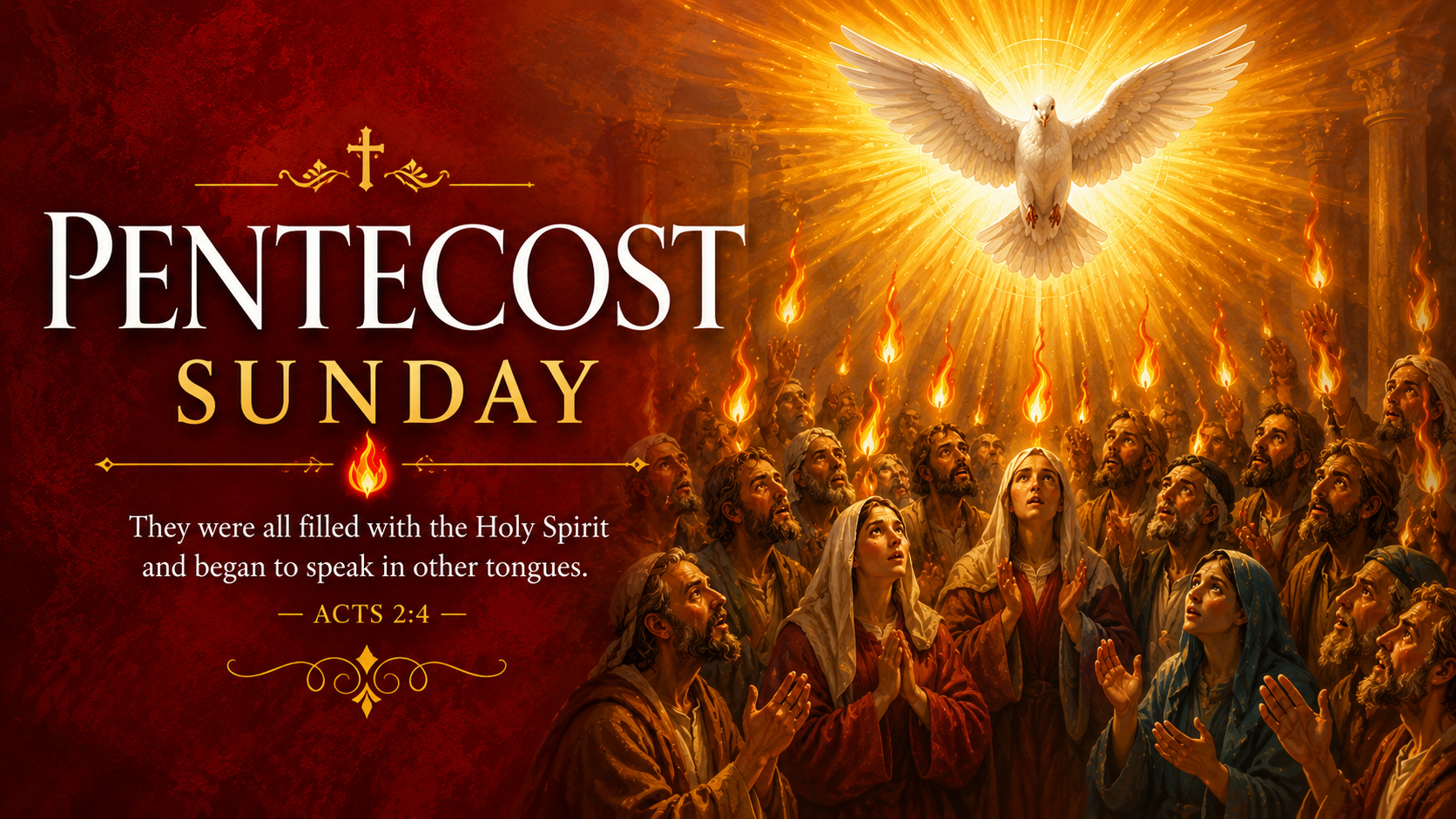
Pentecost SUNDAY
But the Paraclete, the Holy Ghost, whom the Father will send in my name, he will teach you all things, and bring all things to your mind, whatsoever I shall have said to you
Today we celebrate the great feast of Pentecost, the day on which the Holy Spirit came upon the disciples. In today’s Gospel we heard from Jesus’ farewell discourse in which he promised that the Paraclete, the Holy Spirit, would come upon his disciples. The word “Paraclete” is notoriously difficult to translate into English. It has been translated as Counsellor, and as Advocate, though in our older English versions it is usually translated as Comforter. The Holy Spirit is all of these things. It is our Counsellor to guide us into the truth, it is our Advocate to defend us and it is our Comforter to strengthen us in times of adversity. The Father would send the Holy Spirit in name of the Son. He would convict the world of sin, and of righteousness and of judgment. The disciples would be faced with persecution and adversity, but they would be empowered by the strengthening of the Holy Spirit to endure all things. The Holy Spirit would impart to them a peace which the world could not give and would guide them into all truth.
On the feast of Pentecost the people of Israel celebrated the giving of the Law to Moses on Mount Sinai. They had been delivered from slavery in Egypt at the Passover and were then given the Law which they were to keep as a sign of their faithfulness to God’s covenant with them. But the people of Israel were not faithful to this covenant. The prophets continually reminded them of their unfaithfulness and looked forward to a future age when there would be a new covenant when the Law would no longer be written on tablets of stone, but on the hearts of men (Jeremiah 31). The Holy Spirit would then be poured out on all the people, not simply the priests and the prophets, but on all (Joel 2). The Holy Spirit would not only be poured out upon Israel, but on all nations, who would renounce their idols and come to worship the God of Israel in Jerusalem. Then the earth would be filled with the knowledge of the glory of God as the waters cover the sea.
At Jesus’ Ascension the disciples were told to stay in Jerusalem and they would be endowed with power from on high not many days hence. For John had baptised with water, but they would be baptised with the Holy Spirit (Acts 1). This event took place when the days of Pentecost were accomplished and the disciples were all gathered in one place. Suddenly there came a sound from heaven as of a mighty wind and it filled the whole house where they were sitting. There appeared to them parted tongues as of fire and they were all filled with the Holy Spirit, and began to speak in other tongues as the Holy Spirit empowered them (Acts 2). There were Jews who had come to Jerusalem on pilgrimage who were amazed that they could understand the disciples in the languages of the countries where they were born. This was a reversal of the curse of Babel that had meant that human beings could not communicate easily with each other because of their different languages. The Holy Spirit now empowered the disciples with the gift of speaking in other tongues and confidence to preach the gospel to all nations.
The prophets of old had envisaged the nations coming to Jerusalem to hear the Word of the Lord and renounce their idols. But now the Holy Spirit empowered the disciples to go out to preach the Gospel to all nations. The nations were summoned to renounce their idols, to repent and be baptised for the remission of their sins and they would be filled with the Holy Spirit. The Gospel, the good news of salvation through the life, death and resurrection of Jesus would be proclaimed to all nations, beginning from Jerusalem, spreading into Judea and Samaria and to the ends of the earth.
We can read about how the Gospel first began to spread among the nations in the Acts of the Apostles, which recounts the history of the early Church in those first decades. Though those who first believed and were baptised and received the Holy Spirit were circumcised Jews, the Church decided at the Council of Jerusalem that there was no need for Gentile converts to become circumcised Jews before becoming Christians (Acts 15). All that was necessary was that they should repent and be baptised for the remission of their sins, and they too would be filled with the Holy Spirit.
The disciples were empowered by the Holy Spirit not only to speak in tongues, but also to work miracles and to prophesy. But though the ability to speak in tongues was the most obvious initial sign that they had been filled by the Holy Spirit, St. Paul would continually remind his converts that the greatest of the gifts of the Spirit was neither tongues, nor prophecy, but charity, the very bond of peace and of all virtues (1 Corinthians 13). The fruit of the Spirit was love, joy, peace, patience, kindness, gentleness and self control. Against such things there was no law (Galatians 5). For God had sent to them the Spirit of his Son, whereby they too would cry “Abba” Father. The Law of the Spirit of life had set them free from the law of sin and death, for nothing could now separate them from the love of God in Christ Jesus (Romans 8).
What was true then is still true now. Let us pray that we may filled with the fruits of the Spirit and above all with that most excellent gift of charity, the very bond of peace and of all virtues. For all our doings are worth nothing without charity.
Let us make our own the words of the hymn:
Our blest Redeemer, ere he breathed
His tender last farewell,
A guide, a Comforter bequeathed
With us to dwell.
He came sweet influence to impart,
A gracious, willing guest,
While he can find one humble heart
Wherein to rest.
And His that gentle voice we hear,
Soft as the breath of even,
That checks each fault, that calms each fear,
And speaks of heaven.
And every virtue we possess
And every victory won,
And every thought of holiness
Are His alone.
Spirit of purity and grace
Our weakness pitying see,
O make our hearts thy dwelling place
And worthier thee.
by the Revd Dr Robert Wilson PhD (Cantab), Old Roman Apostolate UK



Leave a Reply