
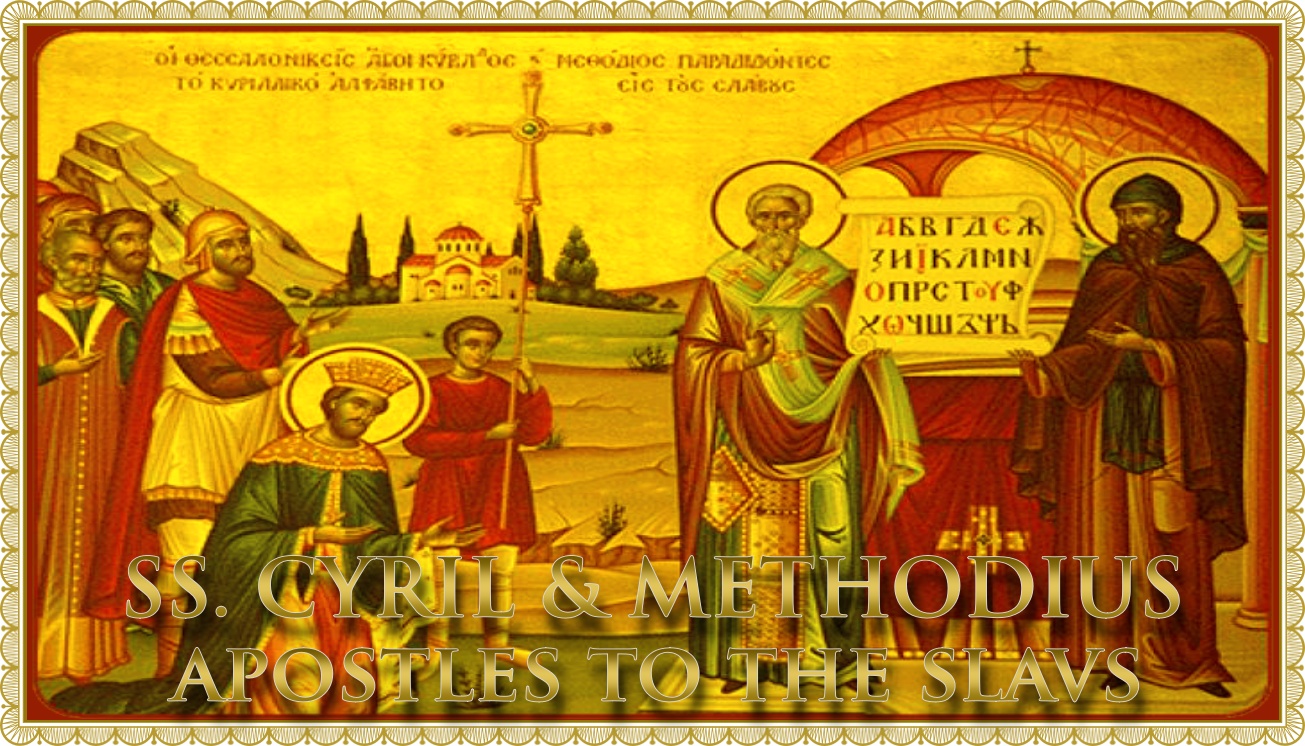
St. Cyril and St. Methodius
Today we celebrate the feasts of St. Cyril and St. Methodius. They were brothers from Thessaloniki who lived in the ninth century. They lived in an age of missionary expansion and were sent by the Patriarch of Constantinople as missionaries to Moravia, a Slavic kingdom to the north of the Byzantine Empire. St. Cyril sought to further the cause of the mission by translating the Byzantine liturgy into the Slavic vernacular of the people, devising an alphabet for this purpose (Glagolitic). This led to controversy with Frankish missionaries also at work in Moravia who opposed the vernacular translations and insisted on the Latin liturgy which was used in the Frankish empire.
St. Cyril and St. Methodius sought to resolve this dispute by appealing to Rome, which they then visited in person. Pope Adrian II was impressed by the missionaries and approved the vernacular translations that St. Cyril had adopted. While St. Cyril died soon afterwards in Rome (in 869), St. Methodius was consecrated as a bishop with special responsibility for missionary work among the Slavs. Unfortunately, despite having received Papal support for his endeavours, St. Methodius again encountered opposition from the Frankish missionaries and was even imprisoned for a time. He died in 885 and his missionary policy was not ultimately successful in Moravia, which eventually fell under Latin rather than Byzantine influence. However, the policy of translating the Byzantine liturgy into the Slavic vernacular was later followed by disciples of St. Methodius in Bulgaria through the adoption of the Cyrillic alphabet (named after St. Cyril), and the policy later spread to other Slavic nations such as Serbia and later Russia. This is the origin of the language of the liturgy known as Old Church Slavonic, which has continued in use among the Slavic nations until the present day. Thus, St. Cyril and St. Methodius are rightly revered as the Apostles of the Slavs, for they pioneered the policy of translating the Byzantine liturgy into the vernacular of the Slavic nations which was central to the development of their own distinctive culture.
The lives of St. Cyril and St. Methodius remind us that the important thing is to plant the seeds which even if they seem to bear little fruit in the short term, may well reap a rich harvest in the long term. The policy of St. Cyril and St. Methodius was not ultimately successful in the country for whose evangelisation they were working, but it would be successfully adopted in other Slavic countries beginning with Bulgaria and lead them to be rightly venerated to this day as the Apostles of the Slavs.
It is important also to realise that this was the period before the later schism between the Eastern and the Western Church. It is clear that St. Cyril and St. Methodius still thought in terms of one Church existing in Western and Eastern forms, rather than two separate rival Churches. This is why they successfully appealed to Rome when their policy was challenged by the Frankish missionaries. For St. Cyril and St. Methodius what mattered was not whether they were under the patronage of Constantinople or Rome, but that they had the necessary support for their missionary work among the Slavs. It is also clear that the Papacy also still thought at this time in terms of one Church existing in Western and Eastern forms, rather than two separate rival churches. That is why the Pope approved the vernacular translations of the Byzantine liturgy which St. Cyril and St. Methodius devised. It was the Franks rather than the Popes themselves who insisted on the exclusive use of Latin and opposed the vernacular liturgy, just as it was the Franks rather than the Popes themselves who insisted on the Filioque addition to the Creed (Rome did not adopt this addition until the eleventh century). Thus, ironically many of the issues that would later come to a head in subsequent centuries between Rome and Constantinople can be shown to be not innovations of the Popes themselves, but positions originally adopted by the Franks and only later adopted by the Papacy under Frankish influence. The lives of St. Cyril and St. Methodius bear witness to this earlier period of the first millennium before the later separation between East and West.
Let us pray for grace that we may be enabled to follow the example of St. Cyril and St. Methodius and continue to uphold that same faith once delivered to the saints in our own time and place.
by the Revd Dr Robert Wilson PhD (Cantab), Old Roman Apostolate UK




Leave a Reply