
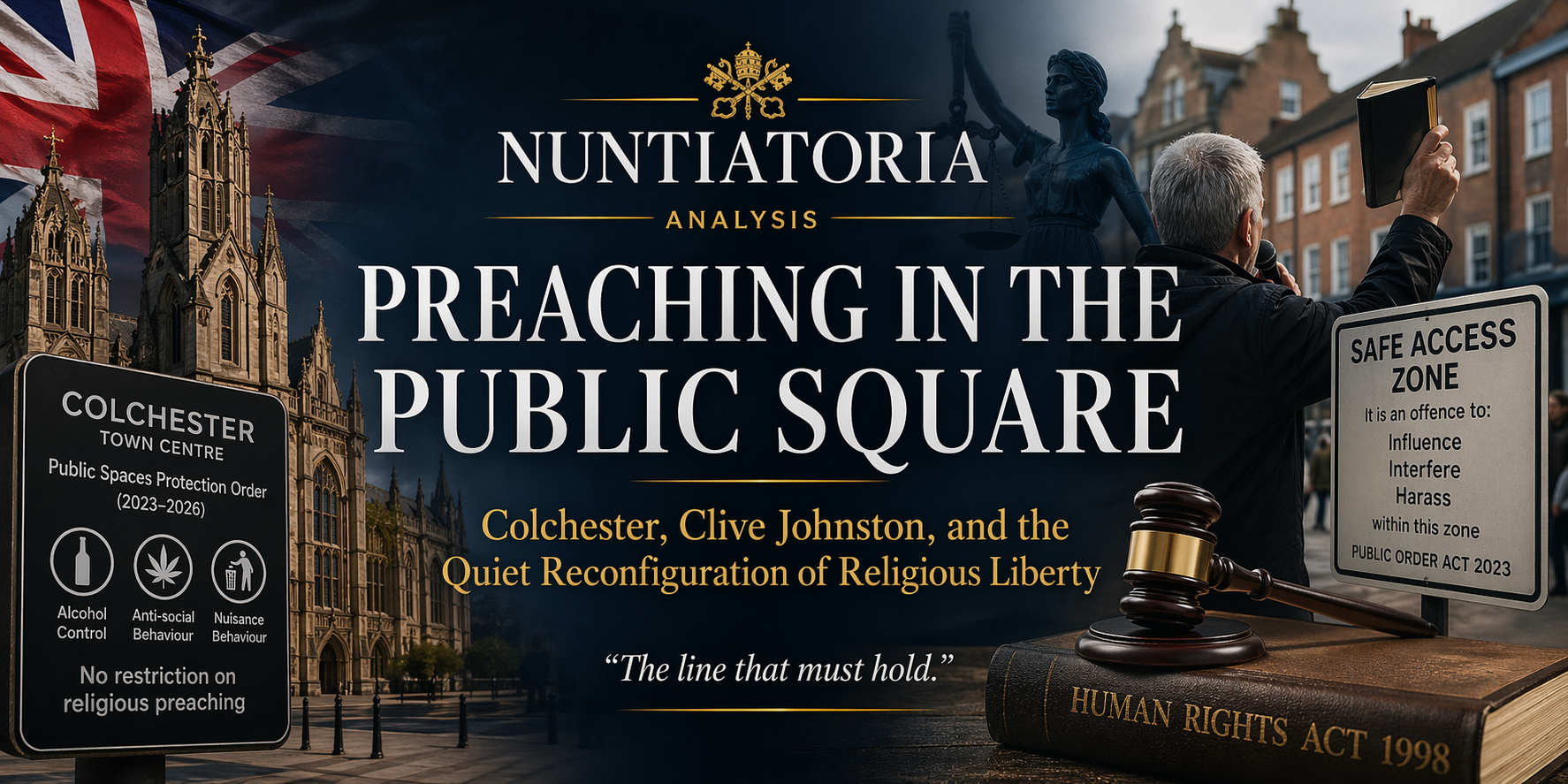
Preaching in the Public Square: Colchester, Clive Johnston, and the Quiet Reconfiguration of Religious Liberty

In Colchester, a dispute initially framed as a local regulatory matter has exposed a deeper and more consequential shift in the legal treatment of religious expression. A campaign promoted by CitizenGO claimed that Christian outreach was being “banned.” Strictly speaking, this is not accurate. Yet the verified facts reveal something arguably more significant: not prohibition, but the emergence of content-sensitive restriction, where what is said—and how it is perceived—becomes the basis for legal intervention.
This distinction is not semantic. It marks the difference between a society that regulates behaviour and one that begins, however cautiously, to regulate belief as expressed in public.
When read alongside the prosecution of Clive Johnston in Northern Ireland, the pattern becomes unmistakable. These are not isolated controversies. They are converging instances of a broader reconfiguration of the public square.
The Colchester Case: From Conduct to Content
The enforcement action in Colchester does not arise from a Public Spaces Protection Orders. The town’s existing PSPO governs anti-social conduct—alcohol misuse, drug activity, nuisance behaviour—and contains no prohibition on preaching.¹ Instead, the relevant mechanism is a Community Protection Notice (CPN) issued under the Anti-social Behaviour, Crime and Policing Act 2014 to Bread of Life Community Church.² The notice followed a prior warning and imposes restrictions on the use of amplification equipment and conduct said to cause “harassment, alarm or distress.” More significantly, it is reported to reference the content of preaching itself, including warnings about damnation (“you are going to hell”), as contributing to that distress.³ This is the decisive feature. The legal threshold, ostensibly concerned with behaviour, is extended to encompass theological claims.
The statutory test itself is clear. Under the Anti-social Behaviour, Crime and Policing Act 2014, a CPN may be issued where conduct is:
“having a detrimental effect, of a persistent or continuing nature, on the quality of life of those in the locality.”⁴
The question therefore arises with precision: can the proclamation of doctrine—however unwelcome—properly be characterised as such “detrimental effect,” or is the statute here being stretched beyond its natural and intended meaning? Contemporary legal commentary has warned against precisely such expansion. As Lord Sumption has observed in his analysis of modern public order law, “the mere causing of offence… is not a proper basis for restricting freedom of expression,” underscoring that the law must resist the drift from objective harm to subjective reaction.⁵
The Johnston Case: From Context to Impact
In Northern Ireland, the prosecution of Clive Johnston proceeds along a parallel, though distinct, axis. Charged under legislation associated with buffer zones established in connection with abortion services—now broadly consolidated under the Public Order Act 2023—Johnston’s case turns not on what he said, but where he said it. The uncontested facts are stark: Johnston did not mention abortion; he delivered a general Christian sermon; yet he was charged on the basis that his presence and expression could influence or distress persons within the zone.⁶ Here, the state does not directly regulate content. Instead, it renders certain contexts legally sensitive, such that even neutral or unrelated religious expression becomes actionable.
The statutory framework underlying such zones introduces offences relating to conduct that may “influence” or “interfere” with protected persons within designated areas, without requiring traditional thresholds of harassment or disorder.⁷ In effect, the law moves from prohibiting coercion to pre-empting potential psychological impact, a far broader and more indeterminate category.
Two Cases, One Trajectory
Taken together, Colchester and Johnston reveal a coherent shift in enforcement logic. In Colchester, content becomes the problem; in Johnston, context becomes the problem. In both, the decisive criterion is neither disorder nor harassment in the classical sense, but perceived impact. This marks a departure from established legal principle. Under the Human Rights Act 1998, incorporating the European Convention on Human Rights, the manifestation of religion in public—including evangelisation—is explicitly protected. The European Court of Human Rights affirmed in Kokkinakis v Greece that “bearing witness in words and deeds is bound up with the existence of religious convictions.”⁸ Similarly, in Redmond-Bate v Director of Public Prosecutions, Sedley LJ articulated the enduring principle that free speech includes “the irritating, the contentious… the unwelcome and the provocative… Freedom only to speak inoffensively is not worth having.”⁹ Both authorities draw a clear line: offence does not constitute unlawfulness. Yet in both Colchester and Johnston, that line appears under pressure.
This principle has been further clarified in subsequent English jurisprudence. In Norwood v Director of Public Prosecutions, the court distinguished between protected expression and material crossing into abusive or threatening territory, reinforcing that only the latter justifies restriction.¹⁰ The implication is clear: the threshold is high, and mere offence does not suffice. The present cases therefore do not test the outer limits of lawful restriction; they test whether the threshold itself is being quietly lowered.
A Pattern of Expansion
These cases align with a broader pattern observable across the United Kingdom. In Aldershot and Farnborough, a proposed injunction sought to restrict not only amplification and obstruction, but also religious conversations and statements concerning moral judgment; legal challenge forced its suspension.¹¹ In Uxbridge, enforcement action against Christian outreach was ultimately withdrawn following scrutiny.¹² Meanwhile, the expansion of buffer zone legislation has introduced the concept of criminalising “influence” itself—detached from any requirement of harassment or coercion. Across these examples, a three-stage progression emerges: regulation of conduct (noise, obstruction), expansion to subjective impact (distress, offence), and the emergence of content or context sensitivity (message or location as inherently problematic). Colchester and Johnston together represent the maturation of this third stage.
To this may be added a further observation: each stage is justified not as a restriction of liberty, but as a refinement of protection. The language remains that of safeguarding; the effect is one of narrowing.
The Reconfiguration of Liberty
The significance of this development lies not in overt prohibition, but in administrative recalibration. Rights remain formally intact. Articles 9 and 10 endure. Yet their application is increasingly mediated by discretionary enforcement mechanisms—CPNs, injunctions, buffer zone provisions—whose thresholds are elastic and whose interpretation is contingent. The result is a public square that is not abolished, but managed. The Christian proclamation, by its nature, cannot be reduced to neutral speech. It asserts moral truths, speaks of judgment and redemption, and calls for conversion. To subject such proclamation to a standard defined by the avoidance of offence—or by the sensitivities of particular spaces—is not merely to regulate its manner. It is to reshape its substance.
A liberty that must continually justify itself against subjective reaction is no longer grounded in principle, but negotiated in circumstance.
Conclusion: The Line That Must Hold
The combined force of the Colchester and Johnston cases presents a question of constitutional importance: does UK law still maintain the distinction between speech that offends and conduct that harms? If that distinction is upheld—as Kokkinakis and Redmond-Bate require—then these cases will likely be corrected through judicial scrutiny. If it is not, then a new principle will have emerged, quietly but decisively: that speech becomes unlawful not by what it does, but by how it is received. In such a framework, freedom of expression is no longer a right secured in principle, but a permission contingent in practice.
For a liberty that depends upon the consent of the offended is no liberty at all—it is merely permission awaiting withdrawal. And a society that conditions truth upon tolerance does not preserve freedom; it dissolves it. What is at stake, therefore, is not the right to preach in Colchester or to stand in proximity to a clinic in Northern Ireland. It is whether the law will continue to recognise that truth claims, by their nature, provoke—and that provocation is not a defect of freedom, but one of its essential signs.
- Colchester City Council, Town Centre Public Spaces Protection Order (2023–2026), operative provisions (alcohol control, anti-social behaviour), confirming no restriction on religious preaching.
- Anti-social Behaviour, Crime and Policing Act 2014, ss.43–58 (Community Protection Notices), esp. s.43.
- Christian Concern, “Church faces criminalisation for lawful Christian preaching in Colchester” (2026); cf. The Times (UK), report noting reliance on statements concerning damnation as causing distress.
- Anti-social Behaviour, Crime and Policing Act 2014, s.43(1): “conduct having a detrimental effect… on the quality of life of those in the locality.”
- Jonathan Sumption, Trials of the State: Law and the Decline of Politics (London: Profile Books, 2019), pp. 62–64.
- Reporting on proceedings concerning Clive Johnston (2026), including charges relating to preaching within a designated buffer zone in Northern Ireland.
- Public Order Act 2023, ss.9–12 (Safe Access Zones).
- Kokkinakis v Greece (1993) 17 EHRR 397, §31.
- Redmond-Bate v Director of Public Prosecutions [1999] EWHC Admin 733, p.7.
- Norwood v Director of Public Prosecutions [2003] EWHC Admin 1564.
- Local Government Lawyer, “Street preaching injunction application paused in face of challenge,” 2025.
- Christian Concern, reporting on West London outreach cases, including incidents in Uxbridge, where enforcement action was withdrawn or not pursued following legal challenge.
RELATED ARTICLES


LATEST ARTICLES
- Today’s Mass: September 25 Feria of Sunday XVII Post PentecostThe Feria of Sunday XVII Post Pentecost focuses on the commandment of charity towards God and neighbour, emphasising unity in faith. It recalls the story of Saints Placidus and Maurus, disciples of St. Benedict. The Gospel highlights Jesus’ teaching on loving God and neighbour as foundational to the Law.
- Today’s homily: Our Lady of WalsinghamThe Mass reflects on the significance of Walsingham, Loreto, and the Christian soul as “Holy Houses” that embody the connection between heaven and earth. It highlights Mary’s central role in the Incarnation and emphasises the importance of inner conversion by inviting believers to reflect on their own hearts as dwelling places for God.
- Today’s Mass: September 24 Our Lady of WalsinghamThe Feast of Our Lady of Walsingham commemorates the vision of Mary that inspired Richeldis de Faverches to build a replica of her house in Nazareth in 1061. This shrine became a significant pilgrimage site, attracting royal visits until its destruction in 1538. The revival of pilgrimage in the 20th century reaffirmed its spiritual importance.
- Sermon for Blessed Virgin Mary of RansomToday, we commemorate the feast of the Blessed Virgin Mary of Ransom, which honours the Mercedarians, a religious order founded in 1218 to free Christian captives from the Moors in Spain. Their mission persists today, highlighting the ongoing relevance of ransoming captives amidst contemporary persecution, combining spiritual redemption with social responsibility.
- OUR LADY OF RANSOM: THE MOTHER OF THE REDEEMER AND THE BREAKING OF CHAINSThe Feast of Our Lady of Ransom, celebrated on 24 September, commemorates the Mercedarian Order’s mission to redeem Christian captives, embodying the concept of liberation from sin through Christ’s sacrifice. This day’s significance links historical devotion with England’s Catholic restoration, connecting the feast to both the Incarnation and personal spiritual freedom.




Leave a Reply