
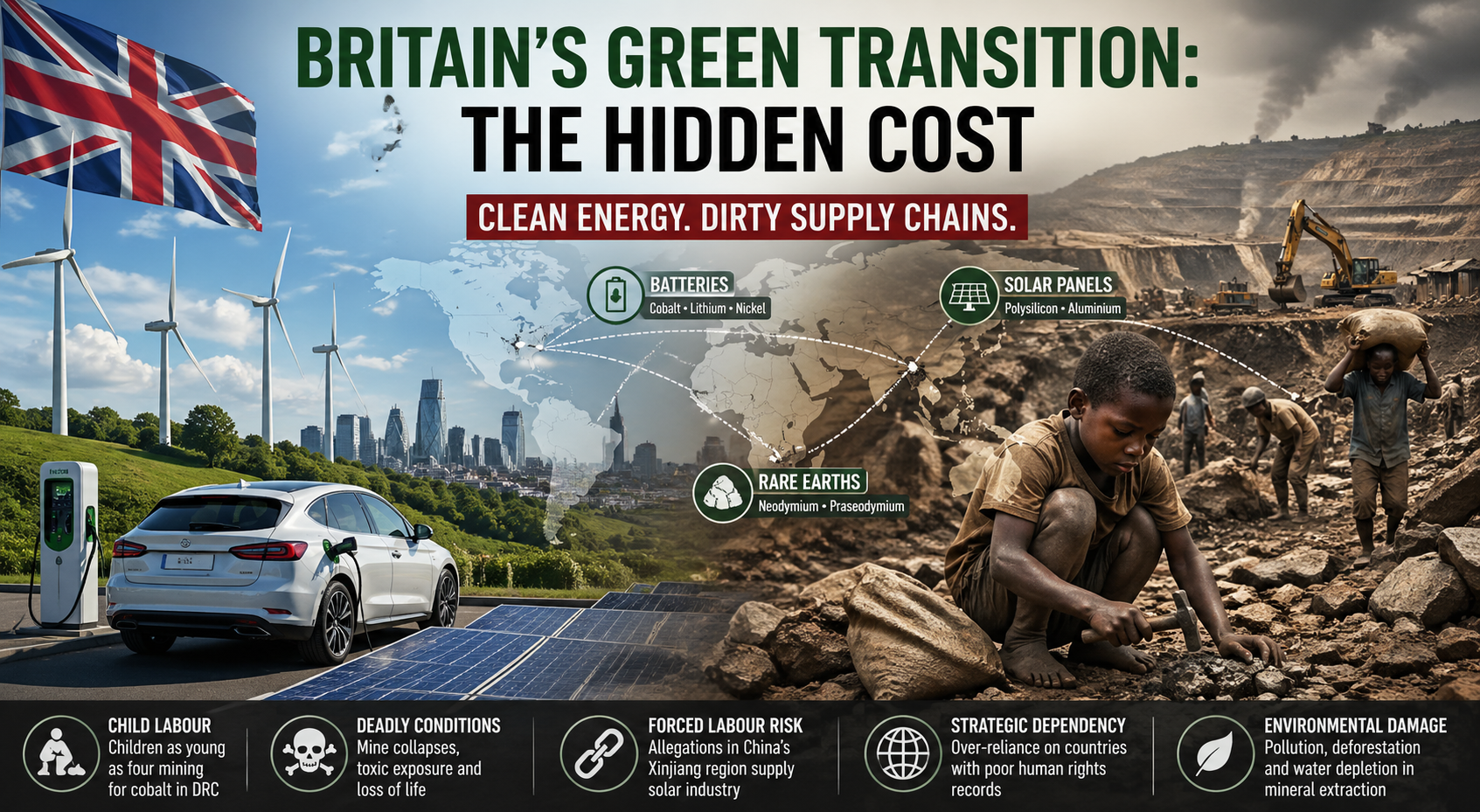
Net Zero and the Moral Supply Chain Crisis: Britain’s Green Transition and the Hidden Cost of “Clean” Energy

The United Kingdom’s transition to Net Zero has been presented as a moral imperative—an ethical response to environmental degradation and climate risk. Yet a growing body of evidence, now amplified by a recent report cited by GB News, suggests that the reality underpinning this transition is far more complex, and far more troubling. Beneath the language of sustainability lies a system of global extraction, dependency, and ethical ambiguity that raises serious questions about the coherence of Britain’s environmental policy.
The Emergence of a “Shadow Supply Chain”
A report publicised by Facts4EU, in collaboration with the Campaign for an Independent Britain and Stand for Our Sovereignty, argues that Britain’s green transition is underpinned by what it describes as “shadowy supply chains” rooted in countries with poor human rights records.¹ The claim is stark: the technologies required to decarbonise the British economy—electric vehicles, wind turbines, solar panels, and battery storage—are dependent on materials extracted under conditions that would be politically and legally unacceptable within the United Kingdom itself.
At the centre of this critique lies the global trade in critical minerals, particularly cobalt, lithium, and rare earth elements. These materials are indispensable to modern energy systems, yet their extraction is geographically concentrated in regions marked by weak governance and systemic exploitation.
Cobalt, Congo, and the Problem of Moral Distance
The most frequently cited case is cobalt mining in the Democratic Republic of Congo, which accounts for approximately 70% of global production.² Investigations by Amnesty International and the OECD have documented widespread use of artisanal mining, including hazardous conditions and the involvement of child labour.³
GB News reporting, drawing on campaign sources, goes further—highlighting claims that children “as young as four” are involved in mining activities linked to global supply chains.⁴ While such figures are contested in their precision, the underlying reality of child labour in artisanal mining is not in dispute. The ethical question, therefore, is not whether abuses exist, but whether the current structure of the green transition implicitly depends upon them.
China’s Industrial Dominance and Forced Labour Allegations
If cobalt represents the extractive problem, China represents the industrial one. The People’s Republic of China dominates the processing and manufacturing stages of green technology supply chains, including solar panels, battery components, and rare earth refining.
Concerns have been raised—by governments, NGOs, and parliamentary committees—about the potential use of forced labour in the Xinjiang region, particularly in the production of polysilicon used in solar panels.⁵ The UK Government itself has acknowledged these risks, committing in principle to the development of supply chains “free from forced labour.”⁶
Yet the structural dependency remains. The International Energy Agency has warned that clean energy supply chains are “highly concentrated”, leaving countries like the UK exposed to both ethical and geopolitical risk.⁷
Environmentalism Without Local Accountability
A further paradox emerges when environmental costs are considered. While Net Zero policies aim to reduce domestic emissions, the extraction and processing of critical minerals generate significant environmental damage elsewhere—water depletion in lithium-rich regions of South America, toxic runoff in cobalt mining zones, and pollution from rare earth processing.
In effect, Britain’s green transition may represent not the elimination of environmental harm, but its geographical displacement.
This critique has been articulated by analysts such as Michael Shellenberger, who argues that renewable supply chains often conceal environmental costs that are politically invisible to Western consumers.⁸
The Case Presented by Critics: Structural Contradiction
Campaigners cited in the GB News report go so far as to describe lithium-ion batteries as “blood batteries,” drawing a direct analogy between modern green technology and historically exploitative resource industries.⁹ Their argument is not merely that abuses occur, but that they are structurally embedded within the current model of rapid decarbonisation.
This position is echoed, in more measured terms, by policy analysts who warn that the speed of the Net Zero transition may be outpacing the development of ethical supply chain governance.
Counterarguments: Reform, Not Rejection
It is essential, however, to distinguish between critique of implementation and rejection of the transition itself. A number of authoritative bodies argue that these problems, while serious, are not intrinsic to renewable energy.
The International Energy Agency has proposed a framework for responsible mineral supply chains, including transparency requirements, diversification of sourcing, and investment in recycling.¹⁰ Similarly, the UK Parliament has heard evidence emphasising the need for “friend-shoring”—sourcing materials from allied nations with higher labour and environmental standards.¹¹
Human rights organisations, including Human Rights Watch, argue that disengagement from high-risk regions may in fact worsen conditions, by removing economic incentives for reform.¹² The challenge, therefore, is not to abandon global supply chains, but to regulate them effectively.
Strategic Risk and National Vulnerability
Beyond ethics, the issue raises questions of national resilience. Dependence on a small number of suppliers—particularly China—creates strategic vulnerabilities that extend beyond energy policy into national security.
The UK Government’s own critical minerals strategy acknowledges this risk, identifying supply chain resilience as a key priority.¹³ Yet progress remains limited, and the scale of dependency suggests that meaningful diversification will take years, if not decades.
Conclusion: A Transition in Tension
The British Net Zero project is not a fiction. It is technologically real, politically entrenched, and environmentally motivated. But it is also, increasingly, morally and strategically contested.
The evidence does not support a simplistic narrative of “clean energy” replacing “dirty energy.” Rather, it reveals a system in which the locus of harm is displaced—out of sight, but not out of existence.
The central question, therefore, is no longer whether Britain should pursue decarbonisation, but whether it can do so without reproducing, in new forms, the very injustices it claims to oppose.
¹ GB News, “Net zero ‘dark truth’: green revolution linked to child labour and deaths,” 2026.
² International Energy Agency, The Role of Critical Minerals in Clean Energy Transitions, 2021.
³ Amnesty International, This is What We Die For, 2016; OECD, Due Diligence Guidance for Responsible Mineral Supply Chains, 2018.
⁴ GB News, “Children ‘as young as four’ mining for green energy materials,” 2026.
⁵ United Nations Human Rights Office, Xinjiang assessment report, 2022.
⁶ UK Government, “Great British Energy and ethical supply chains,” 2025.
⁷ International Energy Agency, Global Supply Chains of EV Batteries, 2022.
⁸ Michael Shellenberger, Apocalypse Never, 2020.
⁹ GB News, reporting on campaign groups, 2026.
¹⁰ International Energy Agency, policy recommendations on mineral governance, 2023.
¹¹ UK Parliament, evidence submissions on critical minerals, 2024–2025.
¹² Human Rights Watch, reports on extractive industries and labour conditions, 2023.
¹³ UK Government, Critical Minerals Strategy, 2022.
RELATED ARTICLES


LATEST ARTICLES
- Today’s homily: Our Lady of WalsinghamThe Mass reflects on the significance of Walsingham, Loreto, and the Christian soul as “Holy Houses” that embody the connection between heaven and earth. It highlights Mary’s central role in the Incarnation and emphasises the importance of inner conversion by inviting believers to reflect on their own hearts as dwelling places for God.
- Today’s Mass: September 24 Our Lady of WalsinghamThe Feast of Our Lady of Walsingham commemorates the vision of Mary that inspired Richeldis de Faverches to build a replica of her house in Nazareth in 1061. This shrine became a significant pilgrimage site, attracting royal visits until its destruction in 1538. The revival of pilgrimage in the 20th century reaffirmed its spiritual importance.
- Sermon for Blessed Virgin Mary of RansomToday, we commemorate the feast of the Blessed Virgin Mary of Ransom, which honours the Mercedarians, a religious order founded in 1218 to free Christian captives from the Moors in Spain. Their mission persists today, highlighting the ongoing relevance of ransoming captives amidst contemporary persecution, combining spiritual redemption with social responsibility.
- OUR LADY OF RANSOM: THE MOTHER OF THE REDEEMER AND THE BREAKING OF CHAINSThe Feast of Our Lady of Ransom, celebrated on 24 September, commemorates the Mercedarian Order’s mission to redeem Christian captives, embodying the concept of liberation from sin through Christ’s sacrifice. This day’s significance links historical devotion with England’s Catholic restoration, connecting the feast to both the Incarnation and personal spiritual freedom.
- Today’s Mass: September 23 Pope Saint Linus, MartyrPope Saint Linus, a nobleman from Tuscany, became an early Christian leader, first in Gaul and then as the Pope after Saint Peter. He was martyred for his faith, noted for his role in baptising and appointing bishops. Saint Thecla, inspired by Saint Paul, chose virginity and endured persecution, ultimately receiving martyrdom.





Leave a Reply