
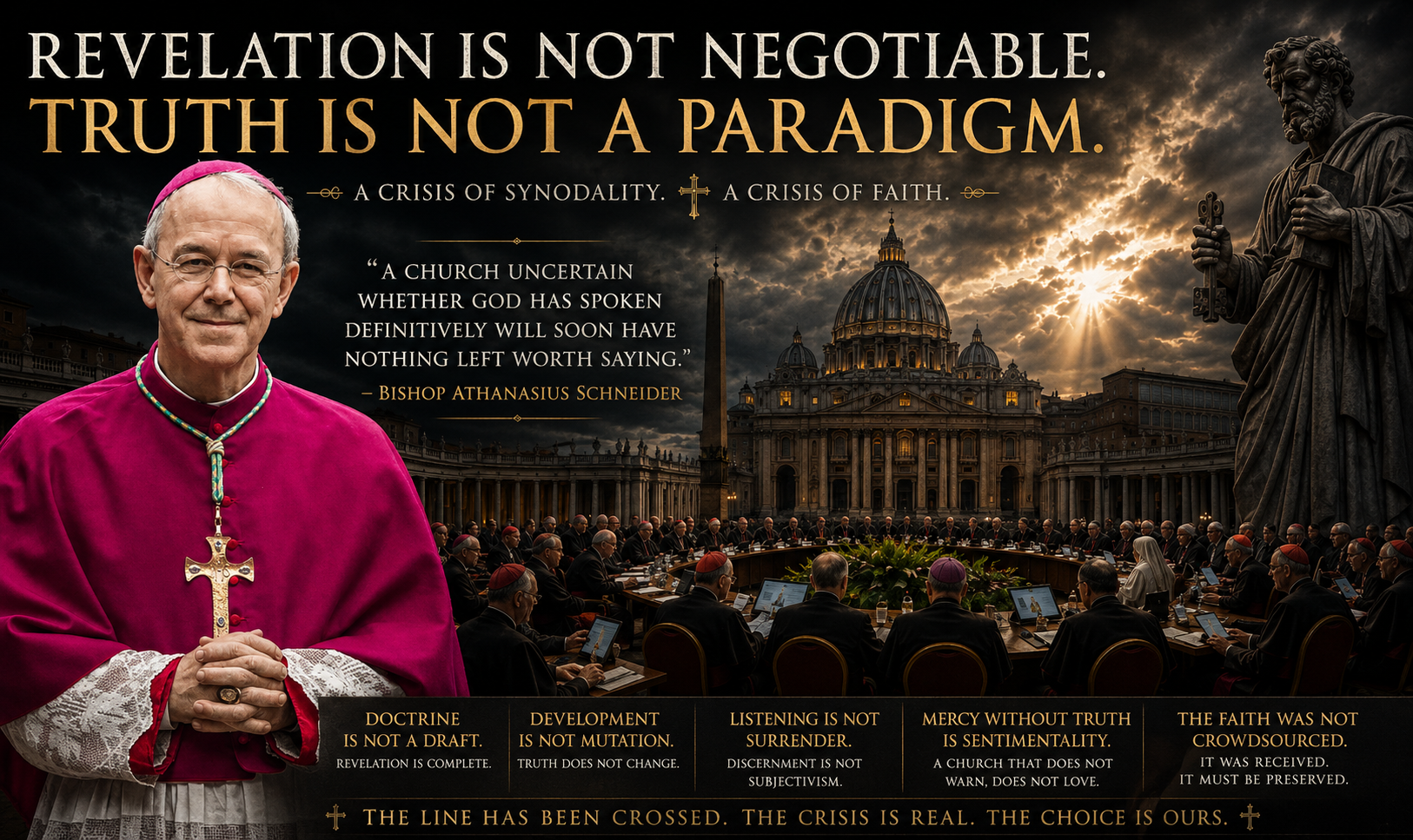
The Synod and the Revolt Against Revelation: Bishop Schneider’s Warning and the Crisis of Catholic Identity

There are crises in the history of the Church that arrive like invading armies — visible, violent, unmistakable. And there are crises far more dangerous precisely because they arrive clothed in the language of renewal, compassion, dialogue, and pastoral concern.
The gravest heresies rarely begin with open rebellion. They begin with ambiguity.
Arianism spread not because bishops openly denied Christ overnight, but because language became elastic enough to permit equivocation. Jansenism survived repeated condemnations by hiding beneath semantic evasions and selective reinterpretations. Liberal Protestantism did not initially announce the abandonment of Christianity; it merely proposed adapting doctrine to the intellectual fashions of modern man. In every age, theological collapse begins when certainty becomes embarrassing and clarity becomes “divisive.”
The contemporary crisis surrounding the Synod on Synodality follows precisely this pattern.
Bishop Athanasius Schneider recently declared that the Final Report of Synod Study Group No. 9 has “unequivocally crossed the line from orthodoxy into heresy.” The statement, made in an interview with journalist Diane Montagna, has reverberated throughout Catholic media because it represents one of the strongest public condemnations yet issued by a serving bishop regarding the synodal process itself. Diane Montagna Substack
Yet the true significance of Schneider’s intervention extends far beyond a dispute over sexuality or synodal procedure. What is now unfolding concerns nothing less than whether Catholicism still believes divine revelation is fixed, binding, and superior to the moral fashions of modern civilisation.
At issue is Study Group No. 9’s treatment of sexuality, anthropology, and moral theology. The report reportedly calls for a “paradigm shift” in the Church’s approach to questions concerning homosexuality and relationships. Such terminology is not accidental. The phrase “paradigm shift,” borrowed from modern philosophy of science, implies not organic development but replacement of one interpretive framework by another. It suggests that previous understandings are not merely incomplete in articulation, but fundamentally inadequate as paradigms themselves.
This strikes directly at the Catholic understanding of doctrinal development.
The Church has always recognised authentic doctrinal growth. Dogma may deepen in clarity, precision, and articulation over time. But authentic development preserves continuity of substance. As Vincent of Lérins explained in the Commonitorium, doctrine develops eodem sensu eademque sententia — “in the same meaning and the same judgment.” The acorn becomes an oak tree, yet remains identifiably the same living reality.
John Henry Newman later elaborated this principle in his Essay on the Development of Christian Doctrine, carefully distinguishing authentic development from corruption. True development preserves type, continuity, and principle. Corruption alters identity itself.
This distinction is decisive.
The Church may deepen her explanation of marriage; she cannot reverse its moral structure. She may refine pastoral practice; she cannot declare intrinsically sinful acts morally positive. She may expand theological understanding; she cannot transform revelation into its opposite.
Yet this is precisely the danger Schneider identifies within the synodal process: not development, but mutation masquerading as development.
The deeper issue is epistemological. How does the Church know truth? Is revelation a fixed deposit entrusted to the Apostles and safeguarded through Tradition, or is doctrine a living process continually reconstructed through historical experience and evolving consciousness?
Modernism answered that question over a century ago.
Pope Pius X recognised the threat with terrifying clarity in Pascendi Dominici Gregis (1907), where he condemned modernism as “the synthesis of all heresies.” Modernism did not primarily deny doctrine outright. Rather, it relocated religion from divine revelation to human experience. Dogma ceased to be immutable truth received from God and became instead symbolic expression evolving through collective consciousness. Pascendi Dominici Gregis
The consequences were revolutionary.
If doctrine arises from experience, then doctrine must evolve as experience evolves. If anthropology changes, morality changes. If human consciousness develops, revelation itself becomes historically conditioned. Theology ceases to interpret reality through divine truth and instead interprets divine truth through contemporary ideology.
The present synodal language reflects this shift unmistakably.
Words such as “listening,” “discernment,” “inclusion,” “accompaniment,” and “lived experience” now dominate ecclesial discourse. In themselves these terms are not objectionable. The Church has always listened pastorally to souls. Yet within the contemporary theological framework these words increasingly function not descriptively but strategically. Their purpose is often semantic destabilisation.
The mechanism is subtle.
Clear moral categories are replaced by therapeutic language. Sin becomes “complexity.” Repentance becomes “journeying.” Conversion becomes “discernment.” Objective disorder becomes “identity.” Theological precision gives way to emotional resonance. Certainty becomes rigidity. Clarity becomes violence.
This is why the present crisis feels simultaneously dramatic and elusive. The doctrinal revolution often proceeds without explicit denial. Instead, language itself is softened until contradiction becomes psychologically tolerable.
But a doctrine permanently contradicted in practice will not survive in principle.
The roots of this crisis long predate the present Synod. The postconciliar period witnessed the gradual rise of proportionalism and situation ethics within Catholic academia. Instead of judging acts according to objective moral order, moral theology increasingly shifted toward intentions, circumstances, relational contexts, and psychological conditions.
This tendency was repeatedly condemned.
Pope Pius XII warned against situation ethics in multiple allocutions during the 1950s, insisting that certain moral norms bind universally regardless of circumstance. Pope Pius XII rejected the idea that subjective sincerity could transform intrinsically evil acts into morally acceptable ones. Humani Generis
The definitive magisterial confrontation arrived with Pope John Paul II’s Veritatis Splendor (1993). There the Pope directly condemned proportionalism, consequentialism, and ethical systems denying intrinsically evil acts. He reaffirmed that moral truth is objective because human nature itself possesses objective meaning rooted in creation. Veritatis Splendor
This point cannot be overstated.
Catholic moral theology is inseparable from Catholic anthropology. The Church teaches not merely isolated rules but a vision of reality itself. Man possesses a nature given by God, ordered toward intelligible ends. Sexual difference is not socially constructed but metaphysically real. Marriage is not an emotional arrangement but participation in the natural and sacramental order established by God.
Modern gender ideology represents a direct revolt against this metaphysical vision. Identity becomes self-created. Desire becomes sovereign. Biology becomes negotiable. Human nature dissolves into psychological self-perception.
And now sections of the Church increasingly appear tempted not to confront this revolution, but to baptise portions of its language.
Among those associated with Study Group No. 9 is Fr Maurizio Chiodi, who has argued that some homosexual relationships may contain morally positive dimensions under certain conditions. Such reasoning fundamentally overturns classical Catholic moral theology because it shifts moral judgment from the objective nature of acts to the subjective experiences surrounding them.
Once this principle is accepted, every doctrinal boundary becomes unstable.
If emotional authenticity can morally justify objectively disordered acts, then morality itself becomes radically subjective. Contraception, divorce, cohabitation, euthanasia, and countless other issues eventually become vulnerable to the same logic. The Church’s moral framework collapses into therapeutic relativism.
This explains Schneider’s comparison to Genesis: “Did God really say?”
The serpent did not begin with direct denial. He began by destabilising confidence in revelation itself.
And this is precisely the deeper tragedy of modern Catholicism: not simple rebellion against doctrine, but exhaustion with certainty. A civilisation drowning in relativism increasingly demands a Church willing to relativise herself. The temptation is immense. Adapt to survive. Soften to remain relevant. Blur distinctions to avoid conflict.
Yet history demonstrates the opposite.
The communities that surrendered doctrine for relevance did not renew Christianity. They emptied their churches. Liberal Protestantism accommodated modernity at every stage and became spiritually weightless in the process. Institutions uncertain of their own truth cannot inspire sacrifice, martyrdom, fidelity, or conversion.
People do not die for ambiguities.
They die for truth.
The ecclesiological implications of synodality are equally profound. Increasingly, synodality appears not merely consultative but epistemological — a new source of doctrinal legitimacy. Truth emerges through process, dialogue, and communal listening rather than descending definitively through revelation safeguarded by Tradition.
This effectively transforms the Church into a permanent theological parliament.
But Catholicism is not governed by evolving consensus. Revelation is not crowdsourced.
The Church does not possess authority over truth; she possesses authority in service to truth.
This is why Schneider’s warning matters beyond traditionalist circles. The issue is not liturgical preference, ecclesiastical politics, or ideological factionalism. The issue is whether the Catholic Church still believes that God has spoken definitively in Christ and that revelation therefore remains binding upon every age, culture, and civilisation.
The wider cultural context makes the crisis even more alarming. Western civilisation itself increasingly suffers from metaphysical collapse. Reality has become negotiable. Language is politicised. Biology is subordinated to identity. Law bends before emotion. Education yields to ideology. Nations lose memory of their own inheritance. Institutions apologise for truth itself.
And now the same anthropological revolution presses relentlessly upon the Church.
But Christianity was never commissioned to mirror civilisation’s confusions back to itself in softened theological language. The Church exists to proclaim what civilisation does not wish to hear: that truth is objective, that man is fallen, that sin is real, that repentance is necessary, and that salvation comes only through conformity to Christ rather than conformity to the age.
Authentic charity therefore cannot exist apart from truth.
Mercy severed from repentance degenerates into sentimentality. Compassion detached from moral order becomes cruelty disguised as kindness. A Church that refuses to warn souls ceases to love them.
This is ultimately why Schneider’s intervention carries such weight. He is not merely criticising imprudent wording or pastoral ambiguity. He is warning that the Church stands perilously close to surrendering the very principle of divine revelation itself.
For once revelation becomes historically negotiable, Christianity loses the one thing that distinguished it from every ideology before it.
A Church uncertain whether God has spoken definitively will soon have nothing left worth saying.
- Pius VI, Auctorem Fidei (Bull Condemning the Errors of the Synod of Pistoia), August 28, 1794, proposition 78, accessed May 15, 2026, https://www.papalencyclicals.net/pius06/p6auctem.htm.
- Pius X, Pascendi Dominici Gregis (Encyclical on the Doctrines of the Modernists), September 8, 1907, §39, accessed May 15, 2026, https://www.vatican.va/content/pius-x/en/encyclicals/documents/hf_p-x_enc_19070908_pascendi-dominici-gregis.html.
- Vincent of Lérins, Commonitorium, chap. 23, in Nicene and Post-Nicene Fathers, Second Series, vol. 11, ed. Philip Schaff and Henry Wace (Peabody, MA: Hendrickson Publishers, 1994), 132.
- John Henry Newman, An Essay on the Development of Christian Doctrine (Notre Dame, IN: University of Notre Dame Press, 1989), 171–89.
- Pius XII, Humani Generis (Encyclical Concerning Some False Opinions Threatening to Undermine the Foundations of Catholic Doctrine), August 12, 1950, §§21–22, accessed May 15, 2026, https://www.vatican.va/content/pius-xii/en/encyclicals/documents/hf_p-xii_enc_12081950_humani-generis.html.
- John Paul II, Veritatis Splendor (Encyclical Regarding Certain Fundamental Questions of the Church’s Moral Teaching), August 6, 1993, §§75–83, accessed May 15, 2026, https://www.vatican.va/content/john-paul-ii/en/encyclicals/documents/hf_jp-ii_enc_06081993_veritatis-splendor.html.
- Catechism of the Catholic Church, 2nd ed. (Vatican City: Libreria Editrice Vaticana, 1997), §§2357–2359.
- Diane Montagna, “Bishop Schneider: Vatican Synod Report Has Crossed ‘Into Heresy,’” Substack, May 14, 2026, accessed May 15, 2026, https://dianemontagna.substack.com/p/bishop-schneider-vaticans-synod-report.
RELATED ARTICLES


Latest
- Today’s Mass: October 03 St Thomas [de Cantilupe] of HerefordSt Thomas de Cantilupe was an influential figure, born into nobility around 1218. Educated in canon law, he supported the baronial party during the Barons’ War and served as Chancellor of England and Bishop of Hereford. Known for his piety and charity, he was canonised in 1320, with his relics drawing pilgrims to Hereford Cathedral.
- 04.10.26 Nuntiatoria CXXVI: OMNIA AUTEM PROBATE: QUOD BONUM EST TENETEThis editorial highlights the importance of discernment in faith, urging Christians to test teachings and hold onto what is good. It critiques contemporary issues, such as compulsory inclusivity at universities, government information security, and interfaith dialogues, emphasizing that a responsible faith must involve critical examination and recognition of true values.
- ORDO w/c 04.10.26The week begins with the Eighteenth Sunday after Pentecost, honouring various saints, culminating in the feast of St Francis of Assisi. Key celebrations include St Wenceslaus, St Michael the Archangel, St Jerome, and St Thérèse of the Child Jesus. The period highlights the call to surrender worldly attachments in devotion to God.
- THE WEDDING GARMENT: The Nineteenth Sunday after PentecostThe Nineteenth Sunday after Pentecost joins St Paul’s command to “put on the new man” with Christ’s parable of the wedding garment. The warning is directed especially towards those already within the household of Faith: Catholic identity, orthodoxy and traditional practice cannot substitute for sanctifying grace and personal conversion. Grace does not merely bring us into the feast; it must make us fit for the presence of the King.
- Blue Labour discovers the Common GoodJonathan Hinder criticises “hyper-liberalism” for prioritising individual autonomy over community values. His emphasis on family and societal duties echoes Christian teachings often overlooked in modern politics. Although Hinder promotes aspects of Blue Labour as solutions to social issues, he underscores the necessity of returning to deeper truths about human nature and moral authority for genuine societal cohesion.


![Today’s Mass: October 03 St Thomas [de Cantilupe] of Hereford](https://nuntiatoria.org/wp-content/uploads/2026/10/thomascantilupemasstitle.jpg)



Leave a Reply