
Ecumenism Without Clarity: The Mullally Meeting and the Crisis of Method

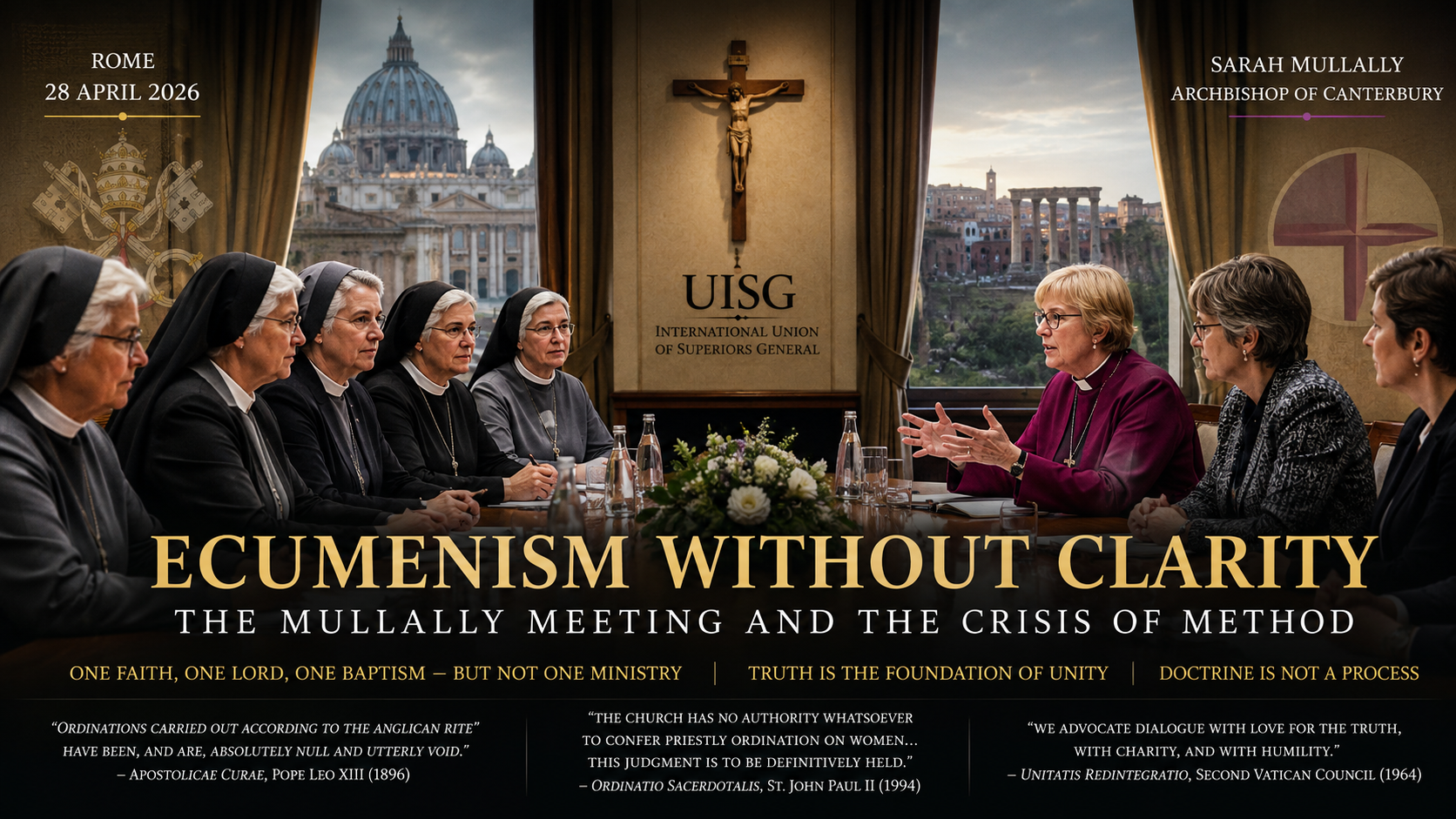
On 28 April 2026, at the Rome headquarters of the International Union of Superiors General, leaders of Catholic women’s religious institutes received Sarah Mullally for a meeting framed explicitly around “women, unity, and walking together.” According to the organisers, the encounter focused on the role of women in the Church, shared mission, and the ongoing “journey” toward Christian unity.¹
No decree was issued. No doctrine proposed. No teaching formally altered. And yet, precisely because of this, the event reveals something more fundamental than a doctrinal statement: it exposes the operative method by which doctrine is now approached. For what is at stake is not merely what the Church teaches, but how the Church now proceeds.
Encounter Before Truth? Since the Second Vatican Council, Catholic ecumenism has increasingly adopted a procedural logic: encounter precedes resolution; dialogue replaces definition; shared action substitutes for theological clarity. The Council’s decree Unitatis Redintegratio indeed calls for dialogue conducted “with love for the truth, with charity, and with humility,”² yet this presumes—not suspends—the primacy of truth itself.
The difficulty arises when the method outpaces its foundation.
For the Catholic Church has already spoken definitively on the question of Anglican orders. In Apostolicae Curae (1896), Pope Leo XIII declared:
“ordinations carried out according to the Anglican rite have been, and are, absolutely null and utterly void.”³
This judgment is not disciplinary but ontological. Where there is no valid priesthood, there is no Eucharistic sacrifice; where there is no Eucharistic sacrifice, the Church’s visible and sacramental structure is not merely impaired but fundamentally altered.
To meet, therefore, with an Anglican “archbishop” is not simply to engage a separated Christian leader. It is to stand in relation to a ministry which, according to the Church’s own judgment, lacks sacramental reality.
The Synodal Turn: Language as Method The language surrounding such encounters is neither incidental nor neutral. It is drawn directly from the framework of the Synod on Synodality, whose working documents repeatedly emphasise “listening to all the baptised,” “journeying together,” and “walking side by side.”⁴
The UISG itself adopts this lexicon. In describing the Mullally meeting, it spoke of “prophetic presence,” “shared discernment,” and the need to accompany one another in a common journey.¹ These are not merely descriptive phrases; they constitute a methodology.
Within this framework, the question is no longer framed as:
Is this ministry valid?
but rather:
What can be learned from this experience?
Thus the centre of gravity shifts from ontology to phenomenology—from what is objectively true to what is subjectively lived.
UISG and the Comparative Question
The role of the UISG is not incidental but structural. As a global body representing women religious, it has become a principal conduit for articulating lived experience, advancing questions of participation and governance, and shaping the language of synodal discourse.
Within this context, the presence of a woman archbishop is not merely ecumenical—it is comparative. It introduces, without formal argument, a model: a communion in which women occupy episcopal office. No explicit claim is made; none is required. The fact itself becomes an experiential datum to be “discerned.”
Thus the question is subtly but decisively reframed. Not:
Can the Church ordain women?
but:
How should the Church respond to the reality that others already do?
Yet the Church has already answered this question. In Ordinatio Sacerdotalis (1994), Pope John Paul II declared:
“the Church has no authority whatsoever to confer priestly ordination on women… this judgment is to be definitively held by all the Church’s faithful.”⁵
The matter is not open to sociological revision, nor subject to comparative ecclesiology. It belongs to the deposit of faith as received and transmitted.
From Doctrine to Process
Here, then, is the decisive shift. Traditionally, the Church resolves questions by appeal to Scripture, Apostolic Tradition, and the consistent teaching of the Magisterium. Within the emerging synodal paradigm, however, questions are not resolved but prolonged; not answered but reframed; not closed but reopened as processes.
What was defined becomes “to be explored.”
What was settled becomes “to be listened to anew.”
The meeting with Mullally does not contradict doctrine explicitly. It does something more consequential: it relocates the discussion into a procedural framework in which definitive teaching is no longer determinative of method.
The Risk of Practical Equivalence Actions communicate meaning irrespective of disclaimers. To meet as counterparts, to share platforms, to engage in a common language of mission and leadership—these gestures suggest a parity which doctrine denies.
If Anglican orders are indeed “absolutely null and utterly void,” then such parity cannot exist without ambiguity. The danger is not formal heresy, but practical equivalence: the appearance of unity where a real ontological rupture remains.
As Athanasius Schneider has observed in relation to contemporary ecclesial ambiguity, “confusion about truth is never a service to unity, but its greatest obstacle.”⁶ The clarity of doctrine is not an impediment to communion; it is its necessary foundation.
Ambiguity, in sacramental theology, is never neutral. It does not merely obscure truth—it conditions how truth is received.
Conclusion: A Crisis of Method The meeting between the UISG and Sarah Mullally is not, in itself, a doctrinal error. It is something more revealing: a manifestation of a methodological shift in which process increasingly governs perception, and perception begins to condition belief.
The Church does not possess the priesthood as a construct to be adapted, but as a sacramental reality to be received. Where that reality has been defined, it cannot be indefinitely deferred without consequence.
A Church that treats definitive truth as provisional process does not deepen that truth.
What is treated as optional will not long be believed at all.
¹ International Union of Superiors General, report on meeting with Sarah Mullally, Rome, 28 April 2026.
² Unitatis Redintegratio, Second Vatican Council, §11, 21 November 1964.
³ Apostolicae Curae, Pope Leo XIII, 13 September 1896.
⁴ Synod on Synodality, Working Documents and Synthesis Reports (2023–2024).
⁵ Ordinatio Sacerdotalis, Pope John Paul II, 22 May 1994.
⁶ Athanasius Schneider, statements on doctrinal clarity and unity, various addresses.
Related Articles


Latest Articles
- Blue Labour discovers the Common GoodJonathan Hinder criticises “hyper-liberalism” for prioritising individual autonomy over community values. His emphasis on family and societal duties echoes Christian teachings often overlooked in modern politics. Although Hinder promotes aspects of Blue Labour as solutions to social issues, he underscores the necessity of returning to deeper truths about human nature and moral authority for genuine societal cohesion.
- INCLUSION BY COMPULSION: Caius College, STOP HATE UK and the boundary between law and ideologyCaius College’s decision to mandate ninety minutes of inclusivity training by Stop Hate UK for undergraduates raises concerns about academic freedom and the potential imposition of ideological conformity. Questions about the accuracy of legal definitions and the distinction between lawful disagreement and unlawful conduct further complicate the issue, warranting careful scrutiny.
- THE ADHĀN IN THE CHURCH: Dialogue or the erasure of sacred boundaries?In September, the Islamic call to prayer was recited inside a German church, highlighting evolving Christian views on sacred spaces. This incident raises concerns over whether hosting Islamic practices within churches constitutes misplaced hospitality and blurs the boundaries between religions, challenging the integrity of Christian worship environments.
- Rome Built a Door Out of Écône ~ Priests Are Walking the Other WaySince July’s consecrations, a route has been established for priests to leave the Society of St Pius X (SSPX), but few have done so, while more priests continue to join. The ongoing appeal of the SSPX reflects deep convictions about liturgy and doctrine, contrasting with a declining diocesan environment, which prompts a significant movement towards traditional practices.
- The Pope came to speak of France’s soul ~ the streets have answeredDuring his visit to France, Pope Leo XIV focused on proclaiming Christ, emphasising the need for life, doctrinal integrity, and priestly vocations. He faced tensions in reconciling revolutionary ideals with Christian teachings. While affirming the Eucharist, his interpretations shifted towards community experiences, sparking debates about theological priorities and liturgical significance.


Leave a Reply