
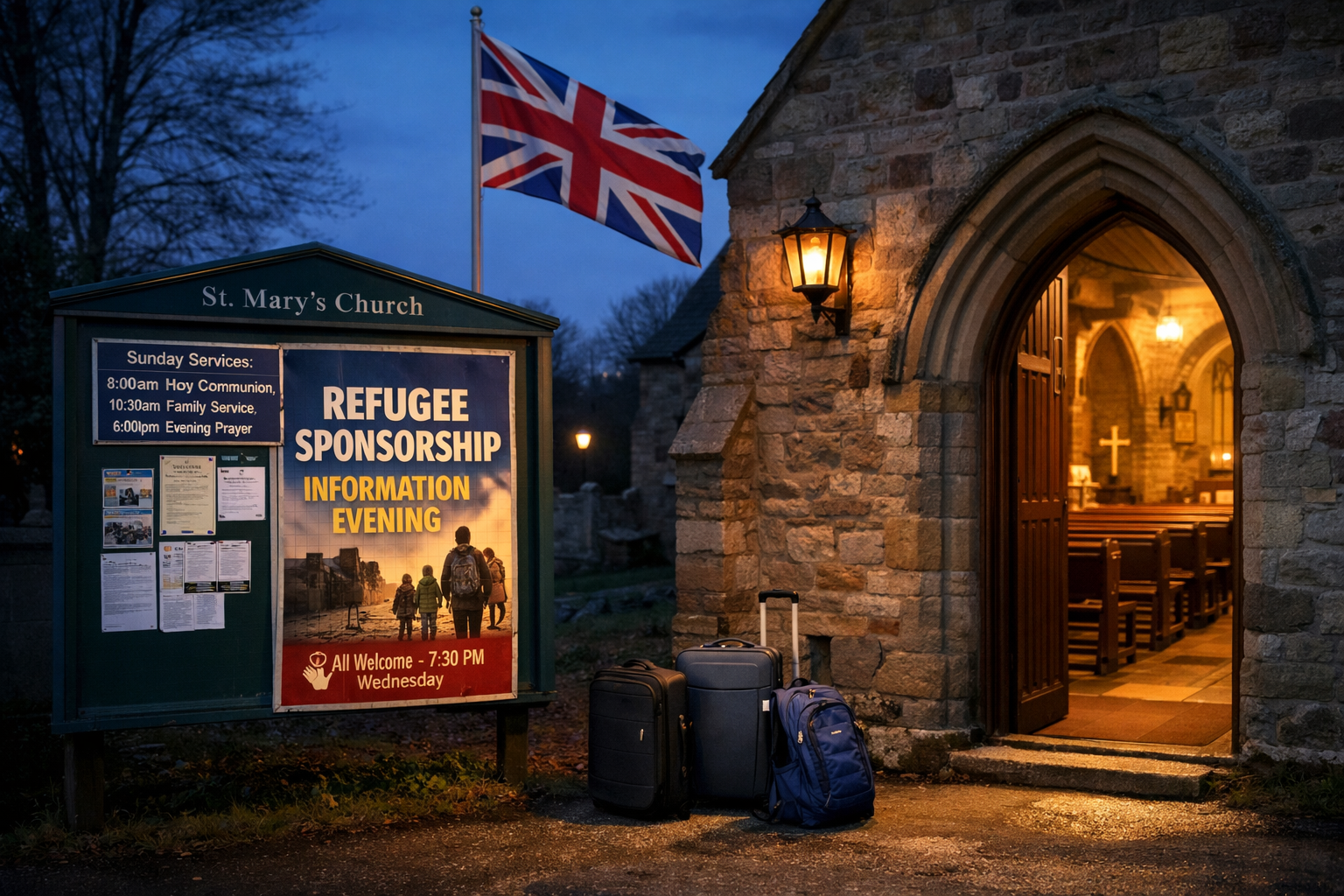
Hospitality Without Foresight: The Risks of Church-Led Refugee Sponsorship
On 16 January 2026, the Church Times published an opinion article entitled “Churches stand ready to help refugees” by Krish Kandiah, a British evangelical minister, charity executive, and founder of the refugee-advocacy organisation Sanctuary Foundation.¹ Writing as a long-standing proponent of church-led refugee resettlement and a frequent contributor to Anglican public discourse, Kandiah argues that churches across the United Kingdom should prepare to implement a proposed Named Community Sponsorship Programme, presented as a model that “combines compassion with control.”
Because this argument is already being cited approvingly within ecclesial and policy-adjacent circles, it warrants careful scrutiny. What follows is not a rejection of Christian charity toward those in genuine need, but a critique of the moral framing, theological assumptions, and political implications embedded in Kandiah’s case.

What the Named Community Sponsorship Programme Proposes
The Named Community Sponsorship Programme is an anticipated expansion of the UK’s existing Community Sponsorship Scheme, administered by the Home Office. Under the current framework, approved community groups — often churches or charities — may apply to sponsor a refugee family already recognised by the UN High Commissioner for Refugees, committing to provide housing, integration support, and pastoral assistance for a defined period.²
The proposed named variant would extend this arrangement by allowing sponsoring bodies to identify and nominate specific individuals or families whom they believe to be at risk, thereby transferring significant responsibility for selection, advocacy, and early integration from the state to civil-society actors. Kandiah presents this as a humane and efficient system that matches refugees “in genuine need” with communities ready to support them.
A Morally Charged but Historically Weak Analogy
Kandiah frames his argument by invoking the hostility faced by Irish migrants in 1950s Britain, epitomised by the infamous signs reading “No Blacks. No Irish. No Dogs,” and suggests that contemporary scepticism toward asylum-seekers is a direct analogue. The rhetorical force of the comparison is clear; its moral precision is not.
Post-war Irish migration occurred within a shared linguistic, cultural, and overwhelmingly Christian civilisational context, and was largely lawful and labour-driven. Contemporary asylum pressures are of a fundamentally different order: unprecedented scale, complex legal categories, significant cultural and religious discontinuities, and a long record of integration difficulties across Europe. To collapse these distinctions is to substitute moral accusation for moral reasoning, rendering legitimate prudential concerns indistinguishable from racial prejudice.
National Identity Misread as Moral Failure
The article further interprets the visibility of national symbols — particularly the St George’s flag — as evidence of fear and exclusion. This reading is pastorally careless and theologically thin. National identity is not intrinsically opposed to Christian charity. Classical Christian moral theology, articulated in the doctrine of ordo caritatis, affirms that love is rightly ordered: beginning with family, locality, and nation before extending outward.³
Concern for social cohesion, cultural continuity, and institutional capacity is not a repudiation of the Gospel. It is one of the conditions under which genuine charity can endure.
From Prophetic Witness to Humanitarian Management
Kandiah repeatedly invokes the Church’s “prophetic role,” yet prophecy is redefined almost entirely in managerial terms. The Church is praised for sponsoring families, facilitating integration, countering negative public narratives, and reducing long-term costs to the state. Hospitality is treated as a moral absolute, detached from conversion, catechesis, sacramental life, and moral formation.
References to early sponsorship initiatives involving the Church of England, including those associated with Lambeth Palace, are presented as unqualified successes. No assessment is offered of their ecclesial fruit: whether parish life has been strengthened, doctrine clarified, or Christian identity deepened. The Church appears less as a truth-bearing institution and more as a morally motivated delivery mechanism.
Selective Evidence, and the Question of Responsibility
The article appeals to pilot schemes, polling by More in Common, and selective US data to argue that community-led sponsorship improves integration outcomes and reduces irregular migration.⁴ What is not addressed is how such schemes would operate at scale in institutions already facing safeguarding pressures, administrative constraints, and declining volunteer capacity — matters that bear directly on the moral responsibility to foresee harm.
Safeguarding, Capacity, and the Duty of Prudence
This omission is not peripheral. Any programme that embeds new arrivals within parish life, housing networks, or informal pastoral settings necessarily engages safeguarding obligations toward children, vulnerable adults, and volunteers. Churches already operate under safeguarding regimes that are complex and resource-intensive. To expand sponsorship without explicit attention to vetting standards, information-sharing with statutory authorities, risk assessment, and ongoing oversight is to proceed without adequate moral seriousness.
This concern is sharpened by recent ecclesial history. Churches have suffered profound loss of public trust precisely because safeguarding risks were underestimated or subordinated to well-intentioned goals.⁵ In that context, proposals for church-led sponsorship must meet a higher, not lower, threshold of clarity and accountability.
Administrative and financial capacity also matters. Community sponsorship entails sustained commitments: securing and maintaining housing, navigating immigration compliance, liaising with local authorities, coordinating healthcare and education access, and absorbing legal and reputational risk. These burdens fall on a limited number of clergy and volunteers, often over years rather than months. Claims that sponsorship “reduces costs to the state” obscure the more basic point that costs are displaced — from public systems to private citizens and ecclesial bodies — and must be acknowledged honestly.⁶
Finally, prudence requires sober recognition that harm, while not characteristic of most asylum seekers, is not unknown. A small number of cases involving serious criminality have occurred within existing asylum systems.⁷ Acknowledging this does not deny the dignity of genuine refugees; it recognises the moral duty to protect the vulnerable and to assess foreseeable risk. Christian charity has never required the suspension of foresight. On the contrary, prudence is integral to charity rightly exercised.⁸
Safeguarding is not an obstacle to hospitality; it is one of its necessary conditions.
Ecclesial Authority and Political Instrumentalisation
Kandiah urges churches to signal to the Government that they are “ready and waiting” to implement the programme, even as the wider immigration reforms he references tighten settlement rules and extend uncertainty for migrants already in the UK. This appeal presumes a moral authority that many ecclesial institutions have weakened through abuse scandals, doctrinal incoherence, and episcopal evasiveness — realities the article does not acknowledge.
The risk is not merely practical but theological: the Church is positioned as a parallel arm of state migration policy, increasingly instrumentalised and further detached from its spiritual mission.
The Unasked Question of Limits
Most revealing is what the article does not address. Christian tradition affirms the duty to assist the stranger, but it also affirms the legitimacy of borders, the priority of the common good, and the moral distinction between emergency refuge and permanent resettlement. Charity does not abolish prudence; it presupposes it.⁹
By refusing to articulate limits, the article advances a moral absolutism that ultimately undermines sustainable compassion and deepens public mistrust.
Advocacy and Institutional Interest
Context also matters. Kandiah writes not only as a Christian commentator but as the founder of the Sanctuary Foundation, an organisation whose mission aligns directly with the policy framework he promotes. This does not negate sincerity, but it situates the piece as advocacy rather than disinterested theological reflection.
Conclusion
“Churches stand ready to help refugees” is eloquent and well-intentioned. Yet it exemplifies a broader malaise in contemporary ecclesial discourse: moral sentiment replacing moral reasoning, and policy enthusiasm substituting for theological depth. Authentic Christian hospitality is not opposed to order, limits, or prudence. It depends upon them. Without that foundation, the Church risks becoming not a prophetic witness to truth, but a well-meaning adjunct to policies it no longer has the authority to judge.
¹ Krish Kandiah, “Churches stand ready to help refugees,” Church Times, 16 January 2026.
² UK Home Office, Community Sponsorship Scheme: Policy Overview.
³ St Thomas Aquinas, Summa Theologiae, II–II, q.26.
⁴ More in Common, Public Attitudes to Community Sponsorship, UK polling summary.
⁵ Independent Inquiry into Child Sexual Abuse (IICSA), Final Report, 2022.
⁶ UK National Audit Office, Investigation into Asylum Accommodation, HC 1109, 2023.
⁷ UK Home Office, Asylum and Crime: Statistical and Analytical Briefings, parliamentary releases.
⁸ St Thomas Aquinas, Summa Theologiae, II–II, q.47 (on prudence).
⁹ Congregation for the Doctrine of the Faith, Note on the Common Good and Political Responsibility, 2002.
RELATED ARTICLES


LATEST ARTICLES
- Today’s homily: Christ the KingThe homily reflects on Christ’s kingship as seen in the Gospel narrative. It contrasts earthly authority with divine truth, emphasising that true allegiance to God requires genuine obedience and transformation. Believers are called to examine their personal commitments and respond to Christ’s demands in everyday life, ultimately recognising their identity as bearers of God’s image.
- Sermon for Christ the KingToday marks the celebration of Christ the King and the Twenty Second Sunday after Pentecost, a feast asserting Christ’s sovereignty against totalitarianism. St. Paul emphasised Christ’s supremacy over power and principalities, challenging early Gnostic beliefs. The early Church’s victory over evil is affirmed in Christ’s resurrection, offering hope and unity amidst contemporary struggles.
- Today’s Mass: October 25 SOVEREIGNTY OF OUR LORD JESUS CHRIST, SUPREME KINGThe Feast of the Sovereignty of Our Lord Jesus Christ celebrates Christ’s dual kingship by birth and conquest. Established by Pius XI, it aims to deepen faith and counter anti-clericalism. The liturgical observance underscores His authority as King, advocating for societal recognition of His reign to bring peace and harmony.
- TRADITION BEHIND THE FENCEThe Vatican’s prohibition of the traditional Ad Petri Sedem pilgrimage to St Peter’s Basilica has sparked controversy, especially among traditional Catholics. While some cite scheduling conflicts, the broader issue lies in the restrictive policies of Traditionis custodes, which may confine traditional liturgical practices to specific enclaves, risking the transmission and recognition of Catholic Tradition within the wider Church.
- Today’s Mass: October 24 St Raphael the ArchangelThe Feast of Saint Raphael the Archangel highlights his healing powers as depicted in the Book of Tobit, where he aids Tobit and his son, Tobiah. Venerated as a protector of travellers and the blind, Raphael is celebrated for his miraculous interventions. His legacy includes support for nurses, matchmakers, and Catholic studies.





Leave a Reply