
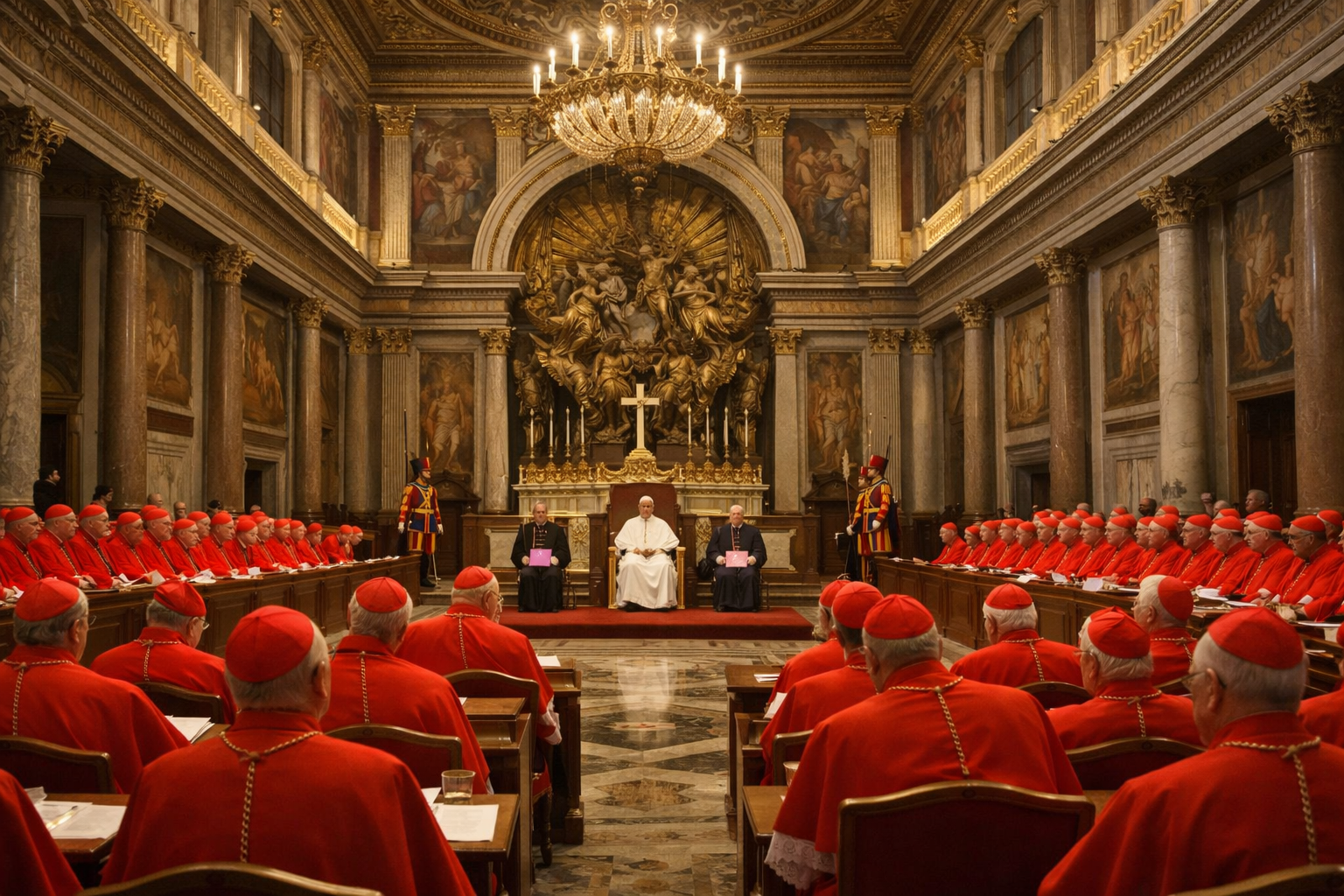
Infallibility or Irrelevance: Cardinals David and Radcliffe, Holy Orders, and the Crisis of Authority
Recent public statements by Pablo Virgilio David, Cardinal of Kalookan, and Timothy Radcliffe, former Master of the Order of Preachers, have exposed a fault line that runs far deeper than questions of tone, emphasis, or pastoral strategy. At issue is a foundational ecclesiological question: either the Church teaches infallibly, or she does not. If she does—and if such teaching may nevertheless be questioned, relativised, or bypassed by cardinals—then the rationale for hierarchy and magisterium collapses from within.
This is not an abstract dispute. It concerns the nature of Holy Orders itself and the binding force of the Church’s definitive teaching as articulated by John Paul II.
The Definitive Teaching on Holy Orders
In 1994, Pope John Paul II issued the Apostolic Letter Ordinatio Sacerdotalis in response to growing pressure to admit women to ordained ministry. He declared, with deliberate precision, that “the Church has no authority whatsoever to confer priestly ordination on women,” and that this judgment “is to be definitively held by all the Church’s faithful.”¹
This was not presented as a disciplinary norm or a prudential judgment, but as a doctrinal boundary rooted in divine constitution. In 1995, the Congregation for the Doctrine of the Faith clarified that this teaching belongs to the ordinary and universal Magisterium, and is therefore infallible.²
Crucially, the teaching concerns the sacrament of Holy Orders as such. Holy Orders is one sacrament, conferred in three degrees—bishop, priest, and deacon—and governed by a single sacramental logic. Attempts to isolate one degree from the rest in order to evade doctrinal consequences are foreign to Catholic sacramental theology.
Cardinal David and the Dilution of In Persona Christi
At a press conference following the Extraordinary Consistory of January 2026, Cardinal David argued that the concept of in persona Christi should not be understood as proper to the ordained alone. Because “Christ includes the body,” he suggested, all the baptised act in persona Christi by virtue of baptismal dignity, and the ordained therefore do not possess a “monopoly” on this representation.
This formulation represents a serious theological conflation. Catholic doctrine has always distinguished between the common priesthood of the faithful, rooted in baptism, and the ministerial priesthood, conferred through ordination.³ The priest acts in persona Christi Capitis—in the person of Christ the Head—precisely because ordination effects an ontological configuration to Christ that baptism alone does not confer.⁴
To dissolve this distinction is not a harmless expansion of language. It empties in persona Christi of its sacramental content and undermines the theological basis for a male-only ordained ministry—not by refuting doctrine, but by redefining its terms.
Cardinal Radcliffe and the Diaconal Question
Cardinal Radcliffe, in a widely discussed January 2026 interview, avoided explicitly calling for women priests. Instead, he expressed support for “rapid progress” toward the ordination of women as deacons, presenting this as a measured development distinct from the question of priesthood.⁸
At this point, the doctrinal issue cannot be deferred. The diaconate is not an auxiliary ministry standing outside Holy Orders. It is one of the three degrees of the one sacrament of Holy Orders.⁵ The attempt to present women deacons as a neutral or compromise position collapses once the sacramental theology of Orders is taken seriously.
Why “Women Deacons” Cannot Be Separated from Women Priests
The proposal to ordain women as deacons while maintaining a male-only priesthood is often framed as a prudent middle path. In Catholic doctrine, this distinction is untenable.
Holy Orders is one sacrament, not three separate sacraments. The episcopate, presbyterate, and diaconate are distinct degrees, but they are united in a single sacramental reality.¹ To be ordained a deacon is to receive sacramental ordination, including an ontological character that configures the recipient to Christ in a manner distinct from baptism alone.²
The argument of Ordinatio Sacerdotalis is therefore sacramental and Christological, not merely functional. Pope John Paul II grounded the impossibility of women’s ordination in the Church’s lack of authority to alter what Christ instituted.³ That lack of authority applies to the sacrament of Orders as such. If the Church lacks authority to ordain women to one degree of Orders by divine constitution, she lacks it for all degrees.
Attempts to reclassify the diaconate as a non-sacramental or purely functional ministry contradict the Church’s own teaching. The Catechism explicitly teaches that deacons are ordained “not unto the priesthood, but unto a ministry,” while remaining fully within the sacrament of Orders.⁶ “Not unto the priesthood” refers to function, not to sacramental reality.
Historical appeals to ancient “deaconesses” likewise fail to establish sacramental precedent. The Church has repeatedly clarified that historical deaconesses were not ordained in the sacramental sense, did not receive Holy Orders, and did not exercise diaconal ministry equivalent to that of ordained male deacons.⁷ Continuity of terminology does not imply continuity of sacrament.
Once women are admitted to sacramental ordination at any degree, the theological rationale for excluding them from the presbyterate collapses. For this reason, “women deacons” functions not as a stable settlement, but as a doctrinal wedge.
A Shared Pattern of Evasion
Though differing in emphasis, the approaches of Cardinals David and Radcliffe converge in substance. Neither directly denies Ordinatio Sacerdotalis. Instead, both seek to render it ineffective—one by relativising in persona Christi, the other by isolating the diaconate from the unity of Holy Orders.
In both cases, an infallible teaching is treated not as a boundary, but as a problem to be managed.
The Silence of Authority and the Scandal of Impunity
An additional and unavoidable incongruity now presents itself. Cardinals may publicly relativise or evade infallible teaching on Holy Orders without correction, censure, or consequence—not from marginal figures, but from men who occupy the highest ranks of ecclesial authority. This silence is not neutral. It is itself an act with doctrinal consequences.
In the Catholic constitution of the Church, bishops—and above all cardinals—are not freelance theologians. They are guardians of the deposit of faith, bound not merely to avoid error, but to defend definitive teaching when it is obscured or undermined. When such figures advance formulations that hollow out infallible doctrine, the absence of correction constitutes a failure of governance as much as of teaching.
This failure is magnified when it proceeds without papal intervention. The Pope is not merely a moderator of discussion or a convener of synodal processes. He is the supreme guardian of unity in faith, charged with confirming the brethren precisely when that unity is threatened. Silence in the face of doctrinal evasion by cardinals therefore communicates—intentionally or not—that infallible teaching is negotiable in practice even if affirmed in theory.
The contradiction is stark. On the one hand, the Church insists that certain doctrines are definitively settled and beyond debate. On the other, senior prelates publicly problematise those doctrines while remaining unrebuked and unreproved. The faithful are left to conclude that definitive teaching binds only those without influence.
Such asymmetry corrodes authority at its root. Discipline without doctrinal coherence becomes arbitrary; doctrine without enforcement becomes aspirational. If bishops may challenge infallible teaching with impunity, then infallibility ceases to function as a real boundary and becomes a ceremonial claim—invoked rhetorically, ignored operationally.
Ultimately, responsibility cannot be indefinitely diffused. The Pope alone possesses both the authority and the obligation to clarify, correct, and—where necessary—discipline. When that authority is not exercised in defense of infallible teaching, the Church’s claim to doctrinal continuity is weakened not by external opposition, but by internal abdication.
Infallibility, Hierarchy, and the End of Debate
In Catholic theology, infallibility exists precisely to mark the limit of legitimate debate. Its purpose is not authoritarian closure, but the safeguarding of revealed truth against erosion by opinion, culture, or power.
Either a doctrine is infallibly taught, or it is not. If it is infallible, it is not subject to revision, reinterpretation, or synodal negotiation. If it may be reopened whenever influential figures dissent, then infallibility is a fiction. There is no third category.
When cardinals publicly question or relativise what the Church has definitively taught, hierarchy loses its raison d’être. Bishops are successors of the apostles in order to guard and transmit the faith, not to facilitate conversations whose conclusions remain perpetually provisional. Authority shifts from truth to process; unity becomes procedural rather than doctrinal; the magisterium risks becoming performative rather than binding.
Conclusion
The issue raised by Cardinals David and Radcliffe is not whether women possess equal dignity in Christ—the Church has always affirmed this—but whether the sacramental constitution of the Church is received as given or treated as negotiable.
Pope John Paul II left no ambiguity. To imply otherwise, whether by redefinition, evasion, or silence, is not development but dissent. If infallible teaching can be publicly questioned by those charged with guarding it—and left unchastised—then hierarchy is reduced to theatre and the magisterium to commentary. The Church must choose between fidelity to what she has received and a perpetual provisionalism that ultimately empties authority of meaning.
- John Paul II, Ordinatio Sacerdotalis (22 May 1994), §4.
- Congregation for the Doctrine of the Faith, Responsum ad Dubium on Ordinatio Sacerdotalis (28 October 1995).
- Second Vatican Council, Lumen Gentium, §10.
- Catechism of the Catholic Church, §§1548–1551.
- Catechism of the Catholic Church, §1536.
- Catechism of the Catholic Church, §1569.
- International Theological Commission, From the Diakonia of Christ to the Diakonia of the Apostles (2002), esp. §§68–69.
- The Telegraph (London), interview with Cardinal Timothy Radcliffe OP, 6 January 2026.
RELATED ARTICLES


Latest
- Today’s Mass: October 24 St Raphael the ArchangelThe Feast of Saint Raphael the Archangel highlights his healing powers as depicted in the Book of Tobit, where he aids Tobit and his son, Tobiah. Venerated as a protector of travellers and the blind, Raphael is celebrated for his miraculous interventions. His legacy includes support for nurses, matchmakers, and Catholic studies.
- 25.10.26 Nuntiatoria CXXIX: CHRISTUS REXThe text discusses the relationship between Christ’s kingship and authority within the Church amidst contemporary challenges. It contrasts ecclesiastical power with genuine faith, emphasising that authority must protect divine truth rather than alter it. The witness of imprisoned priests illustrates the enduring significance of fidelity to Christ over institutional conformity.
- THE DOMESTIC CHURCH: 25 October – 2 November 2026 A Home with Room for Heaven: Preparing for All Saints and All SoulsThe content outlines a week’s plan for traditional Catholic families to prepare for the feasts of All Saints and All Souls. Emphasising daily prayers, remembrance of the deceased, and engagement with children’s activities, it aims to integrate Catholic customs into family life, enriching spiritual practices and fostering a shared faith experience.
- ORDO w/c 25.10.26The text outlines the liturgical calendar for the last week of October and the beginning of November, highlighting key celebrations. Notable events include the Feast of Christ the King, St Evaristus, the Vigil of Saints Simon and Jude, and the Feast of All Saints, emphasising themes of holiness, unity in faith, and the Church’s teachings.
- Christ the King: The Sovereignty of the Crucified RedeemerThe Mass of Christ the King articulates core Catholic beliefs about Jesus’ divine authority, redemptive sacrifice, and the essence of His Kingdom. It emphasises Christ as Prophet, Priest, and King, whose sovereignty is inseparable from His mission of reconciliation, calling the faithful to acknowledge His authority and embrace moral duties rooted in divine truth.




Leave a Reply