
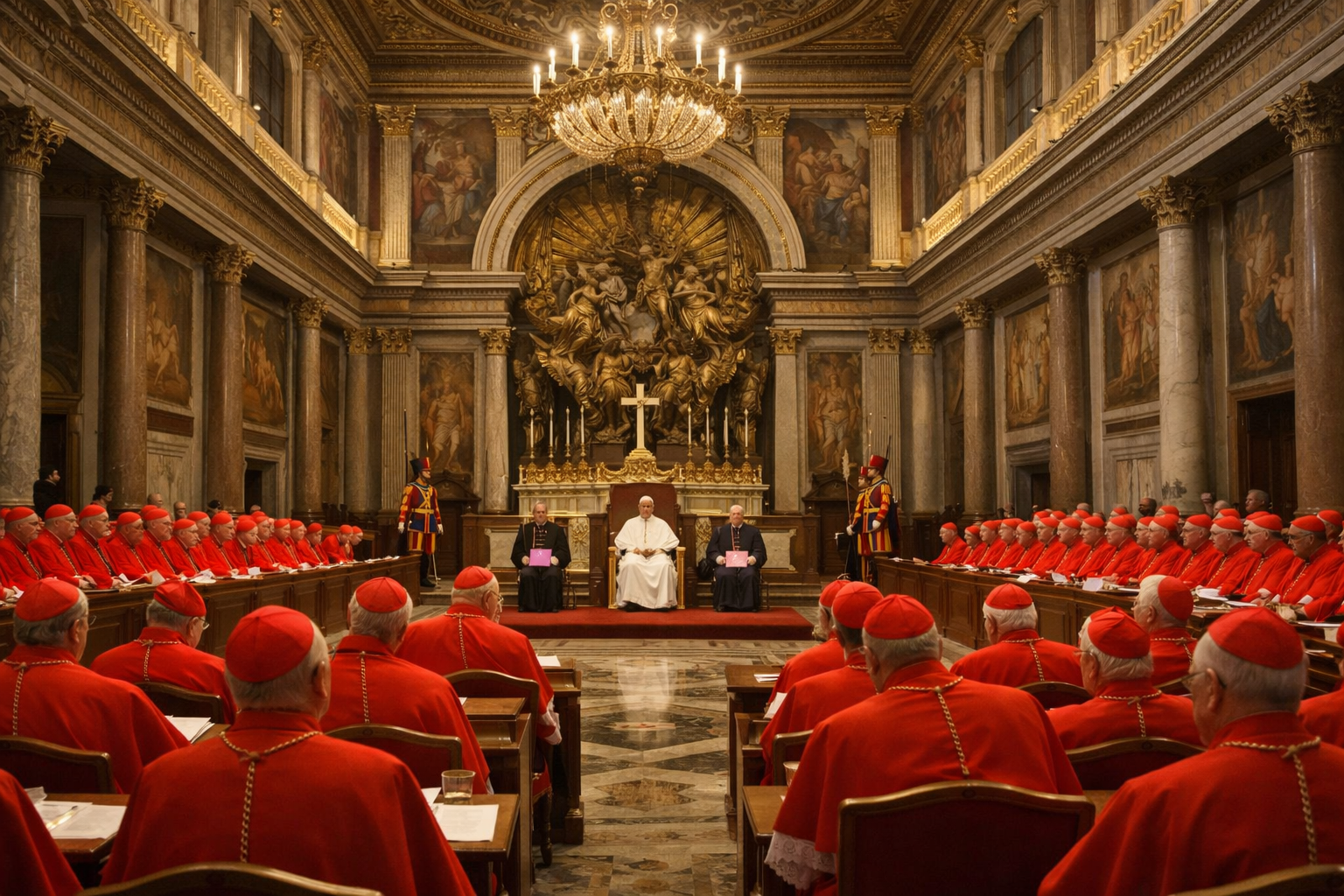
The Crisis That Would Not Die: Pope Leo XIV and Post-Conciliar Authority
The early governance signals of Pope Leo XIV have been widely interpreted as a stabilising correction after more than a decade of ecclesial turbulence. Annual meetings of the College of Cardinals, a more disciplined language around synodality, and repeated affirmations of Vatican II as the Church’s “road map” suggest a pontificate seeking order, coherence, and institutional calm. Yet the deeper question remains unresolved: does this model heal the post-conciliar crisis of authority, or does it merely manage it?¹
This distinction matters. The crisis facing the Church is not principally procedural. It is theological and ecclesiological: a long-standing ambiguity about where authority resides, how it is exercised, and by what standard it is judged.²
A Correction of Method, Not of Foundations
Leo XIV’s most visible reform is not doctrinal but methodological. By restoring the College of Cardinals to a regular consultative role through annual consistories, he has re-centred governance within a recognisably Roman structure.³ This move implicitly pushes back against the diffuse and often amorphous synodal processes that characterised the later Francis years, where authority appeared increasingly displaced into commissions, listening sessions, and provisional assemblies.⁴
Yet this correction remains intra-systemic. The Pope has not questioned the post-conciliar framework itself; rather, he has sought to operate it with greater restraint. Synodality is reframed as a method of discernment, not a competing locus of authority. Collegiality is emphasised, but without juridical redefinition. Vatican II is repeatedly invoked—but never re-examined.⁵
As a result, the fundamental ambiguity introduced after the Council remains intact.
Vatican II as Horizon and Limitation
Leo XIV’s insistence that Vatican II remains the Church’s authoritative horizon is intended as a unifying gesture. In practice, however, it functions as a constraint. The Council is treated as a settled point of reference rather than a contested moment requiring doctrinal clarification.⁶
The difficulty is that the post-conciliar crisis did not arise from Vatican II’s existence, but from its interpretation. Concepts such as collegiality, the People of God, and pastoral adaptation were introduced without the precise theological delimitation that earlier councils provided.⁷ Subsequent decades have shown that these concepts are elastic—capable of being stretched toward bureaucratic managerialism on the one hand, or quasi-parliamentary ecclesiology on the other.
Leo XIV’s governance does not resolve this elasticity. It presumes that better process will yield better outcomes, while leaving unresolved the deeper question of what authority is in the Church: whether it is fundamentally doctrinal and ontological, or procedural and consultative.⁸
Authority Reasserted, but Not Re-grounded
There is no doubt that Leo XIV has reasserted the papal office as a principle of unity rather than a facilitator of perpetual debate. His language consistently affirms that synods do not govern the Church, that bishops do not derive authority from consensus, and that the Pope is not merely a moderator.⁹ These are important correctives.
Yet they remain assertions, not definitions. The post-conciliar Church has grown accustomed to a functional understanding of authority—one that operates through processes, consultations, and managed outcomes. Without an explicit retrieval of the pre-conciliar theology of authority as something received, objective, and bounded by Tradition, even well-intentioned reforms risk being absorbed into the same system that produced the crisis.¹⁰
In this sense, Leo XIV’s model stabilises governance without re-founding it.
Resolution or Entrenchment?
Does this pontificate resolve the post-conciliar crisis of authority? The honest answer, at this stage, is no. But neither does it exacerbate it in the manner of recent years.
What Leo XIV offers is a holding pattern: a slowing of institutional drift, a tightening of consultative mechanisms, and a deliberate avoidance of radical gestures. This may buy the Church time. It may reduce immediate conflict. It may even restore a measure of confidence among bishops and cardinals weary of perpetual experimentation.¹¹
But time alone does not resolve theological ambiguity. Unless the Church is willing to confront, clearly and authoritatively, the unresolved ecclesiological questions left in the wake of Vatican II—especially concerning authority, Tradition, and the limits of pastoral adaptation—the crisis will remain latent, ready to re-emerge under a future pontificate less cautious than this one.¹²
Conclusion
Pope Leo XIV governs as a man aware of the fragility of the post-conciliar settlement. His model mitigates the symptoms of the crisis of authority, but it does not yet address its cause. Collegiality has been regularised, synodality disciplined, and Rome re-centred—but the theological foundations remain unchanged.
Whether this pontificate becomes a bridge to genuine doctrinal clarification, or merely a pause before renewed instability, will depend on whether Leo XIV is willing to move beyond managerial correction toward authoritative teaching. Until then, the crisis of authority is not resolved. It is simply better administered.
¹ Cf. Joseph Ratzinger, Theological Highlights of Vatican II (New York: Paulist Press, 1966), on the unresolved reception of conciliar ecclesiology.
² Vatican I, Pastor Aeternus, DS 3050–3075.
³ See historical treatment of consistories in Klaus Schatz, Papal Primacy (Collegeville: Liturgical Press, 1996).
⁴ Cf. critiques of synodal proceduralism in Massimo Faggioli, The Rising Laity (New York: Paulist Press, 2021).
⁵ Vatican II, Lumen Gentium, §§22–25.
⁶ Benedict XVI, Address to the Roman Curia, 22 December 2005 (hermeneutic of continuity).
⁷ Yves Congar, True and False Reform in the Church (Notre Dame: University of Notre Dame Press, 2011 ed.).
⁸ Congregation for the Doctrine of the Faith, Donum Veritatis (1990), §§16–18.
⁹ Leo XIV, Address to the Extraordinary Consistory of Cardinals, 8 January 2026.
¹⁰ Romano Amerio, Iota Unum (Kansas City: Sarto House, 1996), chs. 3–5.
¹¹ George Weigel, The Irony of Modern Catholic History (New York: Basic Books, 2019).
¹² Archbishop Marcel Lefebvre, They Have Uncrowned Him (Kansas City: Angelus Press, 1988).
RELATED ARTICLES


Latest
- Mary Is Co-Redemptrix: Cardinal Burke Reopens Rome’s Marian ControversyCardinal Raymond Leo Burke has declared the Virgin Mary as “Co-Redemptrix” amidst controversy over the Vatican’s restriction on this title. The debate revolves around the appropriateness of certain theological language and whether terminology historically used can still accurately express Marian cooperation in Redemption without compromising Christ’s unique role.
- When Politics Defines Doctrine: Edmund Waldstein, Integralism and the New Boundary at HeiligenkreuzThe ongoing exclusion of Father Edmund Waldstein from teaching at Heiligenkreuz has sparked debate on the limits of acceptable Catholic thought, particularly regarding integralism and its relationship to Church doctrine. Critics argue that Waldstein and similar positions challenge both Catholic teachings and democratic values, raising questions about the intersection of faith and politics.
- Christianity Is Right ~ Not Right WingThe article discusses the distinction between Catholic orthodoxy and modern political ideologies, particularly the Right and Christian nationalism. It argues that Catholic beliefs about family, morality, and authority predate contemporary political classifications and should not be conflated with right-wing politics. The ordo amoris framework is presented as a guiding principle for evaluating political alliances while maintaining a focus on the common good and the Social Kingship of Christ.
- Today’s homily: The Nativity of the Blessed Virgin MaryThe Nativity of the Blessed Virgin Mary marks a significant moment in salvation history, representing the dawn of the Incarnation. Mary’s birth, unnoticed by the world, was part of God’s providential plan leading to Christ. This feast invites reflection on humility, obedience, and trust in God’s will, emphasising Mary’s role as the Mother of the Redeemer.
- Today’s Mass: September 08 The Nativity of the Blessed Virgin MaryThe Nativity of the Blessed Virgin Mary celebrates her birth, symbolising a new beginning tied to salvation. Originating in the East, it gained recognition in Rome under Pope Sergius I. Additionally, the feast commemorates Saint Hadrian, a martyr who converted to Christianity, underscoring themes of faith and redemption.



Leave a Reply