
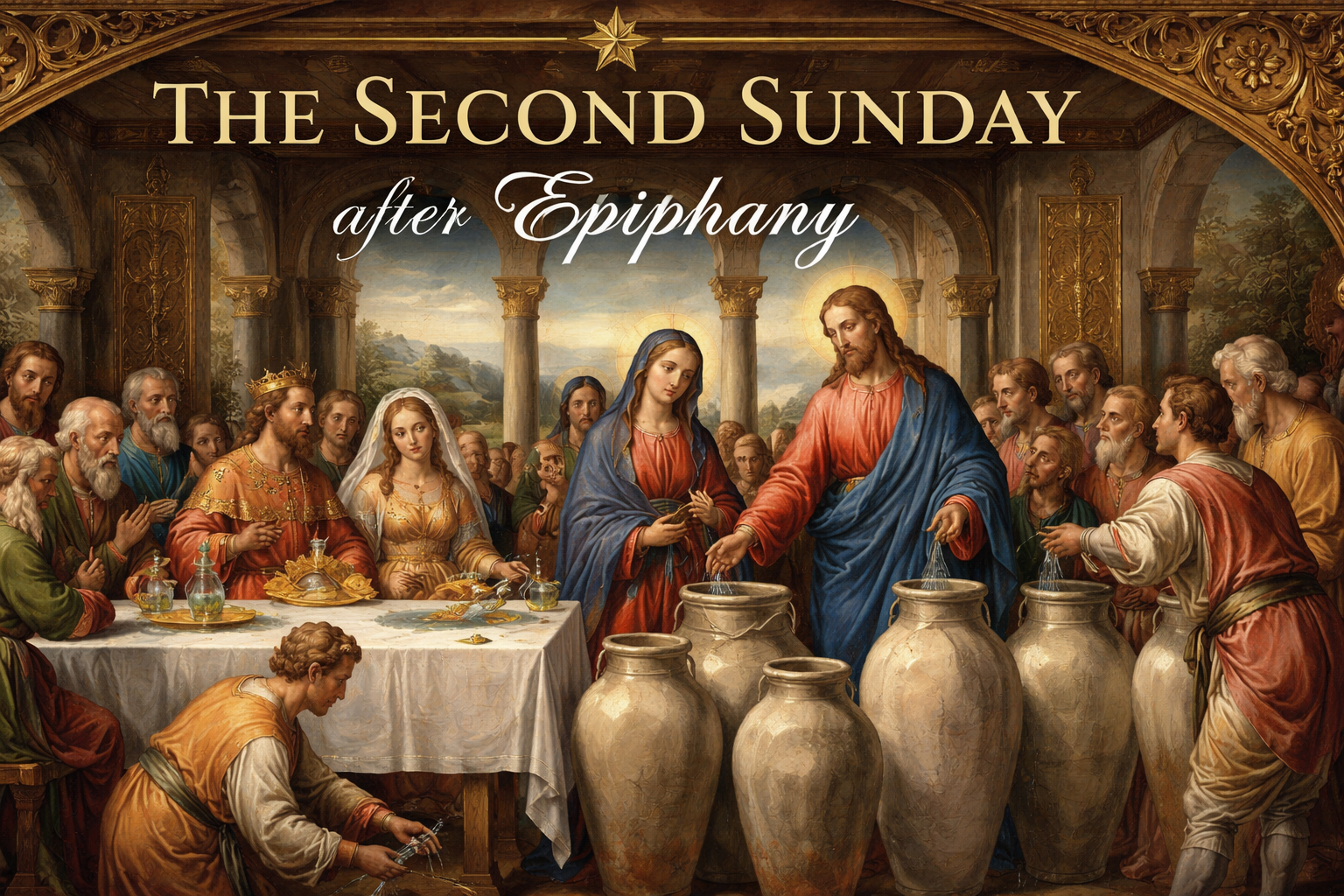
The Second Sunday after Epiphany in the Tridentine Rite
Cana of Galilee: Manifestation, Transformation, and the Ordering of Creation

The Second Sunday after Epiphany occupies a theologically deliberate place in the traditional Roman calendar. The Church continues her contemplation of manifestatio—the gradual unveiling of the divine identity of Christ—not by introducing novelty, but by deepening perception. Having adored the Infant God with the Magi and heard the Father’s voice at the Jordan, the faithful are now confronted with Christ’s first public sign, performed not in the Temple or the synagogue, but within the ordinary fabric of human life: a wedding feast.
This choice is neither accidental nor merely pastoral. In the Roman Rite, Cana is presented as a revelation of how Christ restores creation itself—quietly, authoritatively, and from within.
Liturgical Theology: Cana as Present Mystery
The Tridentine liturgy proclaims the Gospel of Cana (John 2:1–11) with marked sobriety. There is no dramatic emphasis, no liturgical amplification. This restraint is itself theological. The Roman Rite teaches that Christ’s glory is not manifested through display, but through effective presence. He speaks little, acts decisively, and allows the transformation to be recognised by its fruits.
The Collect situates the miracle within the moral order by asking that the faithful may have both the knowledge of God’s will and the strength to accomplish it. Revelation, in the Roman understanding, is never merely informational; it is intrinsically normative. What Christ reveals must govern how man lives.
The Offertory action silently echoes Cana. Created elements—unchanged to the senses—are offered, taken up, and prepared for transformation. The altar becomes the new locus of divine action, where what appears ordinary is elevated beyond natural capacity. Cana is thus not merely remembered; it is recapitulated.
Patristic Commentary: The Creator Revealed in His Creation
The Fathers of the Church consistently read Cana as a theophany of divine authorship rather than a gesture of courtesy.
St Augustine of Hippo insists that Christ’s miracle does not violate nature but reveals its Lord. The same Word who daily turns water into wine through the vine does so instantaneously at Cana. What differs is not the power at work, but the timescale.¹ By compressing the ordinary processes of nature into a single act, Christ discloses Himself as the One through whom all natural causality already operates.
Faith, for Augustine, arises here not from astonishment but from recognition: the disciples believe because they perceive that the Creator is acting openly within His creation.
St John Chrysostom emphasises the discretion of the miracle. Christ does not announce His action, nor does He claim credit. He responds to His Mother’s understated intercession and allows the transformation to be discovered indirectly.² Chrysostom draws from this a profound lesson in divine pedagogy: God manifests truth through efficacy rather than assertion.
The six stone jars also receive sustained patristic attention. Associated with Jewish rites of purification, they symbolise the Old Law—holy, divinely given, yet preparatory. Christ neither rejects nor replaces them; He fills them. The Law is not abolished but fulfilled and interiorised.³
Scholastic Precision: St Thomas Aquinas and the Order of Grace
St Thomas Aquinas provides the Church with her most exact theological synthesis of Cana. He explains why this miracle is called the principium signorum: it marks the beginning of Christ’s public, faith-forming action. The sign is ordered toward belief, not admiration. *“He manifested His glory, and His disciples believed in Him.”*⁴
Aquinas places particular emphasis on the choice of wine. Wine signifies joy, communion, and sacrifice. That Christ inaugurates His signs with wine anticipates the Eucharistic mystery, in which wine will become the sacramental instrument of sacrificial charity and ecclesial unity.⁵
Equally central is Aquinas’s doctrine of secondary causality. Christ commands the servants to fill the jars and to draw from them. Divine omnipotence does not bypass human action; it elevates and perfects it. Grace presupposes nature and heals it—a principle foundational to Catholic sacramental theology and moral realism.⁶
Marriage, Order, and Moral Restoration
That Cana occurs within the context of marriage is theologically decisive. The Roman Rite implicitly teaches that Christ’s redemptive work is not confined to explicitly religious acts, but extends to the natural institutions wounded by sin. Marriage is neither sentimentalised nor instrumentalised; it is restored to its proper dignity within the order of creation and grace.
The Epistle (Romans 12:6–16) reinforces this vision by presenting the Christian life as ordered, differentiated, and unified by charity. Distinct gifts and offices exist not for self-expression but for harmony within the Body of Christ. Just as water at Cana does not resist transformation, so the Christian is called to docility before divine order.
Cana as a Perennial Epiphany
In the Tridentine Rite, the Second Sunday after Epiphany articulates a distinctly Catholic realism. Christ does not reveal Himself through abstraction or sentiment, but through objective transformation. His presence changes what He touches. Where He is received, nothing remains merely natural.
Cana stands as a rebuke to every reduction of Christianity to metaphor, ethics alone, or interior feeling. The Roman liturgy proclaims instead a faith rooted in reality: water becomes wine; law becomes fulfilment; nature becomes grace.
In this season of Epiphany, the Church prays that the glory once manifested in Cana may be made visible again—in the liturgy, in the moral life, and in the quiet obedience of those who believe.
- St Augustine of Hippo, Tractates on the Gospel of John, Tractate VIII.
- St John Chrysostom, Homilies on the Gospel of John, Homily XXI.
- Ibid.; cf. patristic consensus on John 2:6.
- St Thomas Aquinas, Summa Theologiae, III, q.43, a.2.
- Ibid., III, q.73–75.
- Ibid., I, q.1, a.8; I–II, q.109, a.2.
related articles


Latest articles
- Mary Is Co-Redemptrix: Cardinal Burke Reopens Rome’s Marian ControversyCardinal Raymond Leo Burke has declared the Virgin Mary as “Co-Redemptrix” amidst controversy over the Vatican’s restriction on this title. The debate revolves around the appropriateness of certain theological language and whether terminology historically used can still accurately express Marian cooperation in Redemption without compromising Christ’s unique role.
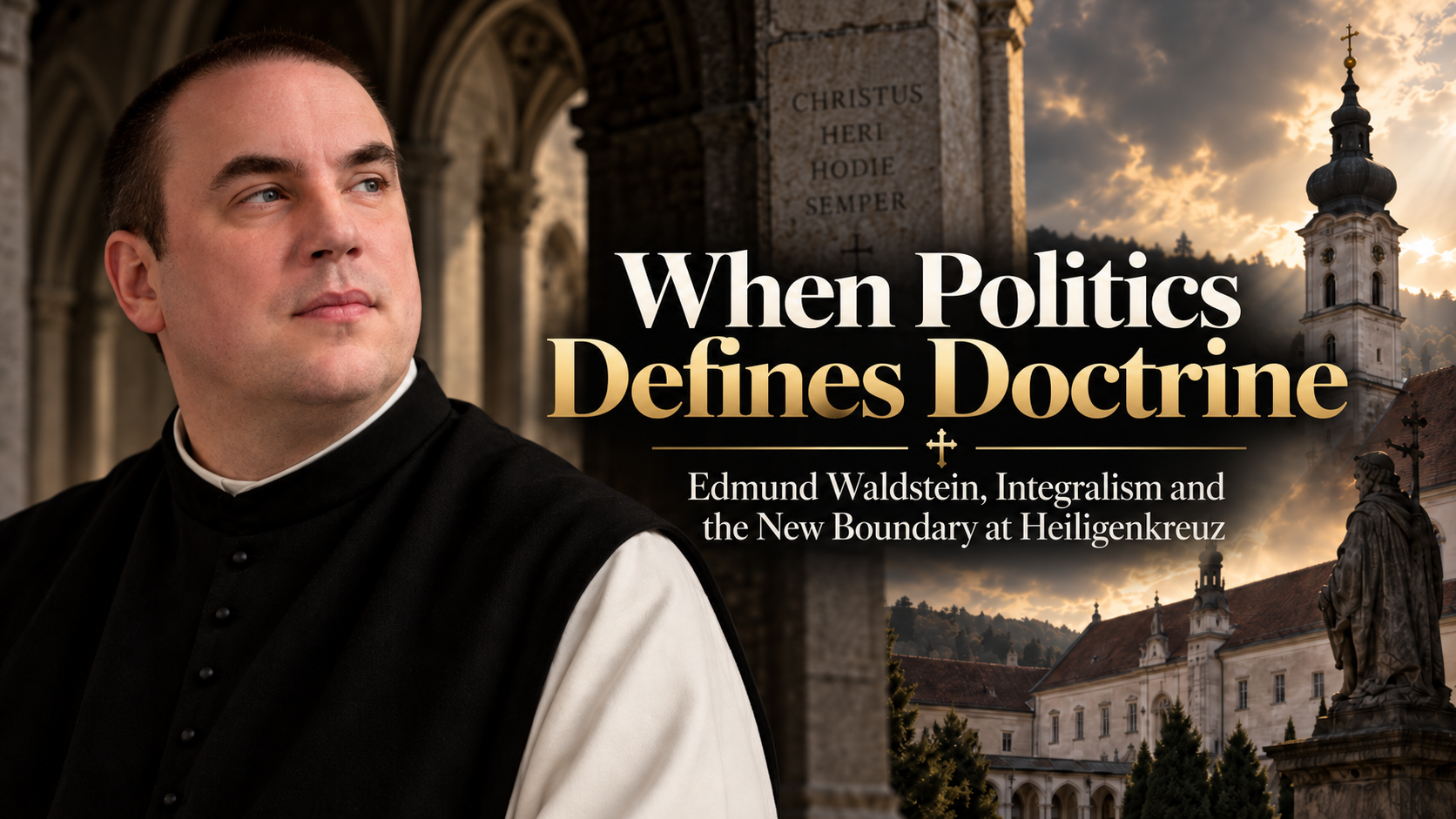
- When Politics Defines Doctrine: Edmund Waldstein, Integralism and the New Boundary at HeiligenkreuzThe ongoing exclusion of Father Edmund Waldstein from teaching at Heiligenkreuz has sparked debate on the limits of acceptable Catholic thought, particularly regarding integralism and its relationship to Church doctrine. Critics argue that Waldstein and similar positions challenge both Catholic teachings and democratic values, raising questions about the intersection of faith and politics.
- Christianity Is Right ~ Not Right WingThe article discusses the distinction between Catholic orthodoxy and modern political ideologies, particularly the Right and Christian nationalism. It argues that Catholic beliefs about family, morality, and authority predate contemporary political classifications and should not be conflated with right-wing politics. The ordo amoris framework is presented as a guiding principle for evaluating political alliances while maintaining a focus on the common good and the Social Kingship of Christ.
- Today’s homily: The Nativity of the Blessed Virgin MaryThe Nativity of the Blessed Virgin Mary marks a significant moment in salvation history, representing the dawn of the Incarnation. Mary’s birth, unnoticed by the world, was part of God’s providential plan leading to Christ. This feast invites reflection on humility, obedience, and trust in God’s will, emphasising Mary’s role as the Mother of the Redeemer.
- Today’s Mass: September 08 The Nativity of the Blessed Virgin MaryThe Nativity of the Blessed Virgin Mary celebrates her birth, symbolising a new beginning tied to salvation. Originating in the East, it gained recognition in Rome under Pope Sergius I. Additionally, the feast commemorates Saint Hadrian, a martyr who converted to Christianity, underscoring themes of faith and redemption.




Leave a Reply