
FROM ALTAR TO TABLE: The Anthropological Revolution of the Novus Ordo Missae
Suggested Substack Section: Analysis
Christian liturgy is never neutral. Long before it is analysed, it is absorbed. It forms instinct, posture, expectation, and belief at a pre-rational level. For this reason, changes to liturgical form are never merely aesthetic or pastoral; they are anthropological. When the Roman Rite shifted from altar to table, from orientation toward God to orientation toward the assembly, it enacted not a retrieval of ancient practice but a profound redefinition of what worship is and who it is for.¹
The claim that the Novus Ordo Missae represents a “return to primitive Christianity” has become a post conciliar commonplace. Yet when measured against history, archaeology, patristic theology, and the universal logic of sacrifice, that claim collapses. What the reform produced was not recovery, but reversal.²
Christianity as Cult: Sacrifice Before Community
From its inception, Christianity understood itself as a cultic religion. The Eucharist was not conceived as a symbolic meal expressing communal belonging, but as the sacramental presence of Christ’s once-for-all Sacrifice.³ The Church did not first gather and then decide how to worship; she worshipped because Christ had offered Himself, and the gathering took its meaning from that act.
Where sacrifice is real, an altar is required. Where an altar exists, orientation follows. And where orientation is lost, theology soon follows.⁴
This logic is inscribed into salvation history itself. The Temple in Jerusalem was oriented, hierarchical, and sacrificial. The New Covenant does not abolish this structure; it fulfils it. The Eucharist is not less sacrificial than the Temple cult but more so, because it makes present the very Sacrifice toward which the Temple pointed.⁵
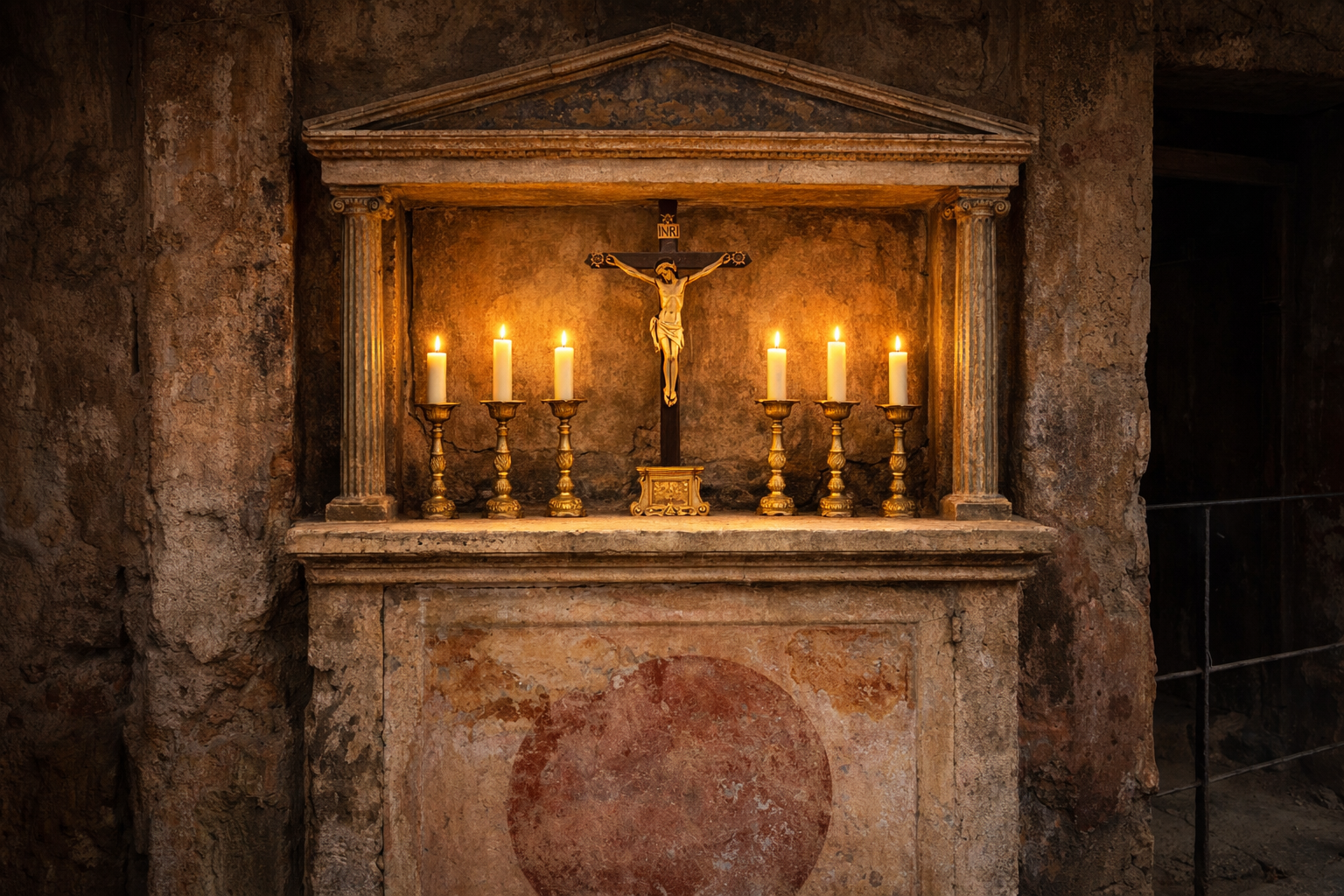
The traditional Roman Rite embodied this anthropology with unambiguous clarity: a fixed and consecrated stone altar; elevation and separation of the sanctuary; priest and people facing the same direction; a silent Canon addressed to God alone; and offertory prayers that explicitly name propitiation and sacrifice.⁶ This was not clerical theatre. It was catechesis enacted in space. As Joseph Ratzinger observed, common liturgical orientation is an act of humility: priest and people alike turn away from themselves toward the Lord who comes.⁷
The Roman House and the Conversion of Sacred Space
The myth of the “primitive wooden table” collapses as soon as Christianity is placed back into its actual historical environment. The ancient world distinguished clearly between a mensa and an ara. Tables were for eating. Altars were for gods.⁸
When Christianity entered Rome, it entered homes that were already religious spaces. Embedded into the masonry of Roman houses was the lararium: a fixed household shrine that received daily offerings of wine, grain, and incense to the household gods.⁹ Conversion therefore demanded more than new beliefs; it demanded the seizure and redirection of space.
When a Roman household became Christian, the lararium could not simply be ignored. It had to be displaced—and replaced. The Church did not abolish sacrifice; she claimed the altar. Pagan domestic shrines were purified and consecrated for Eucharistic worship.¹⁰ The unbloody offerings of anticipation gave way to the true unbloody Sacrifice of the Mass.
This was not syncretism but judgment. Pagan religion was not affirmed but fulfilled—and thereby rendered obsolete.¹¹
Because these early altars were fixed into the wall, the posture of worship followed naturally. One does not gather around a wall-altar. One stands before it. The priest faced the altar, commonly facing East, leading the faithful in a common act of worship directed toward God rather than toward one another.¹²
When persecution ceased and basilicas were constructed, this logic did not change. The altar did not migrate to the centre of the assembly. It remained fixed, elevated, and oriented. Stone replaced brick; scale replaced intimacy; but the theology remained continuous.¹³

The Fiction of the “Primitive Table”
Against this evidence, the appeal to “primitive Christianity” in defence of the modern table-centred liturgy is historically untenable. No archaeological, textual, or patristic source supports the claim that the normative Eucharistic praxis of the early Church was a communal meal gathered around a central table understood primarily in horizontal terms.¹⁴
Even scholars unsympathetic to traditional liturgy concede that the evidence for such a model is thin to non-existent.¹⁵ The early Church inherited Jewish sacrificial theology, synagogue orientation, and Greco-Roman cultic space. She did not flatten these into domestic conviviality; she intensified them into sacramental realism.
To suggest that the Church began with tables and later “sacralised” them into altars is to reverse the historical record entirely.¹⁶
The Novus Ordo and the Eclipse of Sacrifice
The Novus Ordo Missae does not merely permit a meal-centred interpretation; it structurally privileges one. The General Instruction repeatedly emphasises the altar as “the table of the Lord,” language which—while not false in itself—becomes distorting when detached from sacrificial primacy.¹⁷
This emphasis is reinforced by the suppression of the traditional Offertory prayers, the widespread adoption of freestanding altars, the normative posture of the priest facing the people, the reduction of silence, and the transformation of the celebrant into a visible presider.¹⁸ These changes do not simply express a new theology; they form it.
Facing the people, the priest must engage, explain, and perform. The rite no longer absorbs the personality of the celebrant; it requires it. The vertical axis of worship is replaced by a horizontal one. The altar becomes a stage; the sanctuary becomes a circle; worship becomes dialogue.¹⁹
This is not accidental. It reflects a modern unease with mediation, hierarchy, propitiation, and judgment. Sacrifice implies sin. Sin implies judgment. Judgment implies transcendence. The table avoids all three.²⁰
Two Anthropologies, Two Forms of Christianity
At stake is not preference but anthropology.
The altar presupposes man as sinner, God as holy, worship as atonement, priesthood as mediation, and salvation as costly.²¹
The table presupposes man as participant, God as immanent, worship as affirmation, priesthood as facilitation, and salvation as belonging.²²
These are not complementary emphases. They generate different kinds of Christians.
A Church formed by the altar speaks naturally of repentance, penance, sacrifice, and judgment. A Church formed by the table speaks endlessly of welcome, inclusion, and journey—while struggling to explain why the Cross was necessary at all.²³
This explains the postconciliar paradox: unprecedented accessibility coinciding with catastrophic loss of belief in the Real Presence, the sacrificial priesthood, and the necessity of the Mass.²⁴ The form taught what the words attempted to retain.
Why the Revolution Matters
The shift from altar to table mirrors the wider collapse of transcendence in modernity. Where God is no longer feared, sacrifice becomes unintelligible. Where sacrifice disappears, religion becomes therapy. Where worship turns inward, Christianity dissolves into sentiment.²⁵
The tragedy is not aesthetic but soteriological.
A Christianity without sacrifice cannot explain suffering, evil, or redemption. And a liturgy that trains man to look at himself while worshipping cannot long sustain belief in a God who demands everything.
Christianity did not begin at a table.
It began at an altar.
And it will not survive the eclipse of that truth.
- Aidan Kavanagh, On Liturgical Theology (Collegeville: Liturgical Press, 1984), 73–89.
- Klaus Gamber, The Reform of the Roman Liturgy (San Juan Capistrano: Una Voce Press, 1993), 15–32.
- Council of Trent, Session XXII, Doctrine on the Sacrifice of the Mass.
- Louis Bouyer, Liturgical Piety (Notre Dame: University of Notre Dame Press, 1955), 33–41.
- Hebrews 9:11–14; 10:10–14; Malachi 1:11.
- Missale Romanum (1962), Offertory prayers; cf. Jungmann, Mass of the Roman Rite, I.
- Joseph Ratzinger, The Spirit of the Liturgy (Ignatius Press, 2000), 74–84.
- Jörg Rüpke, Religion of the Romans (Cambridge: Polity Press, 2007), 157–164.
- John R. Clarke, The Houses of Roman Italy (Berkeley: University of California Press, 1991), 37–41.
- Josef A. Jungmann, The Early Liturgy (Notre Dame: University of Notre Dame Press, 1959), 24–29.
- Irenaeus, Adversus Haereses, IV.18.
- Uwe Michael Lang, Turning Towards the Lord (Ignatius Press, 2004), 41–92.
- Liber Pontificalis; Council of Epaone (517), Canon 26.
- Louis Bouyer, Eucharist (Notre Dame, 1968), 27–31.
- Paul Bradshaw, The Search for the Origins of Christian Worship (Oxford, 2002), 73–75.
- Robert Taft, The Liturgy of the Hours in East and West (Collegeville, 1986), 295–300.
- Institutio Generalis Missalis Romani, §§296–299.
- Annibale Bugnini, The Reform of the Liturgy (Collegeville, 1990), 620–631.
- Romano Guardini, The Spirit of the Liturgy (Crossroad, 1998), 56–65.
- Dietrich von Hildebrand, The Trojan Horse in the City of God (Sophia Institute Press, 1993), 23–31.
- Council of Trent, Session VI & XXII.
- Vatican II, Sacrosanctum Concilium, esp. §§7–14 (as interpreted in practice).
- Henri de Lubac, Corpus Mysticum (Notre Dame, 2006 ed.), 249–260.
- Pew Research Center, “What Americans Know About the Eucharist,” 2019.
- Charles Taylor, A Secular Age (Harvard University Press, 2007), 539–543.
related articles


Latest articles
- Today’s homily: Christ the KingThe homily reflects on Christ’s kingship as seen in the Gospel narrative. It contrasts earthly authority with divine truth, emphasising that true allegiance to God requires genuine obedience and transformation. Believers are called to examine their personal commitments and respond to Christ’s demands in everyday life, ultimately recognising their identity as bearers of God’s image.
- Sermon for Christ the KingToday marks the celebration of Christ the King and the Twenty Second Sunday after Pentecost, a feast asserting Christ’s sovereignty against totalitarianism. St. Paul emphasised Christ’s supremacy over power and principalities, challenging early Gnostic beliefs. The early Church’s victory over evil is affirmed in Christ’s resurrection, offering hope and unity amidst contemporary struggles.
- Today’s Mass: October 25 SOVEREIGNTY OF OUR LORD JESUS CHRIST, SUPREME KINGThe Feast of the Sovereignty of Our Lord Jesus Christ celebrates Christ’s dual kingship by birth and conquest. Established by Pius XI, it aims to deepen faith and counter anti-clericalism. The liturgical observance underscores His authority as King, advocating for societal recognition of His reign to bring peace and harmony.
- TRADITION BEHIND THE FENCEThe Vatican’s prohibition of the traditional Ad Petri Sedem pilgrimage to St Peter’s Basilica has sparked controversy, especially among traditional Catholics. While some cite scheduling conflicts, the broader issue lies in the restrictive policies of Traditionis custodes, which may confine traditional liturgical practices to specific enclaves, risking the transmission and recognition of Catholic Tradition within the wider Church.
- Today’s Mass: October 24 St Raphael the ArchangelThe Feast of Saint Raphael the Archangel highlights his healing powers as depicted in the Book of Tobit, where he aids Tobit and his son, Tobiah. Venerated as a protector of travellers and the blind, Raphael is celebrated for his miraculous interventions. His legacy includes support for nurses, matchmakers, and Catholic studies.





Leave a Reply