
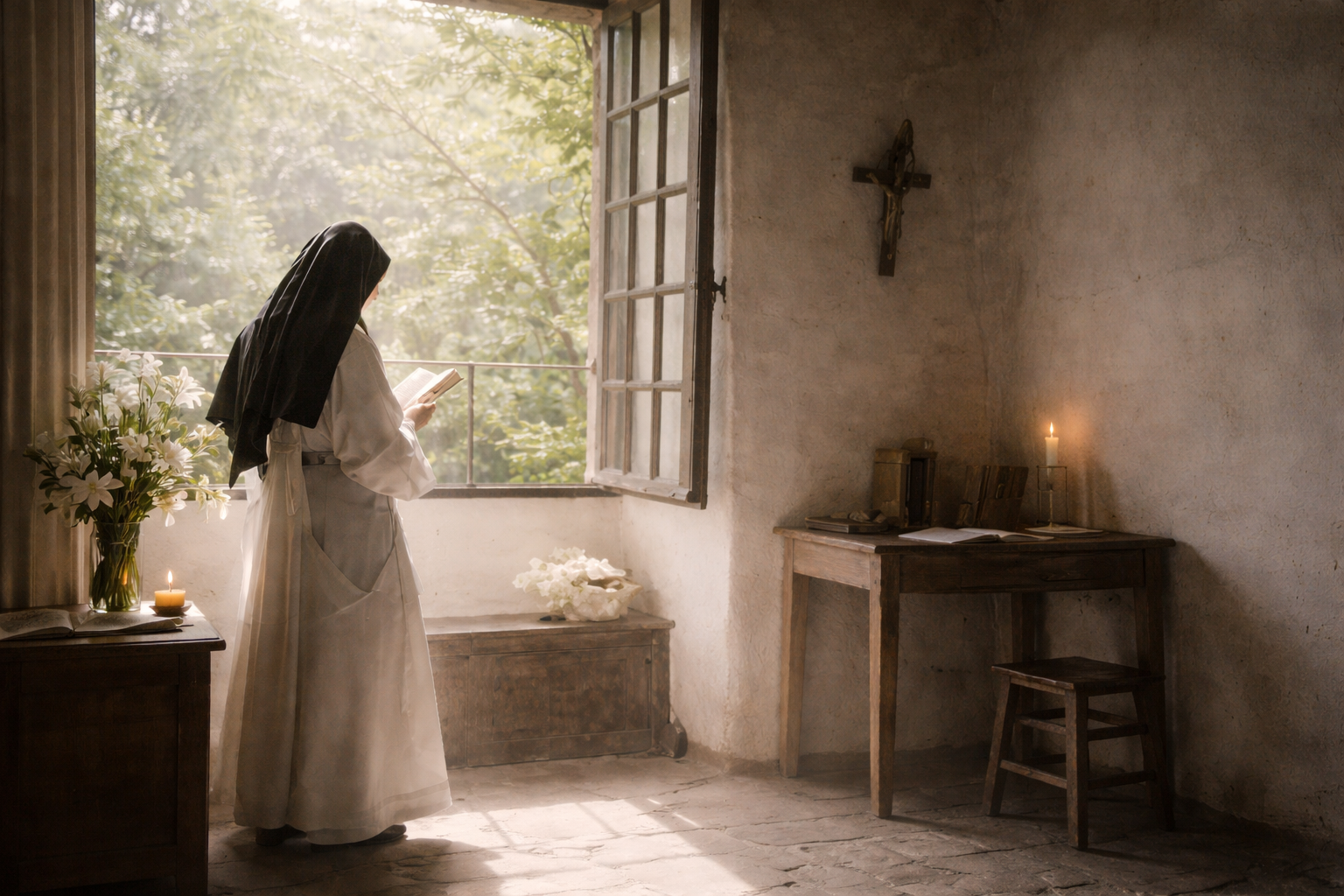
Pre-1955 Holy Week Retreat for Young Catholic Women
There are three places available for young adult Catholic women to attend a Holy Week retreat celebrated according to the pre-1955 rites, held at La Petite Chartreuse Monastery, a traditional contemplative foundation, with a visiting priest present throughout the Triduum.
This retreat is offered within a wholly contemplative monastic setting, uniting the stability of the common life with the silence and solitude of eremitical prayer. La Petite Chartreuse follows the ancient Western monastic tradition in which coenobitical and eremitical life are held in harmony—a form of monasticism largely lost in modernity but foundational to the Christian West.
The community lives as moniales eremitici (hermit nuns), consecrated to and in imitation of the Blessed Virgin Mary, Mediatrix of All Graces. Their hidden life of prayer, sacrifice, and enclosure is ordered entirely to union with God and the good of the Church.
The retreat will be structured around:
- The Pre-1955 Holy Week liturgies
- The Divine Office according to the Rule of St Benedict
- The Holy Sacrifice of the Mass
- Nocturnal Holy Hours of reparation
- Silence, enclosure, and solitary contemplative prayer
Recommended for inquirers:
- Unmarried Catholic women without obligations of state (one need not be actively discerning religious life)
- Those drawn to silence, solitude, enclosure, and the Traditional Latin Mass
- Those who have sought traditional semi-eremitical or contemplative communities and found none available
- For practical reasons, residents of the USA may find attendance more feasible
Those who enquire via the website listed on the flyer below will be provided with the location details and a detailed horarium, closely following the monastery’s regular schedule.

RELATED ARTICLES


LATEST ARTICLES
- Today’s homily: Christ the KingThe homily reflects on Christ’s kingship as seen in the Gospel narrative. It contrasts earthly authority with divine truth, emphasising that true allegiance to God requires genuine obedience and transformation. Believers are called to examine their personal commitments and respond to Christ’s demands in everyday life, ultimately recognising their identity as bearers of God’s image.
- Sermon for Christ the KingToday marks the celebration of Christ the King and the Twenty Second Sunday after Pentecost, a feast asserting Christ’s sovereignty against totalitarianism. St. Paul emphasised Christ’s supremacy over power and principalities, challenging early Gnostic beliefs. The early Church’s victory over evil is affirmed in Christ’s resurrection, offering hope and unity amidst contemporary struggles.
- Today’s Mass: October 25 SOVEREIGNTY OF OUR LORD JESUS CHRIST, SUPREME KINGThe Feast of the Sovereignty of Our Lord Jesus Christ celebrates Christ’s dual kingship by birth and conquest. Established by Pius XI, it aims to deepen faith and counter anti-clericalism. The liturgical observance underscores His authority as King, advocating for societal recognition of His reign to bring peace and harmony.
- TRADITION BEHIND THE FENCEThe Vatican’s prohibition of the traditional Ad Petri Sedem pilgrimage to St Peter’s Basilica has sparked controversy, especially among traditional Catholics. While some cite scheduling conflicts, the broader issue lies in the restrictive policies of Traditionis custodes, which may confine traditional liturgical practices to specific enclaves, risking the transmission and recognition of Catholic Tradition within the wider Church.
- Today’s Mass: October 24 St Raphael the ArchangelThe Feast of Saint Raphael the Archangel highlights his healing powers as depicted in the Book of Tobit, where he aids Tobit and his son, Tobiah. Venerated as a protector of travellers and the blind, Raphael is celebrated for his miraculous interventions. His legacy includes support for nurses, matchmakers, and Catholic studies.
CURRENT EDITION





Leave a Reply