
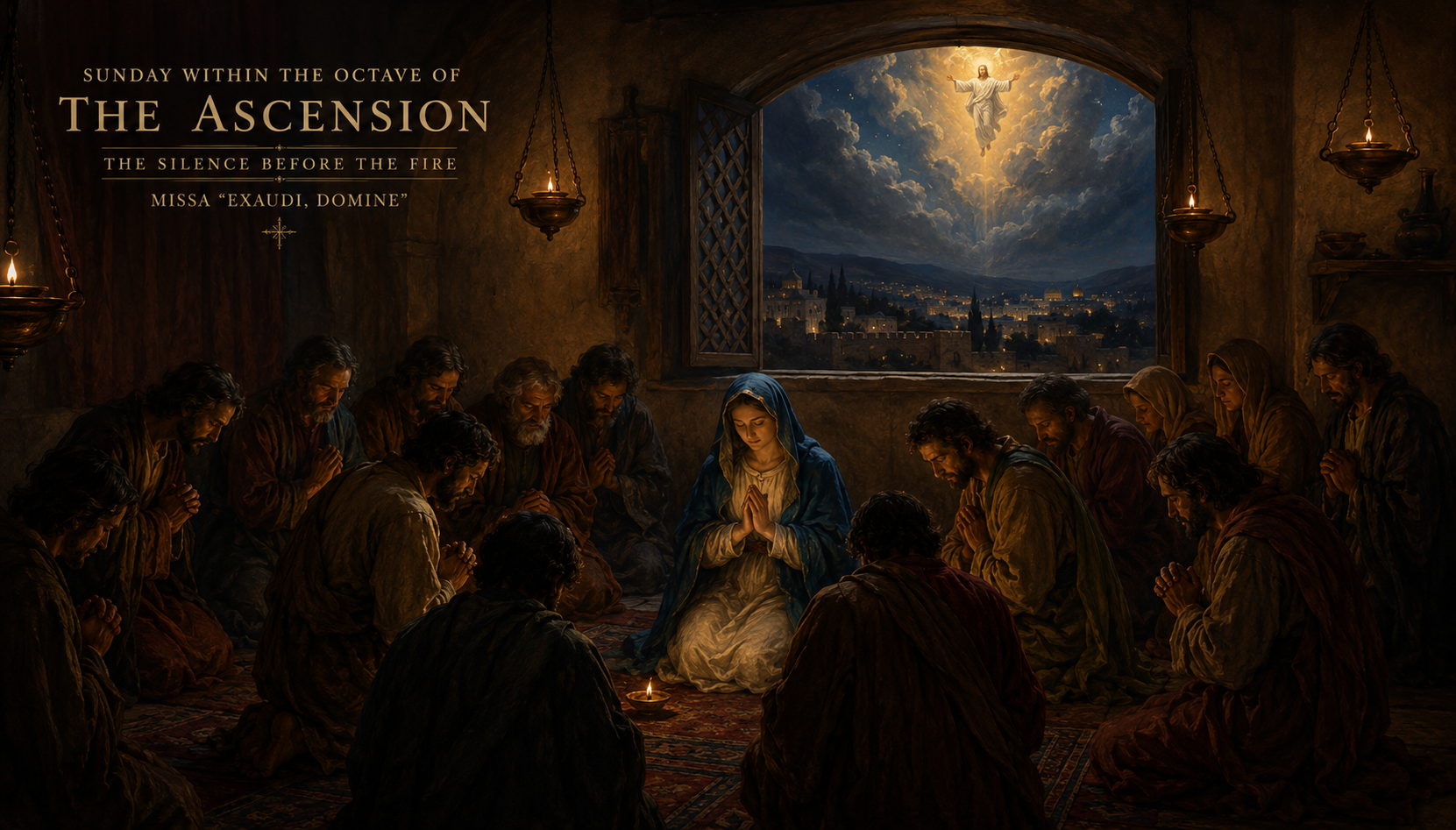
Sunday Within the Octave of the Ascension: The Silence Before the Fire
Missa “Exaudi, Domine”

The Sunday within the Octave of the Ascension occupies one of the most mysterious and contemplative positions within the entire liturgical year. The Church stands between two immensities. The Lord has ascended into Heaven in glory, yet the Holy Ghost has not yet descended in power. Christ has withdrawn visibly from the sight of the Apostles, but Pentecost still lies ahead. The liturgy therefore enters a sacred stillness, poised between triumph and mission, between heavenly enthronement and apostolic transformation. Few Sundays communicate so powerfully the atmosphere of longing, expectation, and supernatural dependence.
The Introit immediately establishes the spiritual tone of the day: “Exaudi, Domine, vocem meam qua clamavi ad te, alleluia” — “Hear, O Lord, my voice with which I have cried unto Thee, alleluia.” The Alleluia remains, because the Resurrection joy of Easter has not ended, yet it sounds different now. Earlier in Paschaltide it rang with triumphant exultation. Here it becomes quieter, deeper, almost aching with yearning. The Church rejoices, but she also waits. She knows Christ reigns gloriously at the right hand of the Father, yet she still longs for the promised descent of the Comforter.
The atmosphere of this Sunday cannot be understood without entering spiritually into the experience of the Apostles themselves. Modern Christians often approach the Ascension retrospectively, already knowing the outcome of Pentecost. The Apostles did not possess that hindsight. They stood upon the Mount of Olives watching Christ disappear beyond the clouds, hearing the final promise, and then returning to Jerusalem with little more than faith and expectation. No tongues of fire had yet descended. No mighty wind had shaken the Cenacle. No conversions had yet overturned Jerusalem. No missionary triumphs had reached the nations. There was only silence, uncertainty, prayer, and waiting.
That waiting is one of the great forgotten disciplines of the spiritual life. Modern civilisation has systematically trained men against it. Everything within contemporary culture encourages immediacy: instant communication, instant gratification, instant stimulation, instant outrage, instant answers. Silence now appears threatening because silence confronts the soul with itself. Men flood their lives with distraction because recollection exposes spiritual poverty. Yet throughout salvation history God repeatedly forms souls precisely in periods of hiddenness and expectation. Abraham waited. Israel waited. The prophets waited. The Blessed Virgin waited in Nazareth. The Apostles waited in Jerusalem. Before divine action becomes manifest, Heaven frequently prepares the soul through silence.
This is why the Sunday within the Octave of the Ascension possesses such profound theological significance. It reveals that Christianity is not sustained by constant emotional consolation or visible triumph. The Apostles are being taught to walk by faith rather than by sight. During the earthly ministry of Christ they relied continually upon His visible presence. They heard His voice directly. They watched Him calm storms, raise the dead, and silence His enemies. Yet now the visible Christ withdraws from them. St Leo the Great explains that what had once been visible in the Redeemer passed into the sacramental life of the Church.¹ Christ ascends not in order to abandon His people, but in order to reign universally as eternal High Priest and King.
The Ascension therefore is not departure in the ordinary sense. It is enthronement. Human nature itself enters Heaven in the glorified humanity of Christ. The Fathers contemplate this mystery with awe. St Augustine speaks of Heaven astonished to behold human flesh exalted above the angelic choirs.² The wounds of Calvary now shine before the throne of the Father as eternal signs of redemption. Christ ascends not merely as God, but as the God-Man, carrying redeemed humanity into celestial glory. The Ascension therefore reveals the true destiny of man. Humanity is ordered not merely toward earthly prosperity, political fulfilment, psychological comfort, or material satisfaction, but toward eternal communion with God.
In this sense the Ascension stands as a direct contradiction to the assumptions of modern civilisation. Contemporary culture repeatedly reduces man to economics, biology, appetite, identity, or consumption. Modern political ideologies attempt to create meaning entirely within temporal structures. Heaven disappears from public consciousness, and once transcendence vanishes, civilisation itself begins to lose coherence. Politics becomes pseudo-religion because salvation is sought within history. Pleasure becomes sacred because eternity has been forgotten. Identity fragments because man no longer understands his supernatural origin and destiny. The Sunday within the Octave of the Ascension therefore confronts modernity with a radically different anthropology: human life finds its meaning only when viewed beneath the horizon of eternity.
The Collect of the Mass deepens this perspective by praying that, as we believe Christ ascended into Heaven, we too may dwell already in spirit amidst heavenly things.³ The Church does not call Christians to despise the world as creation, but she insists that earthly realities can only be rightly ordered when subordinated to eternal realities. Christians remain within history, yet they belong ultimately beyond history. This tension defines the entire life of the Church. She lives permanently between the Ascension and the Second Coming. Christ reigns in Heaven, while His Mystical Body still journeys through a fallen world awaiting final consummation.
The Epistle from the First Letter of St Peter speaks directly into this atmosphere of pilgrimage and vigilance. “Be prudent therefore, and watch in prayers.”⁴ St Peter writes to Christians living amidst hostility and uncertainty. He does not promise worldly security or cultural dominance. Instead he exhorts sobriety, charity, endurance, and fidelity under suffering. Christianity appears not as social respectability, but as persevering union with Christ in the midst of opposition. That message possesses renewed urgency in the contemporary world, where many Christians increasingly experience alienation from the moral assumptions of the surrounding culture. Institutions once shaped by Christian civilisation now frequently oppose Christian anthropology itself. The faithful often feel as though they inhabit an age of spiritual disintegration. The Sunday within the Octave of the Ascension speaks directly into such conditions. The Apostles too knew uncertainty, weakness, confusion, and fear. Yet Heaven had not abandoned them. The fire of Pentecost was already approaching.
The Gospel from St John develops this mystery further. Christ tells the Apostles that sorrow has filled their hearts because He goes to the Father, yet He insists that His departure is necessary for the coming of the Paraclete.⁵ Here Christianity reveals one of its deepest paradoxes: apparent absence may conceal a greater form of presence. God often removes sensible supports in order to deepen faith. Many souls begin the spiritual life sustained by emotional fervour and consolation. Yet mature sanctity requires purification beyond sentiment alone. The saints repeatedly testify that God sometimes appears most hidden precisely when He is accomplishing His deepest work within the soul. The Apostles themselves required this purification. So long as Christ remained visibly beside them, they frequently misunderstood His mission. After Pentecost, however, these same fearful men would confront emperors, prisons, torture, and martyrdom with supernatural courage.
This transformation begins in the Cenacle. The Acts of the Apostles tells us that the Apostles “persevered with one mind in prayer, with the women, and Mary the Mother of Jesus.”⁶ The Church’s first novena unfolds in silence within the Upper Room. Before missionary expansion, before theological controversy, before councils, monasteries, cathedrals, and Christendom itself, there is simply the praying Church gathered around the Blessed Virgin awaiting divine action. This image contains an entire theology of renewal. Christianity did not conquer the Roman world through worldly power, political influence, or institutional strategy. The Apostles conquered Rome only after they had first learned how to kneel.
This lesson remains profoundly relevant. Modern society constantly tempts Christians toward frantic activism detached from contemplation. Even ecclesiastical life can become absorbed in programmes, administration, publicity, and perpetual activity. Yet the deepest renewals in Church history invariably begin in hiddenness, prayer, sacrifice, and recollection. Before St Benedict renewed Europe, there was the solitude of Subiaco. Before St Francis preached to crowds, there was penance and silence. Before the Counter-Reformation transformed Catholic life, there were hidden Carmelites praying behind cloister walls. The world celebrates spectacle and noise. God frequently begins His greatest works in obscurity.
At the centre of this waiting Church stands the Blessed Virgin Mary. Though the liturgy does not explicitly foreground her on this Sunday, spiritually she permeates the entire octave. The same Holy Ghost who overshadowed her at Nazareth now prepares to descend again upon the infant Church. She who formed Christ physically now accompanies the formation of His Mystical Body. Mary embodies perfect fidelity during divine silence. At Nazareth she believed before seeing. At Calvary she remained faithful beneath apparent defeat. In the Cenacle she waits calmly while the Apostles still struggle with fear and uncertainty. Around her gather men who will soon evangelise nations, yet who presently remain hidden behind closed doors. The Mother steadies the infant Church simply through unwavering fidelity.
The older liturgical tradition subtly reinforces these themes throughout Ascensiontide. The extinguishing of the Paschal Candle following the Gospel of the Ascension symbolises the withdrawal of Christ’s visible earthly presence.⁷ Yet the sanctuary does not descend into darkness. The altar lamps remain burning before the tabernacle. Christ is hidden, not absent. This distinction is spiritually decisive. The Church lives by sacramental presence during the apparent silence between Ascension and Pentecost. Christ reigns invisibly, intercedes perpetually, and governs providentially even when earthly events appear chaotic or hostile.
The Epistle to the Hebrews illuminates this mystery further by presenting Christ as the eternal High Priest who has entered not into an earthly sanctuary made by hands, but into Heaven itself, there to appear before the Father on our behalf.⁸ The Ascension therefore is inseparable from the heavenly priesthood of Christ. The sacrifice once offered visibly upon Calvary is eternally presented before the throne of God. Every earthly altar participates mystically in this heavenly liturgy. The Church upon earth worships in union with the glorified Christ who continually intercedes for His people. Thus the apparent absence of Christ after the Ascension conceals a deeper sacramental intimacy. The Church loses visible proximity only to gain perpetual mystical communion.
This gives the Sunday within the Octave of the Ascension its profoundly eschatological character. The Apostles awaiting Pentecost become an image of the entire Church awaiting the return of Christ. The age of the Church is itself a great octave between Ascension and Parousia. The Holy Ghost sustains the Mystical Body throughout history while the Bride awaits the return of the Bridegroom. Christianity is therefore fundamentally a religion of expectation. The modern world waits for political salvation, technological salvation, psychological salvation, or social salvation. The Church waits for the return of the King.
This expectation prevents both despair and triumphalism. Christians need not despair because Christ already reigns gloriously above history. Yet neither may they absolutise earthly politics or imagine the Kingdom of God can be fully realised through temporal structures alone. The Ascension places all earthly powers beneath the sovereignty of Christ. Empires rise and fall. Civilisations flourish and decay. Ideologies appear triumphant and then collapse into dust. But the glorified Christ reigns eternally at the right hand of the Father.
The Sunday within the Octave of the Ascension therefore becomes one of the Church’s great liturgical lessons in supernatural hope. The Apostles do not flee the world in fear, nor do they attempt to conquer it prematurely through worldly means. They pray. They wait. They persevere. And Heaven prepares the fire.
The image with which the liturgy leaves us is unforgettable. The lamps burn softly within the Upper Room. Jerusalem continues its ordinary life beneath the machinery of empire. The Apostles kneel in prayer around the Blessed Virgin. Above them Christ reigns invisibly in glory. Before them lies Pentecost, martyrdom, sanctity, evangelisation, councils, monasteries, cathedrals, and centuries of Christian civilisation still unborn. The world sees only frightened men hidden in obscurity. Heaven sees the beginning of the transformation of history.
¹ St Leo the Great, Sermon 74 on the Ascension, in Nicene and Post-Nicene Fathers, Second Series, Vol. 12 (Peabody, MA: Hendrickson Publishers, 1994), pp. 186–189.
² St Augustine, Sermon 263, in The Works of Saint Augustine, Part III, Vol. 7 (Hyde Park, NY: New City Press, 1993), pp. 108–112.
³ Missale Romanum (1962), Collect for the Sunday within the Octave of the Ascension.
⁴ 1 Peter 4:7.
⁵ John 16:5–14.
⁶ Acts 1:14.
⁷ Adrian Fortescue, The Ceremonies of the Roman Rite Described (London: Burns Oates & Washbourne, 1917), pp. 344–345.
⁸ Hebrews 9:24.
⁹ Dom Prosper Guéranger, The Liturgical Year: Paschal Time, Book III (Fitzwilliam, NH: Loreto Publications, 2000), pp. 214–229.
¹⁰ Pius Parsch, The Church’s Year of Grace, Vol. 3 (Collegeville, MN: Liturgical Press, 1957), pp. 256–266.
¹¹ St Gregory the Great, Homilies on the Gospels, Book II, Homily 29 (Kalamazoo, MI: Cistercian Publications, 1990), pp. 226–231.
¹² Pope Pius XII, Mediator Dei (1947), §§61–64.
¹³ Catechism of the Catholic Church, §§659–667.
related articles


Latest articles
- Today’s Mass: October 03 St Thomas [de Cantilupe] of HerefordSt Thomas de Cantilupe was an influential figure, born into nobility around 1218. Educated in canon law, he supported the baronial party during the Barons’ War and served as Chancellor of England and Bishop of Hereford. Known for his piety and charity, he was canonised in 1320, with his relics drawing pilgrims to Hereford Cathedral.
- 04.10.26 Nuntiatoria CXXVI: OMNIA AUTEM PROBATE: QUOD BONUM EST TENETEThis editorial highlights the importance of discernment in faith, urging Christians to test teachings and hold onto what is good. It critiques contemporary issues, such as compulsory inclusivity at universities, government information security, and interfaith dialogues, emphasizing that a responsible faith must involve critical examination and recognition of true values.
- ORDO w/c 04.10.26The week begins with the Eighteenth Sunday after Pentecost, honouring various saints, culminating in the feast of St Francis of Assisi. Key celebrations include St Wenceslaus, St Michael the Archangel, St Jerome, and St Thérèse of the Child Jesus. The period highlights the call to surrender worldly attachments in devotion to God.
- THE WEDDING GARMENT: The Nineteenth Sunday after PentecostThe Nineteenth Sunday after Pentecost joins St Paul’s command to “put on the new man” with Christ’s parable of the wedding garment. The warning is directed especially towards those already within the household of Faith: Catholic identity, orthodoxy and traditional practice cannot substitute for sanctifying grace and personal conversion. Grace does not merely bring us into the feast; it must make us fit for the presence of the King.
- Blue Labour discovers the Common GoodJonathan Hinder criticises “hyper-liberalism” for prioritising individual autonomy over community values. His emphasis on family and societal duties echoes Christian teachings often overlooked in modern politics. Although Hinder promotes aspects of Blue Labour as solutions to social issues, he underscores the necessity of returning to deeper truths about human nature and moral authority for genuine societal cohesion.


![Today’s Mass: October 03 St Thomas [de Cantilupe] of Hereford](https://nuntiatoria.org/wp-content/uploads/2026/10/thomascantilupemasstitle.jpg)



Leave a Reply