
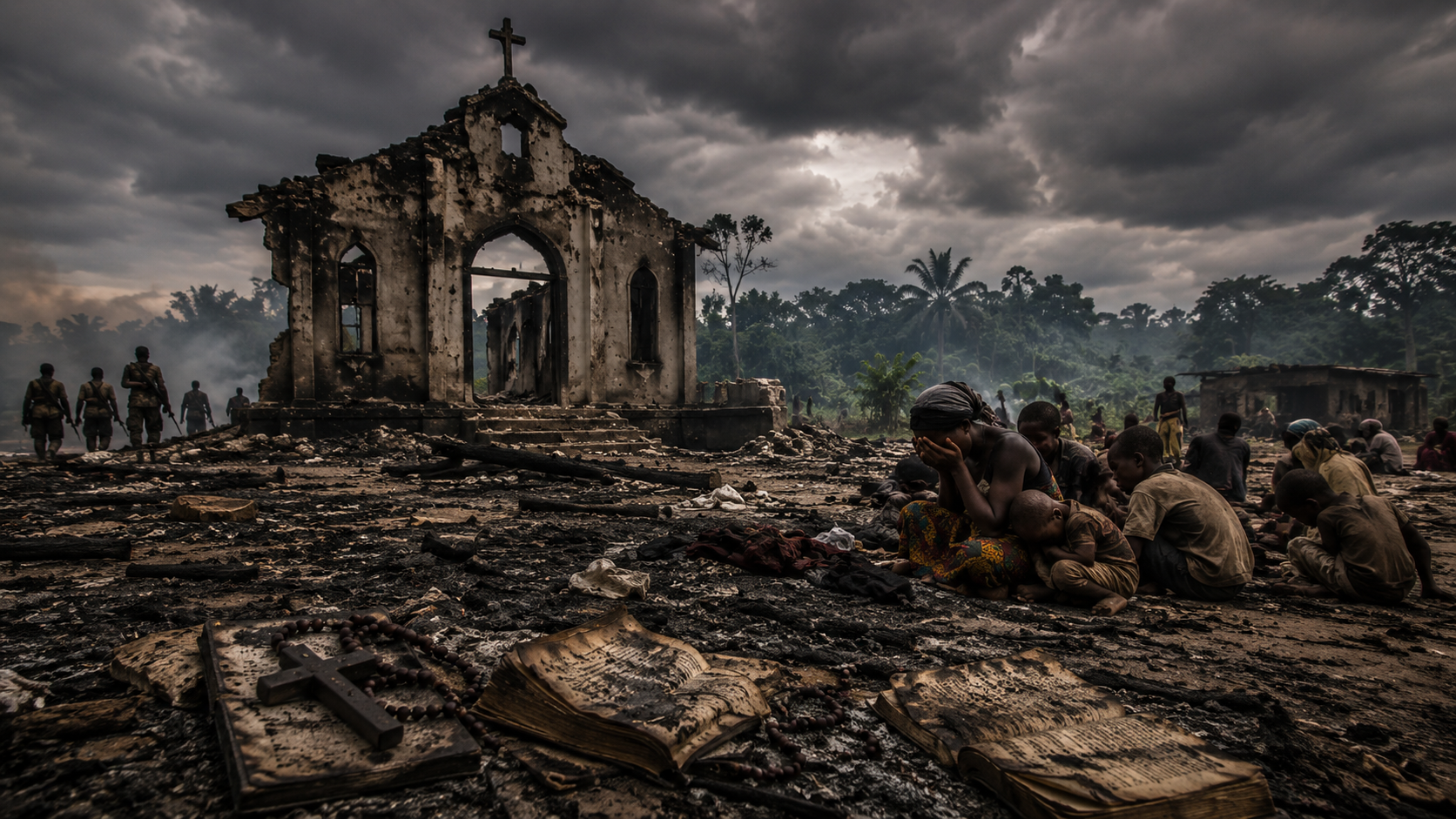
The Silent Martyrs of Congo: Jihad, Massacre, and the Collapse of the World’s Moral Imagination

For much of the Western world, the Democratic Republic of the Congo appears only intermittently in public consciousness — a distant landscape of militias, poverty, disease, and endless instability somewhere beyond the edge of meaningful concern. Yet behind the numbing abstraction of “conflict in central Africa” lies one of the most devastating and underreported humanitarian catastrophes of the modern age: the sustained destruction of civilian life across eastern Congo and, increasingly, the systematic persecution of Christians by Islamist insurgents linked to the global jihadist movement.
A newly released report from Amnesty International has once again exposed the horrifying scale of atrocities being committed in eastern Congo by the Allied Democratic Forces (ADF), the Islamic State-affiliated insurgent movement operating across parts of the region. Amnesty’s findings describe massacres, torture, mutilation, sexual violence, abductions, forced labour, forced conversion, and systematic attacks on civilians throughout 2025. Agnès Callamard, Amnesty’s Secretary General, characterised the violence as “a dehumanising campaign of abuse” and warned that the acts constituted war crimes which the international community “must not continue to ignore.”¹
The warning itself reveals the deeper scandal: the world already has ignored them.
The details emerging from eastern Congo are difficult to read without recalling the darkest chapters of modern religious violence. In September 2025, militants attacked the village of Ntoyo, slaughtering more than sixty civilians using machetes, firearms, and hammers. Survivors described scenes of extraordinary savagery. “I’d never seen so many bodies,” one witness said. Another reported that militants “shot at anything that moved.”²
Such brutality is not incidental. It is performative.
Groups such as the ADF do not merely kill; they terrorise symbolically. Violence becomes theatre intended to annihilate social confidence, fracture communal cohesion, and demonstrate the impotence of both state and international authority. The deliberate cruelty is itself strategic. Amnesty documented dozens of abductions during the reporting period, including children forced into labour and militant operations. Women and girls were subjected to rape, forced marriage, and death threats for refusing conversion to Islam or submission to fighters.³
Rawya Rageh, Amnesty’s crisis response researcher, noted that “the vast majority of the ADF’s victims have been Christians.”⁴ That statement should have triggered sustained international alarm. Instead, it passed through much of the Western media ecosystem with surprisingly limited attention.
The reason is not merely geographical distance. It is ideological discomfort.
Contemporary Western institutions often struggle to speak plainly about anti-Christian persecution when it emerges outside familiar political categories. The language of “violent extremism” or “regional insurgency” is considered safer than acknowledging explicitly religious targeting. Yet the evidence increasingly demonstrates that eastern Congo has become part of the broader transnational jihadist landscape stretching across sub-Saharan Africa.
The Allied Democratic Forces originated during the 1990s as a Ugandan Islamist insurgency opposing the government of President Yoweri Museveni. Over time, however, the group evolved beyond its local origins. By the late 2010s, it had formally aligned itself with the Islamic State network under Islamic State Central Africa Province (ISCAP). Its propaganda, recruitment patterns, theological rhetoric, and operational methods increasingly mirrored those of ISIS affiliates elsewhere.⁵
This evolution matters profoundly because it transformed the conflict from a primarily regional insurgency into a component of global jihadist expansion.
The methods now associated with the ADF bear unmistakable similarities to Boko Haram in Nigeria, al-Shabaab in Somalia, and ISIS in Syria and Iraq: ritualised violence, ideological coercion, forced conversion, child recruitment, sexual enslavement, and attacks on civilian religious identity. Villages are not simply occupied; they are psychologically shattered.
Nor are Christians the only victims. Amnesty rightly notes that Muslims unwilling to conform to the ADF’s extremist interpretation of Islam have likewise been murdered or abducted. Islamist extremism has always devoured insufficiently compliant Muslims alongside external enemies. Yet this does not negate the reality that Christian populations remain primary and repeated targets, particularly in isolated rural communities where churches function not only as places of worship but as the centre of social and moral life.
The suffering of Christians in Congo also cannot be isolated from the wider collapse of eastern Congo itself — a region whose agony has continued for more than three decades.
To understand the present catastrophe, one must return to the aftermath of the Rwandan genocide. The genocide and subsequent refugee crisis destabilised the entire Great Lakes region, drawing neighbouring states and armed factions into what became the First and Second Congo Wars. These conflicts involved numerous African nations and countless militias, eventually producing one of the deadliest humanitarian disasters since the Second World War. Millions perished through violence, starvation, disease, and displacement.⁶
The wars formally ended. The fragmentation never did.
Eastern Congo today exists as a patchwork of militias, insurgencies, criminal syndicates, ethnic armed groups, corrupt political actors, and foreign-backed movements competing over territory, identity, and extraordinary mineral wealth. The region contains vast reserves of cobalt, coltan, tin, gold, and rare earth resources essential to global electronics and modern industry. Beneath the language of humanitarian concern lies an uncomfortable geopolitical reality: the world depends economically upon materials extracted from regions governed by chronic instability.
Conflict became profitable.
Weak governance became useful.
Perpetual fragmentation became normalised.
Within this environment, jihadist insurgencies have flourished alongside ethnic militias and foreign proxies. The resurgence of the Rwanda-backed M23 rebellion has further destabilised eastern Congo, generating mass displacement and intensifying regional tensions. Recent sanctions imposed by the United States against former Congolese President Joseph Kabila reflected mounting concern over alleged political support networks tied to armed destabilisation efforts.⁷
According to the U.S. Treasury Department, Kabila allegedly provided support to the Congo River Alliance and associated M23 structures in an effort to regain political leverage amid continuing instability. Congolese Deputy Prime Minister Jacquemain Shabani responded by describing Kabila as “the architect of the destabilization of Congo.”⁸
Meanwhile, civilians continue to die in extraordinary numbers while regional diplomacy drifts between paralysis and performative concern.
The failures of international intervention have become increasingly impossible to conceal. The United Nations mission MONUSCO — among the largest and most expensive peacekeeping operations in modern history — has struggled repeatedly to contain militia violence or restore meaningful civilian security. In many Congolese communities, resentment toward international peacekeepers has grown severe. Armed groups continue to operate with astonishing freedom while ordinary populations remain vulnerable to massacre, kidnapping, and displacement.⁹
This collapse of confidence has profound consequences. When states fail, populations retreat toward narrower identities for survival: tribe, militia, religion, clan, ethnicity. In such conditions, extremist movements thrive because they offer certainty within chaos. Jihadist groups understand this dynamic well. They do not merely exploit instability; they embed themselves within it.
The Democratic Republic of the Congo now ranks 29th on the 2026 Open Doors World Watch List of the world’s worst countries for Christian persecution.¹⁰ Yet rankings and statistics risk obscuring the human reality beneath them.
Behind each number stands a murdered priest.
A burned church.
A displaced family.
A child carried into the forest by armed men.
A congregation gathering in secret because public worship has become dangerous.
The wider continental pattern is increasingly unmistakable. From northern Nigeria to Burkina Faso, from Mozambique’s Cabo Delgado province to eastern Congo, Christian populations increasingly occupy the fault lines of expanding Islamist insurgencies. In Nigeria alone, thousands of Christians have been killed over recent years by jihadist organisations and militant factions. In Mozambique, churches, schools, and clergy have repeatedly been targeted by Islamic State-linked militants. Across the Sahel, Christian communities are frequently among the first civilian victims when extremist groups consolidate territory.¹¹
Yet these realities exist in strange tension with the moral priorities of many Western institutions.
Extraordinary energy is devoted to symbolic ideological disputes, performative activism, online outrage rituals, and linguistic sensitivities, while the extermination of vulnerable Christian populations in Africa struggles to command sustained public attention. Entire villages may disappear with scarcely a fraction of the emotional mobilisation generated elsewhere by comparatively trivial cultural controversies within affluent societies.
This asymmetry reveals something deeper than media imbalance. It exposes a crisis of moral imagination.
Modern humanitarian discourse often speaks incessantly of “human dignity,” “vulnerable communities,” and “global solidarity,” yet these principles increasingly appear distributed according to ideological visibility rather than universal moral consistency. Some victims become symbols. Others become statistics.
The Congolese Christian frequently becomes neither.
Nor should the West imagine these events as disconnected from its own future. The Congolese catastrophe demonstrates what occurs when governance collapses, communal trust erodes, extremist ideology expands, and international institutions lose credibility simultaneously. It reveals how quickly human beings revert toward fear, faction, and violence when no authority remains capable of defending the weak.
For Christians specifically, the crisis carries an additional spiritual challenge. Western Christianity increasingly inhabits a culture of comfort, institutional exhaustion, and accommodation. Much public religious discourse revolves around relevance, inclusion, branding, and adaptation to modern sensibilities. Meanwhile, elsewhere in the world, Christians continue to face kidnapping, torture, forced conversion, and martyrdom with extraordinary courage and fidelity.
The ancient Church once spoke of the “Church of the Martyrs” not as poetry but as lived reality.
That reality has never vanished.
It survives today in the forests of Congo, where unknown believers continue to die largely unseen by the civilisation that once claimed Christianity as its moral foundation. Their names rarely trend. Their churches rarely appear on television screens. Their deaths seldom provoke marches, slogans, or international campaigns.
But history will remember what the modern world preferred not to see:
that while prosperous societies argued endlessly about compassion, some of the most vulnerable Christians on earth were butchered in silence beneath the indifferent gaze of the international order.
¹ Amnesty International – DRC: Civilians killed, abducted and tortured in dehumanising campaign by ADF armed group.
² Ibid.
³ Ibid.
⁴ Nayana Mena, “Report exposes atrocities against Christians in DRC,” The Telegraph, 6 May 2026.
⁵ International Crisis Group, “ADF-Nalu: A Ugandan Rebel Group in Eastern Congo,” Africa Briefing No. 93, 2012.
⁶ Gérard Prunier, Africa’s World War: Congo, the Rwandan Genocide, and the Making of a Continental Catastrophe (Oxford: Oxford University Press, 2009), pp. 1–18.
⁷ Reuters, “U.S. sanctions former Congo President Joseph Kabila over support for rebels,” April 2026.
⁸ Ibid.
⁹ United Nations MONUSCO Mission Overview.
¹⁰ Open Doors World Watch List 2026 – Democratic Republic of the Congo.
¹¹ Aid to the Church in Need, “Christian persecution and jihadist expansion in sub-Saharan Africa,” regional reporting dossier, 2025.
¹² Nina Shea, Persecuted: The Global Assault on Christians (Nashville: Thomas Nelson, 2013), pp. 201–230.
RELATED ARTICLES


LATEST ARTICLES
- Today’s homily: St Nicholas TolentinoThe reflection celebrates Saint Nicholas of Tolentino, emphasising that holiness is achieved not through personal efforts but through grace. It highlights his life of service, prayer, and self-discipline, suggesting that his true sanctity stems from dependence on God. The message reinforces the importance of a single-hearted focus on God in one’s spiritual journey.
- Today’s Mass: September 10 St Nicholas of TolentinoSaint Nicholas of Tolentino, born around 1246 in Italy, became a devout Augustinian hermit known for his piety and dedication to preaching. He spent his later years in Tolentino, promoting virtue, and maintaining his chastity until his death in 1306. Canonised in 1446, his tomb is revered by the faithful.
- Sermon for St. Nicholas of TolentinoToday we honour St. Nicholas of Tolentino, who lived from 1245 to 1305. Abiding in Tolentino, he dedicated his life to ministry, healing, and reconciliation amidst societal discord. A member of the Augustinian order, he exemplified service without seeking fame, inspiring others to witness their faith in everyday life.
- Today’s Mass: September 09 Day II in the Octave of The Nativity of the Blessed Virgin MaryThe feast of Our Lady’s Nativity, of ancient Eastern origin and established at Rome by the time of Pope St Sergius I, celebrates Mary as the immaculate New Eve and the dawn of salvation, the chosen tabernacle from whom the Redeemer would take His flesh. Today the Church also commemorates St Gorgonius, an officer of the imperial household at Nicomedia who, with his companion Dorotheus, embraced the Faith and suffered martyrdom under Diocletian in A.D. 303; his relics were later translated to Rome.
- NOMEN MANET, RES DEEST ~ The Name Remains; the Reality Is Lacking: Spiritual Conference for Nuntiatoria CXXIIThe content emphasises the disconnect between the names associated with Catholicism and the actual practices of faith. It highlights the importance of embodying belief through genuine actions, urging self-examination rather than mere external observance. Ultimately, it advocates for a restoration of sincerity in faith, calling individuals to authentically reflect their beliefs through their lives and worship.




Leave a Reply