
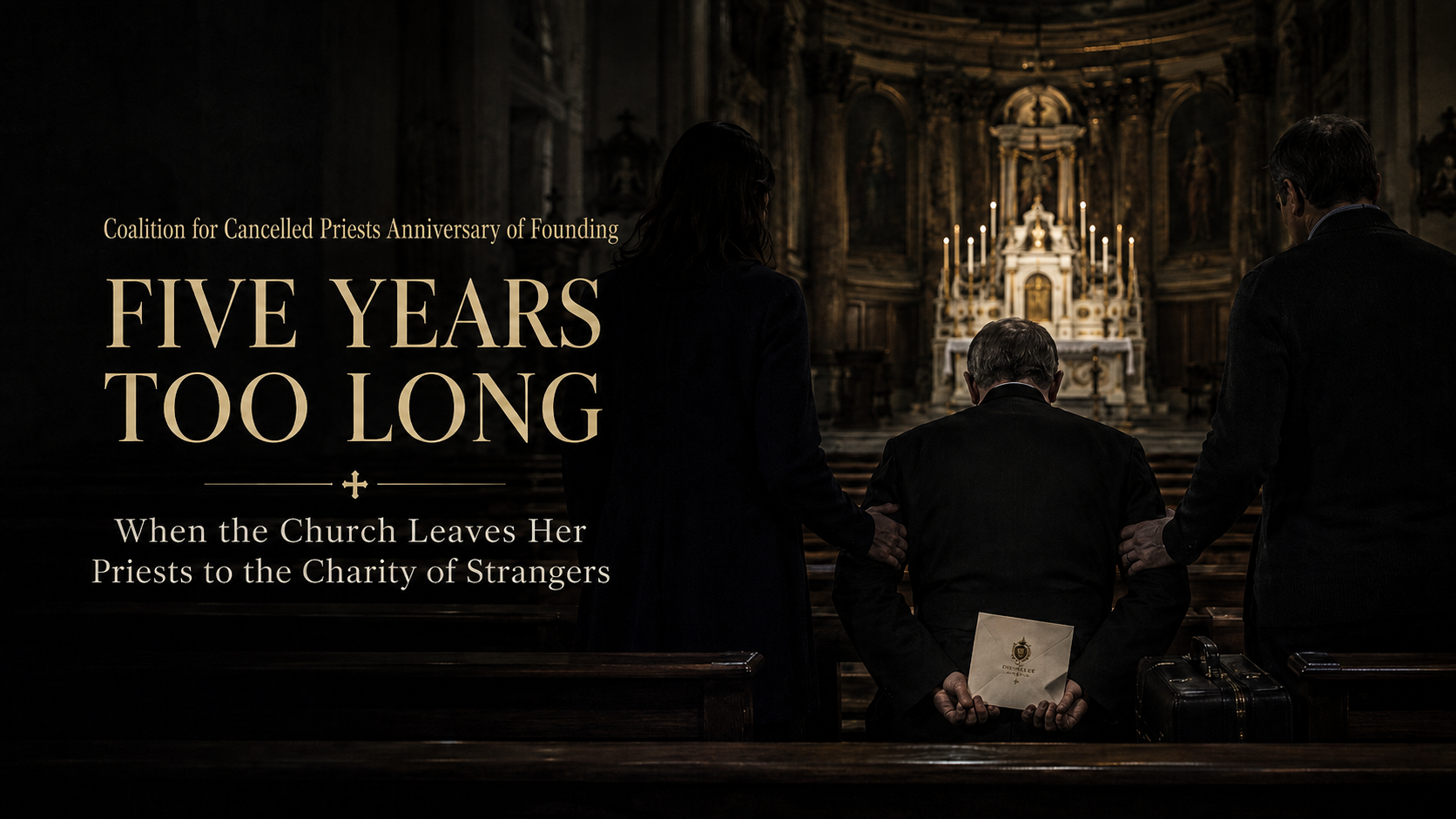
Five Years Too Long: When the Church Leaves Her Priests to the Charity of Strangers
The Coalition for Canceled Priests was incorporated on 15 June 2021 because priests deprived of ministry were also being left without income, housing, counsel or a timely judgement. Its fifth anniversary exposes a contradiction at the heart of contemporary ecclesiastical government: bishops called fathers, priests treated as disposable personnel, and the laity forced to support men whom the hierarchy has allowed to fall.

On 15 June 2026, the Coalition for Canceled Priests reached its fifth anniversary. It did not celebrate.
“We do not celebrate that we have been around for five years,” its anniversary statement declared. “We mourn it.”¹
That sentence contains the whole indictment. An organisation established to find housing, food, transport, medical care, spiritual direction and legal assistance for abandoned Catholic priests should not need to exist. Its survival is not an institutional triumph. It is evidence that ordinary ecclesiastical structures have repeatedly failed to discharge obligations arising from the sacred bond between a bishop and his priests.
A man is not ordained so that a private charity may one day have to find him somewhere to sleep.
The Coalition was incorporated in Illinois on 15 June 2021. Its co-founder, Fr John Lovell, had been removed from active ministry in the Diocese of Rockford in 2012 and says that his long struggle to recover his good name led him to help other priests facing similar circumstances. The organisation later became publicly associated with Fr James Altman, whose removal as pastor in the Diocese of La Crosse was decreed on 9 July 2021. Yet the Coalition had already been legally incorporated before that decree was issued. It did not begin merely as a campaign for one celebrated priest, however much later publicity may have suggested otherwise.²
Five years later, its official list of services reads like an inventory of responsibilities that should never have been allowed to fall outside the institutional Church: civil and canonical counsel, assistance towards restoration to ministry, housing, food, transport, medical care, insurance and spiritual direction.³
The need for such work cannot be dismissed by attaching a contentious name to the cause. Some priests associated with the Coalition have made statements or adopted positions that many Catholics will judge imprudent, inflammatory or wrong. A just cause is not made just by every person who supports it, but neither is it invalidated by the faults of one of its advocates.
Law exists precisely because justice cannot depend upon whether the accused is agreeable, discreet, popular or easy to defend.
The Coalition’s existence does not prove that every priest describing himself as “cancelled” is innocent. “Cancelled priest” is not a canonical category. The expression may conceal several radically different situations. A priest may have been lawfully removed from a particular office. He may be subject to a temporary precautionary restriction while a serious allegation is investigated. He may have had particular faculties withdrawn. He may have received a penal precept, been suspended, deprived of office, dismissed from the clerical state, or merely left without an assignment. He may also have been pushed into an informal administrative exile in which no charge is clearly made and no final judgement ever arrives.⁴
These cases cannot honestly be treated as though they were identical.
There are guilty priests. There are priests whose conduct, even if it does not constitute a canonical crime, makes their continued presence in a particular office gravely harmful. There are men who invoke “orthodoxy” to excuse insubordination, intemperance, negligence or destructive behaviour. There are allegations so serious that a bishop must restrict a priest immediately to protect children, vulnerable adults, witnesses or the integrity of an investigation.
A bishop who refuses to act against genuine wrongdoing does not display mercy. He betrays the victims, the faithful, the priesthood and the offender himself.
But discipline is not cancellation.
Discipline establishes what has happened, identifies the applicable law, hears the priest, weighs the evidence, reaches a decision and permits lawful recourse. Cancellation imposes many of the effects of a punishment while avoiding the procedural burdens that accompany a punishment.
The priest loses his parish. His public ministry ceases. The rectory must be vacated. His income becomes uncertain. His reputation collapses beneath a cloud of insinuation. Parishioners are told that the matter is confidential. Meetings are postponed. Letters remain unanswered. Months become years. No competent authority either establishes his guilt or restores him to the ministry for which he was ordained.
The effects of a sentence are imposed without the responsibility of pronouncing one.
This distinction matters even in the gravest cases. The Dicastery for the Doctrine of the Faith states expressly that a precautionary restriction is not a penalty, that it must not be presented as though guilt had already been established, that it must be revoked when its cause ceases, and that it ends with the conclusion of the canonical process.⁵ A temporary measure imposed for protection cannot justly become an indefinite punishment administered by delay.
Silence is not a verdict. Delay is not discernment. Destitution is not discipline.
Canon law requires an authority, before issuing a singular decree, to seek the necessary information and proofs and, as far as possible, to hear those whose rights may be injured. A decision is to be given in writing, with its reasons at least summarily stated. Legitimate notification matters because the time allowed for seeking revocation or lodging recourse may be extremely short.⁶
An oral instruction, an unexplained removal from the parish schedule, or a message conveyed through a chancery official may therefore do more than wound a priest personally. It may place him at a grave canonical disadvantage. A decision that remains deliberately vague is harder to contest than a decree whose legal basis must be defended.
Informality can become an instrument of power.
The Church’s law protects a person’s good name and the right to defend his rights in a competent ecclesiastical forum. It requires the diocesan bishop to listen to his priests, protect their rights and ensure their decent support and social assistance. Even when a priest is punished, the law states that care must be taken that he does not lack what is necessary for his worthy support. When a pastor is removed, provision is to be considered for another assignment or a pension according to the circumstances.⁷
These are not optional courtesies. They are juridical expressions of a theological reality.
Incardination is not the Catholic equivalent of an employment contract terminable when a member of staff becomes awkward. Through incardination, a cleric belongs permanently to a particular Church or other competent ecclesiastical body. The priest assumes obligations of obedience, celibacy, prayer, study, holiness and pastoral service. The Church assumes obligations towards him. That bond does not disappear because the relationship has become difficult.
The bishop is not merely the priest’s employer. He is supposed to be his ecclesiastical father.
The Holy See’s Directory for the Pastoral Ministry of Bishops could hardly be clearer. A bishop is not to relate to priests “merely as a ruler towards his subjects, but rather as a father and a friend”. He should create a climate of affection and trust. Obedience is strengthened, not weakened, when the bishop explains the reasons for his decisions. He should know each priest’s character, gifts, aspirations, health and financial situation; respect and defend his rights; and resolve disputes swiftly before prolonged anxiety damages fraternal charity and pastoral ministry.⁸
The same Directory says that no priest should feel excluded from the bishop’s paternity, fraternity and friendship. The bishop is not above the law. He must observe the same justice that he applies to others, avoid authoritarianism, hear interested parties before judging their actions, and ensure that diocesan structures remain at the service of souls rather than allowing administrative demands to take precedence over persons.
The language is not ambiguous. The problem is not that the Church lacks principles. It is that her practice can become a denial of her own doctrine of authority.
The relationship between bishop and priest is hierarchical, but it is not merely hierarchical. They share in the one priesthood of Christ in different degrees. The priest does not possess the fullness of Holy Orders, nor does he govern the particular Church independently of the bishop. Yet he is not an interchangeable functionary of the chancery. Catholic teaching itself says that bishops should regard priests as “brothers and friends” and care for their material and spiritual welfare.⁹
When that sacramental relationship is reduced to administrative command, both fatherhood and obedience are corrupted. The bishop begins to govern as a chief executive. The priest begins to obey as an employee protecting his position. Neither relationship remains fully ecclesial.
This also explains why the consequences extend far beyond priests who are formally removed. Every other priest is watching.
They notice which questions cannot safely be asked. They learn which diocesan policies may be discussed only in private. They see what happens to the priest who requests written reasons, disputes a fashionable programme, preaches Catholic moral teaching without euphemism, celebrates the traditional liturgy with conviction, or refuses to describe settled doctrine as an open conversation.
The most effective censorship rarely announces: “You are being punished for teaching the Catholic Faith.” It speaks instead of tone, inflexibility, pastoral sensitivity, divisiveness, rigidity, imprudence, poor judgement, deficient collegiality or failure to work as part of a team.
Sometimes those criticisms are justified. Sometimes they provide an administrative vocabulary in which orthodoxy itself may be recast as a personality disorder.
The system punishes one priest and catechises a hundred.
The priest who remains in office learns to trim his sermons, avoid difficult subjects, repeat the approved language and leave the implications of Catholic doctrine unexplored. He is not formally silenced. He simply understands what candour may cost. Fervour gives way to caution. Prudence, once the virtue by which truth is applied wisely, is reduced to the skill of remaining unnoticed.
Such a priest may keep his faculties, income and rectory. Something more serious may nevertheless have been taken from him: the freedom of a spiritual father to warn his children of danger.
The Coalition’s anniversary statement connects this crisis to inadequate seminary formation. There is truth in the complaint, although it requires care. Seminaries differ greatly, and it would be unjust to suggest that none teaches Catholic doctrine, Sacred Scripture, sound theology or the practical duties of ministry. Yet newly ordained priests can emerge from years of study insufficiently prepared for budgets, buildings, employment law, safeguarding, conflict, communications, hostile media and the human complexities of governing a parish.
These skills matter. A priest’s practical incompetence can harm souls, exhaust colleagues and create crises that no amount of personal devotion can repair.
But the Church’s deepest problem is not a shortage of management. It is management detached from fatherhood, doctrine and the supernatural end of authority.
Saint John Paul II taught that human formation is the necessary foundation of priestly formation. A priest must love truth, respect every person, possess a sense of justice, keep his word, exercise balanced judgement and become a bridge rather than an obstacle between souls and Christ.¹⁰ Those qualities are needed not only in parish priests. They are indispensable in bishops, vicars general, seminary rectors, vocations directors, judicial vicars and everyone entrusted with power over another man’s vocation.
The Church cannot repair a crisis caused by bureaucracy merely by teaching priests to become better bureaucrats.
The anniversary statement also names modernism. That charge should not be used as a slogan for every administrative dispute, but neither should its relevance be dismissed. Saint Pius X identified in modernism a conception of religious truth that must adapt itself to experience, sentiment and the supposed demands of life. Dogma, in this system, is no longer received as immutable truth to which human life must conform; it is treated as a formula whose continued validity depends upon its capacity to evolve with religious consciousness.¹¹
The administrative consequence is predictable. Once truth is measured by adaptation, the priest who insists upon permanence becomes a problem. Doctrine becomes “dialogue”. Tradition becomes “nostalgia”. Moral clarity becomes “exclusion”. Fidelity becomes “rigidity”. The decisive question is no longer whether the priest is teaching what the Church has always taught, but whether his teaching conforms to the institution’s present direction.
This is how modernism becomes management.
The loss does not remain inside rectories and chanceries. When priests become afraid to preach, society is deprived of the Church’s public witness. The faithful hear less about the natural law, the sanctity of life, the final judgement, the duties of rulers, the rights of parents, the nature of marriage, the reality of sin, the necessity of conversion and the social kingship of Christ.
A hierarchy that rewards silence whenever truth becomes costly should not be surprised when the public square becomes secular.
Pius XI taught in Quas Primas that peace, liberty and well-ordered discipline depend upon the recognition of Christ’s kingship in private and public life. He did not imagine that Christ would reign socially while His priests whispered, calculated and waited for retirement.¹² The public reign of Christ requires a clergy willing to proclaim His law and bishops willing to sustain them when that proclamation provokes hostility.
This does not mean that a lay coalition should become an alternative hierarchy. The Coalition for Canceled Priests must itself remain answerable to the truth it invokes. No charity is above scrutiny. Financial accountability, sound governance and prudent judgement are obligations, not concessions to critics. Support for priests must not become a cult of personalities, an indiscriminate canonisation of every grievance, or theatrical contempt for episcopal office.
A priest does not become a confessor of the Faith merely because he has quarrelled with his bishop.
The Coalition’s own anniversary statement recognises this. It calls for prayer that the Pope, cardinals, bishops and priests will be faithful to God, affirms respect for their offices and acknowledges the necessity of a faithful Catholic hierarchy. That is the correct foundation. The answer to abusive authority is not the destruction of authority. It is the conversion of authority to its proper end.
The Church does not need bishops with less authority. She needs bishops whose authority more clearly resembles that of Christ.
Several reforms follow from that principle. Decisions seriously affecting a priest’s ministry should be made in writing and should state their canonical basis and reasons. A priest should have prompt access to competent canonical counsel. Restrictions presented as precautionary should be reviewed at defined intervals and brought to an end when their purpose no longer exists. Investigations and recourses should proceed within enforceable timescales. Public statements should distinguish an allegation from an established offence. The rights and care of alleged victims must be protected without treating an accusation as a conviction. Housing, medical provision and adequate subsistence should continue while a priest remains incardinated and his case unresolved.
A bishop should personally meet a priest facing removal whenever that is reasonably possible. No man should learn the effective end of his ministry from a chancery employee, a changed parish schedule or an unanswered email.
None of this weakens episcopal government. It rescues it from arbitrariness.
The Coalition describes its mission through the account of Moses, Aaron and Hur in Exodus. As Israel fought Amalec, Moses’ hands became heavy. Aaron and Hur placed a stone beneath him and supported his hands on either side until sunset, while Josue prevailed in battle.¹³
It is an apt image. Some priests are exhausted by accusation, isolation, poverty and years of uncertainty. Others remain in ministry but are weary from fear. The laity who provide a room, pay a medical bill, obtain canonical advice, offer friendship or simply remind a priest that his vocation still matters are holding up hands that should never have been left unsupported.
They do not replace the bishop. Their intervention reveals his absence.
The Coalition for Canceled Priests should measure its ultimate success by the day it can cease to exist. That day will come when allegations are investigated justly, guilt is punished lawfully, innocence is vindicated promptly, priests are supported decently, bishops govern as fathers, and obedience is no longer demanded as though it meant silent submission to unexplained power.
Until then, its fifth anniversary cannot be celebrated.
Five years is already five years too long.
¹ Coalition for Canceled Priests, “5 Years, With No Reason to Celebrate,” fifth-anniversary statement, 15 June 2026.
² Brian Fraga, “Mel Gibson Chimes In to Support ‘Canceled’ Priests Like Fr. James Altman,” National Catholic Reporter, 16 September 2021; Fr John P. Lovell, “Second Annual Cancelled Priests Conference,” OnePeterFive, 2 May 2023; Diocese of La Crosse, “Statement Regarding Father James Altman,” 9 July 2021.
³ Coalition for Canceled Priests, “What Does the Coalition Assist With?” organisation website, accessed 27 June 2026.
⁴ Code of Canon Law (1983), cann. 1333, 1336, 1722 and 1740–1747; Francis, Apostolic Constitution Pascite Gregem Dei, 23 May 2021.
⁵ Dicastery for the Doctrine of the Faith, Vademecum on Certain Points of Procedure in Treating Cases of Sexual Abuse of Minors Committed by Clerics, version 2.0, 5 June 2022, no. 61.
⁶ Code of Canon Law, cann. 50–55 and 1732–1739.
⁷ Ibid., cann. 220–221, 281, 384, 1350 and 1746.
⁸ Congregation for Bishops, Apostolorum Successores: Directory for the Pastoral Ministry of Bishops, 22 February 2004, nos. 63–66, 75–78 and 176–177.
⁹ Second Vatican Council, Decree Presbyterorum Ordinis, 7 December 1965, no. 7.
¹⁰ John Paul II, Post-Synodal Apostolic Exhortation Pastores Dabo Vobis, 25 March 1992, nos. 43 and 57.
¹¹ Pius X, Encyclical Pascendi Dominici Gregis, 8 September 1907, nos. 13, 15, 26 and 38.
¹² Pius XI, Encyclical Quas Primas, 11 December 1925, no. 19.
¹³ Exodus 17:11–13, Douay-Rheims.
RELATED ARTiCLES


LATEST ARTICLES
- Today’s Mass: October 03 St Thomas [de Cantilupe] of HerefordSt Thomas de Cantilupe was an influential figure, born into nobility around 1218. Educated in canon law, he supported the baronial party during the Barons’ War and served as Chancellor of England and Bishop of Hereford. Known for his piety and charity, he was canonised in 1320, with his relics drawing pilgrims to Hereford Cathedral.
- 04.10.26 Nuntiatoria CXXVI: OMNIA AUTEM PROBATE: QUOD BONUM EST TENETEThis editorial highlights the importance of discernment in faith, urging Christians to test teachings and hold onto what is good. It critiques contemporary issues, such as compulsory inclusivity at universities, government information security, and interfaith dialogues, emphasizing that a responsible faith must involve critical examination and recognition of true values.
- ORDO w/c 04.10.26The week begins with the Eighteenth Sunday after Pentecost, honouring various saints, culminating in the feast of St Francis of Assisi. Key celebrations include St Wenceslaus, St Michael the Archangel, St Jerome, and St Thérèse of the Child Jesus. The period highlights the call to surrender worldly attachments in devotion to God.
- THE WEDDING GARMENT: The Nineteenth Sunday after PentecostThe Nineteenth Sunday after Pentecost joins St Paul’s command to “put on the new man” with Christ’s parable of the wedding garment. The warning is directed especially towards those already within the household of Faith: Catholic identity, orthodoxy and traditional practice cannot substitute for sanctifying grace and personal conversion. Grace does not merely bring us into the feast; it must make us fit for the presence of the King.
- Blue Labour discovers the Common GoodJonathan Hinder criticises “hyper-liberalism” for prioritising individual autonomy over community values. His emphasis on family and societal duties echoes Christian teachings often overlooked in modern politics. Although Hinder promotes aspects of Blue Labour as solutions to social issues, he underscores the necessity of returning to deeper truths about human nature and moral authority for genuine societal cohesion.
CURRENT EDITION


Today’s Mass Propers
- Today’s Mass: October 03 St Thomas [de Cantilupe] of Hereford
 St Thomas de Cantilupe was an influential figure, born into nobility around 1218. Educated in canon law, he supported the baronial party during the Barons’ War and served as Chancellor of England and Bishop of Hereford. Known for his piety and charity, he was canonised in 1320, with his relics drawing pilgrims to Hereford Cathedral.
![Today’s Mass: October 03 St Thomas [de Cantilupe] of Hereford](https://nuntiatoria.org/wp-content/uploads/2026/10/thomascantilupemasstitle.jpg)



Leave a Reply