
Still Waiting at Rome’s Door
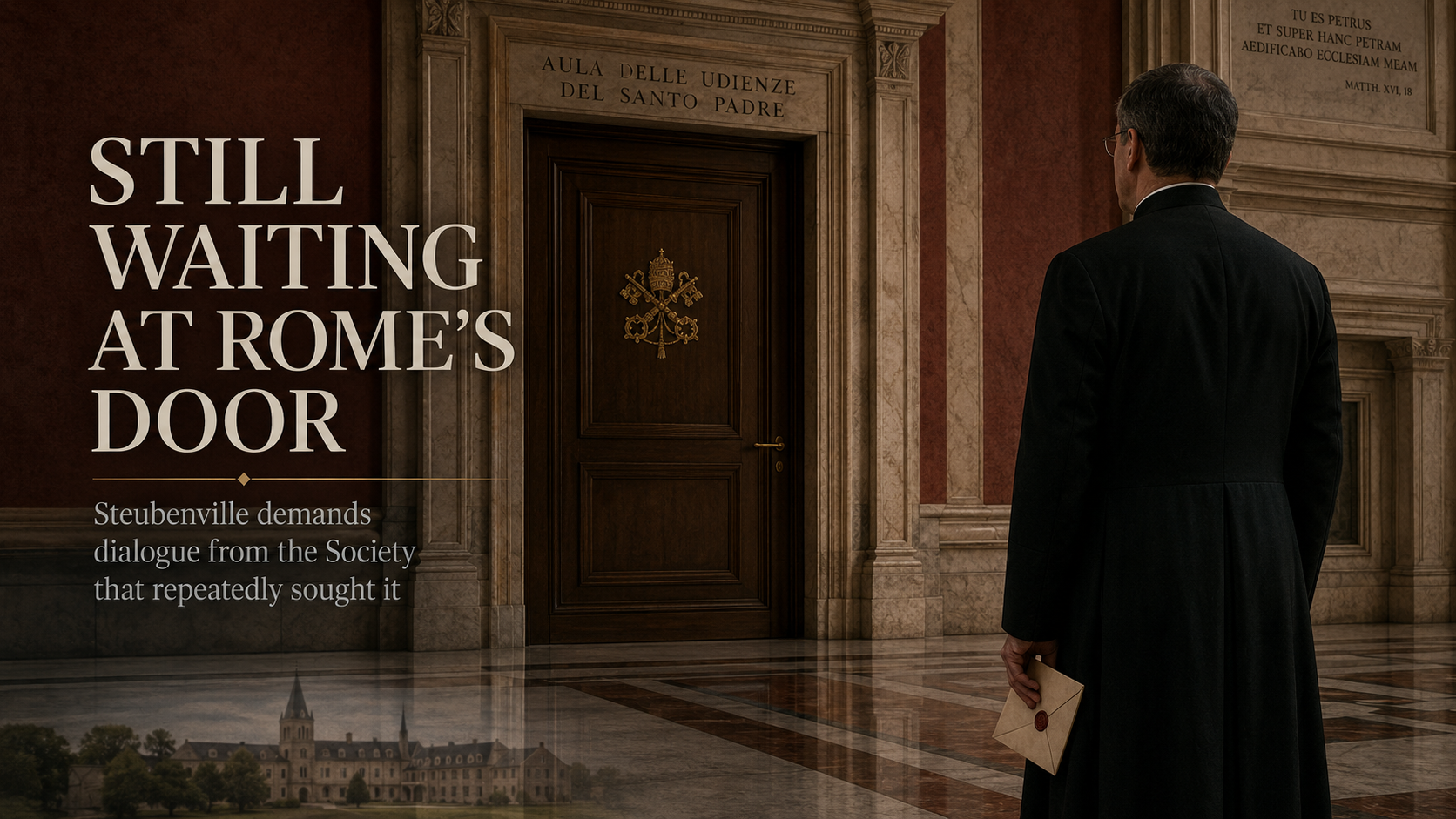
Scott Hahn and Franciscan University theologians have urged the Society of Saint Pius X to “re-enter into dialogue” with the Holy See. They neglect to tell their readers that the Society proposed doctrinal talks seven years ago, that its Superior General wrote twice to Pope Leo XIV, and that his repeated request for a personal audience has still received no publicly acknowledged answer.
The concern expressed by the Franciscan University theologians is legitimate. Their presentation of the history is not.
Their open letter, published on 25 June and signed by Scott Hahn, John Bergsma, Michael Waldstein, Mark Miravalle, Regis Martin, Father Dave Pivonka TOR and twenty other faculty members and administrators, asks the Society of Saint Pius X to abandon the episcopal consecrations planned for 1 July. The signatories fear that the act will deepen the Society’s separation from Rome and inflict another wound upon the Church.
That fear deserves to be taken seriously. Episcopal consecration without a pontifical mandate is a grave act carrying grave canonical consequences. No Catholic should speak lightly of the possibility of a rupture that could burden another generation.
The letter’s argument, however, depends upon a history it does not disclose. Its final appeal is:
“Please, re-enter into dialogue with the Holy See.”
The SSPX has been asking for dialogue.
In January 2019, Father Davide Pagliarani, newly elected Superior General of the Society, wrote to Archbishop Guido Pozzo of the Pontifical Commission Ecclesia Dei. He proposed regular written exchanges between theologians of the Holy See and the SSPX, supported by twice-yearly meetings. He named three priests qualified to represent the Society and suggested that the results might eventually be published.¹
This was not a vague gesture towards eventual reconciliation. It was a concrete proposal for an organised theological discussion.
Seven years later, Father Pagliarani told Cardinal Víctor Manuel Fernández that the proposal had elicited no real interest. According to his account, the Society was told orally that doctrinal agreement with Rome was considered impossible. The Holy See’s own account of the February 2026 negotiations confirms the existence of the 2019 letter and acknowledges that Cardinal Fernández proposed discussing the subjects listed in it.²
The Society did not refuse to talk. Its proposed talks did not take place.
After the election of Pope Leo XIV, Pagliarani approached Rome again. In an interview given on 2 February 2026, he stated that he had written to the Pope during the previous summer requesting an audience. Having received no reply, he wrote again several months later, explaining the Society’s doctrinal disagreement, its pastoral circumstances and its desire to continue serving the Church.³
A response eventually came from Cardinal Fernández. Pagliarani said that it did not address his request to meet the Pope and did not answer the proposal contained in his letters.
The SSPX announced the planned consecrations on 2 February. Ten days later, Cardinal Fernández received Pagliarani at the Palace of the Holy Office. The meeting lasted an hour and a half. The Cardinal proposed a theological dialogue, approved by the Pope, which would seek to identify the “minimum requirements” for full communion and define a canonical status for the Society. Suspension of the consecrations was made a prior condition.⁴
At that meeting, Pagliarani renewed his wish to meet Pope Leo personally.
No such audience has been publicly announced.
The Society subsequently rejected the particular process offered by Cardinal Fernández. That decision is open to criticism. Pagliarani might have suspended the consecrations and tested Rome’s offer. Even a restricted discussion might have provided an opportunity to avert the approaching collision.
Refusal of the terms of one proposed process, however, is not refusal of dialogue itself.
Pagliarani’s written response of 18 February began by welcoming the renewed opening of doctrinal discussion. He recalled that he had proposed precisely such a discussion in 2019. He said that theological dialogue had always been desirable, but objected that the proposed framework had predetermined the principal matters in dispute. Cardinal Fernández had stated, according to the Society’s account, that the texts of the Second Vatican Council could be discussed but not corrected; Pagliarani added that the legitimacy of the liturgical reform could not be challenged.⁵
The Society was therefore being invited to discuss the meaning and degree of assent owed to conclusions which it would not be permitted to question. Rome is entitled to impose those limits. The SSPX is entitled to say that such a process cannot resolve the disagreement which separates them.
One may call the Society’s position obstinate. One may consider its interpretation of the Council false, its claim of necessity exaggerated and its refusal of Rome’s conditions imprudent. What one cannot honestly call it is an absence of attempted dialogue.
By April, Pagliarani was still asking for an audience. When asked whether he continued to hope to see the Pope before the consecrations, he replied:
“Of course, this corresponds to my sincerest desire.”
He added that there had been “no personal reply or reaction from the Holy Father”. Before possibly declaring schismatic a society containing more than a thousand members and serving hundreds of thousands of faithful, he suggested, it might be reasonable for the Pope to know personally those liable to be judged.⁶
Pagliarani then made an uncomfortable comparison. Whatever the SSPX thought of Pope Francis’s programme for the Church, Francis had been willing to receive him. When Pagliarani requested a meeting, he said, an audience was granted within twenty-four hours.
The contrast is difficult to ignore. The Pope most bitterly opposed by the Society met its Superior General. Pope Leo, as of 26 June, has not publicly done so.
On 24 June, the SSPX addressed a new profession of faith to the Pope and the College of Cardinals. The accompanying letter expressed the hope that its doctrinal declaration might one day form the basis of “an honest discussion with the Holy See, in a spirit of peace, brotherhood, and charity”.⁷
The next day, the Franciscan University signatories instructed the Society to “re-enter into dialogue”.
Perhaps their letter had already been drafted before the SSPX published its latest declaration. That would explain its failure to mention the document issued only one day earlier. It cannot explain the omission of the 2019 proposal, the two letters to Pope Leo, the February meeting with Cardinal Fernández, the renewed request for an audience, or Pagliarani’s public appeal in April.
Those facts are not peripheral to the controversy. They change the moral character of the appeal.
The Steubenville letter places the entire burden of reconciliation upon Écône. Rome is portrayed as the patient guardian of communion; the SSPX is portrayed as the party walking away. No corresponding appeal is made to Pope Leo to receive the man who has repeatedly asked to see him.
The letter asks Pagliarani to return to a conversation without acknowledging that he had been seeking one. It asks the Society to step back but does not ask the Pope to step forward. It warns of the wound that may be inflicted on 1 July but passes over the audience which might yet help to prevent it.
Its canonical argument is similarly compressed. The signatories quote Canon 751, defining schism as the refusal of submission to the Supreme Pontiff or of communion with those subject to him, and then write as though an unauthorised consecration necessarily proves that refusal.
Canon law distinguishes the two offences. Schism is defined in Canon 751 and penalised under Canon 1364. Consecration without a pontifical mandate is separately penalised by Canon 1387.⁸ The distinction does not make the proposed consecrations lawful or harmless. It does mean that schism cannot simply be assumed; the nature, intention and objective significance of the act must be argued.
The Society says that the new bishops will receive sacramental orders but no territorial jurisdiction and that it is not establishing a rival Church. Its opponents may contend that the act itself contradicts those professions. That is the serious argument. Merely placing the definition of schism beside the proposed consecrations does not make it.
The Steubenville theologians then move from abbreviated canonical reasoning to emotional and scriptural pressure.
They address the faithful with Our Lord’s question after the departure of the unbelieving disciples in John 6: “Do you also want to leave?” In the Douay-Rheims: “Will you also go away?”
The rhetorical allocation of roles is plain. The SSPX and its faithful are placed among the disciples abandoning Christ; the authors implicitly stand with the faithful Apostles who remain. The letter then asks, “What are you looking for? Whom are you seeking?” before assuring them that “Christ is right here, in his Church, in his sacraments”.
This is not a neutral use of Scripture. It treats the contested conclusion as though it were Christ’s own judgment upon the controversy.
It also carries an unfortunate sacramental insinuation. Christ is indeed present in His Church and His sacraments. He is also present in every validly celebrated Mass. The Holy See has never denied the validity of SSPX priestly ordinations or Eucharistic celebrations. Pope Francis authorised its priests to hear confessions validly and licitly and approved provisions for the valid celebration of marriages involving its faithful.⁹
The Society’s canonical irregularity is real. It does not empty its tabernacles.
A theological appeal may warn that disobedience damages ecclesial communion. It should not suggest that Catholics attending an SSPX chapel have gone searching for Christ somewhere He cannot be found.
The appeal would have been more convincing had its authors addressed both parties.
They could have asked the SSPX to suspend the consecrations while every possible avenue remained open. They could have asked Pope Leo to grant the personal meeting sought by its Superior General. They could have acknowledged Rome’s right to demand obedience while asking whether pastoral prudence might require the Pope to hear Pagliarani before judging him. They could have appealed for truth as well as unity, and for listening as well as submission.
Instead, every imperative is directed towards Écône.
“Please don’t do this.”
“Please don’t create this wound.”
“Please, re-enter into dialogue.”
There should have been one more:
Holy Father, please receive him.
The SSPX may be mistaken. Its argument from necessity may fail. Its planned consecrations may prove a grave error whose consequences endure for decades. None of those possibilities excuses rewriting the record which led to them.
Before telling the Society to return to dialogue, Scott Hahn and his colleagues should ask why, as of 26 June, its Superior General was still waiting for an audience with the Pope.
¹ Davide Pagliarani, letter to Archbishop Guido Pozzo, Secretary of the Pontifical Commission Ecclesia Dei, 17 January 2019.
² Davide Pagliarani, letter to Cardinal Víctor Manuel Fernández, 18 February 2026; Holy See, communiqué reported by Vatican News, “Holy See Proposes Theological Dialogue with Society of St Pius X”, 12 February 2026.
³ Davide Pagliarani, “Interview with the Superior General of the Priestly Society of Saint Pius X”, interview given 2 February and published 5 February 2026.
⁴ Dicastery for the Doctrine of the Faith, communiqué of 12 February 2026; General House of the SSPX, “Communiqué: Meeting in Rome”, 12 February 2026.
⁵ Pagliarani, letter to Cardinal Fernández, 18 February 2026.
⁶ Davide Pagliarani, “‘Who Is Tearing the Tunic of Christ?’: Interview with the Superior General of the Society of Saint Pius X”, 23 April 2026.
⁷ Davide Pagliarani and the General Council of the SSPX, “Open Letter to His Holiness Pope Leo XIV and to the Cardinals of the Holy Church”, 24 June 2026.
⁸ Code of Canon Law, cann. 751, 1364 and 1387.
⁹ Francis, Apostolic Letter Misericordia et misera, 20 November 2016, no. 12; Pontifical Commission Ecclesia Dei, letter concerning faculties for marriages of faithful attached to the Society of Saint Pius X, 27 March 2017.
RELATED ARTiCLES


LATEST ARTICLES
- Today’s Mass: October 03 St Thomas [de Cantilupe] of HerefordSt Thomas de Cantilupe was an influential figure, born into nobility around 1218. Educated in canon law, he supported the baronial party during the Barons’ War and served as Chancellor of England and Bishop of Hereford. Known for his piety and charity, he was canonised in 1320, with his relics drawing pilgrims to Hereford Cathedral.
- 04.10.26 Nuntiatoria CXXVI: OMNIA AUTEM PROBATE: QUOD BONUM EST TENETEThis editorial highlights the importance of discernment in faith, urging Christians to test teachings and hold onto what is good. It critiques contemporary issues, such as compulsory inclusivity at universities, government information security, and interfaith dialogues, emphasizing that a responsible faith must involve critical examination and recognition of true values.
- ORDO w/c 04.10.26The week begins with the Eighteenth Sunday after Pentecost, honouring various saints, culminating in the feast of St Francis of Assisi. Key celebrations include St Wenceslaus, St Michael the Archangel, St Jerome, and St Thérèse of the Child Jesus. The period highlights the call to surrender worldly attachments in devotion to God.
- THE WEDDING GARMENT: The Nineteenth Sunday after PentecostThe Nineteenth Sunday after Pentecost joins St Paul’s command to “put on the new man” with Christ’s parable of the wedding garment. The warning is directed especially towards those already within the household of Faith: Catholic identity, orthodoxy and traditional practice cannot substitute for sanctifying grace and personal conversion. Grace does not merely bring us into the feast; it must make us fit for the presence of the King.
- Blue Labour discovers the Common GoodJonathan Hinder criticises “hyper-liberalism” for prioritising individual autonomy over community values. His emphasis on family and societal duties echoes Christian teachings often overlooked in modern politics. Although Hinder promotes aspects of Blue Labour as solutions to social issues, he underscores the necessity of returning to deeper truths about human nature and moral authority for genuine societal cohesion.
CURRENT EDITION


Today’s Mass Propers
- Today’s Mass: October 03 St Thomas [de Cantilupe] of Hereford
 St Thomas de Cantilupe was an influential figure, born into nobility around 1218. Educated in canon law, he supported the baronial party during the Barons’ War and served as Chancellor of England and Bishop of Hereford. Known for his piety and charity, he was canonised in 1320, with his relics drawing pilgrims to Hereford Cathedral.
![Today’s Mass: October 03 St Thomas [de Cantilupe] of Hereford](https://nuntiatoria.org/wp-content/uploads/2026/10/thomascantilupemasstitle.jpg)



Leave a Reply