
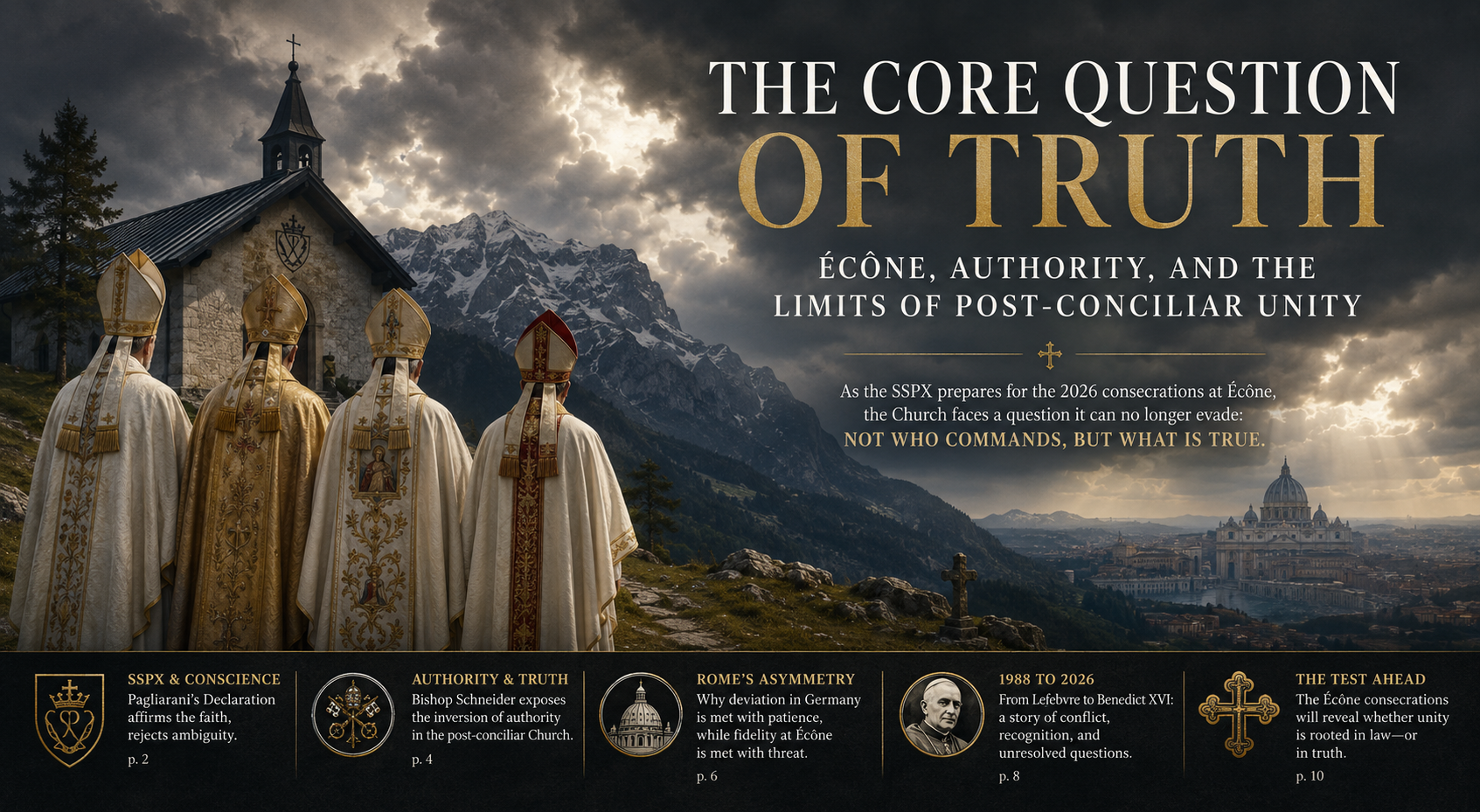
THE CORE QUESTION OF TRUTH: ÉCÔNE, AUTHORITY, AND THE LIMITS OF POST-CONCILIAR UNITY
The episcopal consecrations scheduled for 1 July 2026 by the Priestly Society of Saint Pius X at Écône do not represent an isolated act of disobedience, nor merely a repetition of 1988. They are the most acute expression to date of a crisis that has never been resolved: the fracture between doctrinal clarity and juridical authority in the post-conciliar Church. What is now at stake is not simply canonical order, but the conditions under which truth itself is recognised as binding for communion.
In his recent intervention, Bishop Athanasius Schneider identifies the issue with precision too long avoided: “At its core, the conflict revolves around the question of truth.”¹ This is not emphasis but correction. For decades, the SSPX question has been treated as a matter of mandate, obedience, and canonical discipline. Yet such categories are secondary. They presuppose agreement about what is to be believed. Where that agreement is obscured, discipline ceases to preserve unity and begins to mask its absence.
Vatican II and the Problem of Non-Definitive Authority
The dispute turns on a fact simultaneously acknowledged and functionally denied. The Second Vatican Council did not define dogma in an extraordinary manner. Pope Paul VI stated explicitly that the Council “avoided pronouncing, in an extraordinary manner, dogmas endowed with the note of infallibility.”²
Yet what was presented as pastoral has, in practice, been elevated to a test of orthodoxy. As Schneider asks, why is “unconditional acceptance” of Vatican II required for full communion when no such demand is made regarding the non-definitive acts of prior councils?¹ The question exposes a structural contradiction. Either non-definitive teachings admit of theological evaluation, or they do not. If they do, then resistance cannot be reduced to disobedience. If they do not, then the distinction between dogma and pastoral teaching collapses entirely.
Ambiguity and the Memory of the Church
The SSPX has consistently argued that certain conciliar formulations—on religious liberty, ecumenism, interreligious dialogue, and collegiality—are ambiguously expressed and difficult to reconcile with prior magisterial teaching. This claim may be contested, but it is not without precedent.
The condemnation of Pope Honorius I did not rest upon formal heresy, but upon his failure to extinguish ambiguity, thereby enabling doctrinal error.³ The Church’s response was categorical: ambiguity in matters of faith cannot be tolerated. As Pope Pius VI later affirmed, “Ambiguity can never be tolerated in a Synod… whose principal glory consists in teaching the truth with clarity.”¹
The implication is unavoidable. If ambiguity exists—and this is the contested point—then its resolution is not optional but obligatory. To defer that resolution while enforcing assent is to invert the order of theology itself.
Authority Distorted: Legalism and Papal-Centrism
Schneider’s further diagnosis identifies two distortions that have shaped the present impasse: juridical positivism and exaggerated papal-centrism. The former reduces ecclesial life to legal compliance detached from theological ends; the latter risks attributing to non-definitive papal acts a quasi-absolute authority.
The result is a shift in the locus of certainty. Instead of asking whether a teaching is clear and continuous with tradition, the operative question becomes whether it has been promulgated. Authority is no longer measured by truth; truth is measured by authority. This inversion is historically untenable. The Church has never taught that the authenticity of doctrine derives from its promulgation alone.
When law is invoked to compel assent to formulations whose doctrinal status is disputed, it ceases to function as a safeguard of unity. It becomes, instead, a mechanism of division.
The SSPX and the Dilemma of Conscience
The Declaration of Catholic Faith issued by Fr Davide Pagliarani is therefore decisive. It affirms without equivocation adherence to Catholic doctrine, recognition of papal primacy, and fidelity to the Roman Church.⁴ It insists that the Society “does not refuse the authority of the Pope,” but cannot accept “doctrinal novelties or ambiguous formulations that compromise the integrity of the faith.”⁴
This is not the language of schism, but of conscience. The refusal is narrowly defined: not against dogma, but against the obligation to assent to what is perceived as ambiguity. Whether that perception is correct is not the immediate question. The fact that it exists—and is articulated within the framework of Catholic fidelity—is the decisive reality.
The SSPX is not claiming authority; it is appealing beyond authority to the truth which authority exists to serve.
1988 and 2026: From Rupture to Recognition
The comparison with 1988 remains unavoidable. The consecrations carried out by Archbishop Marcel Lefebvre were met with excommunication and the Apostolic Letter Ecclesia Dei of Pope John Paul II.⁵ Yet even then, Rome acknowledged the legitimacy of the concerns that had prompted the act, calling for respect toward those attached to the older liturgical forms.
Subsequent developments have only deepened the ambiguity. Pope Benedict XVI lifted the excommunications in 2009, recognising that the situation was not reducible to schism in the strict sense.⁶ Pope Francis extended faculties for confession and marriage, effectively recognising the pastoral necessity of the Society’s ministry.⁷
The juridical reality is therefore more precise than is often admitted. The consecration of a bishop without a pontifical mandate constitutes a grave delict under canon law, but it is not, of itself, identical with formal schism. The persistent classification of the SSPX as schismatic reflects not canonical precision, but interpretative judgment.
The forthcoming consecrations must therefore be read not as a rupture, but as an escalation within a situation already marked by partial recognition and unresolved contradiction.
The Roman Response and the Problem of Asymmetry
The response of the Holy See will expose whether this contradiction is to be resolved or managed. Here the statements of Cardinal Pietro Parolin are decisive. Addressing the German Synodal Way—whose proposals have included the blessing of same-sex unions and the re-evaluation of sexual morality—he has emphasised that the Holy See “does not wish divisions to escalate into punitive measures,” preferring dialogue and gradual resolution.⁸
The asymmetry is stark. In Germany, doctrinal deviation is met with patience. At Écône, doctrinal reservation is met with the threat of sanction. The former proposes change to settled teaching; the latter resists perceived ambiguity in recent formulations. Yet it is the latter that is consistently framed as the greater threat to unity.
This disparity cannot be sustained without consequence. It suggests that unity is no longer measured by conformity to the deposit of faith, but by conformity to the current exercise of authority—irrespective of the clarity or continuity of its expressions.
Écône as a Theological Event
The consecrations at Écône will therefore function as more than a canonical act. They will constitute a theological event. They will force into visibility the unresolved question that has been deferred for decades: whether the Church’s unity is grounded in juridical cohesion or doctrinal clarity.
If penalties are imposed, they will not resolve the conflict. They will merely restate it in legal form. If, however, a genuinely pastoral solution is pursued—one that acknowledges the legitimacy of the underlying questions—then Écône may yet become not a point of rupture, but the beginning of resolution.
Conclusion: Not Who Commands, But What Is True
The crisis exposed by the SSPX cannot be resolved by appeals to obedience alone, because obedience presupposes clarity. Where clarity is lacking, authority risks becoming coercive rather than persuasive.
The Church has faced such moments before. Her response has never been the suppression of doctrinal tension, but its resolution in truth. The alternative—unity maintained through the enforcement of ambiguity—has never endured.
Écône now stands as the test. Not of loyalty, but of principle. Not of jurisdiction, but of truth.
The question that will determine its meaning is not who commands, but what is true.
- Diane Montagna, “Bishop Schneider Sets Out ‘Core Question’ in SSPX Episcopal Consecration Debate,” 4 June 2026.
- Pope Paul VI.
- Third Council of Constantinople (680–681), condemnation of Pope Honorius I.
- Fr Davide Pagliarani, Declaration of Catholic Faith, 14 May 2026.
- Pope John Paul II, Ecclesia Dei, 2 July 1988.
- Pope Benedict XVI, Decree, 21 January 2009.
- Pope Francis, Misericordia et Misera (2016).
- Cardinal Pietro Parolin, remarks on German Synodal Way, 2026.
RELATED ARTiCLES


LATEST ARTICLES
- Today’s Mass: October 25 SOVEREIGNTY OF OUR LORD JESUS CHRIST, SUPREME KINGThe Feast of the Sovereignty of Our Lord Jesus Christ celebrates Christ’s dual kingship by birth and conquest. Established by Pius XI, it aims to deepen faith and counter anti-clericalism. The liturgical observance underscores His authority as King, advocating for societal recognition of His reign to bring peace and harmony.
- TRADITION BEHIND THE FENCEThe Vatican’s prohibition of the traditional Ad Petri Sedem pilgrimage to St Peter’s Basilica has sparked controversy, especially among traditional Catholics. While some cite scheduling conflicts, the broader issue lies in the restrictive policies of Traditionis custodes, which may confine traditional liturgical practices to specific enclaves, risking the transmission and recognition of Catholic Tradition within the wider Church.
- Today’s Mass: October 24 St Raphael the ArchangelThe Feast of Saint Raphael the Archangel highlights his healing powers as depicted in the Book of Tobit, where he aids Tobit and his son, Tobiah. Venerated as a protector of travellers and the blind, Raphael is celebrated for his miraculous interventions. His legacy includes support for nurses, matchmakers, and Catholic studies.
- 25.10.26 Nuntiatoria CXXIX: CHRISTUS REXThe text discusses the relationship between Christ’s kingship and authority within the Church amidst contemporary challenges. It contrasts ecclesiastical power with genuine faith, emphasising that authority must protect divine truth rather than alter it. The witness of imprisoned priests illustrates the enduring significance of fidelity to Christ over institutional conformity.
- THE DOMESTIC CHURCH: 25 October – 2 November 2026 A Home with Room for Heaven: Preparing for All Saints and All SoulsThe content outlines a week’s plan for traditional Catholic families to prepare for the feasts of All Saints and All Souls. Emphasising daily prayers, remembrance of the deceased, and engagement with children’s activities, it aims to integrate Catholic customs into family life, enriching spiritual practices and fostering a shared faith experience.
CURRENT EDITION


DAILY MASS ONLINE
One of the earliest online apostolates dedicated to the Traditional Latin Mass, Old Roman TV began broadcasting the Holy Sacrifice on the Feast of the Assumption, 15 August 2008. During the COVID-19 pandemic, additional programming — devotions, catechesis, and conferences — was added to support the faithful in prayer and formation.
Support the daily Holy Mass on Old Roman TV by offering a Mass intention — for loved ones, thanksgiving, or the repose of souls. Your intention helps sustain the sacred liturgy and brings grace to those you remember before God’s altar.
SUPPORT THE DAILY MASS ONLINE
Likely the world’s longest-running daily online broadcast of the
Traditional Latin Mass, streaming faithfully since the
Feast of the Assumption 2008.

This apostolate cannot continue without immediate help
Please support us with a contribution toward
chapel rent, sacristy supplies, operating costs, and web-hosting.
Our essential monthly costs reach £1,000.
MASS INTENTIONS
If your offering is for a Mass Intention, kindly complete the form below in full so we may correctly match it to your donation. For anniversary intentions — birthdays, wedding anniversaries, anniversaries of death — please be sure to include the relevant date.


Today’s Mass Propers
- Today’s Mass: October 25 SOVEREIGNTY OF OUR LORD JESUS CHRIST, SUPREME KING
 The Feast of the Sovereignty of Our Lord Jesus Christ celebrates Christ’s dual kingship by birth and conquest. Established by Pius XI, it aims to deepen faith and counter anti-clericalism. The liturgical observance underscores His authority as King, advocating for societal recognition of His reign to bring peace and harmony.



Leave a Reply