
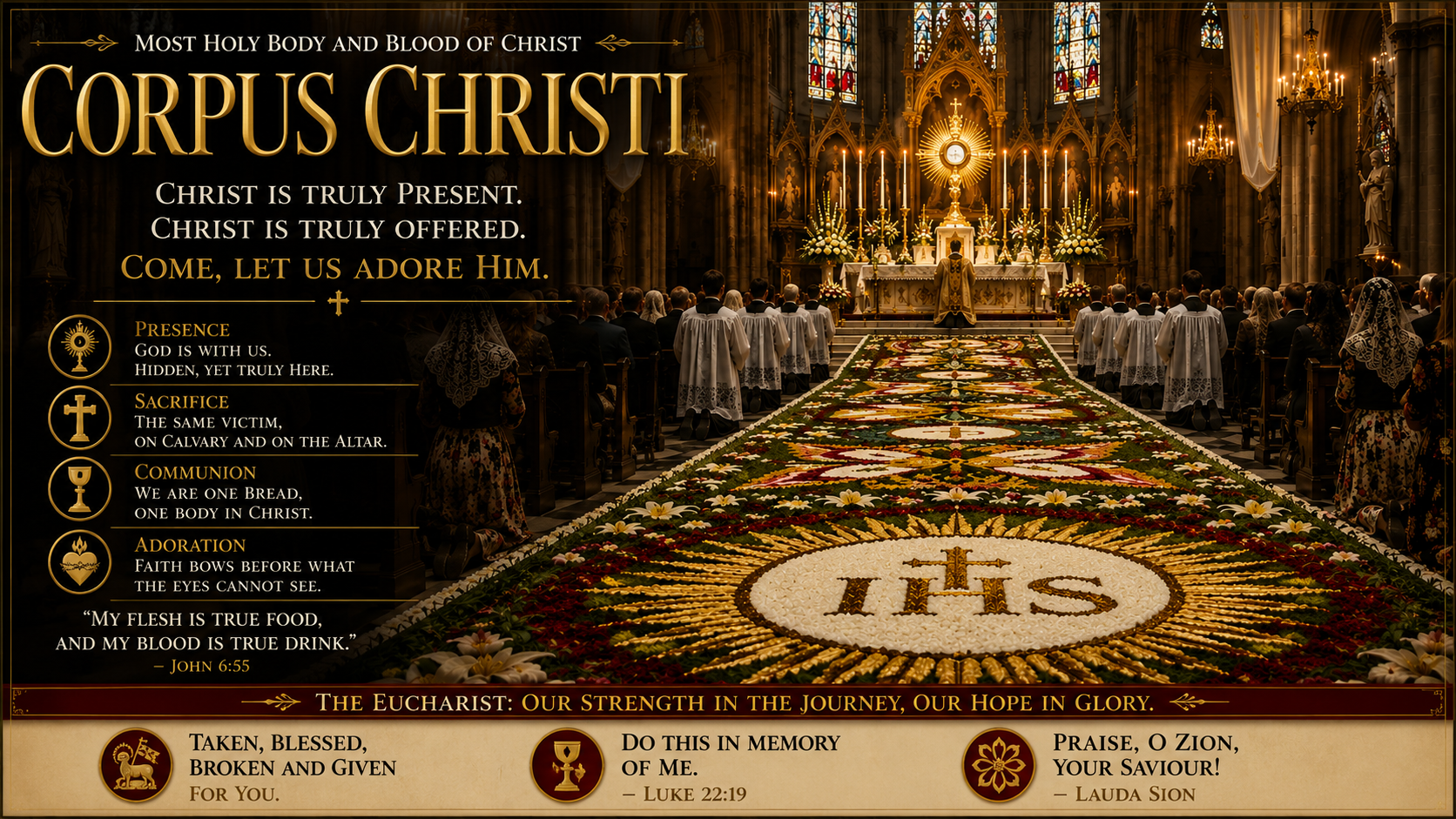
Corpus Christi: The Presence that Consumes, the Sacrifice that Endures, the Communion that Judges
The Liturgy, Theology, and Spirituality of the Most Holy Body and Blood of Christ in the Tridentine Rite

There are feasts which commemorate, and there are feasts which unveil. Corpus Christi belongs to the latter. It does not merely recall the institution of the Eucharist in the shadowed intimacy of Maundy Thursday; it draws that mystery into the full light of day and compels the Church to behold what she possesses. What was given under the sign of impending sacrifice is here adored in the clarity of triumph. The Church does not simply remember—she contemplates, proclaims, and exposes to the world the most dangerous and consoling truth entrusted to her: that Christ is not absent, but present.
For the Eucharist is not a symbol awaiting interpretation; it is a reality demanding faith. At the heart of this feast stands the doctrine of the Real Presence—Christ whole and entire, Body, Blood, Soul, and Divinity, contained truly, really, and substantially under the species of bread and wine. The liturgy does not argue this; it sings it into the soul. In the sequence Lauda Sion Salvatorem, attributed to Thomas Aquinas, the Church proclaims without concession: “Sub diversis speciebus, signis tantum, et non rebus, latent res eximiæ.” Beneath differing species, beneath mere signs, lie the realities themselves. There is no softening here, no retreat into metaphor. The Eucharist is what it appears not to be.
And yet, this Presence is inseparable from Sacrifice. Corpus Christi does not present Christ as merely abiding; it presents Him as offered. The same Christ who once hung upon the Cross now stands upon the altar—not as a repetition, but as a perpetuation of that one oblation. The liturgy insists upon this identity. The Victim is the same; the Priest is the same; only the manner of offering differs. As Thomas Aquinas teaches, the Mass is truly and properly a sacrifice, because it makes present sacramentally the sacrifice of Calvary.¹ The altar is not a table alone; it is a place of immolation.
This is why the feast emerges not from Holy Thursday directly, but from the maturity of the Paschal cycle. Only after the Resurrection and Ascension can the Church fully perceive what has been given: not merely a memorial, but an abiding Victim; not merely a sign of unity, but the sacrificial centre of the Mystical Body. The Eucharist is Calvary extended through time, the Cross planted invisibly in every place where the Mass is offered.
The liturgy of Corpus Christi reveals this not only in its texts, but in its rhythm. The Introit—Cibavit eos ex adipe frumenti—declares that God has fed His people with the finest of wheat, yet this nourishment is no ordinary food. The Gospel, drawn from Gospel of John chapter 6, presses the point beyond endurance: “My flesh is meat indeed, and my blood is drink indeed.” There is no mitigation, no symbolic escape. Many depart because they cannot bear the literal force of the claim. The Church, in instituting this feast, places that same claim before every generation and demands the same decision: Will you also go away?
The answer is not given in argument, but in adoration. For the proper response to the Eucharist is not analysis, but worship. The hymns of the feast—Pange lingua gloriosi, Tantum ergo Sacramentum, Adoro te devote—do not merely instruct; they bow. “Sight, touch, taste are all deceived,” the Church sings, “but hearing alone suffices.” Faith, not sense, governs this mystery. Christ is hidden—not to diminish His presence, but to purify the soul that approaches Him. The veil of the species becomes the test of love.
And this hiddenness is not passive; it is active. The Eucharist draws the soul into what it contains. To receive the Body of Christ is not merely to be nourished by Him, but to be configured to Him. The Sacrament effects what it signifies. As Augustine of Hippo declares, “Be what you see, and receive what you are.”² But what is seen? A Body given. What is received? A Victim offered. The logic is inescapable: the communicant must become what he consumes.
Here the feast reaches its most demanding truth. The Eucharist does not merely comfort; it claims. It does not simply unite; it transforms. To partake of the Body of Christ is to be drawn into His sacrifice—to become, in one’s own measure, an offering. The altar extends into the life of the faithful. Every act, every suffering, every surrender becomes material for oblation. The Christian does not leave the sacrifice behind at the sanctuary; he carries it into himself. As Paul the Apostle writes, “I fill up those things that are wanting of the sufferings of Christ in my flesh” (Colossians 1:24)—not as deficiency, but as participation.
This is why the procession of Corpus Christi is not mere pageantry. It is the outward manifestation of an inward truth. Christ, veiled in the monstrance, is carried into the streets—not because He needs to be seen, but because the world needs to be confronted. The hidden God passes visibly through a society that does not recognise Him. It is both proclamation and judgment. As Pius Parsch notes, the procession extends the Mass beyond the walls of the church, making the world itself the arena of Eucharistic encounter.³
Yet even here, the tension of the mystery remains. For the Eucharist is at once presence and anticipation. Christ is truly here—but not yet seen. The faithful receive Him under veils, in a mode proper to pilgrimage. As John Chrysostom reminds us, what we receive now is what we shall one day behold unveiled.⁴ The Sacrament is thus both fulfilment and promise: fulfilment of Christ’s words, promise of the Beatific Vision.
And it is precisely here that the feast becomes eschatological. The Eucharist is not only the food of the journey; it is the pledge of the end. It prepares the soul not merely for perseverance, but for judgment. For the same Presence that sanctifies also discerns. To receive worthily is to be united; to receive unworthily is to be judged. The altar is both table and tribunal.
This is the truth that cannot be evaded, and which the liturgy of Corpus Christi ultimately presses upon the soul with uncompromising clarity:
The Eucharist is Christ.
Christ is Victim.
The Victim is offered.
And what is offered must be consumed—or it condemns.
There is no neutral encounter with the Blessed Sacrament. To kneel is to adore; to receive is to consent; to refuse is to depart. The mystery permits no distance. It draws the soul into decision.
And so the Church sings, and processes, and adores—not as one who has mastered the mystery, but as one who has been mastered by it. For in the Most Holy Eucharist, she possesses not a relic, but a Presence; not a memory, but a Sacrifice; not a sign alone, but the beginning of eternal life.
To kneel before the monstrance is to stand already at the threshold of eternity.
To receive the Host is to touch the Victim who will judge the living and the dead.
To adore the hidden Christ is to prepare to behold Him unveiled.
For in the Sacrament of the Altar, heaven is not only promised.
It has already begun.
- Thomas Aquinas, Summa Theologiae, III, q.83, a.1; q.76, a.1–2.
- Augustine of Hippo, Sermon 272, in Patrologia Latina, vol. 38.
- Pius Parsch, The Church’s Year of Grace, vol. III (Collegeville: Liturgical Press, 1953), pp. 45–48.
- John Chrysostom, Homilies on the Gospel of Matthew, Homily 82.
related articles


Latest articles
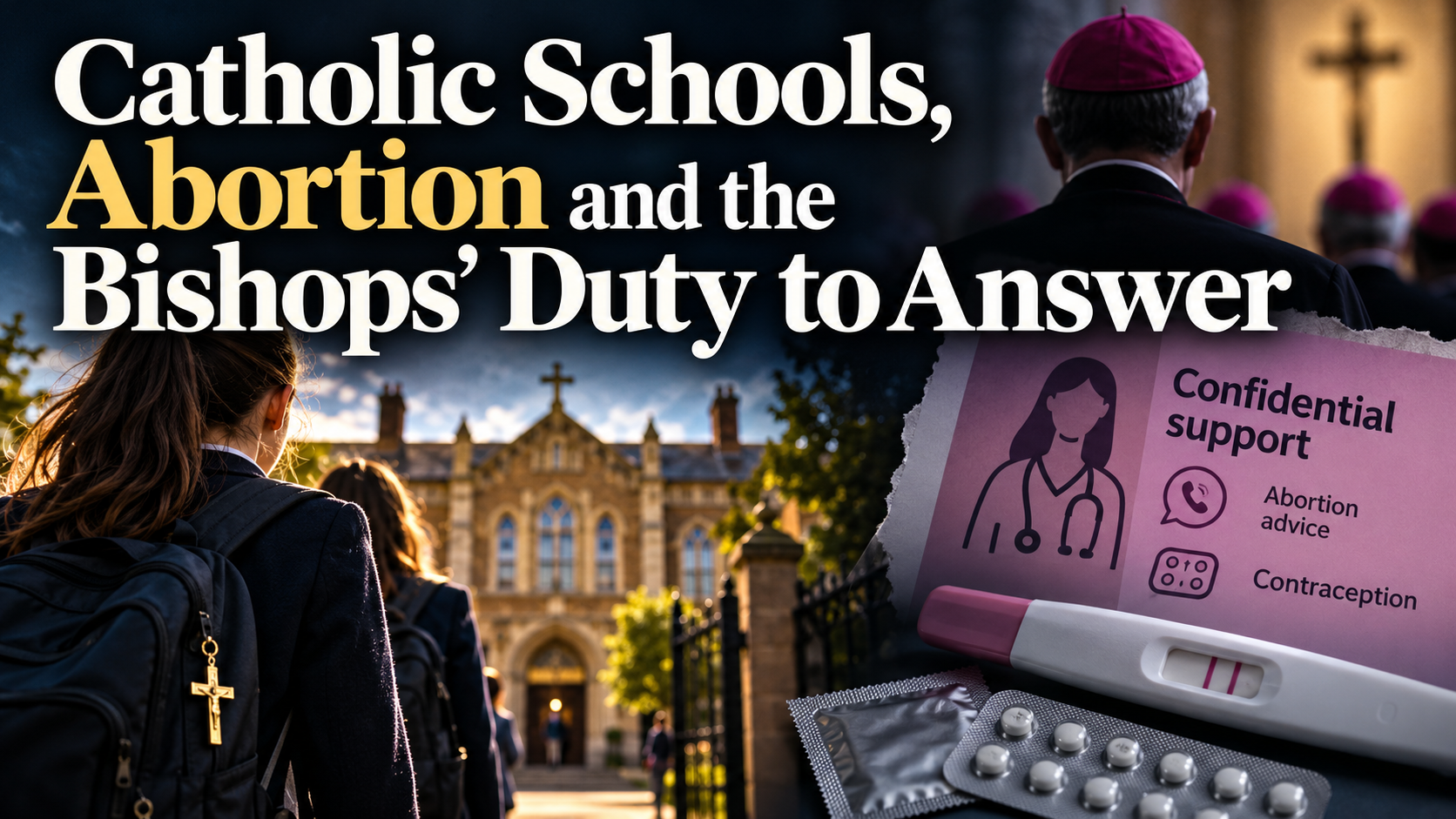
- UK Catholic Schools, Abortion and the Bishops’ Duty to AnswerJohn Smeaton has raised concerns regarding the teachings on abortion and contraception in Catholic schools, questioning the Catholic Education Service’s adherence to Church doctrine. He highlights the need for clarity and accountability in education. Parents should not bear the responsibility of ensuring doctrinal fidelity, which should instead be guaranteed by bishops and educational authorities.
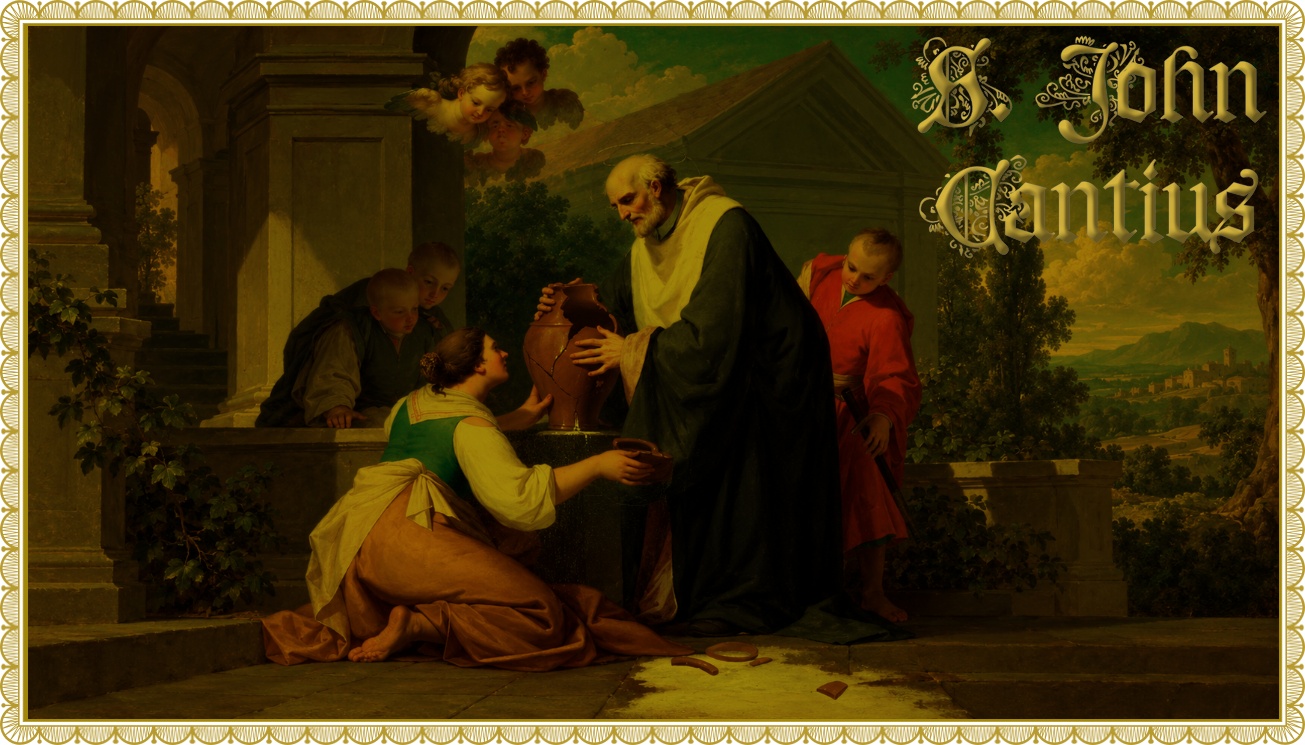
- Today’s homily: St John CantiusThe account of St John of Kenty illustrates true charity, as he prioritised the needs of a poor man over his own comfort, exemplifying how knowledge of faith must translate into actions. His life was marked by humility, generosity, and a dedication to both charitable works and doctrinal integrity, urging a holistic expression of faith.
- Today’s Mass: October 22 St John CantiusSt John of Kenty, originally a humble country lad, succeeded as a theology professor in Kraków but faced opposition that led to his role as a parish priest. Known for his kindness, he lived simply, aiding the poor. After winning his parishioners’ hearts, he returned to teaching, living a life of humility and faith.
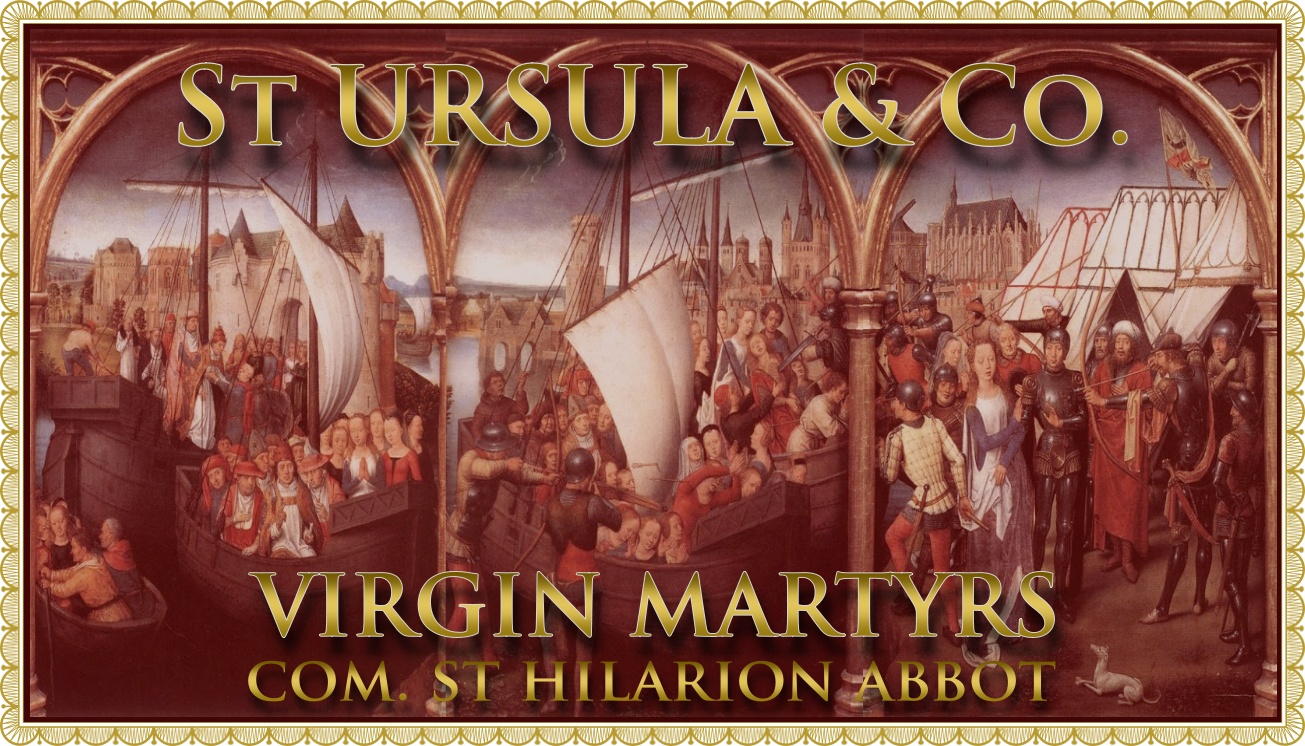
- Today’s Mass: October 21 St Ursula, Virgin Martyr & CompanionsSt Ursula and Companions, Virgins and Martyrs; Commemoration of St Hilarion, Confessor. Though legends concerning Ursula and eleven thousand virgins are historically uncertain, early Christian martyrs were venerated at Cologne. St Hilarion, Palestinian hermit and disciple of St Anthony, embraced severe penance and solitude, dying in 371 aged eighty.
- FR RIPPERGER’S YEAR OF SILENCE: Obedience is not an explanationFr Chad Ripperger has accepted a year-long withdrawal from public speaking as requested by Archbishop Golka of Denver, aimed at focusing on his priestly community. This decision, following the removal of another exorcist, raises concerns about the Church’s balance between discretion and public witness regarding exorcism and supernatural matters.



Leave a Reply