
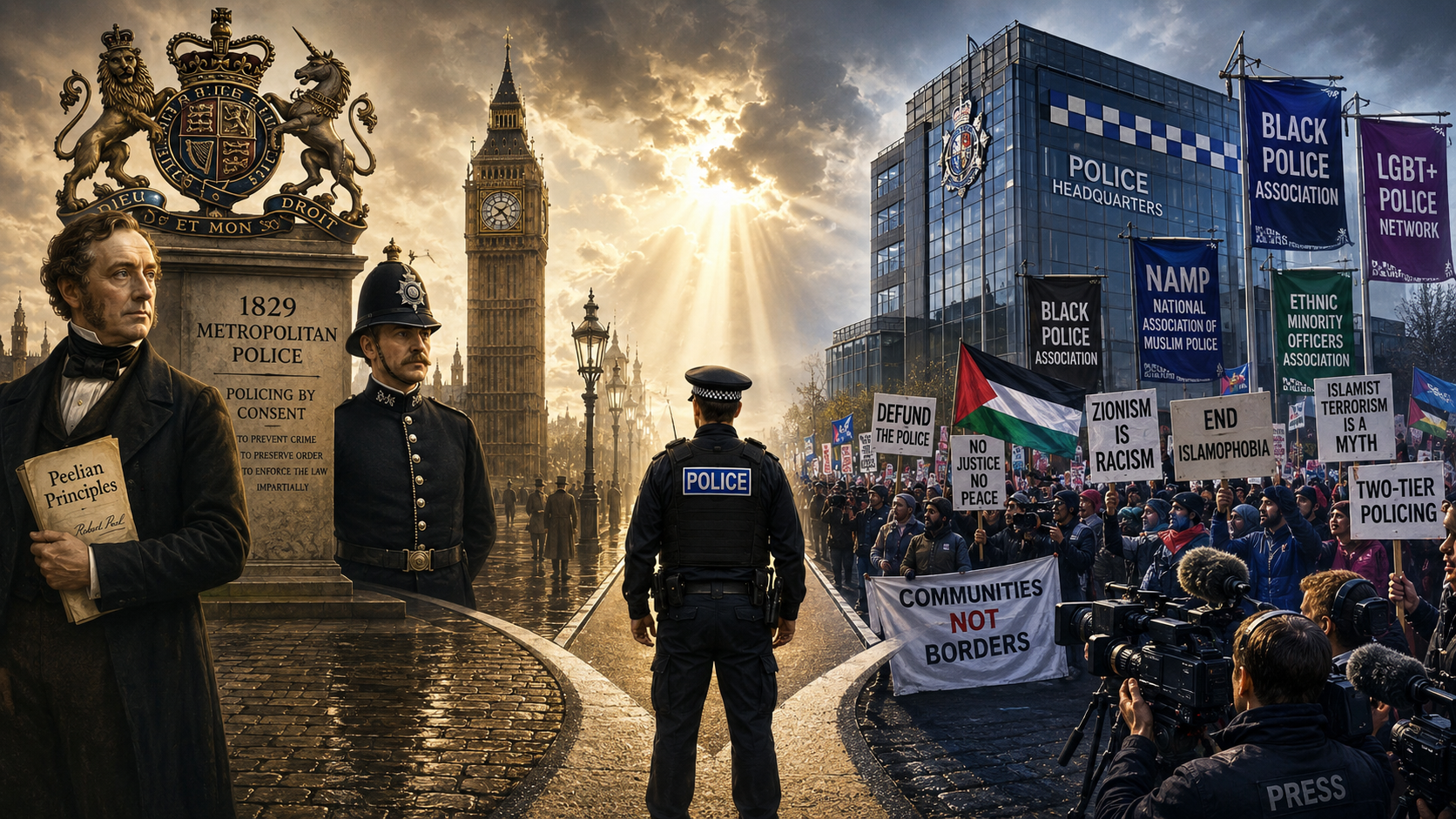
From Peel to Politics: Identity, Legitimacy, and the Unravelling of Policing by Consent
The controversy surrounding the National Association of Muslim Police is not fundamentally about one organisation, one policy paper, or even one police force. It is about the gradual transformation of British policing from an institution rooted in common citizenship into one increasingly shaped by the assumptions of identity politics. At stake is not merely public confidence in the police, but the legitimacy of policing itself.

Andrew Gilligan’s recent investigation into the National Association of Muslim Police (NAMP) has generated controversy because of the organisation’s reported positions on Zionism, anti-Muslim hatred, and the language used in counter-terrorism. According to published reports, NAMP has described Zionism as “one of the manifestations of anti-Muslim hatred, stripping Muslims of their humanity,” characterised the Israel Defence Forces as a “Zionist terrorist group,” and argued that the term “Islamist terrorism” should be abandoned because its use contributes to anti-Muslim hostility.¹ The immediate questions raised by these statements are obvious. Why is an organisation associated with British policing taking positions on one of the world’s most contentious geopolitical disputes? Why is a body that enjoys relationships with police forces and national policing structures seeking to influence the language of counter-terrorism? Yet important though these questions are, they do not reach the heart of the matter. NAMP is not the principal story. Rather, it is a symptom of a deeper transformation that has been occurring within British policing for several decades.
For much of its history, British policing rested upon a remarkably simple constitutional settlement. When Sir Robert Peel established the Metropolitan Police in 1829, he deliberately rejected the continental model of a police force functioning as an instrument of political authority. The police were not created to advance ideologies, arbitrate social disputes, or shape public attitudes. Their role was more modest and more profound: to prevent crime, preserve public order, and enforce the law impartially.² This philosophy became known as policing by consent. Properly understood, the phrase does not mean policing according to popular opinion. Rather, it reflects the principle that police authority depends upon widespread public confidence that officers exercise their considerable powers fairly, consistently, and on behalf of the entire community. Citizens tolerate the existence of coercive powers because they believe those powers are exercised according to law rather than ideology.
The significance of the NAMP controversy lies precisely in the fact that so many within modern policing appear unsurprised by it. Had a comparable organisation issued such statements thirty years ago, many senior officers would likely have regarded them as incompatible with the appearance of institutional neutrality. Today, however, such interventions are often treated as an ordinary feature of contemporary policing culture. That change did not occur overnight. Its roots lie in a broader transformation affecting not merely the police but much of the public sector. The publication of the Macpherson Report following the murder of Stephen Lawrence marked an important moment in this process.³ The report identified genuine failures and demanded necessary reforms, yet its broader legacy extended beyond the specific circumstances of the Lawrence case. It accelerated a wider shift in institutional thinking, encouraging public bodies increasingly to understand society through the lens of group identity, representation, and lived experience rather than through the older language of common citizenship and equal treatment before the law.
To acknowledge this transformation is not to deny that policing faced genuine challenges. Britain became a more diverse society. Relations between some communities and police forces were strained. Minority officers often reported experiences of discrimination, isolation, or limited opportunities for advancement. It is therefore entirely reasonable that forces should seek better engagement with communities and provide support networks for officers from different backgrounds. Indeed, defenders of organisations such as NAMP argue precisely this point. They maintain that representative associations help forces understand diverse communities, improve recruitment, challenge prejudice, and build trust where trust has historically been lacking. Such arguments deserve to be taken seriously because they arise from legitimate concerns.
Yet these arguments do not resolve the central problem. Supporting officers and representing political causes are not the same thing. Assisting recruitment and commenting upon foreign conflicts are not the same thing. Improving community relations and seeking to redefine the language of counter-terrorism are not the same thing. The difficulty arises when organisations embedded within policing move beyond professional welfare and begin participating in ideological debates that have little or no connection to the impartial enforcement of the law. At that point, questions of institutional neutrality inevitably arise.
The distinction between citizenship and identity is critical to understanding why this matters. The traditional British constitutional model assumed that citizens possessed countless private differences while sharing a common public status. People might belong to different religions, ethnic groups, political parties, or social classes, but before the law they remained equal citizens. The task of public institutions was not to mediate between competing tribal interests but to administer common rules impartially. Identity politics begins from a different premise. It encourages institutions to understand society primarily as a collection of groups, each possessing its own experiences, grievances, perspectives, and representative claims. Governance increasingly becomes the management of relationships between those groups rather than the impartial application of universal principles.
This intellectual shift has had profound consequences for policing. Over the past quarter-century, police forces have witnessed the growth of identity-based staff associations, advisory panels, diversity departments, community engagement structures, and increasingly complex frameworks for managing perceptions and sensitivities. Many of these developments were introduced for understandable reasons. Yet over time they have encouraged a conception of policing in which officers are increasingly viewed not merely as servants of the law but as representatives of particular communities and identities. The problem is not that officers possess religious, ethnic, or cultural identities. Every police officer does. The problem arises when institutions begin organising themselves around those identities. Once that process begins, the logic becomes difficult to contain. If one group requires representative structures within policing, why should another not demand the same? If one identity-based organisation is entitled to advocate for political concerns, why should others remain silent? If institutions are expected to balance competing interests, why should those interests not compete for influence?
The consequences of this transformation can be seen in a series of controversies that have damaged public confidence in policing. The Harry Miller case, in which a former police officer was visited by police over lawful social media posts and subsequently challenged the recording of a non-crime hate incident, became a defining moment in public debate about freedom of expression and police overreach.⁴ During the Covid era, questions were raised about the enforcement of restrictions, including the policing of the Sarah Everard vigil on Clapham Common.⁵ More recently, debates surrounding public disorder, protest policing, and allegations of differential treatment between different causes and communities have fuelled accusations—whether justified or not—of inconsistency and political bias. The significance of these incidents lies not simply in their individual merits but in their cumulative effect. Each controversy reinforces the perception that policing is drifting away from strict neutrality and towards the management of social and political sensitivities.
This perception matters because legitimacy depends as much upon appearances as realities. A police force need not actually be politically biased to lose public confidence. It need only appear politically aligned. Citizens frequently criticise institutions they nevertheless regard as legitimate. Legitimacy concerns something deeper: the belief that an institution possesses a rightful authority which ought to be respected even when its decisions are unpopular. For generations, British policing benefited from an extraordinary reservoir of legitimacy because most citizens believed officers were acting on behalf of the entire nation. Today that assumption appears increasingly fragile. Repeated scandals, declining detection rates, failures in criminal investigations, concerns about violent crime, and the perception of political entanglement have all contributed to a widening gap between police leadership and public opinion.⁶
What makes this development particularly dangerous is that it extends beyond policing itself. Similar trends can be observed across universities, schools, local government, the civil service, and other public institutions. Increasingly, organisations that once defined themselves through universal public service now speak the language of representation, identity, inclusion, and community engagement. There is, of course, nothing inherently wrong with recognising the diversity of modern society. The difficulty arises when diversity becomes a substitute for common purpose. A nation cannot function indefinitely if its institutions teach citizens to think of themselves primarily as members of competing groups rather than participants in a shared civic enterprise.
The British constitutional tradition has historically sought to avoid precisely this outcome. Its genius lay in creating institutions capable of commanding loyalty across lines of class, religion, ethnicity, and politics. Courts belonged to everyone because they applied the same law to all. Parliament belonged to everyone because its authority derived from the nation as a whole. The police belonged to everyone because they enforced the law impartially. These institutions did not require citizens to abandon their private identities. They required only that those identities remain subordinate to a common public citizenship.
That principle is now under pressure. Increasingly, public institutions appear more comfortable speaking about communities than citizens, identities than individuals, representation than responsibility, and inclusion than cohesion. Yet social trust depends upon the existence of institutions that transcend particular interests. A society in which every organisation becomes an arena for competing identity claims eventually loses the common ground necessary for democratic life. Citizens cease to regard themselves as participants in a shared national project and begin instead to see themselves as members of rival constituencies competing for recognition, influence, and protection.
The true significance of the NAMP controversy therefore lies far beyond the actions of any single organisation. It reveals how deeply the assumptions of identity politics have penetrated institutions once expected to stand above such divisions. The danger is not that Muslim officers participate in policing; they have done so with distinction for many years. Nor is the danger that minority communities seek fair treatment and representation. The danger is that institutions charged with enforcing common laws increasingly adopt a framework that emphasises difference over unity, representation over impartiality, and group identity over shared citizenship.
The genius of the Peelian settlement was that it transformed strangers into fellow citizens by ensuring that the law stood above faction. The tragedy of identity politics is that it reverses that achievement. It teaches institutions to see citizens primarily as members of competing groups and encourages those groups to view institutions as prizes to be captured rather than common goods to be preserved. A police force can serve a nation or it can mediate between tribes. It cannot do both. British policing was built upon the belief that officers served the law rather than causes, the nation rather than communities, and the public rather than particular interests. That belief sustained policing by consent for nearly two centuries. If it is allowed to erode, the consequences will extend far beyond the reputation of any one police force. They will strike at the foundations of the public trust upon which the entire constitutional order depends.
¹ Andrew Gilligan, “The Disturbing Truth About the National Association of Muslim Police,” The Spectator, 5 June 2026.
² Home Office and College of Policing materials on the Peelian Principles and the founding of the Metropolitan Police, 1829.
³ Sir William Macpherson, The Stephen Lawrence Inquiry (London: HMSO, 1999).
⁴ R (Miller) v College of Policing [2021] EWCA Civ 1926.
⁵ House of Commons reports and independent reviews concerning the policing of the Sarah Everard vigil, 2021.
⁶ Dame Louise Casey, Final Report of the Casey Review into the Metropolitan Police Service (2023); Home Office and Crime Survey data on public confidence in policing.
RELATED ARTiCLES


LATEST ARTICLES
- Today’s Mass: October 24 St Raphael the ArchangelThe Feast of Saint Raphael the Archangel highlights his healing powers as depicted in the Book of Tobit, where he aids Tobit and his son, Tobiah. Venerated as a protector of travellers and the blind, Raphael is celebrated for his miraculous interventions. His legacy includes support for nurses, matchmakers, and Catholic studies.
- 25.10.26 Nuntiatoria CXXIX: CHRISTUS REXThe text discusses the relationship between Christ’s kingship and authority within the Church amidst contemporary challenges. It contrasts ecclesiastical power with genuine faith, emphasising that authority must protect divine truth rather than alter it. The witness of imprisoned priests illustrates the enduring significance of fidelity to Christ over institutional conformity.
- THE DOMESTIC CHURCH: 25 October – 2 November 2026 A Home with Room for Heaven: Preparing for All Saints and All SoulsThe content outlines a week’s plan for traditional Catholic families to prepare for the feasts of All Saints and All Souls. Emphasising daily prayers, remembrance of the deceased, and engagement with children’s activities, it aims to integrate Catholic customs into family life, enriching spiritual practices and fostering a shared faith experience.
- ORDO w/c 25.10.26The text outlines the liturgical calendar for the last week of October and the beginning of November, highlighting key celebrations. Notable events include the Feast of Christ the King, St Evaristus, the Vigil of Saints Simon and Jude, and the Feast of All Saints, emphasising themes of holiness, unity in faith, and the Church’s teachings.
- Christ the King: The Sovereignty of the Crucified RedeemerThe Mass of Christ the King articulates core Catholic beliefs about Jesus’ divine authority, redemptive sacrifice, and the essence of His Kingdom. It emphasises Christ as Prophet, Priest, and King, whose sovereignty is inseparable from His mission of reconciliation, calling the faithful to acknowledge His authority and embrace moral duties rooted in divine truth.
CURRENT EDITION


DAILY MASS ONLINE
One of the earliest online apostolates dedicated to the Traditional Latin Mass, Old Roman TV began broadcasting the Holy Sacrifice on the Feast of the Assumption, 15 August 2008. During the COVID-19 pandemic, additional programming — devotions, catechesis, and conferences — was added to support the faithful in prayer and formation.
Support the daily Holy Mass on Old Roman TV by offering a Mass intention — for loved ones, thanksgiving, or the repose of souls. Your intention helps sustain the sacred liturgy and brings grace to those you remember before God’s altar.
SUPPORT THE DAILY MASS ONLINE
Likely the world’s longest-running daily online broadcast of the
Traditional Latin Mass, streaming faithfully since the
Feast of the Assumption 2008.

This apostolate cannot continue without immediate help
Please support us with a contribution toward
chapel rent, sacristy supplies, operating costs, and web-hosting.
Our essential monthly costs reach £1,000.
MASS INTENTIONS
If your offering is for a Mass Intention, kindly complete the form below in full so we may correctly match it to your donation. For anniversary intentions — birthdays, wedding anniversaries, anniversaries of death — please be sure to include the relevant date.


Today’s Mass Propers
- Today’s Mass: October 24 St Raphael the Archangel
 The Feast of Saint Raphael the Archangel highlights his healing powers as depicted in the Book of Tobit, where he aids Tobit and his son, Tobiah. Venerated as a protector of travellers and the blind, Raphael is celebrated for his miraculous interventions. His legacy includes support for nurses, matchmakers, and Catholic studies.




Leave a Reply