
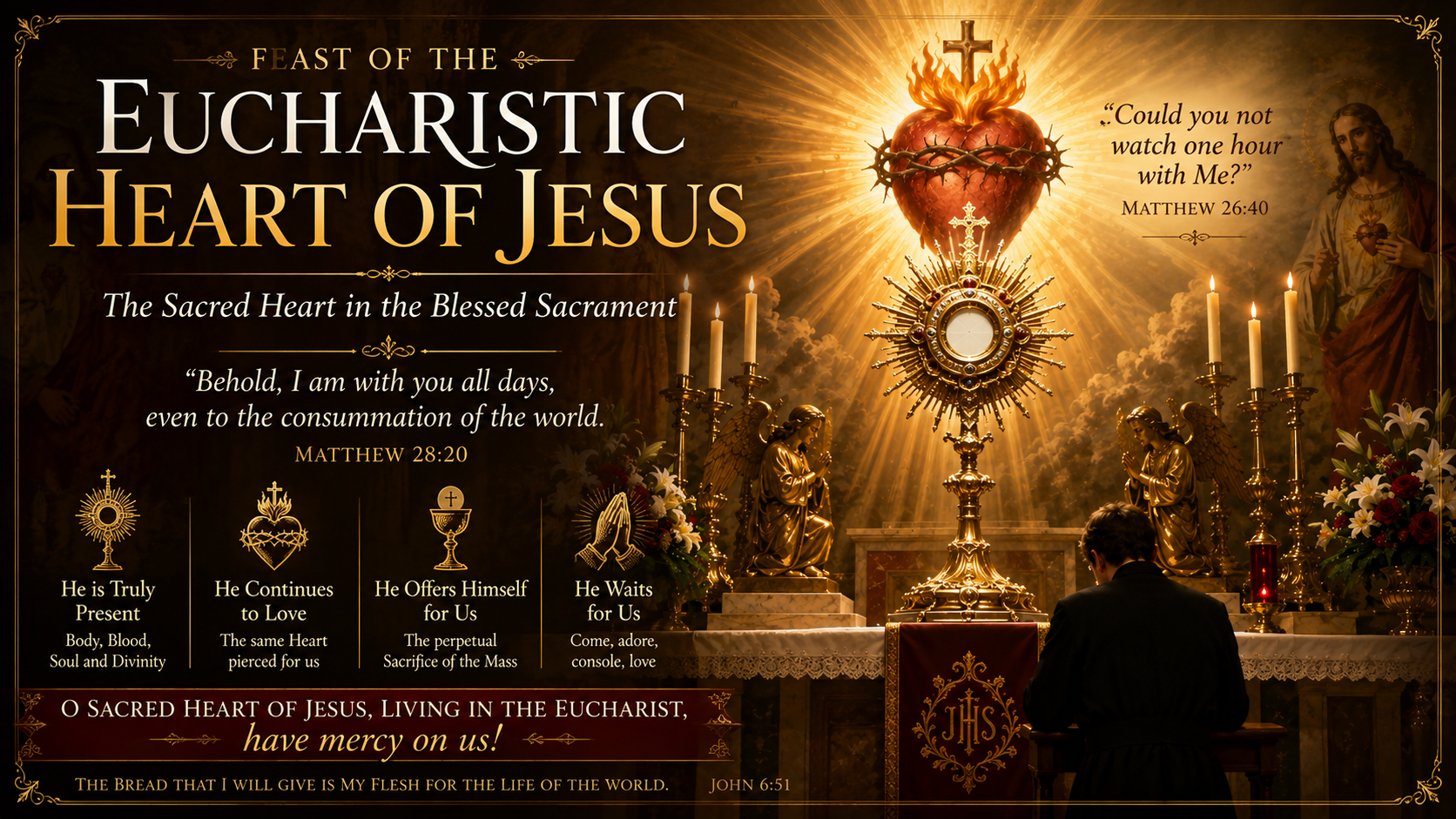
The Eucharistic Heart of Jesus: The Living Heart of the Church
The Feast of the Eucharistic Heart of Jesus, celebrated on the Thursday after the Feast of the Sacred Heart, is one of the Church’s most profound yet neglected observances. Rooted in Scripture, the Fathers, scholastic theology, Eucharistic mysticism, and the Church’s liturgical tradition, it invites the faithful to contemplate the enduring presence of Christ’s sacrificial love in the Blessed Sacrament. In an age of distraction and spiritual forgetfulness, the feast reminds Catholics that the Church lives from the Heart of Christ, sacramentally present in the Holy Eucharist.

The Feast of the Eucharistic Heart of Jesus is one of the most profound yet least appreciated treasures of the Church’s liturgical and devotional life. Celebrated on the Thursday following the Feast of the Sacred Heart, it invites the faithful to contemplate a reality that stands at the very centre of Catholic faith: the enduring presence of the love of Christ in the Most Holy Eucharist. While the Feast of the Sacred Heart directs attention to the divine charity revealed in the humanity of Our Lord, the Feast of the Eucharistic Heart focuses upon that same charity as it continues its work through Christ’s sacramental presence in the Church. The distinction is subtle but significant. The Eucharistic Heart devotion asks not only how Christ loved but where that love remains active in the world.
The origins of the feast lie in the flowering of Eucharistic spirituality that characterised the nineteenth and early twentieth centuries, particularly through the influence of St Peter Julian Eymard and the Congregation of the Blessed Sacrament. Yet the theological roots of the devotion extend much deeper. They are found in the Gospel itself, in the writings of the Fathers, in the theology of the scholastics, and in the mystical tradition of the Church. The devotion did not arise because Catholics wished to create a new object of piety. Rather, it emerged from the recognition that the Sacred Heart devotion naturally reaches its fulfilment in the Eucharist. The Heart that was formed in the womb of the Blessed Virgin, that beat with compassion for sinners, that was troubled in Gethsemane, and that was pierced upon Calvary remains present in the Blessed Sacrament. The Eucharistic Heart is therefore not a different heart from the Sacred Heart; it is the Sacred Heart contemplated under its sacramental aspect.
The Fathers of the Church saw profound significance in the piercing of Christ’s side recorded by St John. “One of the soldiers with a spear opened his side, and immediately there came out blood and water.”¹ For St Augustine, this was not merely the final indignity inflicted upon a corpse. It represented the birth of the Church from the side of the New Adam just as Eve had been formed from the side of the first Adam.² St John Chrysostom likewise saw in the blood and water the mysteries of the sacraments flowing from Christ to His Church.³ The Church, therefore, lives from what proceeds from the Heart of Christ. The sacraments are not external additions to the Christian life but the very means by which the life of Christ is communicated to His members.
This patristic insight would later be deepened by medieval theologians and mystics. St Bonaventure taught that the wound in Christ’s side was opened so that souls might enter into the sanctuary of His Heart and contemplate the immensity of divine love.⁴ St Gertrude the Great frequently described mystical experiences in which she heard the beating Heart of Christ and understood it as the source of life for the whole Church.⁵ St Mechtilde of Hackeborn spoke of the Sacred Heart as an inexhaustible treasury from which all grace flows.⁶ These mystics were not introducing novelties but drawing out the implications of truths already present in Scripture and Tradition. The Heart of Christ was understood not merely as a symbol but as the privileged manifestation of the divine charity that sustains the entire economy of salvation.
The Church’s theological reflection reached a particular clarity in the work of St Thomas Aquinas. Although Aquinas did not write specifically about the Sacred Heart devotion as later generations would know it, his Eucharistic theology provides its intellectual foundation. He teaches that the Eucharist differs from all other sacraments because it contains not merely grace but Christ Himself.⁷ Every other sacrament confers grace through Christ; the Eucharist confers Christ Himself, who is the source of grace. Consequently, when Catholics adore the Blessed Sacrament, they are not venerating a sacred object or recalling a past event. They are worshipping the living Christ, whole and entire, body, blood, soul, and divinity.
This theological principle lies at the heart of the feast. The Eucharistic Heart devotion insists that the Eucharist is personal. The Blessed Sacrament is not simply the continuation of Christ’s teaching or the memorial of His sacrifice. It is Christ Himself continuing His presence among His people. The Eucharistic Heart therefore signifies the perpetual action of Christ’s love within the Church. The Incarnation did not conclude at the Ascension. Through the Eucharist, Christ continues to dwell among His people, hidden beneath sacramental veils yet no less real than when He walked the roads of Galilee.
This insight was central to the spirituality of St Peter Julian Eymard, often called the Apostle of the Eucharist. Eymard repeatedly described the Eucharist as the continuation of the Incarnation.⁸ Just as the divinity of Christ was hidden beneath the ordinary appearance of His humanity, so His glorified humanity is hidden beneath the appearances of bread and wine. The humility of Bethlehem, the obscurity of Nazareth, and the self-emptying of Calvary all continue in the Eucharist. For Eymard, the tabernacle was not merely a repository for the Blessed Sacrament but the dwelling place of the living Christ, whose Heart remains turned toward humanity with the same love that moved Him to redeem the world.
The liturgical placement of the feast illuminates this theology. Corpus Christi celebrates the gift of the Eucharist. The Feast of the Sacred Heart celebrates the divine charity from which that gift proceeds. The Feast of the Eucharistic Heart then contemplates the continuing operation of that charity in the sacramental life of the Church. The sequence is profoundly logical. It leads the faithful from the mystery of Christ’s Presence to the mystery of His Love and finally to the mystery of His Loving Presence. The Eucharistic Heart feast thus serves as a bridge between Eucharistic theology and Sacred Heart spirituality, demonstrating that the two devotions are inseparable.
The magisterial tradition of the Church strongly supports this understanding. Pope Pius XII’s encyclical Haurietis Aquas remains the definitive theological treatment of devotion to the Sacred Heart. There the Pope explains that the Heart of Jesus signifies the entirety of Christ’s love: human, spiritual, and divine.⁹ Through the hypostatic union, the human Heart of Jesus becomes the natural symbol of God’s infinite charity. The devotion is therefore not sentimentalism but Christology. It directs attention to the mystery of the Word made flesh and to the love by which He accomplished redemption.
One of the most intriguing developments of recent decades has been the scientific investigation of several Eucharistic miracles. While Catholic faith does not depend upon such phenomena, and the Church has always exercised great caution in evaluating them, the findings of certain investigations have attracted considerable attention. The most famous example is the miracle of Lanciano, traditionally dated to the eighth century and subjected to scientific analysis in the 1970s by Professor Odoardo Linoli. His examination concluded that the flesh preserved in the reliquary consisted of genuine human myocardial tissue and that the blood was human blood of type AB.¹⁰
Subsequent investigations into reported Eucharistic miracles at Buenos Aires, Sokolka, Tixtla, and Legnica have yielded remarkably similar findings. Independent examinations identified human cardiac tissue, often originating from the myocardium of the left ventricle and exhibiting characteristics associated with severe physiological stress.¹¹ These findings do not constitute proof of the doctrine of the Real Presence, which rests upon divine revelation and the Church’s teaching authority. Nevertheless, they are noteworthy for their symbolic coherence. The Church has always associated the Eucharist with the sacrificial love of Christ and has long contemplated the Blessed Sacrament as the sacrament of His Heart. It is therefore striking that when extraordinary Eucharistic phenomena have been examined scientifically, the tissue repeatedly identified has been cardiac tissue rather than tissue from another part of the body. The convergence between traditional theology, devotional intuition, and forensic observation is difficult to overlook.
This evidence acquires additional significance when viewed through the lens of the feast itself. The Eucharistic Heart devotion teaches that Christ remains sacramentally present not merely as an object of adoration but as a living subject who continues to love, intercede, and offer Himself for the salvation of souls. The repeated appearance of myocardial tissue in these investigations serves as a vivid reminder that Catholic devotion to the Heart of Jesus is not simply symbolic language. The Heart occupies a central place in Catholic spirituality because it represents the living charity by which Christ redeemed the world and through which He continues to nourish His Church in the Holy Eucharist.
This perspective also sheds light upon the traditional emphasis on reparation. Modern Catholics sometimes struggle to understand the language of consoling the Heart of Jesus. Yet the concept is deeply rooted in Scripture and spirituality. The revelations to St Margaret Mary repeatedly emphasise human ingratitude, indifference, and neglect.¹² The Eucharistic Heart devotion applies this insight to the Blessed Sacrament. Christ remains present among His people, yet so often receives little attention in return. The language of reparation does not imply any deficiency in God. Rather, it recognises that love naturally seeks a response. Adoration, visits to the Blessed Sacrament, Holy Hours, and acts of reparation are therefore expressions of friendship and fidelity toward the Lord who remains sacramentally present.
The feast also offers a corrective to some of the characteristic temptations of contemporary Christianity. The modern Church often becomes preoccupied with programmes, strategies, structures, and initiatives. Such concerns have their place, but they can obscure the deeper reality from which all authentic renewal proceeds. Every significant reform in the history of the Church has been rooted in a return to Christ Himself. The great monastic renewals, the missionary expansions, the flourishing of religious orders, the revival of Eucharistic congresses, and the lives of the saints all emerged from a profound Eucharistic spirituality. The Church is renewed not principally through administration but through sanctity, and sanctity is nourished above all by intimacy with Christ in the Eucharist.
The Feast of the Eucharistic Heart therefore possesses a particular relevance in an age marked by distraction, activism, and spiritual fragmentation. It reminds Catholics that the centre of the Church is neither an institution nor a programme but a Person. Christ remains present in the Blessed Sacrament. His Heart continues to burn with the same charity that moved Him to become man, to suffer, to die, and to rise again. The Eucharistic Heart devotion invites the faithful to return to that source, recognising that every grace, every renewal, and every hope for the future of the Church ultimately flows from Him.
In the end, the Feast of the Eucharistic Heart of Jesus directs attention to the deepest reality of Catholic life. The Church lives because Christ lives. The Church loves because Christ first loved her. The Church endures because Christ remains present within her. Hidden beneath the sacramental veils of the Eucharist is the living Heart of the Redeemer, the inexhaustible source of grace, mercy, and divine charity. To contemplate the Eucharistic Heart is therefore to contemplate the very centre of the Christian mystery: the God who loved mankind so greatly that He not only died for them, but chose to remain among them until the end of time.
¹ John 19:34 (Douay-Rheims).
² St Augustine, Tractates on the Gospel of John, Tractate 120.
³ St John Chrysostom, Homilies on the Gospel of John, Homily 85.
⁴ St Bonaventure, Vitis Mystica, ch. 3.
⁵ St Gertrude the Great, The Herald of Divine Love, Book IV.
⁶ St Mechtilde of Hackeborn, Liber Specialis Gratiae, Book I.
⁷ St Thomas Aquinas, Summa Theologiae, III, q.73, a.3.
⁸ St Peter Julian Eymard, The Real Presence and selected Eucharistic writings.
⁹ Pope Pius XII, Haurietis Aquas (1956), §§22–29.
¹⁰ Odoardo Linoli, Ricerche istologiche, immunologiche e biochimiche sulla Carne e sul Sangue del Miracolo Eucaristico di Lanciano (1971).
¹¹ Archdiocese of Buenos Aires investigative documentation; Diocese of Sokolka Scientific Commission Report (2009); Diocese of Chilpancingo-Chilapa Commission Report on Tixtla (2013); Diocese of Legnica Scientific Commission Report (2016).
¹² St Margaret Mary Alacoque, Autobiography and Letters.
related articles


Latest articles
- QUI BENE DISTINGUIT, BENE DOCET ~ He who distinguishes well, teaches well: Spiritual Conference for Nuntiatoria CXXIIIIn a series of Tuesday conferences, the speaker explores themes about recognising reality, receiving divine gifts, and understanding spiritual truths. He highlights the importance of making careful distinctions to maintain sound judgment, especially in an age consumed by distractions and superficial assessments. True wisdom lies in distinguishing truth from perception and nurturing an authentic inner life centred on Christ.
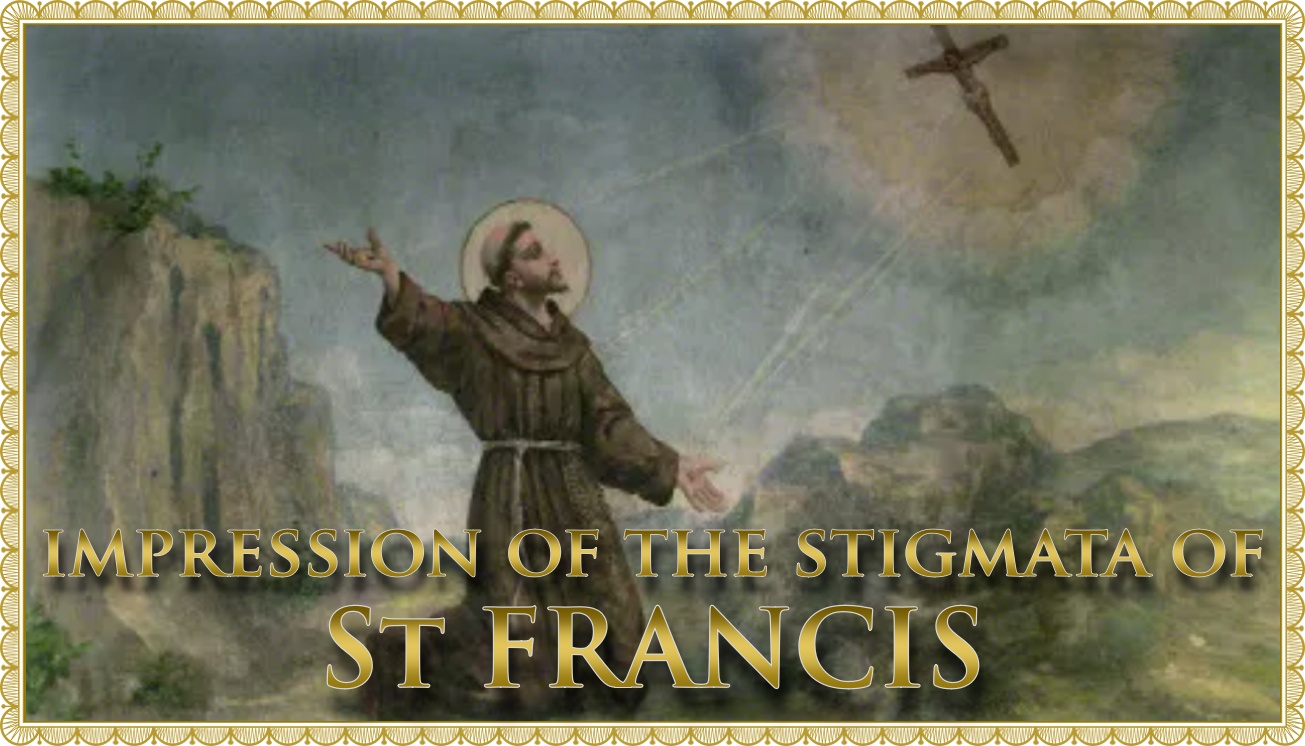
- Today’s homily: Impression of the Stigmata upon St FrancisFrom serving the lepers he once shunned to receiving Christ’s wounds upon Mount Alvernia, Saint Francis shows how grace transforms a soul through obedient love. His stigmata call us to let the Cross shape our lives, beginning with the particular act of mercy or sacrifice we have been reluctant to offer.
- Today’s Mass: September 17 Impression of the Stigmata of St Francis of AssisiSaint Francis received the stigmata because he had first allowed the Cross to transform his soul. His wounds were not a spectacle, but God’s answer to a world growing cold: the visible sign of a life consumed by crucified love. We may never bear Christ’s wounds in our flesh, but we must bear their likeness through penance, fidelity, patience, mercy and sacrificial love.
- Sermon for Stigmata of St. FrancisToday marks the feast of St. Francis’ stigmata, celebrating his transformation from a wealthy merchant’s son to a devoted preacher of poverty and humility. He founded the Franciscan order, emphasising evangelisation and simplicity. His experience of receiving the stigmata exemplifies the Christian doctrine of redemption through suffering, distinguishing it from other faiths.
- Today’s homily: Wednesday Michaelmas EmberThe homily reflects on the significance of fasting and prayer in the Christian faith, emphasising their role in spiritual growth and self-mastery. By juxtaposing scripture from Amos and the Gospel of Mark, it highlights the need for gratitude and humility during abundance, urging believers to recognise their dependence on God. True repentance transforms and restores one’s relationship with Him.



Leave a Reply