

The Empty Altar: Bolzano Cathedral and the Synodal Substitution of the Priesthood
The replacement of an anticipated Sunday Mass in Bolzano Cathedral by a lay-led celebration of the Word was presented as an historic development in female ministry. The event was not an attempted Mass and may have been canonically authorised. Its deeper significance lies in the public transformation of Eucharistic deprivation into ecclesiastical progress—and in the striking correspondence between that symbolism and the emerging synodal reconstruction of priesthood, formation and doctrinal authority.

On Saturday, 14 March 2026, the anticipated Sunday Mass in the Cathedral of the Assumption at Bolzano was replaced by a celebration of the Word led by Maja Clara, a journalist employed by the provincial press agency. ANSA’s language was unambiguous: the service was conducted in sostituzione della messa prefestiva—“in substitution for the anticipated Mass.” Clara had undertaken theological formation at Bressanone, received a mandate from Bishop Ivo Muser and led similar services in smaller churches for approximately ten years. It was, however, the first time that a woman had performed this function in the cathedral.¹
The facts require precision. Clara did not pretend to celebrate Mass. She did not pronounce the words of consecration, claim priestly ordination or simulate the Eucharistic Sacrifice. Canon law permits lay persons, when the needs of the Church warrant it and sacred ministers are lacking, to exercise certain functions, including the ministry of the word and the direction of liturgical prayers. Nothing publicly reported establishes that the celebration itself was unauthorised.²
The central problem is therefore not that a woman prayed publicly, proclaimed readings or directed an authorised gathering. Neither is it necessary to accuse Clara personally of sacramental pretence. The problem is that a scheduled anticipated Mass disappeared from the cathedral, a lay-led service occupied its place, and the substitution was narrated not principally as an unfortunate deprivation but as an advance in female ecclesiastical ministry.
That distinction is decisive. An emergency provision is Catholic when it assists the faithful through a genuine absence while preserving their hunger for the Eucharist and their understanding that something irreplaceable is missing. It becomes ideologically charged when the absence itself is repackaged as opportunity: the empty altar becomes the stage upon which another ministerial identity may be advanced.
The Gloria.tv report drew attention to the Italian description of Clara as la celebrante—“the celebrant”—and to her recollection that, as a child, she had wanted to become a female parish priest. ANSA reported the same childhood aspiration and concluded that rural parishes had been “further ahead” in using such services, while the cathedral was now taking the same step. The vocabulary of progress is unmistakable. This was not presented merely as making the best of an unavoidable Saturday evening without a priest. It was presented as the cathedral catching up.³
Words matter because liturgy teaches by more than propositions. The Church may explain afterwards that the woman was not a priest, that the service was not Mass and that no Eucharistic consecration occurred. The public image nevertheless remains: at the hour previously assigned to Mass, the priest has vanished; another figure stands before the congregation; much of the verbal and ceremonial shape of worship continues; the media call that figure “the celebrant”; and the occasion is reported as a milestone.
Doctrine is not always overthrown first by a decree. It may be weakened by a long alteration of instinct. What the faithful repeatedly see eventually influences what they believe possible. Once the priest is habitually absent from the visible governance, teaching and prayer of the community—appearing chiefly when sacramental consecration or absolution is required—his sacred office is easily reduced in the popular imagination to that of a sacramental technician.
The Church’s own legislation shows why this is dangerous. Redemptionis Sacramentum states that celebrations held in the absence of a priest must remain “altogether extraordinary.” Those directing them must preserve a genuine hunger for the Eucharist, avoid every confusion with Mass and ensure that no opportunity for Eucharistic celebration is missed. When both priest and deacon are absent, the instruction prefers that the parts be distributed among several people rather than that one lay person direct the whole celebration. It adds that it is never appropriate to describe a lay person as “presiding.”⁴
Bolzano created precisely the public impression against which those provisions were directed: a single lay leader visibly occupying the place associated with the absent priest, directing a service substituted for the anticipated Mass and being described as its “celebrant.” Even when every rubric has been observed, the surrounding presentation may still contradict the theological restraint that the Church demands.
Canon law likewise maintains an absolute distinction between Mass and the provision made when Mass is impossible. The Sunday obligation is fulfilled by assisting at Mass on the Sunday itself or on the preceding evening. Only when participation in the Eucharistic celebration has become impossible because of the absence of a sacred minister or another grave cause are the faithful strongly encouraged to attend a celebration of the Word or devote an appropriate period to prayer. The latter is not another means of satisfying the obligation. It is spiritual provision amid an acknowledged impossibility.⁵
The public reports do not explain why a priest could not celebrate the cathedral Mass on 14 March. It would therefore be improper to allege without further evidence that no pastoral necessity existed. It is equally improper, however, to evade the question. If a celebration authorised only for circumstances of ministerial absence replaces Mass in a cathedral, the faithful are entitled to know why the Eucharist could not be offered and what efforts were made to secure a priest.
The numerical argument sharpened by Gloria.tv must also be handled accurately. A crude ratio between nominal Catholics and every priest resident in a diocese cannot establish how many priests are available for parish work on a particular evening. The official diocesan figures nevertheless disclose something more serious than an isolated scheduling difficulty. Bolzano-Bressanone lists 169 diocesan priests and 141 religious priests, but only sixty of each category engaged in parish pastoral ministry. Of its 281 parishes, only seventy-two have resident parish priests. Most strikingly, the diocese records no diocesan candidates for the priesthood.⁶
There is therefore a genuine structural crisis, but it cannot adequately be described as a natural shortage that simply descended upon the diocese. A local Church possessing hundreds of priests, hundreds of commissioned lay leaders and nearly three hundred parishes has produced no diocesan seminarian. The primary question is not how many lay people can be trained to administer decline, but why decades of pastoral policy have failed to inspire a single local candidate to offer himself for the altar.
Substitution can become self-perpetuating. Fewer active priests result in more lay-led services. More lay-led services diminish the visible uniqueness and daily presence of the priest. A priesthood increasingly reduced to occasional sacramental functions becomes less intelligible and less attractive to young men. The resulting absence is then invoked as the reason for constructing still more elaborate systems of substitution.
An extraordinary expedient may thus cease to function as a bridge until the priest returns and become the normal architecture of a Church learning to continue without him. Instead of making the empty altar intolerable, the institution learns to decorate the emptiness. Instead of asking why there are no seminarians, it commissions an alternative ministerial class. Instead of treating Eucharistic absence as a wound, it celebrates the identity of the person standing before the wound.
This is where the LifeSite essay supplied by Father Enoch becomes directly relevant. Its rhetoric is deliberately confrontational, and some of its conclusions go beyond what the documents themselves expressly state. Yet the documentary connection it identifies is real: the synodal programme does not concern meetings alone. It proposes a structural reform of priestly formation designed to produce priests whose identity, methods and exercise of authority are explicitly synodal.⁷
The final report of Synod Study Group 4 states that synodality must affect “the methods of formation for the ordained ministry.” It declares that this is not a matter of minor adjustments, but requires a conversion of hearts, minds, relationships and processes that must become personal, communal and structural. It proposes that ordained ministry be defined “in and from” the People of God, that all the baptised participate broadly in forming future pastors, and that particular attention be given to the contribution of women and families.⁸
The report goes considerably further than recommending that seminarians possess ordinary social maturity or learn to listen courteously. It calls for competent women to be made “co-responsible at all levels of formation,” including within formation teams and vocational discernment. It says that responsibility for forming future priests cannot remain limited to the bishop and those directly entrusted with formation, but requires the contribution of the entire People of God. The views and assessments of women are to receive particular importance even in the process preceding the conferral of Holy Orders.⁹
There can be legitimate contributions from families, parishioners, religious, teachers and professionally qualified women. No prudent bishop should ignore reliable evidence concerning a candidate’s character, conduct, emotional maturity or suitability for pastoral life. The danger lies not in receiving such evidence but in the theoretical relocation of formative authority.
Canon law says that the Church has the proper and exclusive right to form those designated for sacred ministry. The bishop remains the judge of a vocation and the guardian of Holy Orders in his diocese. When “co-responsibility” is expanded to all levels of formation, discernment and assessment, the question becomes whether these contributions serve the bishop’s sacred authority or gradually become an ecclesiastical constituency to which the bishop and candidate must conform.²
The Study Group’s desired product is not merely a holy and orthodox priest who also listens well. It repeatedly calls for men formed in a specifically “synodal spirit,” equipped for listening, dialogue, co-responsibility and ecclesial discernment. These qualities may be understood innocently, but they can also become tests of ideological conformity. A seminarian who maintains the hierarchical constitution of the Church, the distinct authority of Holy Orders or the immutability of settled moral teaching may increasingly be judged not as faithful but as insufficiently relational, insufficiently participatory or insufficiently synodal.
The Bolzano event reveals the practical ecclesiology towards which such formation may tend. The community’s ordinary life, public prayer and administration continue through a network of commissioned ministries. The priest is not necessarily the spiritual father who offers sacrifice, teaches with authority and governs a particular flock. He becomes one minister among others, possessing certain reserved sacramental powers but expected to exercise them within a structure whose direction, evaluation and “discernment” are increasingly shared.
That does not abolish the priesthood by formally ordaining women. It hollows out the priesthood function by function until ordination appears to add little more than the ability to consecrate, absolve and anoint. The ordained man remains sacramentally indispensable but pastorally peripheral.
This is not the defeat of clericalism. It is the creation of a new lay clericalism. Lay functionaries acquire mandates, ecclesiastical offices, sanctuary roles, liturgical prominence, formative authority and participation in governance. They reproduce many of the external marks of clerical status while the actual priest is discouraged from exercising the paternal, doctrinal and governing authority proper to his order.
The laity are not thereby exalted. Their distinctive vocation is principally to sanctify family, work, education, culture, politics and civil society. When the advancement of the laity is imagined chiefly as placing more lay people in sanctuaries, seminaries and chancery structures, the laity are clericalised while the temporal order they are particularly called to Christianise is abandoned.
Women are not honoured by teaching them that ecclesiastical dignity increases according to proximity to the priest’s liturgical place. The Church’s history is illuminated by female martyrs, mystics, founders, abbesses, missionaries, mothers and Doctors whose authority arose not from simulating priesthood but from holiness, truth and heroic fidelity to their own vocations.
The LifeSite essay also connects Study Group 4’s reconstruction of priestly formation with Study Group 9’s proposed method for handling “emerging doctrinal, pastoral and ethical issues.” That connection is not artificial. A priest formed primarily as a guardian and teacher of revealed truth will approach experience in the light of doctrine. A priest formed primarily as a facilitator of communal discernment may be expected to permit experience itself to become generative of doctrinal reformulation.
Study Group 9 explicitly advocates a “paradigm shift” from what it describes as the prevalent methods of past centuries. It proposes a historical, experiential, practical and contextual hermeneutic and rejects a model in which general doctrinal principles are simply applied to concrete circumstances. Its section on homosexuality reproduces a testimony asserting that the root of sin does not lie in a same-sex couple relationship and subsequently asks whether the word “marriage” may be used in relation to persons of the same sex.¹⁰
The report does not formally promulgate a new doctrine of marriage, and fairness requires that this be acknowledged. It says that it is not attempting to force a new doctrine. Yet it simultaneously proposes to overcome the model in which practice is derived from established teaching and asks communities to discern the “good” said to be inscribed within experiences and practices.
The danger lies in the method. A settled moral truth is reclassified as an emerging question. Testimonies that contradict that truth are elevated as theological data. The existing doctrine becomes one voice within a process rather than the norm by which the process is judged. Those who insist that revelation and natural law have already answered the question may then be portrayed as rigid, fearful or unwilling to listen.
The process does not guarantee doctrinal reversal, but it creates the machinery by which reversal can be described as development. The proposed reconstruction of priestly formation ensures that future clergy will be trained not merely to tolerate that machinery but to operate it.
The June 2026 extraordinary consistory brought these themes together at the highest level. Vatican News reported that the cardinals discussed presenting a priesthood that was “beautiful, creative, evangelical, and at the same time not clerical.” They also affirmed that the hierarchy and the People of God participate, though differently, in discerning what the Spirit says to the Church, while acknowledging that complex consultation processes might weigh the Church down.¹¹
Properly understood, opposition to clericalism is entirely Catholic. The priesthood is not an aristocracy, a professional caste or a means of personal advancement. The priest receives authority in order to spend himself for souls. His dignity lies in sacrificial service, not privilege.
The contemporary ambiguity lies in treating the sacred authority of Orders itself as clericalism. A priest who teaches revealed doctrine without submitting it to communal negotiation, governs his parish as a spiritual father, guards the sanctuary, distinguishes ordained from lay ministry and insists upon the objective demands of the moral law may now be suspected of possessing the wrong kind of priestly identity.
The Catholic priest is not created by the community and does not receive his essential authority from its recognition. Through Holy Orders he is sacramentally configured to Christ the Head and Shepherd. At the altar he acts in persona Christi Capitis, offering not a communal celebration of itself but the Sacrifice of Christ. His priesthood exists for the Eucharist, and the Eucharist cannot be manufactured by participation, delegated by committee or supplied by episcopal mandate to a lay person.
The impossibility of ordaining women is therefore not an administrative inequality awaiting synodal correction. Saint John Paul II declared that the Church possesses “no authority whatsoever” to confer priestly ordination upon women and that this judgement must be definitively held by all the faithful.¹²
It is possible, however, to retain that doctrine verbally while weakening its meaning ritually. One need not call a woman a priest if she is called “the celebrant.” One need not ordain her if she is commissioned to occupy the priest’s normal place whenever he is absent. One need not deny sacramental distinction in a document if the faithful are repeatedly presented with a visual approximation of equivalence.
Bolzano Cathedral is therefore significant not because Maja Clara committed sacramental simulation, but because the empty altar was made to signify progress. The priest’s absence provided the occasion for celebrating a new ministerial visibility. The diocese’s lack of seminarians supplied not a summons to recover priestly identity but a reason to expand structures capable of functioning without priests.
The response to a priestly crisis cannot be to make the priest less necessary. The Church needs men who understand that ordination sets them apart not for status but for sacrifice; men who offer Mass as though Calvary were real, absolve penitents as though souls could be lost, preach doctrine as a divine deposit rather than a negotiable proposal, and govern their people as fathers who must answer before God.
The faithful were not deprived merely of one item in a weekly programme when the anticipated Mass disappeared. They were deprived of the sacramental re-presentation of the Sacrifice of the Cross. They could hear the Scriptures and offer sincere prayer, but no authorised lay ministry could supply what only the priest, acting in the person of Christ, could give them.
That deprivation should have been marked by gravity, regret and a renewed prayer for vocations. Instead, the event was narrated as a step forward.
The Mass was absent. The priest was absent. The diocese had no seminarians. The woman standing before the empty altar became the story.
That is not renewal. It is the crisis of the priesthood transformed into a ceremony.
¹ ANSA, “Domani la prima liturgia della parola di una donna nel Duomo di Bolzano,” 13 March 2026.
² Codex Iuris Canonici, canons 230 §3, 232–233.
³ Gloria.tv, “Woman Leads Liturgy on Saturday in Cathedral Instead of Eucharist”; ANSA, “Domani la prima liturgia della parola di una donna nel Duomo di Bolzano.”
⁴ Congregation for Divine Worship and the Discipline of the Sacraments, Redemptionis Sacramentum, §§162–166, 23 April 2004.
⁵ Codex Iuris Canonici, canons 1247–1248.
⁶ Diocese of Bolzano-Bressanone, “Zahlen, Daten und Fakten,” statistics at 1 November 2025.
⁷ Father Enoch, “The synodal church’s plot to emasculate the priesthood of Christ, overturn the moral order,” LifeSiteNews, 23 June 2026.
⁸ General Secretariat of the Synod, Study Group 4, The Revision of the Ratio Fundamentalis Institutionis Sacerdotalis from a Synodal Missionary Perspective, pp. 4–5.
⁹ Study Group 4, The Revision of the Ratio Fundamentalis Institutionis Sacerdotalis from a Synodal Missionary Perspective, pp. 16–17.
¹⁰ General Secretariat of the Synod, Study Group 9, Theological Criteria and Synodal Methodologies for Shared Discernment of Emerging Doctrinal, Pastoral and Ethical Issues, pp. 8–10, 24–27.
¹¹ Vatican News, “Consistory: Fourth session focuses on the Synod and priesthood,” 27 June 2026.
¹² John Paul II, Apostolic Letter Ordinatio Sacerdotalis, §4, 22 May 1994.
RELATED ARTiCLES


LATEST ARTICLES
- Today’s Mass: September 05 Saint Lawrence JustinianSaint Lawrence Justinian, the first Patriarch of Venice, dedicated his life to the poor and the establishment of monasteries, rejecting noble marriage. Renowned for his humility and pastoral dedication, he emphasised the spiritual integrity of Venice’s safety. He was a precursor to the reforms of the Council of Trent, dying on 8 January 1455.
- 06.09.26 Nuntiatoria CXXII: NOMEN MANET, RES DEESTThis edition of Nuntiatoria explores the disconnect between the names of Catholic institutions and the realities they signify. Despite retaining their titles, many aspects of Catholicism—such as episcopal authority in China and religious practice in Poland—exhibit deteriorating substance. The piece cautions against superficial continuity, stressing the importance of genuine faith and practice over mere nomenclature.
- ORDO w/c 06.09.26The document outlines the liturgical schedule for the week of 6 to 13 September 2026, highlighting significant religious observances such as the Fifteenth Sunday after Pentecost and the Nativity of the Blessed Virgin Mary. It reflects on themes of compassion, holiness, fidelity, and humility, underscoring their importance in Christian life.
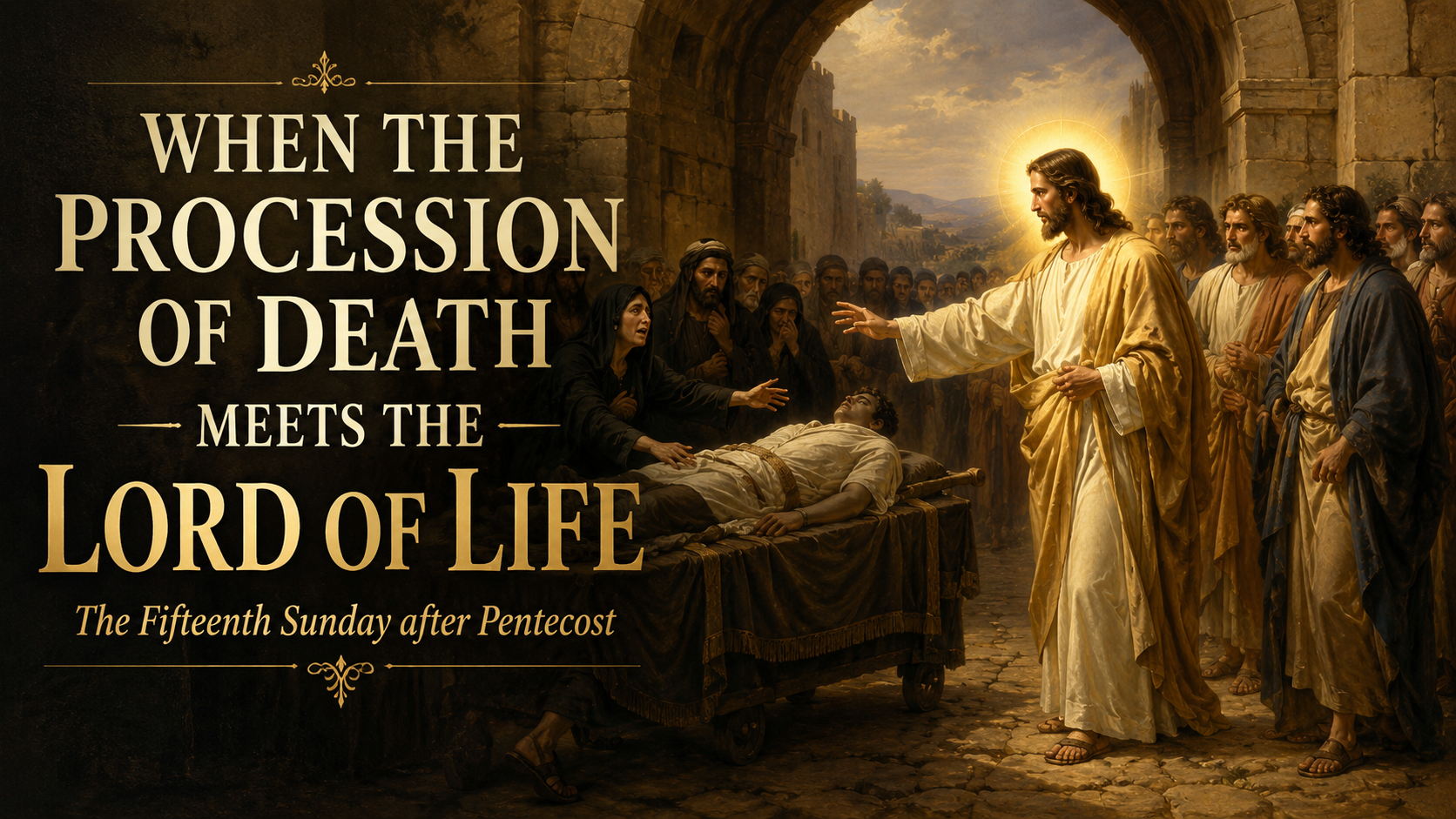
- The Fifteenth Sunday after Pentecost: When the Procession of Death Meets the Lord of LifeThe Fifteenth Sunday after Pentecost focuses on the transformative power of Christ, emphasising the supernatural life granted through grace. The liturgy highlights the Church’s role as a nurturing mother, mourning the spiritually dead while seeking their restoration. Christ’s compassion leads to resurrection, demonstrating that true life is found in dependence on Him.
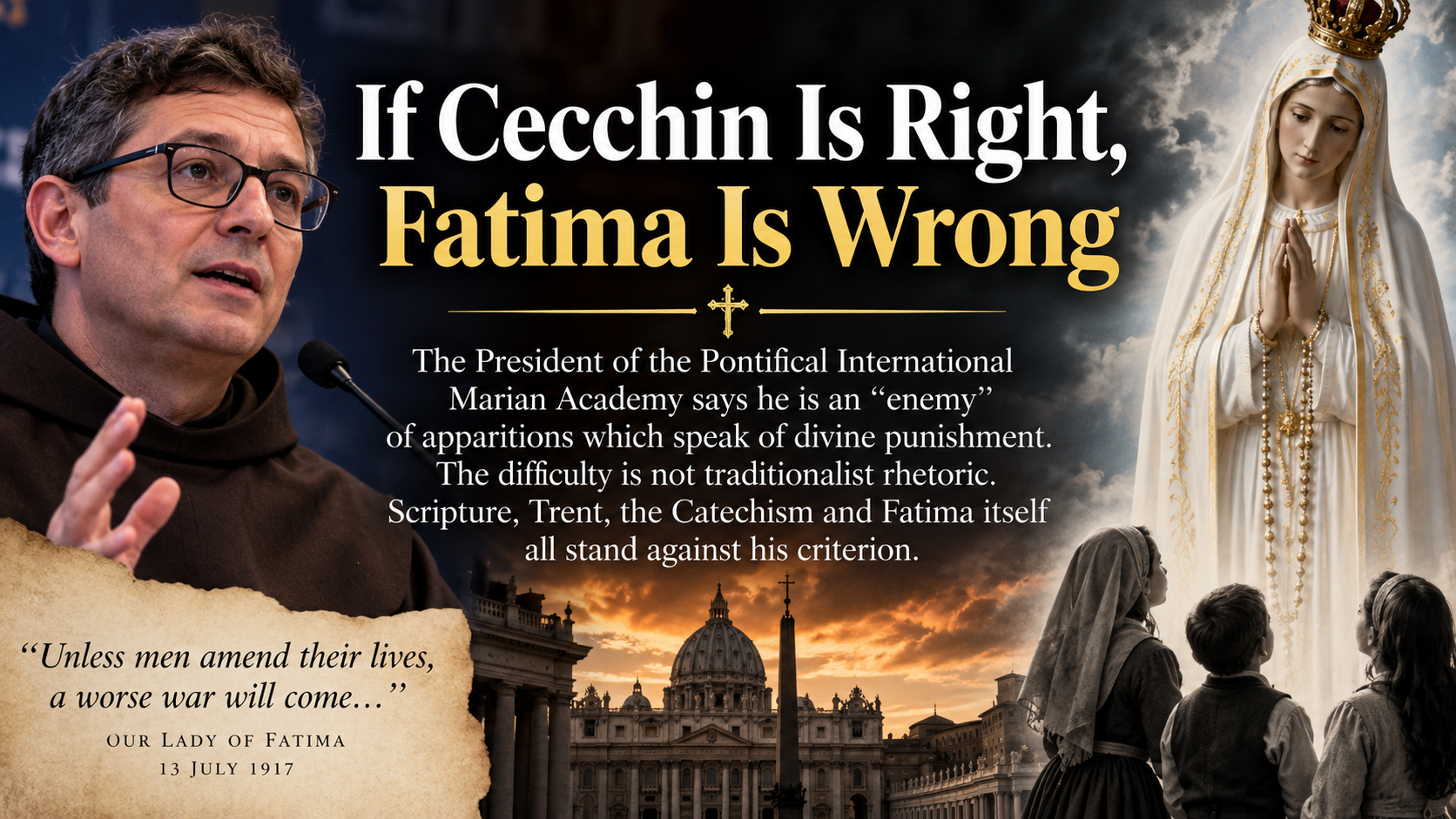
- If Cecchin Is Right, Fatima Is WrongFr Stefano Cecchin, President of the Pontifical International Marian Academy, has declared opposition to apparitions that speak of divine punishment, suggesting they are false. This stance contradicts fundamental Catholic doctrine, including teachings from Scripture, the Catechism, and specifically the Message of Fatima, which warns of divine consequences for sin.
CURRENT EDITION


Today’s Mass Propers
- Today’s Mass: September 05 Saint Lawrence Justinian
 Saint Lawrence Justinian, the first Patriarch of Venice, dedicated his life to the poor and the establishment of monasteries, rejecting noble marriage. Renowned for his humility and pastoral dedication, he emphasised the spiritual integrity of Venice’s safety. He was a precursor to the reforms of the Council of Trent, dying on 8 January 1455.



Leave a Reply