
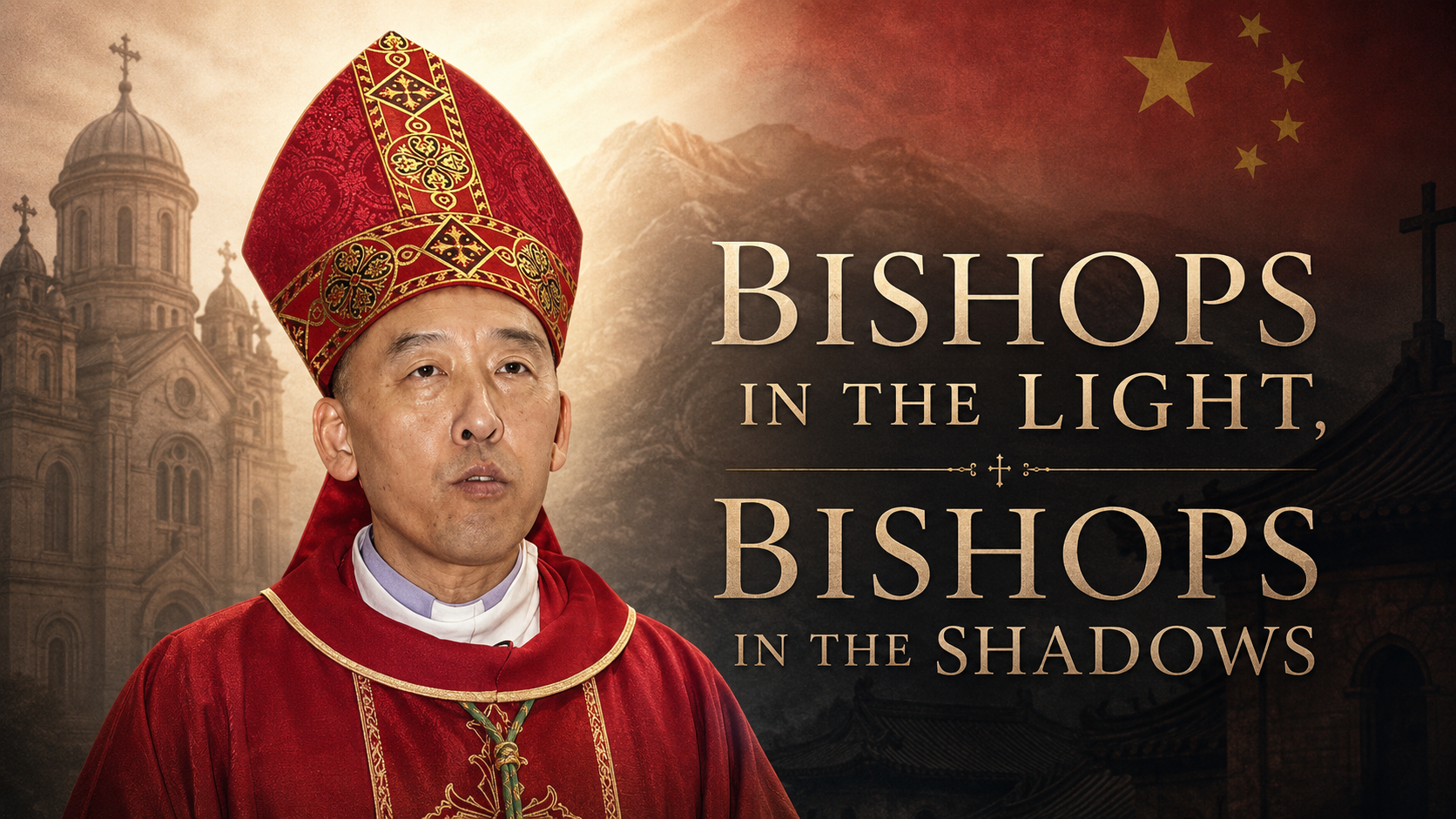
Rome has regularised another bishop produced by China’s state-controlled Catholic system. But the real question is no longer merely who appoints China’s bishops. It is whether the episcopate emerging from the Patriotic Association can still preserve the Catholic Faith.
On 28 April 2026, the state-managed Catholic apparatus in China elected Father Paul Liu Honggang to become Bishop of Datong. On 10 August, Pope Leo XIV appointed him after approving his candidacy within the framework of the still-secret Provisional Agreement between the Holy See and the People’s Republic of China, and on 31 August Liu was consecrated.¹ The chronology is significant. China’s officially recognised Catholic machinery publicly elected the candidate; Rome subsequently appointed him; and the state-recognised Chinese Bishops’ Conference provided its approval for the consecration.² Because the agreement remains secret, it would be irresponsible to claim that Rome necessarily played no part before the Chinese election, but the public sequence remains what it is and immediately raises questions about how much practical freedom the Church possesses in choosing successors of the Apostles under Communist rule. Yet even that is not the deepest problem. The real question is not bureaucracy, diplomatic protocol or merely whether Beijing nominates and Rome approves. The real question is the Faith. What kind of episcopate is this system producing? What conception of episcopal office is being formed within the structures of the Chinese Catholic Patriotic Association? And what does it mean if bishops can emerge from those structures in unquestioned canonical communion with Rome while having already demonstrated extensive accommodation to the ideological demands of an explicitly Communist state?
A bishop is not merely an ecclesiastical administrator possessing jurisdiction over a geographical territory. He is a successor of the Apostles who receives the fullness of Holy Orders so that he may teach the Faith handed down from the Apostles, sanctify the flock entrusted to him, govern it according to the law of Christ and defend it against wolves. Apostolic succession therefore exists for apostolic Faith. The succession of consecrating hands matters because what those hands have received must continue to be handed on. St Paul did not command St Timothy merely to preserve an efficiently functioning chain of ecclesiastical government; he commanded him, “Keep the good thing committed to thy trust by the Holy Ghost, who dwelleth in us.” He required Titus to hold firmly to “the faithful word which is according to doctrine,” and at the end of his own life Paul did not boast that he had preserved an administrative structure but declared, “I have kept the faith.”³ This distinction is indispensable when considering the Chinese episcopate. A man may be genuinely and validly consecrated a bishop while failing terribly to fulfil the purpose of the episcopal office. He may possess sacramental character and canonical jurisdiction while lacking apostolic courage; he may occupy the cathedral, wear the mitre, carry the crozier and appear in the Annuario Pontificio, yet prove unwilling to defend his flock when political power attacks the Faith. The great crises of Church history repeatedly demonstrate this. The horror of the Arian crisis was not that every compromised prelate had somehow ceased sacramentally to be a bishop, but that genuine bishops could fail to confess and defend the divinity of Christ. Their orders were real, and their failure was also real. Sacramental validity does not transform compromise into fidelity.
That is why Datong must be read together with Nuntiatoria’s recent article “The Bishops in the Shadows: China, Écône, and the Question Rome Cannot Avoid.” There we examined historian Anthony E. Clark’s report that perhaps ten bishops have been secretly consecrated in Fujian since the Vatican-China agreement was signed in 2018. We carefully refused to claim what the available evidence did not establish: whether those consecrations occurred with or without secret papal mandates remains unclear. The most important part of the testimony was not the canonical speculation surrounding those consecrations but the explanation reportedly given by an underground Chinese bishop himself. The situation, he said, had become one of emergency because government influence over the episcopate threatened the integrity of the Catholic Faith, and clandestine bishops were being provided to assure the survival of the Church in China.⁴ That supplies the decisive comparison. In one part of China, bishops reportedly disappear into the shadows because Catholics fear that the Faith itself may not survive increasing Communist penetration of ecclesiastical life. In Datong, meanwhile, a bishop emerges publicly through the state-approved apparatus after more than two decades as diocesan administrator, years of senior involvement in the Patriotic Association and a documented record of participation in Communist ideological activity. One episcopate retreats underground because it fears what the State may do to Catholicism; another functions openly within structures the Communist state recognises and supervises. The contrast does not prove the sanctity of every clandestine bishop or the infidelity of every recognised one. It does, however, force the question the Vatican cannot avoid: is having bishops the same thing as having bishops capable of preserving the Faith?
✠Paul Liu’s own record makes that question unusually acute. He is not merely a priest upon whom Chinese authorities reluctantly settled after negotiation with Rome. The official Chinese Catholic account identifies him as vice-chairman of the Shanxi Provincial Catholic Patriotic Association and records that he was elected bishop-designate through the official system on 28 April. At his consecration, the secretary-general of the state-recognised Chinese Catholic Bishops’ Conference read that body’s approval, while the Holy See states that Leo XIV had appointed him on 10 August after approving his candidacy under the Provisional Agreement.⁵ The result is canonically clear enough: Leo appointed him. What remains much less clear is what formation, loyalties and demonstrated qualities now constitute acceptable preparation for the episcopate in China. Benedict XVI had already identified the theological problem with extraordinary precision in his 2007 Letter to the Catholics of China. He distinguished legitimate patriotism and proper cooperation with civil authority from a fundamentally unacceptable ecclesiology, warning against organisations “desired by the State and extraneous to the structure of the Church” placing themselves above bishops and directing ecclesiastical life. The principles of ecclesial “independence and autonomy, self-management and democratic administration” promoted by such structures were, Benedict said, “incompatible with Catholic doctrine.” He insisted that preaching, catechesis, worship, pastoral government and the internal ordering of ecclesial life belong to the Church herself and cannot be surrendered to outside control.⁶ The problem with the Patriotic Association is therefore not that Catholics must somehow cease loving China. Catholics may cherish their country, culture and fellow citizens, honour lawful authority and pray for their rulers. Chinese Catholic martyrs themselves were not enemies of China. The problem arises when the Communist Party demands not merely civic loyalty but the ideological reshaping of religion through “Sinicization,” claiming the practical right to determine how religious communities are organised, how clergy function, what public religious expression is permissible and how the Church must demonstrate conformity to the political priorities of the socialist State. Catholicism may become culturally Chinese; it cannot become ideologically Communist without ceasing to be itself.⁷
Liu’s history shows how close that boundary can become. In October 2018, shortly after the original Vatican-China agreement was signed, he led priests, religious sisters and faithful in Datong at a ceremonial raising of the Chinese national flag. The official Catholic report described the event as occurring under the guidance of Communist Party United Front and religious-affairs authorities and said that it was intended to strengthen national consciousness and encourage adherence to the “socialist core values.”⁸ The difficulty is not the Chinese flag but the ideological programme surrounding it. When a State committed to an officially atheistic political philosophy expects Catholic clergy to demonstrate not simply national loyalty but conformity to its ideological vocabulary, the Catholic question becomes unavoidable: who is catechising whom? Only weeks later, eight people identifying themselves as Catholics of Datong issued an anguished public appeal alleging that a cross and a church had been destroyed, normal Catholic gatherings and celebrations of Mass had been obstructed, Bibles and religious books were difficult to obtain and State interference in Catholic life was intensifying. Their most painful question concerned Rome itself: would Catholics who had suffered for remaining independent of the government-controlled system now become “scapegoats” for improved relations between the Vatican and Beijing?⁹ Liu, then diocesan administrator, responded publicly and firmly, describing the allegations as fictitious, denying that the signatories belonged to his diocese and demanding withdrawal of the report.¹⁰ Both sides must be recorded and it would be wrong to resolve every disputed detail simply by choosing the account that best suits an argument. Yet the broader reality of increasing Party intrusion into Chinese Catholic life is not seriously disputable, and in 2023 authorities in Datong themselves demolished an historic building used by priests and religious sisters.¹¹
The episode of 25 June 2021 is more revealing still, because it moves the question beyond mere membership of official structures into the formation of Liu’s own clergy. Liu personally led priests of the Diocese of Datong through an organised programme of Communist Party-history education. They visited the Daqüanshan memorial and Dongfanghong Museum, were presented with the revolutionary history of the Communist movement, recalled Mao Zedong’s role in that history and examined Mao badges, portraits, quotation books and collected writings. According to the approving official Catholic account, the priests subsequently expressed the hope that China would enjoy still greater prosperity under the leadership of the Communist Party. This was not an accusation issued by an underground dissident or hostile Western organisation but the account published by the state-approved Catholic establishment itself. Liu then composed a poem celebrating the centenary of the Communist Party which the report presented as expressing the sentiments of all the clergy of the Diocese of Datong.¹² Appropriate allowance must always be made for the pressures under which Chinese clergy live, pressures which Catholics in freer societies should not glibly underestimate. There is a genuine moral distinction between voluntary enthusiasm and concessions extracted under fear or duress. Yet there is also an objective distinction between reluctantly enduring an unavoidable State ceremony and personally leading priests through an organised programme of Communist historical formation before giving their corporate voice to praise of the Party. Whatever may be said of Liu’s subjective motives, the latter is what the public record describes.
This is where the Datong appointment ceases to be principally about whether Rome or Beijing possessed the final signature and becomes a question about the substance of Catholic priesthood and episcopacy. Priests are not functionaries of the State or instructors in officially approved political mythology. They are consecrated to Jesus Christ for the salvation of souls; their minds should be formed by Scripture, Tradition, the Fathers, the Magisterium, moral theology and the spiritual life, so that every political ideology may be judged according to Catholic truth. Catholicism judges Communism; Communism does not judge Catholicism. Yet in Datong the future bishop was leading Catholic priests through the Party’s own presentation of Communist revolutionary history rather than publicly forming them to evaluate that history according to Catholic doctrine. Pius XI’s judgement in Divini Redemptoris was not that Communism represented merely one political programme among many about which Catholics could maintain a respectful neutrality. He described atheistic Communism as “intrinsically wrong” because its materialist account of reality contradicts the true nature of man as a creature of God ordered towards an eternal destiny, assaults the supernatural and natural foundations of society and subordinates human life to a collectivist political conception which refuses the sovereign rights of God.¹³ Twenty-first-century China is not identical in every respect to the Communist movements condemned in 1937, but the Chinese Communist Party has not ceased to be atheistic, materialist and authoritarian in its understanding of religion’s relationship to the State. A Catholic bishop may prudently negotiate with such a power and endure concessions necessary to preserve sacramental life; he cannot treat its ideological mythology as spiritually neutral material for the formation of priests.
The contrast between the bishops in the light and the bishops in the shadows is therefore devastating. According to the testimony examined in our previous article, underground Catholics believe clandestine bishops are necessary because State penetration of recognised ecclesiastical structures threatens the preservation of Catholic Faith. Whatever eventually proves to be the precise canonical status of those consecrations, the motive attributed to them is theological, not bureaucratic. They reportedly exist because some Catholics fear that an episcopate able to function openly under Communist supervision may cease to possess the freedom necessary to act apostolically when the demands of the State collide with the demands of Christ. Their existence therefore asks an uncomfortable question. What happens when a bishop can preserve buildings, public ministry and institutional structures only by accepting political boundaries which prevent him from exercising the full Catholic office of a bishop? What happens when open episcopal ministry depends upon ideological accommodation while resistance increasingly requires clandestinity? What happens if the bishop who refuses Communist intrusion disappears into the shadows while the priest who demonstrates his ability to function within the Patriotic Association advances through the recognised system? These questions cannot be answered merely by observing that recognised bishops possess valid orders and communion with Rome. Those things are indispensable, but they are not the whole of episcopal fidelity. A man may be a true bishop by consecration and yet become in practice an episcopal functionary rather than an apostolic witness, preserving administration while failing to preserve the supernatural independence of the Church.
Suppose, indeed, that the Vatican-China agreement ultimately succeeds completely according to an administrative measure of success. Suppose every vacant Chinese diocese receives a bishop, every bishop is consecrated with papal approval, every disputed jurisdiction is regularised, every name appears properly in Rome’s records and every rival or clandestine hierarchy disappears. From the viewpoint of canonical administration, the Chinese problem could be declared solved. But what if the resulting episcopate has learned that institutional survival requires silence about Communist ideology? What if priests are formed to accommodate Sinicization rather than to recognise its limits? What if bishops become more accustomed to explaining the demands of the State to Catholics than explaining the demands of Christ to the State? What if Catholic doctrine survives formally in liturgical books and seminaries while the public sovereignty of Christ and the Church’s right to judge political ideology disappear from pastoral life? The State would no longer need to destroy Catholicism if it had succeeded in domesticating those charged with defending it. Rome would then have solved the problem of episcopal irregularity while leaving the greater problem of Catholic fidelity untouched — and perhaps while making it more difficult to recognise, because everything would now appear externally regular.
This is why the Vatican cannot indefinitely measure the success of the Provisional Agreement by the number of episcopal vacancies it fills. The agreement was signed in 2018, renewed in 2020 and 2022, and extended for another four years in 2024.¹⁴ It has long since ceased to resemble a brief diplomatic experiment, yet its contents remain hidden while Chinese Catholics live with its consequences. The secrecy becomes especially serious when a candidate with Liu’s public record emerges from the mechanism and receives papal appointment. The point is not that Liu should simply be branded a Communist rather than a Catholic, nor that outsiders can judge his conscience or know the exact degree of coercion under which particular actions were performed. Catholic moral theology recognises fear, duress, prudence and the legitimate attempt to preserve greater goods under persecution. But prudence does not destroy objective distinctions. There remains a difference between tolerating what cannot safely be resisted and positively leading others into it, between attending an unavoidable State function and conducting ideological formation for priests, and between avoiding unnecessary confrontation and placing the collective voice of diocesan clergy at the service of a Communist Party celebration. At some point accommodation ceases merely to protect Catholic formation and begins itself to form Catholics.
The essential question concerning ✠Paul Liu is therefore not simply whether the Pope appointed him, because Leo XIV did, nor whether his episcopal consecration is valid, because nothing presented here provides grounds for claiming otherwise. The more serious question is why this public record did not prevent him from being judged suitable for the Catholic episcopate. What qualities does Rome now require of candidates in China? Is demonstrated willingness to defend the freedom of the Church essential? Does leadership in Communist political formation raise serious questions about episcopal suitability? Does public praise of the Party prompt scrutiny of a candidate’s understanding of the Church’s independence and the social kingship of Christ? Is the courage to say non possumus when the State crosses the boundary between Caesar’s things and God’s regarded as an indispensable episcopal virtue, or does precisely such courage make a candidate unacceptable to Beijing and therefore practically impossible for Rome to appoint through the agreement? Those are not hostile questions directed against papal authority. They concern the purpose for which papal authority appoints bishops in the first place.
Benedict XVI understood this because his 2007 letter never placed communion with Rome and resistance to illegitimate State interference in opposition to one another. He insisted upon both. He recognised that Chinese bishops, priests and faithful had endured clandestinity precisely because they sought simultaneously to preserve communion with Peter and protect the Church from control in matters belonging to her divine constitution. Their underground existence was never supposed to become a romantic permanent ideal, but neither was reconciliation supposed to mean absorption into an ecclesiastical conception Benedict himself had declared incompatible with Catholic doctrine. The danger now is that reconciliation may gradually become indistinguishable from precisely that absorption. If the reports from Fujian are substantially correct, there are bishops in China who exist in the shadows because Catholics fear that the integrity of the Faith requires them, while in Datong a bishop has emerged into the light after rising through the Patriotic Association, participating publicly in the structures of Sinicization, leading his priests through Communist Party-history education and offering poetic celebration of the Party’s centenary. The contrast is not proof of personal holiness on one side and personal apostasy on the other. It is evidence of a theological crisis which no amount of diplomatic terminology can make disappear.
The question Rome must therefore contemplate is not which group of bishops possesses the more impressive canonical paperwork, but which episcopate will actually hand on the Faith. Catholic history ultimately asks the same questions of every bishop: Did he keep the Faith? Did he teach it without mutilation? Did he defend his priests and faithful against error? Did he resist when Caesar demanded what belonged to God? Did he suffer rather than allow Christ’s Church to become the instrument of another ideology or another lord? That is why the deepest danger of the Vatican-China agreement may not be that Beijing simply appoints bishops instead of Rome. Such a violation would at least be visible. The subtler danger is the possible emergence of a system in which Beijing produces candidates already shaped for compatibility with the Party, Rome supplies canonical recognition, apostolic succession proceeds without interruption and the resulting regularity is mistaken for proof that the Faith is secure. Everything might eventually look perfectly orderly while Catholicism itself is being hollowed out.
China could therefore one day possess recognised bishops in every diocese and still desperately need bishops in the shadows. The old crisis concerned bishops whom Rome could not recognise. The emerging crisis may prove more dangerous because it concerns bishops whom Rome does recognise but whose capacity to defend Catholicism against ideological absorption remains uncertain. A Church deprived of bishops knows that she is suffering a crisis; a Church abundantly supplied with bishops who no longer behave as guardians of the Faith may fail to recognise the crisis until the damage has become profound. Apostolic succession does not exist simply so that there will always be men called bishops. It exists because Christ entrusted His revelation to the Apostles and commanded that it be preserved and taught until the consummation of the world. The episcopal succession therefore finds its purpose in the apostolic Faith it exists to transmit.
That is the standard by which Datong must finally be judged. The decisive question is not whether ✠Paul Liu possesses a mitre, whether Beijing approves him or even merely whether Rome appointed him, but whether as bishop he will teach the Catholic Faith whole and entire, form priests in the mind of Christ rather than the mythology of Mao, defend his people when Communist authority trespasses upon the things of God, resist the ideological transformation of Catholicism into an instrument of the State, and say non possumus when fidelity requires it. Catholics should pray that he will. Episcopal grace is real, the future is not mechanically determined by the past, and men can demonstrate in office a courage they previously failed to show. But Rome appointed him with his public record already available, and so the larger question remains unavoidable. If the bishops who remain in the light are those whom the Communist system finds acceptable, while bishops disappear into the shadows because Catholics fear for the integrity of the Faith, then the Vatican-China agreement has not yet solved the Chinese Catholic crisis. It has merely altered its form. The ultimate question was never simply whether apostolic succession would continue in China. It was whether those successors of the Apostles would be able, at the end of their course, to say with St Paul: “I have kept the faith.”
¹ Holy See Press Office, “Consecration of Bishop of Datong, China,” 31 August 2026.
² Chinese Catholic Patriotic Association/Chinese Catholic Bishops’ Conference, “Episcopal Consecration of Liu Honggang Held in the Catholic Diocese of Datong,” 31 August 2026.
³ II Timothy 1:14; Titus 1:9; II Timothy 4:7, Douay-Rheims.
⁴ Anthony E. Clark, “Unbroken: News from the Church in China,” Catholic World Report, 23 August 2026; Nuntiatoria, “The Bishops in the Shadows: China, Écône, and the Question Rome Cannot Avoid,” 28 August 2026.
⁵ Chinese Catholic Patriotic Association/Chinese Catholic Bishops’ Conference, official account of the episcopal consecration of ✠Paul Liu Honggang, 31 August 2026; Holy See Press Office, “Consecration of Bishop of Datong, China,” 31 August 2026.
⁶ Benedict XVI, Letter to the Bishops, Priests, Consecrated Persons and Lay Faithful of the Catholic Church in the People’s Republic of China, 27 May 2007, §§7–8; Holy See, Explanatory Note accompanying the Letter.
⁷ Chinese Catholic Patriotic Association/Chinese Catholic Bishops’ Conference, Five-Year Work Plan for Deepening the Sinicization of Catholicism in China (2023–2027), published 2024.
⁸ “Datong Catholic Patriotic Association and Diocese Hold ‘Welcome National Day, Raise the National Flag’ Event,” 22 October 2018, reporting the ceremony of 1 October 2018.
⁹ AsiaNews, “Open letter from Catholics of Datong: We cannot remain silent on the oppression of our faith,” 27 November 2018.
¹⁰ Diocese of Datong, statement signed by diocesan administrator Father Liu Honggang responding to the November 2018 open letter, published 7 December 2018.
¹¹ AsiaNews, “Datong diocese: authorities demolish priests’ and nuns’ house with pickaxe,” 23 February 2023; AsiaNews, “Datong also gets a new bishop,” 31 August 2026.
¹² Datong Catholic Patriotic Association, “‘The Spirit of Daqüanshan Shines Forever’: Datong Catholic Patriotic Association Organises Clergy to Carry Out ‘Three Loves and Four Histories’ Education Activities,” 28 June 2021, recording the activities of 25 June; reproduced by Xinde from the original China Catholic report.
¹³ Pius XI, Divini Redemptoris, 19 March 1937, especially §§9–14 and 58.
¹⁴ Holy See Press Office, “Communiqué on the extension of the Provisional Agreement between the Holy See and the People’s Republic of China regarding the appointment of bishops,” 22 October 2024; Vatican News, “Holy See and China extend Provisional Agreement on appointment of bishops,” 22 October 2024. The latter records the original 2018 agreement and its renewals in 2020, 2022 and 2024.





Leave a Reply