

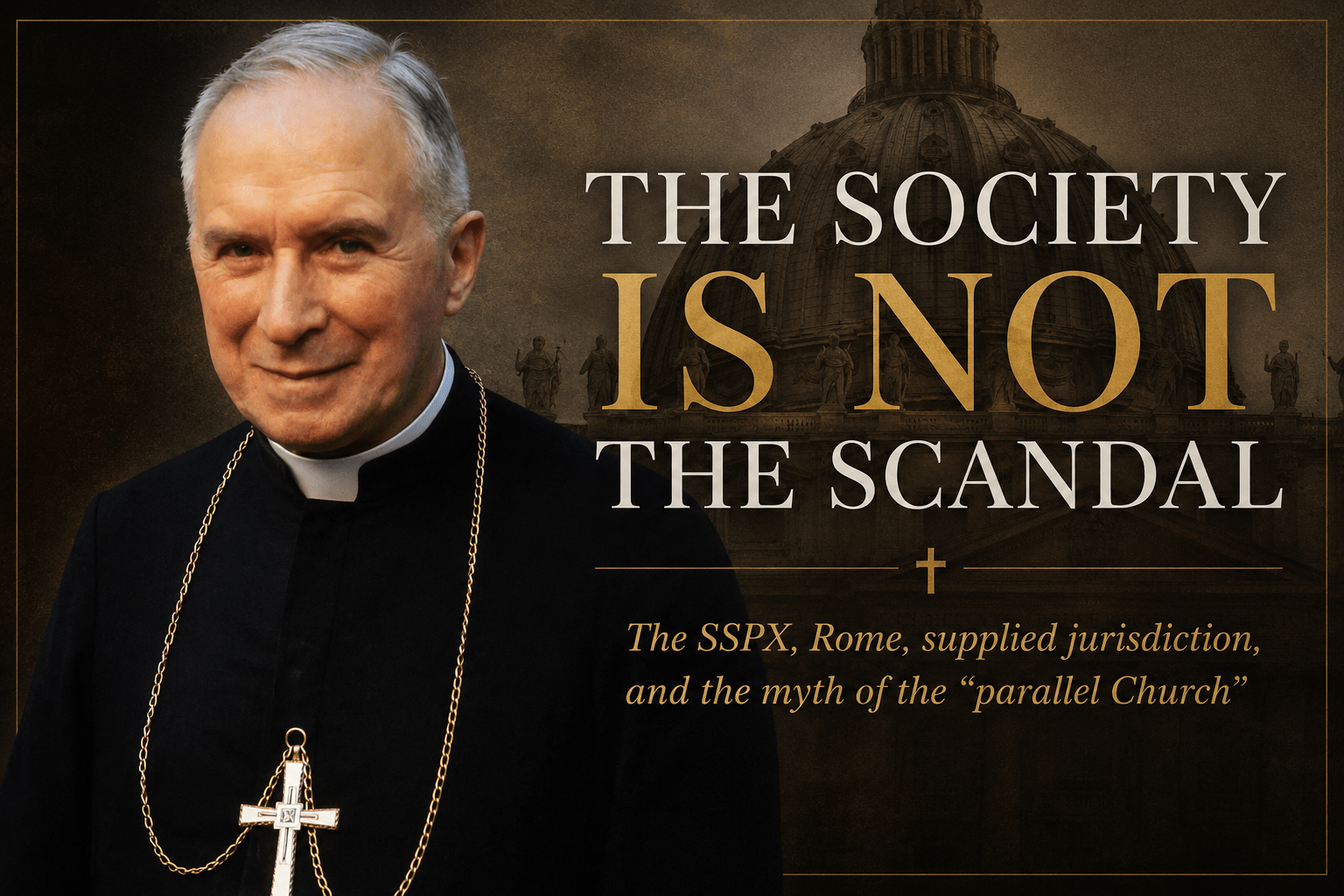
THE SOCIETY IS NOT THE SCANDAL: The SSPX, Rome, supplied jurisdiction, and the myth of the “parallel Church”
There is something too convenient about the accusation that the Society of Saint Pius X has become a “parallel Church”. It offers a simple explanation for a profoundly complicated ecclesial crisis. The Society has seminaries, priories, schools and missions; its superiors assign priests; its bishops ordain and confirm; it maintains a canonical commission and has adjudicated matrimonial causes; and, on 1 July 2026, it once again proceeded with episcopal consecrations without pontifical mandate. Rome responded the following day with extraordinary severity. The Dicastery for the Doctrine of the Faith declared the consecrations schismatic, pronounced censures upon the bishops concerned, described the Society’s sacred ministers as being in schism, and declared SSPX Confessions and marriages invalid.¹ It is therefore tempting to suppose that the argument has finally been settled: the SSPX has crossed the line, Rome has named the offence, and only special pleading remains. Yet canonical declarations, however grave, do not relieve Catholics of the obligation to understand what has actually happened, nor do they erase the preceding half-century of Roman dealings with the Society. The question is not whether the SSPX is irregular. It manifestly is. The question is whether irregularity, resistance and extraordinary ministry amount necessarily to the construction of another Church.
John Lamont has recently addressed precisely this question in Rorate Cæli, answering Fr Clément Barré’s argument that the Society has developed an “ecclesiology of substitution”: an ecclesiology which continues formally to recognise Rome while functionally transferring to the SSPX those vital tasks which properly belong to the Catholic hierarchy.² Barré’s criticism is considerably more serious than the crude accusation that the Society openly claims to be the Church, because he acknowledges that it does not. His argument is instead that the Society has made itself the practical locus of Tradition, doctrinal discernment, clerical formation and episcopal continuity because it judges the ordinary hierarchy functionally incapable of fulfilling those purposes. That argument deserves an answer better than slogans. Yet Lamont is right to identify its central weakness. To demonstrate that the Society has supplied functions left deficient by ecclesiastical authorities is not yet to demonstrate that it believes those authorities have ceased to possess their offices, that jurisdiction has migrated to Écône, or that the Catholic Church now “subsists” within the canonical boundaries of the SSPX. Extraordinary supplementation and ecclesiological substitution are not synonymous concepts.
The Society’s actual position is narrower and more uncomfortable. It maintains that the Catholic Church remains the Catholic Church, that the Roman Pontiff remains Roman Pontiff, that diocesan bishops remain bishops, that valid sacraments and Catholic life continue outside the Society, but that an extraordinary crisis has rendered some ordinary ecclesiastical structures gravely deficient in transmitting the integral Faith, traditional worship, sound priestly formation and reliable sacramental discipline. From this it argues that extraordinary measures may sometimes become morally necessary. One may contest the diagnosis, the extent of the necessity or the proportionality of particular remedies. One may even conclude that the Society has repeatedly misapplied principles that are valid in themselves. But none of this permits the critic simply to substitute another proposition — “the SSPX believes itself to be the true Church” — and then condemn the Society for holding a doctrine it explicitly repudiates.
Archbishop Marcel Lefebvre did not spend his life attempting to escape Rome. Long before Écône became synonymous with resistance, he had served the Church as missionary, bishop, Apostolic Delegate and Superior General. His ecclesiastical career was not that of an adventurer slowly constructing a personal communion beyond papal control. He had spent decades creating and governing Catholic institutions precisely under Roman authority before finding himself at odds with those who exercised it. The historical setting of that conflict cannot honestly be treated as an irrelevant pretext. The received Roman liturgy virtually disappeared from ordinary parish life; priestly formation was transformed; religious houses emptied; catechesis collapsed; Catholic countries rapidly abandoned principles previously proclaimed as duties of Christian society; and moral and doctrinal ambiguity entered areas in which previous generations of the Magisterium had spoken with remarkable consistency. Priests who experimented with the Church’s inherited worship were frequently indulged, while priests who wished simply to continue what they had themselves been taught were often disciplined. The liturgy by which the Roman Church had worshipped for centuries came in many places to be treated not merely as superseded but as positively undesirable. The SSPX did not create those circumstances. It emerged from them.
This matters because necessity lies at the centre of the Society’s defence. That word cannot be permitted to function as an incantation by which positive ecclesiastical law simply disappears. Nor can canon 144 be made into a universal jurisdictional reservoir from which an irregular society draws whatever authority circumstances seem to require. The strongest defence of the SSPX is more disciplined than that. Ordinary jurisdiction belongs to those to whom the Church has entrusted it; the power of Orders is not the power of governance; supplied jurisdiction exists because the Church supplies it, not because an individual or society declares itself competent; and extraordinary measures must remain proportionate to a genuine necessity. The Society’s claim is that the crisis has, in particular cases and circumstances, triggered precisely those principles of necessity, canonical equity and supply by which the Church herself prevents her own laws from defeating the salvation of souls for whose sake those laws exist.
This distinction is not merely an apologetic reconstruction imposed upon the Society from outside. Its own canonical literature expressly denies that its canonical commission possesses ordinary jurisdiction, describing it as “not a canonically erected body” and acknowledging that its district superiors do not possess powers equivalent to local Ordinaries.³ Even its matrimonial tribunals, among the most difficult aspects of the Society’s position, are defended as exercising jurisdiction ad casum, personal rather than territorial, dependent upon the alleged necessity of the faithful and enduring only for as long as that necessity lasts.⁴ Critics are entitled to challenge whether the Church can be said to supply judicial authority in the manner claimed. They are not entitled to transform a claim of temporary, supplied and case-specific jurisdiction into a claim of ordinary jurisdiction and then declare that the latter proves a parallel hierarchy.
The episcopal structure points in the same direction. The Society’s bishops possess no territorial dioceses. Its districts are not presented as dioceses. Its Superior General does not claim universal jurisdiction. It has never created a rival Roman Curia, college of cardinals or machinery for the election of a Pope. It has not declared the Apostolic See vacant, and it does not teach that communion with the SSPX is necessary for membership in the Catholic Church. Its priests name the reigning Pontiff in the Canon of the Mass. Even before the 2026 consecrations, the Society continued to insist that the bishops to be consecrated were intended to serve its sacramental needs rather than establish a parallel ordinary episcopate.⁵ If the purpose of Archbishop Lefebvre and his successors has been to create another Church, it is remarkable that after more than fifty years they have consistently declined to erect the structures by which another Church would unmistakably assert its independence.
This does not dispose of the charge of schism, because schism and the construction of an alternative hierarchy are not identical questions. But neither can schism simply be made another word for grave disobedience. A Catholic may disobey an authority whose authority he nevertheless recognises. The act may be objectively unlawful, gravely imprudent and canonically punishable without necessarily amounting to denial of the superior’s office as such. The Society’s argument concerning the episcopal consecrations, both in 1988 and in 2026, has never been that pontifical mandate is irrelevant because the Pope has no right to govern episcopal consecration. It has been that an extraordinary necessity allegedly justified proceeding without that mandate.⁵ One may conclude that the claim of necessity fails. One may judge the act gravely culpable. But the theological object of an act must still be identified correctly. “The Pope possesses authority, but necessity obliges us to disobey this particular command” is not the same proposition as “the Pope possesses no authority to command us”. The former may be wrong; it is not automatically the latter.
The history of the Society’s dealings with Roman authority makes the idea of a self-contained rival Church still more difficult to sustain. Consider the sacrament of Penance. Long before Pope Francis gave SSPX priests an undisputed faculty to absolve, Society clergy occasionally encountered censures and reserved cases requiring recourse to higher authority. Its canonical guidance explicitly states that when recourse to competent authority is possible, “then we do so”, and records occasions on which SSPX priests made recourse to the Sacred Penitentiary in grave matters reserved to the Holy See.³ Bishop Bernard Fellay later described the practice in greater detail, stating that Society priests in urgent cases involving censures reserved to Rome would absolve and subsequently make the anonymous recourse required by sacramental discipline. According to his testimony, the Penitentiary repeatedly accepted the procedure and on occasion modified the penance imposed.⁶ Because such matters belong to the confidential internal forum, the individual exchanges are not available for public inspection, and the evidential distinction should be maintained: the detailed account is Fellay’s testimony. Yet the broader fact of recourse to the Penitentiary is expressly acknowledged by the Society’s earlier published canonical material.
That evidence matters because a body which considers itself sovereign does not normally appeal to another authority to remit censures reserved by that authority. A parallel Church would not recognise that Rome possessed the right to reserve such matters in the first place, still less distinguish between cases in which recourse to the Holy See remained possible and those in which extraordinary supply was thought necessary. The Society’s practice instead presupposed that Rome remained the competent authority. Its contention was that where recourse could be made, it ought to be made; where recourse was morally or practically impossible, the Church’s extraordinary canonical provisions could be invoked. The critic may answer that the Society judged moral impossibility far too readily. That is a coherent criticism. It is quite different from claiming that the Society believed Roman jurisdiction itself had ceased to exist.
Pope Francis made this anomaly still more explicit. During the Jubilee of Mercy he ensured that those approaching SSPX priests could receive sacramental absolution validly and licitly, and in Misericordia et Misera he continued that provision beyond the Jubilee.⁷ The grant did not regularise the Society as an institution, but it did something which the crude parallel-Church thesis struggles to explain. Francis did not require SSPX priests to abandon the Society, make an abjuration, undergo reception into the Catholic Church or obtain incardination elsewhere before exercising the faculty. He granted a Catholic sacramental faculty to priests who remained members of the SSPX. The Holy See itself subsequently described this as a faculty given “to all priests of said Society” so that the sacrament could be administered validly and licitly.⁸ Whatever one thinks of the Society’s canonical status, Rome was plainly not treating these priests as though they were simply ministers of another denomination.
The Holy See’s 2017 provision for SSPX marriages is stronger evidence still because it required practical cooperation between the Society and diocesan authority. Local Ordinaries were authorised to delegate a diocesan or otherwise regular priest to receive matrimonial consent before an SSPX Nuptial Mass or, where that was not possible, to delegate the SSPX priest himself. The relevant documentation was then to be transmitted to the diocesan curia.⁸ Every element of that arrangement is ecclesiologically significant. The diocesan bishop remained the competent Ordinary; the Society priest was capable of receiving delegation from him; Society and diocesan clergy could cooperate in the same matrimonial celebration; and the resulting marriage belonged in the documentary life of the diocese. A truly parallel Church would ordinarily regard such delegation as superfluous because its own jurisdiction would suffice. The SSPX instead accepted a Roman mechanism whose very purpose was to secure the unquestioned canonical standing of marriages involving its faithful.
The 2026 DDF Explanatory Note now declares SSPX Confessions and marriages invalid.¹ That is a major development and cannot be ignored simply because it cuts against the Society. Yet neither can a decree issued in July 2026 erase the ecclesiological significance of what Rome itself did between 2015 and 2026. The question under discussion is whether the Society has for decades understood itself as a sovereign ecclesial body independent of Roman and diocesan jurisdiction. Rome’s earlier conduct is directly relevant to that question. For years the Holy See granted SSPX priests faculties, authorised local bishops to delegate them, established procedures by which their marriages entered diocesan records, and dealt with their clergy as priests capable of receiving Catholic jurisdiction without first leaving the Society. Whatever canonical effects the new decree now asserts, history has not been retrospectively abolished. Rome itself spent years acting in a manner far more consistent with anomalous internal Catholic irregularity than with straightforward ecclesial separation.
The Society’s matrimonial tribunals remain the hardest test of the argument and therefore should be confronted rather than hidden behind appeals to necessity. The SSPX does claim competence to adjudicate cases of matrimonial nullity where it judges ordinary recourse morally impossible. Such a claim is serious because marriage belongs to the public juridical order of the Church; a marriage cannot be dissolved or declared never to have existed merely by private conviction, pastoral sympathy or an individual priest’s moral opinion. The Society itself expressly recognises this difficulty. Its canonical reasoning rejects private determination by the spouses and insists that an objective judgment possessing public authority is required.⁴ The purpose of its tribunal, on its own account, is therefore not to privatise Catholic marriage but to prevent the very subjectivism which would result if the faithful simply decided for themselves that a previous union had been null.
The Society’s further argument is that the faithful nevertheless possess a right to a sound determination of matrimonial status, while many contemporary annulment decisions are, in its judgment, infected by defective jurisprudence, particularly expansive applications of psychological incapacity. On this basis it claims that necessity can supply jurisdiction ad casum. The canonical reasoning can certainly be challenged, and there are good reasons for particular caution wherever judicial rather than merely executive jurisdiction is claimed. Yet one passage in Bishop Tissier de Mallerais’s exposition is crucial to the ecclesiological question: he concludes that the decisions of these tribunals, like the Society’s other extraordinary acts, “will one day have to be confirmed by the Holy See”.⁴ That statement does not solve the canonical problem, but it tells us a great deal about the ecclesiology behind it. A court claiming sovereign jurisdiction does not normally acknowledge that its acts await eventual confirmation from the authority it has supposedly replaced. The Society’s theory may be juridically mistaken, but its stated terminus remains Roman confirmation rather than permanent judicial independence.
Nor has the SSPX taught that every judgment of an ordinary diocesan matrimonial tribunal must simply be rejected because it comes from outside the Society. Tissier elsewhere acknowledged that contemporary ecclesiastical tribunals sometimes reach decisions upon “true, traditional grounds” and therefore concluded that such judgments cannot automatically be declared invalid merely because they came through the post-conciliar system.⁹ The Society reserves to itself a controversial judgment about which grounds and procedures it considers sound, and that practice itself raises questions. But it is still significant that diocesan jurisdiction is not treated as intrinsically void. The argument is instead that some exercises of legitimate jurisdiction may be unreliable because of the principles employed. That is a dispute about the exercise of jurisdiction, not the proposition that jurisdiction has ceased to exist outside Écône.
Bishop Fellay has additionally testified to less public forms of practical cooperation, including occasions on which Roman authorities allegedly appointed him to fulfil an ecclesiastical judicial function and communications concerning SSPX ordinands and relations with diocesan bishops.⁶ Those particular claims must remain what they are — testimony from Fellay rather than independently published Roman documentation — but they fit a wider pattern which is independently incontestable. Rome negotiated with SSPX superiors, remitted episcopal censures, received the Society into formal doctrinal discussions, granted its priests sacramental faculties, authorised diocesan delegation to its clergy, and for many years discussed the possibility of regularising the Society corporately rather than receiving its members individually from another religion. Benedict XVI stated with equal clarity that the Society lacked canonical status and that its ministers did not then legitimately exercise ministry, yet he immediately located the unresolved problem at the doctrinal level and reorganised Ecclesia Dei precisely so that doctrinal talks could proceed.¹⁰ The contradiction is real, but it is a contradiction of an abnormal Catholic relationship, not easily the relationship between two self-contained Churches.
The 2026 crisis has unquestionably altered the juridical landscape. The DDF now characterises the Society’s ministers as being in schism and expressly warns the faithful against adherence.¹ The Society, for its part, disputes the canonical consequences and continues to insist that the consecrations were rendered necessary by the ecclesial crisis. Whatever judgment one makes of those events, however, the new decree cannot answer retrospectively every ecclesiological question about the Society’s preceding existence. Indeed, it sharpens one of them. If the SSPX had been a completed parallel Church all along, the extraordinary sequence of Roman concessions, negotiations, faculties, matrimonial delegation and internal Catholic procedures would be difficult to explain. If, instead, it has been an irregular Catholic body whose practical independence developed from a disputed theory of necessity, then the history makes considerably more sense — even if one concludes that the events of July 2026 marked a grave escalation or even juridical rupture.
There is an obvious, though deliberately limited, parallel with the position maintained by the Old Roman Apostolate. We likewise do not understand ourselves as a substitute for the Roman Church, still less as a purer communion in which Catholicity has somehow migrated from Rome. We recognise the Roman Pontiff, reject sedevacantism, profess the dogmas of the Catholic Faith, preserve the received Roman liturgy and sacramental tradition, and understand our ministry as existing in irregular circumstances rather than constituting an alternative ordinary hierarchy. Our bishops do not claim diocesan sees in opposition to the territorial hierarchy, nor do we maintain that the continuation of sacramental ministry means ordinary jurisdiction has transferred from the Church’s lawful pastors to ourselves. The historical origins and canonical circumstances of the Old Roman Apostolate and the SSPX are not identical and should not be artificially conflated; nevertheless the same theological distinction is indispensable to understanding both: irregularity is not automatically separation, resistance is not automatically schism, and extraordinary sacramental ministry does not become a rival ecclesiology simply because circumstances have caused it to endure.
Barré’s more sophisticated criticism remains: even if the Society formally disclaims ordinary jurisdiction, perhaps the sheer extent of its activity constitutes substitution in practice. It forms priests, preserves worship, administers sacraments, judges matrimonial cases, governs an international apostolate and perpetuates its own episcopal succession. Has the emergency remedy therefore become functionally indistinguishable from the thing it claims not to replace? This is the strongest objection, and the answer cannot consist simply of pointing to formal disclaimers. The answer must lie in proportionality and limitation. If the Society claimed universal habitual jurisdiction over Catholics, created territorial dioceses, refused Roman recourse even where recourse was safely possible, treated its bishops as an alternative episcopal college, denied papal jurisdiction in principle, or regarded every act of diocesan jurisdiction as void, the charge of substitution would become formidable. Yet its recourse to the Penitentiary, acceptance of papal faculties, reception of diocesan matrimonial delegation, recognition that some diocesan judgments may be sound, and stated anticipation of eventual Roman confirmation point instead to an emergency theory that remains formally subsidiary to ordinary Church authority.
That theory is not without serious dangers. A state of necessity can become self-confirming: every Roman act opposing the Society may itself be invoked as further evidence that the necessity continues. Structures established for exceptional circumstances can acquire institutional permanence; generations who have known nothing else may cease to experience abnormality as abnormal; and the practical prudence of one body can gradually be treated as though it were synonymous with Catholic Tradition itself. These are genuine temptations, and a serious defence of the Society should acknowledge them rather than pretend that every SSPX judgment is vindicated merely because the post-conciliar crisis is real. If necessity is truly the principle, then necessity must also delimit the remedy. The Society must always be able to distinguish what belongs to the Church and her hierarchy by right from what it claims to perform only because ordinary provision has become gravely deficient.
Yet the accusation that a crisis cannot remain a crisis for half a century proves remarkably little. Duration does not establish normality. An ecclesiastical disorder can endure because its causes endure. The real question is whether the conditions identified by Archbishop Lefebvre have disappeared. Here the answer is uncomfortable for his critics. The traditional Roman liturgy remains restricted. Traditional communities remain vulnerable to changes in pontifical and diocesan policy. Priestly formation grounded explicitly in the older theological and ascetical patrimony remains exceptional. Serious disputes over religious liberty, ecumenism, collegiality, liturgical reform and the relationship of particular conciliar formulations to earlier magisterial teaching have not been resolved merely because churchmen insist that there can be no rupture. The Society’s continued existence does not prove that every remedy it employs is proportionate, but the persistence of the conditions to which it originally pointed cannot simply be dismissed as a fiction invented to justify independence.
This is where the argument should be turned back upon Rome. The abnormality of the SSPX is obvious; the abnormality of the ecclesiastical environment which produced it is too often treated as though it required no explanation. Why did Catholics who wished to preserve the received Roman liturgy come to believe that the liturgy required protection from Roman ecclesiastical policy itself? Why were priests attached to teachings openly proclaimed by previous pontiffs so frequently treated as troublesome relics while theological innovators were permitted extraordinary latitude? Why did the Church’s authorities prove more capable of disciplining Archbishop Lefebvre than of arresting the catastrophic collapse of priestly vocations, religious life, catechesis and Catholic practice occurring around him? Why did obedience appear to operate with such extraordinary force against those preserving inherited forms and with such extraordinary elasticity toward those abandoning them? One need not canonise Lefebvre’s decisions in order to recognise that those questions have never received adequate answers.
And there is a still more awkward question for the “parallel Church” thesis. If Rome really understood the Society simply as another ecclesial body, why did it deal with it as it did for decades? Why grant faculties to its priests without requiring them first to leave the Society? Why permit diocesan bishops to delegate those same priests to receive matrimonial consent? Why require the resulting documentation to enter diocesan curiae? Why entertain their recourse in reserved sacramental matters? Why conduct detailed doctrinal negotiations rather than missionary conversations aimed at conversion? Why discuss the corporate regularisation of the Society rather than the individual reception of schismatics? The DDF’s 2026 declaration has now adopted a much harsher juridical description, but the preceding evidence cannot be made to disappear. These are not sentimental gestures. They are evidence about how Rome itself understood the peculiar relationship.
The Society does not claim that Rome has ceased to be Rome. Its entire history of complaint makes sense only because it expects Rome to be Rome. It appeals to papal authority, complains when papal authority is in its judgment exercised contrary to Tradition, seeks faculties or recognition from that authority when circumstances permit, and has repeatedly maintained that an ultimate settlement must come from the same Roman Church against whose recent policies it protests. This is not the ecclesiology of sedevacantism, and it is not straightforward congregational independence. It is an unstable and undoubtedly dangerous position of recognition and resistance, but instability is not the same thing as incoherence. Catholic history provides examples of resistance to particular acts of legitimate superiors precisely because their legitimacy was not denied.
The position is uncomfortable because it refuses everyone the luxury of a simple solution. It refuses the ultramontane fiction that every concrete exercise of papal government must be prudent merely because the Pope commands it. It refuses the sedevacantist fiction that ecclesiastical crisis can be solved by declaring the hierarchy nonexistent. And it must refuse the temptation, occasionally discernible among traditionalists themselves, to treat extraordinary necessity as a new source of sovereignty. Rome possesses authority. That authority is real, supreme and divinely constituted. It is also authority received for definite supernatural ends: preserving Revelation, sanctifying souls and governing the Church according to the constitution Christ gave her. Positive ecclesiastical laws truly bind, but the Church’s own moral and canonical tradition recognises necessity, equity, supplied jurisdiction, diminished imputability, the difference between Orders and jurisdiction, the distinction between disobedience and schism, and the supreme principle that the salvation of souls is the highest law.
None of those concepts was invented at Écône. The difficult question is whether and where they apply. That question cannot be settled by pretending that the crisis to which they are applied never existed, nor simply by citing the authority whose exercise of authority is itself part of the controversy. The Society must submit its extraordinary claims ultimately to the judgment of the Church, and its best canonical arguments have historically conceded exactly that. Rome, however, has an obligation no less grave: to judge according to Catholic truth rather than administrative expediency, to distinguish juridical disobedience from doctrinal apostasy and true schism, and to address the theological causes of the conflict rather than imagining that a disciplinary decree can make them disappear.
The Society is therefore not best defended by claiming that everything it does is normal. That would be manifestly false and, indeed, destructive of its own case. It is defended by insisting that abnormal circumstances can generate abnormal remedies without thereby creating a new Church; that an illegal act is not automatically a schismatic act in its theological intention; that jurisdiction claimed as supplied is not ordinary jurisdiction merely because it is exercised repeatedly; and that practical cooperation with Roman authority over Confessions, censures, marriages and canonical matters profoundly complicates the accusation that the SSPX has always understood itself as ecclesiastically sovereign. The Society must be judged according to what it actually claims and does, not according to the ecclesiology which its opponents find most convenient to attribute to it.
The SSPX is not the cause of the crisis. It is evidence that the crisis was real. Rome may yet prove Archbishop Lefebvre wrong, and every Catholic should desire nothing more ardently than a Church in which no priest or faithful Catholic can plausibly argue that extraordinary structures are necessary for the preservation of Tradition. But Rome will not prove Lefebvre wrong merely by repeating the word “schism”, nor by describing as an “ecclesiology of substitution” every attempt to preserve Catholic goods which ordinary authority has failed adequately to provide. It will prove him wrong when the Tradition he feared would be extinguished can live securely within the ordinary life of the Church; when priests can preach the perennial Faith without euphemism or professional hazard; when seminarians can be formed according to the Church’s theological inheritance without suspicion; when the ancient Roman liturgy no longer survives at the pleasure of administrators who regard attachment to it as an ecclesiastical problem; and when doctrinal disputes are answered by doctrine rather than merely by discipline.
Until then, the Society remains an uncomfortable witness. Not because it can claim to have made every correct decision, and not because its irregularity ought to become permanent, but because its very existence continues to expose a question Rome has never successfully answered. The SSPX has repeatedly recognised Roman authority even while resisting particular exercises of it; resorted to Roman authority when it believed recourse possible; accepted faculties from the Pope; cooperated with diocesan bishops over marriages; insisted upon public judgment rather than private conscience in matrimonial cases; and looked ultimately toward Roman judgment and canonical settlement. Those facts belong in the centre of the argument, not in apologetic small print.
The final question is therefore not simply whether the Society has obeyed. It is whether a Catholic body can resist gravely defective government without thereby denying government itself; whether extraordinary ministry can preserve rather than replace ordinary hierarchy; and whether those who unquestionably possess authority may themselves create circumstances in which obedience to particular commands appears to endanger the very goods their authority exists to protect. Those are grave questions, and no Catholic should answer them lightly. But neither should they be silenced by labels.
The Society is not the scandal.
The scandal is that, more than half a century after Archbishop Lefebvre began his resistance, Rome has still not succeeded in making his resistance unnecessary.
1. Dicastery for the Doctrine of the Faith, Nota Esplicativa, 2 July 2026; Dicastery for the Doctrine of the Faith, Decreto, 2 July 2026.
2. John Lamont, “Does the Society of Saint Pius X Really Espouse an Ecclesiology of Substitution? Fr. Barré and the Roman Policy towards the SSPX,” Rorate Cæli, August 2026; Clément Barré, “The SSPX’s Ecclesiology of Substitution: Part of the Whole, or a New Whole? — And the Problem with a Crisis that Never Ends,” English translation published by Rorate Cæli, July 2026.
3. Peter Scott, “Questions about Our Canonical Commission,” The Priests’ Bulletin, October 1997; reproduced by the Society of Saint Pius X, District of the USA.
4. Bernard Tissier de Mallerais, “Legitimacy and Status of Our Tribunals,” lecture delivered at the Canon Law Seminar on Marriage Cases, Écône, 25 August 1998; Society of Saint Pius X, District of the USA.
5. Society of Saint Pius X, “A Timeline of the Society of Saint Pius X’s July 1, 2026 Episcopal Consecrations,” July 2026.
6. Bernard Fellay, interview with Luis Román, 17 February 2022, Society of Saint Pius X, District of the USA.
7. Francis, Apostolic Letter Misericordia et Misera, 20 November 2016, no. 12.
8. Pontifical Commission Ecclesia Dei, Letter to the Ordinaries of the Episcopal Conferences concerned on faculties for marriages of faithful of the Society of Saint Pius X, 27 March 2017.
9. Bernard Tissier de Mallerais, “An Approach to Declarations of Nullity,” lecture notes, 28 August 1998; Society of Saint Pius X, District of the USA.
10. Benedict XVI, Letter to the Bishops of the Catholic Church concerning the remission of the excommunication of the four bishops consecrated by Archbishop Lefebvre, 10 March 2009; Benedict XVI, Apostolic Letter Ecclesiae Unitatem, 2 July 2009.
RELATED ARTiCLES


LATEST ARTICLES
- Quod accepimus, custodimus et tradimus ~ What we have received, we guard and hand on: Spiritual Conference for Nuntiatoria CXXIVThe Catholic Faith has reached us at a time when parts of its doctrinal, moral and liturgical inheritance are contested, obscured or neglected even within the Church. This spiritual conference asks what happened, why it happened and, above all, what Catholics can do despite it. Fidelity in a crisis requires more than private endurance: Catholics must know the Faith, defend it, resist what would corrupt it, restore what has been damaged, build where institutions have failed and hand the inheritance whole to those who come after them. We are not called merely to outlast the crisis, but to fight for the Faith through it.
- Archbishop Viganò’s “Schism of the Head”: A True Diagnosis That Risks a False EcclesiologyArchbishop ✠Carlo Maria Viganò correctly identifies the limits of papal authority and the modernist practice of eroding doctrine through pastoral processes. His theory of a “schism of the head”, however, risks replacing papal maximalism with a private judgement that makes each resister the judge of whether the Pope remains united to the Church.
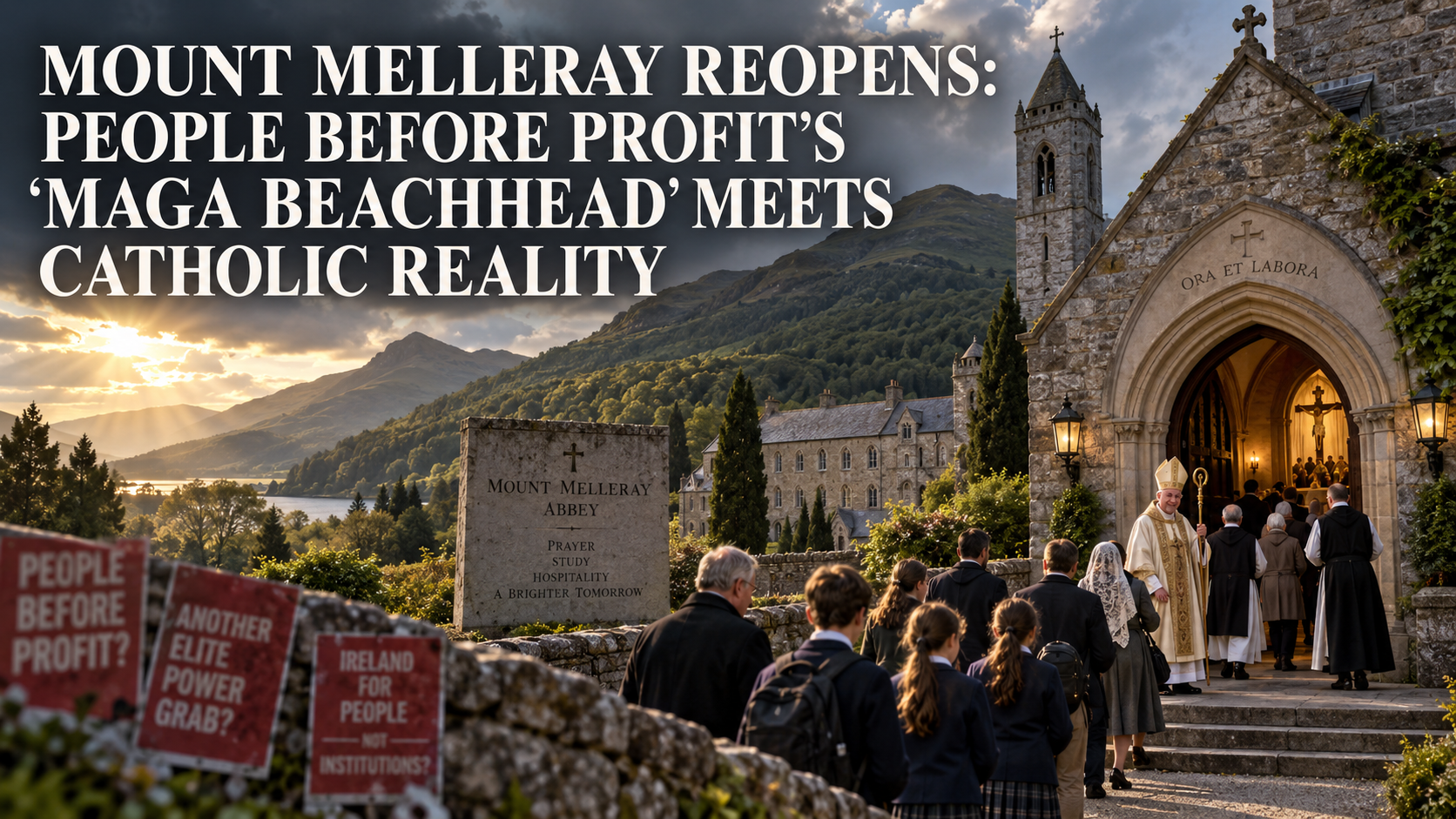
- MOUNT MELLERAY REOPENS: People Before Profit’s “MAGA beachhead” meets Catholic realityPeople Before Profit warned that Ave Maria University’s arrival at Mount Melleray would create a “MAGA beachhead” and has now demanded confiscatory taxation of Catholic property transactions. Yet the abbey has reopened with students, prayer, education and public worship. Behind the political rhetoric lies a more important question: when Ireland’s old religious communities can no longer sustain their foundations, must their patrimony inevitably be secularised?
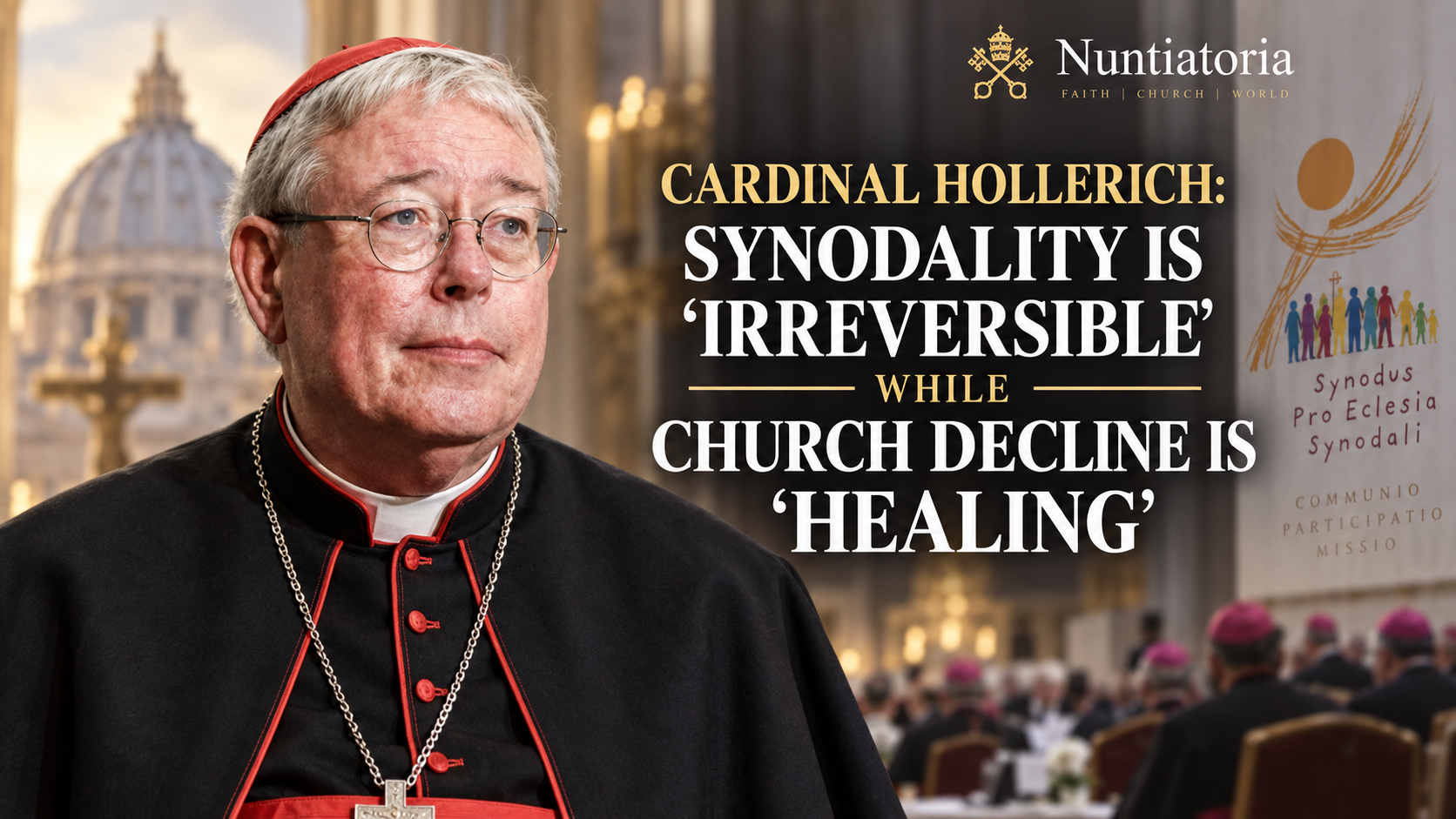
- Cardinal Hollerich: Synodality is “irreversible” while Church decline is “healing”Cardinal Jean-Claude Hollerich asserts that the synodal process initiated by Pope Francis is “irreversible”, viewing the decline in Catholic practice as a potential healing process. However, he warns against equating decline with justification. Evidence from France and Germany highlights the significant downturn in sacramental practice, urging a need for genuine evaluation of pastoral methods to ensure faithful transmission of the Faith.
- Cardinal Arborelius Faces New Evidence of Failure to Implement Vatican DecreeNew documentary evidence intensifies questions over the Diocese of Stockholm’s response to a Vatican decree declaring Fr Tobias Unnerstål’s suspension invalid. The affair has become a test not simply of one priest’s treatment, but of a more fundamental Catholic principle: whether canon law binds those exercising ecclesiastical authority as surely as those subject to it.
CURRENT EDITION


Today’s Mass Propers
- Today’s Mass: September 22 St Matthew, Apostle & Evangelist
 Matthew the Apostle and Evangelist, also called Levi, was sitting at his tax-collector’s desk in Capernaum when he was called by Christ. He followed Him at once, and also gave a feast for Him and the other disciples.

Leave a Reply