
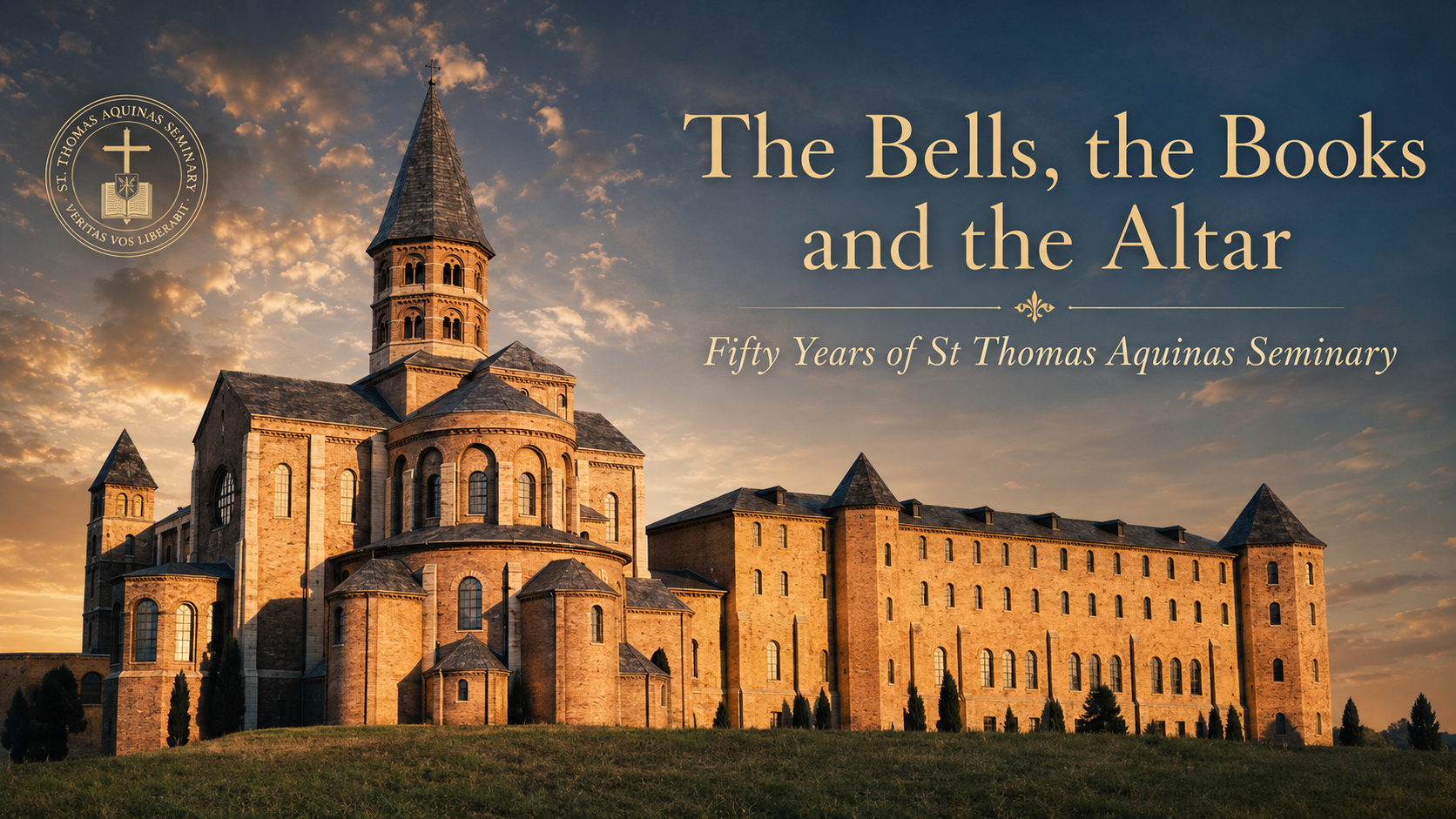
The Bells, the Books and the Altar: Fifty Years of St Thomas Aquinas Seminary
A Legacy of Tradition is an accomplished account of the Society of Saint Pius X’s American seminary. Its real achievement lies not in celebrating buildings or personalities, but in showing what the old Catholic understanding of priestly formation requires—and what has been lost wherever that understanding has faded.

A priest remembers arriving at St Thomas Aquinas Seminary and being appalled by the chanting. The chant was nowhere near the standard he had expected. Another recalls mangling the Epistle at a solemn Mass so thoroughly that, when he went to apologise, his rector congratulated him on having come so close to the right notes while still sounding so dreadful. A third admits that he entered expecting to find every seminarian holy and exemplary, only to discover, with some relief, that he fitted in quite well.
These are among the best moments in A Legacy of Tradition: Fifty Years of Saint Thomas Aquinas Seminary. The documentary has plenty of handsome architecture, solemn music, episcopal reminiscence and institutional history. What saves it from becoming a glossy jubilee brochure is the presence of human beings: young men who took themselves too seriously, professors who spoke English through formidable French accents, rectors who inherited half-finished buildings, and communities which periodically appeared to be coming apart at the seams.
The film was produced for the golden jubilee of the English-speaking seminary of the Society of Saint Pius X in the United States. Its history began on 10 November 1974, when St Joseph’s House of Studies was opened in an old farmhouse at Armada, Michigan. It was not yet a complete seminary. Candidates were taught Latin, French, chant and the rudiments of ecclesiastical life before proceeding to Écône for the greater part of their priestly formation. From Armada the institution moved to Ridgefield, Connecticut, then to Winona, Minnesota, and finally to the purpose-built seminary at Dillwyn, Virginia.¹
That journey supplies the documentary with its chronological frame, though the history is not told simply as a tale of steady expansion. Buildings become too small; directors leave; professors quarrel; students disappear with them; money has to be found; another property is bought; and, before long, the whole business begins again somewhere else.
The first house in Michigan was furnished partly with objects removed from Catholic churches being remodelled after the Second Vatican Council. Vestments, pews, statues and books, suddenly unwanted elsewhere, found their way into the new seminary. The film does not dwell upon the irony. It hardly needs to. At the very moment when one part of the Church was clearing away the material inheritance of its recent past, another was using the cast-offs to train priests for the traditional Roman altar.
It is a small detail, but it gives the history a certain bite. The Society’s story in America was never principally about nostalgia for old buildings, lace or Latin. It began with the judgement that a particular conception of the Catholic priesthood was being dismantled and that preserving the older liturgy without preserving the formation which belonged to it would not be enough.
That judgement governs the film. A seminary, as Archbishop Marcel Lefebvre understood it, was not a theological college with a chapel attached. It was a religious house in which the whole day—Mass, Office, silence, study, meals, recreation and work—was directed towards remaking the habits of the man who entered it. The seminarian might possess goodwill, intelligence and a genuine vocation. He would also arrive with vanity, poor judgement, gaps in his education and habits acquired from the world outside. The rule existed because goodwill alone would not make him a priest.
The documentary is particularly good on this ordinary texture of formation. There are bells to be obeyed, jobs to be done, cold afternoons to be spent outdoors and books to be read whether or not one happens to fancy them. The young men learn to sing, serve, study and live together. They also learn that religious life is full of other people, which is often the sharper mortification.
This account is more persuasive than any number of vocation posters. Modern promotional material often presents priesthood as a noble form of personal fulfilment: a man discovers his special calling, develops his gifts and sets out to make a difference. A Legacy of Tradition speaks another language. The candidate is not encouraged to become more completely himself. He must be formed into an alter Christus, another Christ, capable of offering the Sacrifice, teaching the Faith and governing souls.
That does not mean the destruction of personality. The witnesses in the film are anything but interchangeable. Some are dry, some affectionate, some blunt, some distinctly mischievous. Yet personality is placed under discipline. The priest’s temperament may colour his ministry; it cannot be permitted to define the priesthood according to his own preferences.

The film’s treatment of Fr Yves le Roux, rector from 2003 until 2023, brings this into focus. His central concern, according to former students, was priestly fatherhood. Many seminarians had weak or confused ideas of what a father was. Some had perhaps scarcely experienced fatherhood in a convincing form. Fr le Roux believed that a priest who had never learnt to receive correction, endure embarrassment, exercise authority or care for others in a stable common life would struggle to become a father to his people.
His method was not always delicate. He corrected seminarians, teased them and punctured their dignity when it became overinflated. The governing principle was simple enough: take God seriously, take the Precious Blood seriously, but do not make the mistake of taking yourself too seriously.²
There is sound spiritual judgement in that, and a necessary corrective to two opposite clerical distortions. One is the priest who becomes a remote ecclesiastical functionary, protected by his office and unable to speak to ordinary men. The other is the priest who treats informality as a virtue, plays down his sacred character and becomes little more than the affable manager of a religious club. True priestly fatherhood requires neither starch nor chummy self-effacement. It requires authority disciplined by sacrifice.
Bishop Richard Williamson’s long association with the seminary receives generous treatment. He took charge after the serious rupture of 1983, when nine priests broke with Archbishop Lefebvre and most of the existing teaching staff either departed or were dismissed. Whatever may be said of his later course, the testimony presented here is consistent: he restored order, taught with unusual force and understood that the modern educational system was sending candidates to the seminary without the cultural equipment once taken for granted.
His answer was the humanities year. Seminarians were introduced to literature, music, history, languages and the liberal arts before beginning the more strictly ecclesiastical stages of formation. The purpose was not to turn priests into amateur aesthetes. A man who cannot follow an argument, recognise beauty, understand history or read serious prose will be badly placed to teach the Faith to anyone. He may memorise the correct conclusions, but he will have little idea how civilisation, imagination and natural reason prepare the soul to receive them.
The documentary is right to give Bishop Williamson credit for this work. It is also rather too tidy about how his story ended. His transfer from Winona to Argentina in 2003 closes his part in the film, leaving the viewer with warm recollections of a formidable rector and teacher. There is no reference to his later conflict with the Society, his expulsion in 2012 or the further divisions which followed.
An anniversary documentary is entitled to choose its limits, and no one could reasonably expect a complete history of every subsequent controversy. Still, a single sentence would have made the treatment more honest. Gratitude for what a man once accomplished does not require silence about what later went wrong. The seminary’s own history ought to have taught that lesson rather well.
The same selectivity appears in the account of “the Nine”. The priests who opposed Archbishop Lefebvre in 1983 are described as rebels whose actions nearly destroyed the American seminary. That is the Society’s understanding of the dispute, and the film makes no pretence of offering a tribunal brief from both sides. The episode is nevertheless included, which is to the documentary’s credit. Institutional films commonly turn genuine ruptures into vague “challenges” and hope no one asks for names.
Here there are names, lawsuits, defections and some lingering hurt. A priest who lived through the period offers perhaps the most useful verdict: young clergy can become proud, and none of them is indispensable. He puts the matter more colourfully than that. The good sense remains.
Visually, the film is conventional but handsome. Interviews, archive material, music and views of the successive properties are assembled with care. The present Virginia seminary naturally receives the grandest treatment. Its long corridors, chapel, cloister and ordered proportions supply a visual answer to the improvised farmhouse in which the story began.
The architecture is not incidental. Fr le Roux wanted a building which “spoke of God”. That phrase could easily have slipped into pious advertising, but the film explains what he meant. A seminary building forms its inhabitants before the rector says a word. A chapel built unmistakably for sacrifice, a refectory intended for common meals, a real library and cloisters designed for recollection tell a man that his life has acquired an order not invented by himself.
Modern ecclesiastical architecture often prides itself on flexibility. Everything can be moved, rearranged, partitioned or adapted for some other purpose. Such buildings also communicate a theology. They suggest that no activity is quite permanent and that sacred use is only one option among several. St Thomas Aquinas Seminary takes the opposite view. Stone, timber and proportion are made to say that the work undertaken there is settled, serious and expected to continue.
The move to Virginia was not as stately as the finished building now makes it appear. The seminarians arrived before everything was ready. Their belongings had gone ahead; accommodation was scattered among motels, bunkhouses and sheds; the water supply failed; work continued for ten or twelve hours a day. Men who had entered a carefully regulated religious house found themselves living amid muddle, noise and shifting arrangements.
That experience produced one of the film’s shrewdest lessons. Interior silence which depends entirely upon exterior quiet is not worth very much. A priest will encounter broken boilers, difficult parishioners, inconvenient telephone calls, financial trouble, illness and the peculiar chaos which follows certain well-meaning committees. The seminary must teach him to pray when the timetable is intact, then discover whether he can still pray when it is not.

The documentary’s pacing slackens slightly during the later historical sections. There is a stretch in which successive moves, appointments and building problems begin to blur. A few minutes might have been trimmed without loss. The music occasionally works harder than the material requires, and the final vocational appeal is more explicit than the quieter testimony preceding it.
Yet the ending has been earned. The viewer has seen what the invitation involves. The young man is not being offered a picturesque life among books and vestments. He is being invited to surrender his own programme, submit to years of formation and accept responsibility for souls whose needs will not fit conveniently into his plans.
The film’s closing message is that the need for priests remains greater than the Society can answer. Its official jubilee material reported that the Virginia building, completed only eight years earlier, was already full.³ Whether one accepts all the Society’s conclusions concerning the post-conciliar crisis or not, that fact demands attention. Across much of the Western Church, seminaries have closed, merged or survived with a fraction of their former numbers. Here the recurring difficulty has been finding enough room.
Numbers do not prove orthodoxy, prudence or canonical right. They do reveal attraction and vitality. Young men do not usually surrender six or seven years to an exacting rule because they have been seduced by nostalgia. They enter because they believe the altar, the sacrifice and the salvation of souls are real enough to govern an entire life.
Subsequent events have given the documentary an added significance. Fr Michael Goldade appears in it as the rector entrusted with continuing the work inherited from Fr le Roux. On 1 July 2026 he was consecrated a bishop at Écône alongside Fr Pascal Schreiber, Fr Michel Poinsinet de Sivry and Fr Marc Hanappier. The Society presented the consecrations as necessary for the continued transmission of Holy Orders and Confirmation; Rome declared them illicit, without pontifical mandate and schismatic in character.⁴ ⁵
That controversy does not belong at the centre of a review of this film. It does, however, alter the weight of its closing passages. The seminary’s history is bound up with the Society’s conviction that the preservation of the priesthood requires bishops capable of ordaining. What appeared in 2025 as an anniversary reflection has since become part of the immediate background to the most serious conflict between Écône and Rome since 1988.
The fruitfulness shown in the documentary cannot settle the canonical argument. Neither can the canonical argument make the fruitfulness disappear. Both facts have to be faced, not one used to blot out the other.
A Legacy of Tradition is an institutional film and makes no apology for it. It tells the story from inside, honours its founders, states its convictions and asks for more vocations. Its omissions are real. Its account of certain disputes is one-sided. It could have trusted its audience with a little more complexity.
Even so, it succeeds where many religious documentaries fail. It gives the viewer some notion of the thing itself. Priesthood here is not a job in the Church, an outlet for pastoral enthusiasm or a badge of theological competence. It is a sacramental fatherhood formed through prayer, doctrine, obedience, common life and sacrifice.
The farmhouse, the leaking pipes, the bad chant, the hockey matches, the libraries and the long Virginia corridors finally belong to the same story. Men came to be trained for the altar. Some left. Some quarrelled. Some became priests, rectors and bishops. The buildings changed, and the troubles changed with them. The bells continued to ring.
That is the documentary’s quietest point, and its most convincing one.

¹ A Legacy of Tradition: Fifty Years of Saint Thomas Aquinas Seminary, documentary transcript supplied to Nuntiatoria; St Thomas Aquinas Seminary, “50th Anniversary Celebration”, 30 October 2024.
² A Legacy of Tradition, documentary transcript, particularly the recollections concerning Fr Yves le Roux and priestly fatherhood.
³ Fr Michael Goldade, “The 50th Anniversary”, St Thomas Aquinas Seminary, November 2024.
⁴ General House of the Society of Saint Pius X, “Statement Following the Episcopal Consecrations”, 1 July 2026.
⁵ Dicastery for the Doctrine of the Faith, decree concerning the episcopal consecrations, 2 July 2026.
RELATED ARTiCLES


LATEST ARTICLES
- Today’s Mass: October 25 SOVEREIGNTY OF OUR LORD JESUS CHRIST, SUPREME KINGThe Feast of the Sovereignty of Our Lord Jesus Christ celebrates Christ’s dual kingship by birth and conquest. Established by Pius XI, it aims to deepen faith and counter anti-clericalism. The liturgical observance underscores His authority as King, advocating for societal recognition of His reign to bring peace and harmony.
- TRADITION BEHIND THE FENCEThe Vatican’s prohibition of the traditional Ad Petri Sedem pilgrimage to St Peter’s Basilica has sparked controversy, especially among traditional Catholics. While some cite scheduling conflicts, the broader issue lies in the restrictive policies of Traditionis custodes, which may confine traditional liturgical practices to specific enclaves, risking the transmission and recognition of Catholic Tradition within the wider Church.
- Today’s Mass: October 24 St Raphael the ArchangelThe Feast of Saint Raphael the Archangel highlights his healing powers as depicted in the Book of Tobit, where he aids Tobit and his son, Tobiah. Venerated as a protector of travellers and the blind, Raphael is celebrated for his miraculous interventions. His legacy includes support for nurses, matchmakers, and Catholic studies.
- 25.10.26 Nuntiatoria CXXIX: CHRISTUS REXThe text discusses the relationship between Christ’s kingship and authority within the Church amidst contemporary challenges. It contrasts ecclesiastical power with genuine faith, emphasising that authority must protect divine truth rather than alter it. The witness of imprisoned priests illustrates the enduring significance of fidelity to Christ over institutional conformity.
- THE DOMESTIC CHURCH: 25 October – 2 November 2026 A Home with Room for Heaven: Preparing for All Saints and All SoulsThe content outlines a week’s plan for traditional Catholic families to prepare for the feasts of All Saints and All Souls. Emphasising daily prayers, remembrance of the deceased, and engagement with children’s activities, it aims to integrate Catholic customs into family life, enriching spiritual practices and fostering a shared faith experience.
CURRENT EDITION


Today’s Mass Propers
- Today’s Mass: October 25 SOVEREIGNTY OF OUR LORD JESUS CHRIST, SUPREME KING
 The Feast of the Sovereignty of Our Lord Jesus Christ celebrates Christ’s dual kingship by birth and conquest. Established by Pius XI, it aims to deepen faith and counter anti-clericalism. The liturgical observance underscores His authority as King, advocating for societal recognition of His reign to bring peace and harmony.



Leave a Reply