
Ratzinger’s Regensburg Letter and the Unanswered Case for the Roman Missal
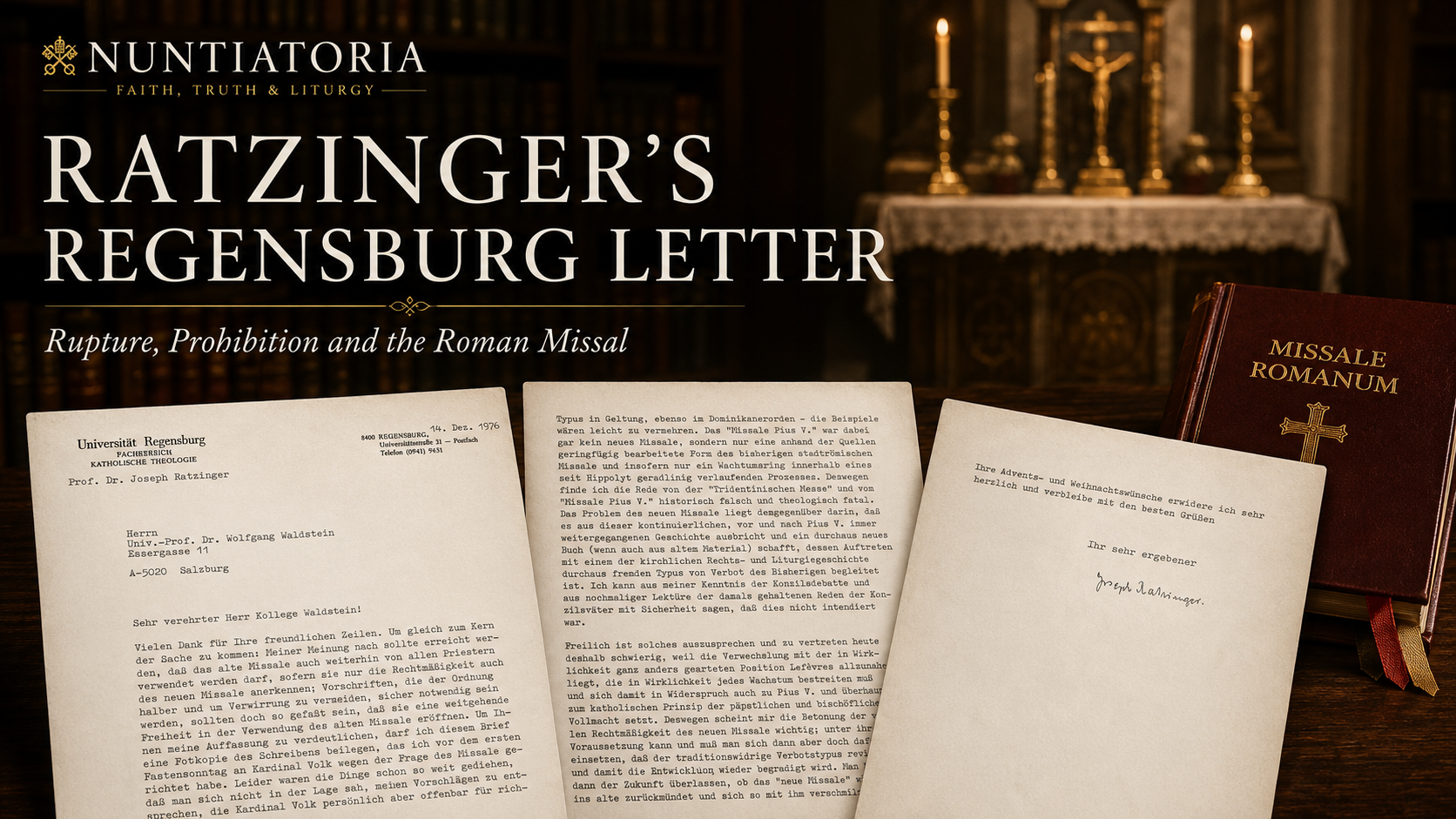
A private letter written in 1976 shows Joseph Ratzinger already convinced that the post-conciliar Missal had broken with the previous course of Roman liturgical development, and that the attempted prohibition of the older rite was foreign to Catholic tradition. Fifty years later, Rome has still not answered his argument.

On 14 December 1976, Professor Joseph Ratzinger wrote from the Catholic theological faculty of the University of Regensburg to his colleague Wolfgang Waldstein in Salzburg. After the customary thanks for Waldstein’s letter, he went immediately to the disputed question of the Roman Missal.
“In my opinion,” Ratzinger wrote, “we should strive to ensure that the old Missal may continue to be used by all priests, provided they recognise the legitimacy of the new Missal as well.” Regulations might be required for good order and to prevent confusion, but they should be framed so as to permit “extensive freedom” in the use of the older liturgical books.¹
That was not a passing concession made to elderly priests or unsettled congregations. Ratzinger was proposing a general settlement founded upon two principles. The inherited Roman Missal should be freely available to priests; those using it should not deny the legitimacy of the Missal promulgated by Paul VI. These principles would eventually form the juridical structure of Summorum Pontificum in 2007 and Universae Ecclesiae in 2011.
The greater significance of the letter lies in the reasoning that led him there. Ratzinger did not defend the old Missal because of nostalgia, aesthetics or pastoral indulgence. He defended it because the effort to extinguish it contradicted the legal and liturgical customs of the Church.
He contrasted the reform of St Pius V with the manner in which the new Missal had been introduced after the Second Vatican Council. The Missal promulgated in 1570 had preserved rites and customs possessing an antiquity of more than two centuries. Ratzinger referred to the continued use of distinct liturgical traditions in Cologne, Trier, Milan and the Dominican Order. St Pius V had not imagined himself to be creating the Roman liturgy anew. He had revised and codified an existing book within an inherited course of development.
For that reason, Ratzinger regarded the descriptions “Tridentine Mass” and “Missal of Pius V” as historically misleading and theologically harmful. They suggest that the traditional Roman Mass was manufactured after Trent by papal authority, rather as the reformed order was constructed by committees after Vatican II. The similarity is superficial. Pius V standardised an established Roman use while protecting venerable alternatives. The Consilium working under Paul VI dismantled, rearranged and extensively rewrote the received order itself.
Ratzinger stated the distinction with unusual severity:
“The problem with the new Missal lies in the fact that it breaks away from this continuous history—which had been progressing steadily both before and after Pius V—and creates an entirely new book, albeit from old material.”
This was not the language of a man troubled merely by poor translations, ugly vestments or undignified celebrations. Ratzinger identified a rupture in the formation of the liturgical book. Ancient material had certainly been employed, but antiquity of source did not by itself produce continuity of rite. Fragments taken from different periods and traditions could be assembled into a new construction while the received Roman order was displaced.
The rupture was aggravated by the treatment of the older Missal. Its effective prohibition was, Ratzinger wrote, “entirely foreign to the history of ecclesiastical law and liturgy”. He added that, from his knowledge of the conciliar debates and his renewed reading of the Council Fathers’ interventions, he could say with certainty that such an outcome had not been intended by the Second Vatican Council.
That judgement should be assigned its proper weight. A private letter from a theologian is not an authoritative interpretation of an ecumenical council. Ratzinger was, however, an expert who had participated closely in the conciliar proceedings and who later occupied the highest doctrinal office in the Church. His testimony cannot reasonably be dismissed as the resentment of somebody hostile to the Council.
It also exposes a confusion that has disfigured the liturgical dispute ever since. Recognition of the new Missal’s sacramental validity and juridical legitimacy does not require Catholics to pretend that its creation was organic, its introduction prudent or its pastoral consequences uniformly beneficial. Ratzinger affirmed legitimacy while describing rupture. He accepted the authority of Paul VI without treating every exercise of that authority as historically defensible.
The distinction matters because papal authority over the liturgy is neither imaginary nor unlimited in its moral character. The Pope possesses the legal competence to regulate the Church’s public worship. He does not possess the power to transform historical discontinuity into continuity by decree, or to make an inherited Catholic rite harmful by declaring it undesirable.
As Benedict XVI would later explain, the Pope is not “an absolute monarch whose thoughts and desires are law”. The Petrine office is bound to obedience: to Christ, to the deposit of faith and to the great communion of the Church through the ages.² Liturgical authority must therefore be exercised as stewardship. The sacred rites are entrusted to ecclesiastical authority; they are not raw material placed at its disposal.
Ratzinger’s criticism of Archbishop Marcel Lefebvre in the letter is less convincing. He feared that his own position would be confused with Lefebvre’s, which he characterised as rejecting all liturgical growth and thereby contradicting papal and episcopal authority. That description is too broad.
Archbishop Lefebvre did not deny that liturgical rites could develop. His objection was that the reform of Paul VI represented a deliberately constructed departure from the inherited Roman order, accompanied by theological changes and omissions which weakened the traditional expression of the Catholic doctrine of sacrifice, priesthood and propitiation. One may dispute Lefebvre’s conclusions without attributing to him the belief that every historical development of the liturgy was illegitimate.
The real disagreement lay elsewhere. Ratzinger believed that Catholics could recognise the new Missal without qualification as a legitimate rite, criticise the rupture by which it had been produced, and work for the restoration of the old Missal within the Church’s ordinary structures. Lefebvre believed that the defects of the reform justified a more radical resistance and that the crisis could not be resolved by liturgical permission alone.
Yet the proximity of their historical diagnoses remains striking. Ratzinger agreed that a new liturgical book had been constructed. He agreed that it broke with the continuous development of the Roman rite. He agreed that its introduction had been accompanied by an unprecedented prohibition. The distance between the two men concerned the theological consequences of those facts and the limits of permissible resistance, not the existence of the rupture itself.
When Benedict XVI issued Summorum Pontificum on 7 July 2007, he enacted the remedy proposed in the Waldstein letter more than thirty years earlier. The 1962 Missal had, he declared, “never been abrogated”. A priest of the Latin Church could celebrate according to it without obtaining permission from his Ordinary or from the Holy See. In the accompanying letter to the bishops, Benedict explained that liturgical history contained growth and progress, but not rupture; what previous generations had held sacred could not suddenly be treated as forbidden or harmful.³
Universae Ecclesiae confirmed the same settlement in 2011. The older liturgy was to be made available generously, while groups requesting it were not to deny the validity or legitimacy of the newer form or the authority of the Roman Pontiff. The instruction also provided for new saints and additional prefaces to be incorporated into the older books.⁴
That provision corresponded closely to the final paragraphs of the 1976 letter. Ratzinger did not want the old Missal frozen as an archaeological exhibit. He hoped that it would be restored to a living course of liturgical development, and even speculated that the new Missal might eventually be drawn back towards the old until the rupture had been repaired.
The decrees Quo magis and Cum sanctissima, issued by the Congregation for the Doctrine of the Faith in 2020 with the approval of Pope Francis, continued that programme. The first authorised seven additional prefaces for use with the 1962 Missal; the second made provision for saints canonised after its calendar had been fixed. These were not acts of Benedict XVI, but they were the institutional fruit of work initiated under his legislation.⁵
Traditionis custodes reversed the juridical settlement in 2021. It declared the books promulgated by Paul VI and John Paul II to be the “unique expression” of the Roman rite’s lex orandi, restored restrictive episcopal control and abrogated previous norms and customs inconsistent with its provisions.⁶
The legislation could curtail the freedom granted by Summorum Pontificum. It could not answer the historical case made in the Regensburg letter. A later pope may repeal an earlier pope’s disciplinary law; he cannot thereby prove that the inherited Missal was abrogated in 1970, that its suppression belonged to Catholic tradition, or that the reconstructed rite emerged through the same organic process as the Roman books which preceded it.
Nor does the invocation of authority resolve the matter. Authority may compel external conformity. It cannot require the intellect to call rupture continuity. The more insistently the traditional Missal is presented as a threat to ecclesial unity, the more urgent becomes the question Ratzinger raised: how did the Church’s own immemorial worship become an offence against the Church?
Pope Leo XIV has inherited this wound. In March 2026, a message sent in his name to the French bishops described the continuing liturgical division as painful and asked for “concrete solutions” that would permit the generous inclusion of Catholics sincerely attached to the Vetus Ordo, while respecting the liturgical orientations of the Second Vatican Council.⁷
The outlines of such a solution do not need to be invented. Ratzinger supplied them in 1976: recognition of legitimate ecclesiastical authority, sensible provisions for order, and extensive freedom for priests to use the older Missal. His proposal did not require the abandonment of the reformed liturgy. It required an end to the fiction that the Roman tradition could be protected by prohibiting its most mature expression.
There are questions in Ratzinger’s programme which remain open. The prospect of the two Missals gradually merging is neither straightforward nor necessarily desirable. The theological criticisms directed against the reform cannot be settled merely by granting wider permissions. His characterisation of Lefebvre did not do justice to the substance of the traditionalist case.
None of these qualifications weakens the principal testimony of the letter. In 1976, before the positions had hardened into the familiar camps, Ratzinger saw that the Church had departed from her own legal and liturgical habits. A traditional Missal had been replaced by a new construction and then subjected to an alien kind of prohibition. He spent the remainder of his theological life trying to repair the damage without denying the authority of those who had caused it.
Rome possesses the legal power to regulate the older Missal. It does not possess the power to make its suppression traditional, or to turn rupture into organic development by repeating the language of obedience. The prohibition created the wound. The freedom Ratzinger advocated remains the most credible beginning of its cure.
¹ Joseph Ratzinger, letter to Professor Wolfgang Waldstein, University of Regensburg, 14 December 1976, original German typescript reproduced with this article; subsequently cited in Wolfgang Waldstein, “Zum Motuproprio Summorum Pontificum”, Una Voce Korrespondenz, vol. 38, no. 3, 2008, pp. 201–214.
² Benedict XVI, Homily at the Mass of Possession of the Chair of the Bishop of Rome, Basilica of St John Lateran, 7 May 2005.
³ Benedict XVI, Apostolic Letter Summorum Pontificum, 7 July 2007, arts 1–5; Letter to the Bishops accompanying Summorum Pontificum, 7 July 2007.
⁴ Pontifical Commission Ecclesia Dei, Instruction Universae Ecclesiae, 30 April 2011, nos 12 and 19–25.
⁵ Congregation for the Doctrine of the Faith, Decrees Quo magis and Cum sanctissima, 22 February 2020.
⁶ Francis, Apostolic Letter Traditionis custodes, 16 July 2021, arts 1–8.
⁷ Message conveyed by Cardinal Pietro Parolin in the name of Pope Leo XIV to the French Bishops’ Conference, March 2026, calling for concrete solutions for the generous inclusion of Catholics attached to the Vetus Ordo.
RELATED ARTiCLES


LATEST ARTICLES
- The Dawn of Salvation: The Nativity of the Blessed Virgin MaryOn 8 September, the Church celebrates the Nativity of the Blessed Virgin Mary, heralded as the beginning of salvation. This feast underscores Mary’s unique role as the Mother of God, prepared by grace for the Incarnation of Christ. It acknowledges her obedience as the New Eve, integral to the divine plan of redemption.
- The Church Does Not Need Our Denial: Truth, scandal and the false defence of ecclesiastical reputationThe text explores the concept of “spiritual denial” within the Catholic Church regarding serious allegations against church leaders. It argues that this denial, often perceived as loyalty, leads to evasion of uncomfortable truths. The piece emphasises that acknowledging these failures does not undermine the Church’s integrity, urging faithful confrontation of wrongdoing while maintaining justice for all involved.
- The Dossier against the Victim: Bergoglio, Grassi and the Counter-Investigation the Church CommissionedAfter Fr Julio César Grassi was convicted of child sexual abuse, the Argentine Episcopal Conference, under Cardinal Bergoglio, commissioned a counter-investigation claiming his innocence, allegedly costing US$300,000. A new book by Grassi’s victim details intimidation faced by him post-conviction, highlighting the disparity in institutional support between the abuser and the victim.
- What takes priority? Leo XIV, Sexual Morality and the Synodal Reordering of Moral EmphasisPope Leo XIV has not rejected Catholic sexual morality, but his remarks hint at a pastoral shift prioritising issues such as justice and equality over sexual ethics. As the Amoris Laetitia synod approaches, concerns arise about whether moral teachings will remain authoritative as pastoral priorities evolve. The Church’s foundational beliefs may risk being undermined in this reordering.
- After the Mistrial: The Lindsay Clancy Spectacle DeepensThe mistrial concerning Lindsay Clancy’s case revealed a split jury regarding her criminal responsibility for the deaths of her three children. Although eleven jurors seemed to lean towards a lack of guilt due to mental illness, the incident highlights the complex interplay between compassion, public perception, and accountability in tragic cases.
CURRENT EDITION


Today’s Mass Propers
- Today’s Mass: September 07 Feria of Sunday XV Post Pentecost
 The Sunday XV Post Pentecost Mass emphasises the importance of living a life governed by the Holy Spirit, encouraging Christians to act with grace, charity, and humility. St Paul’s teachings remind believers to bear one another’s burdens and avoid self-deceit, ultimately striving for spiritual growth and communion with God through the Eucharist.



Leave a Reply