
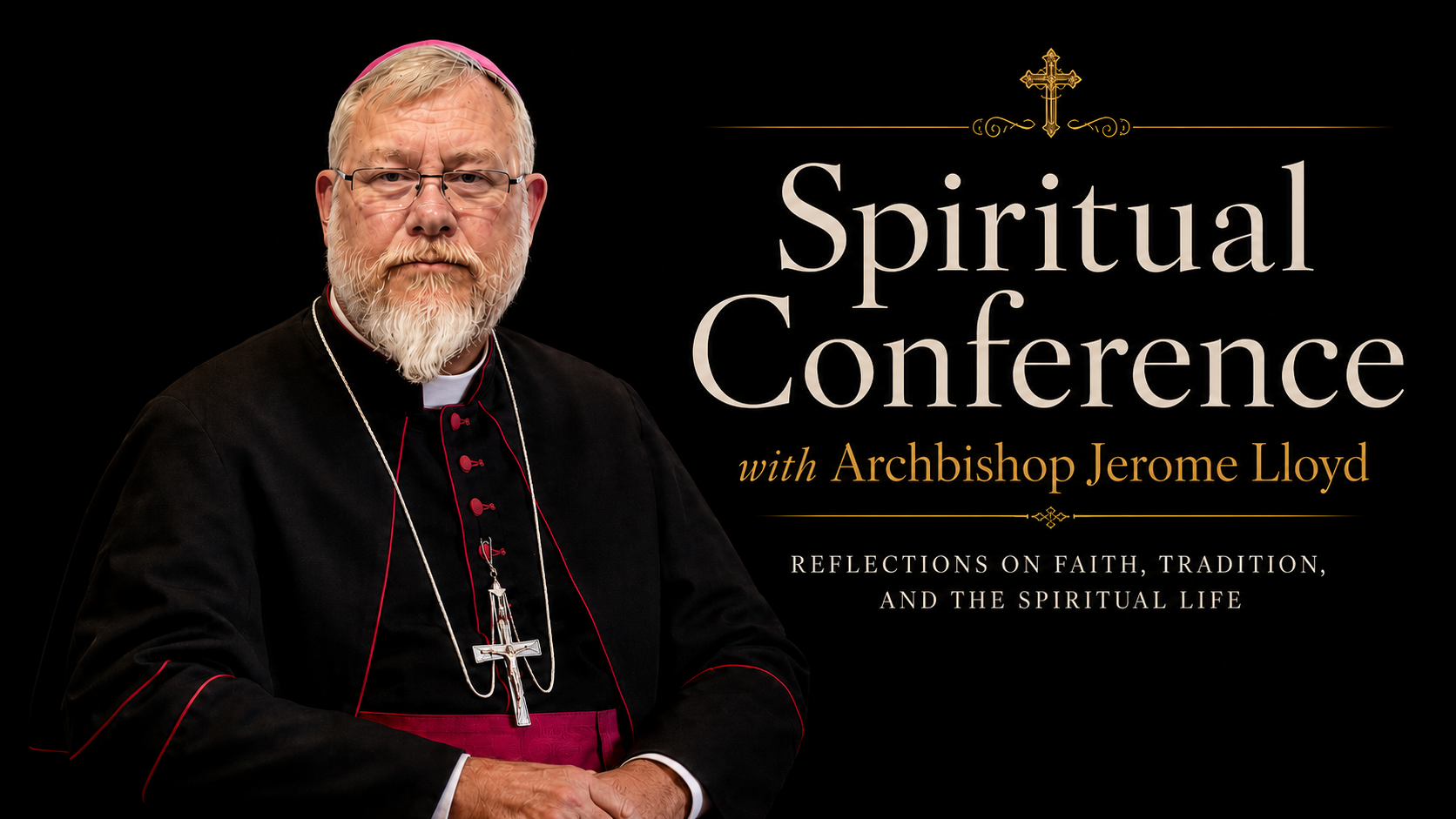
DEPOSITUM CUSTODI – Guard What Has Been Entrusted to You: A Spiritual Conference for Nuntiatoria CXX
“O Timothy, keep that which is committed to thy trust, avoiding the profane novelties of words, and oppositions of knowledge falsely so called.”
— I Timothy 6:20
The motto of this week’s Nuntiatoria follows almost inevitably from that of last week. Last week we considered Accipere, non fingere — receive, do not invent.¹ This week St Paul takes us one step further: Depositum custodi — guard what has been entrusted to you. It is not enough to receive. What we have received must be cherished, preserved, lived and ultimately handed on. And immediately this changes the character of the reflection, because custody is not principally an argument about what other people ought to do. It is first a question addressed to me. What has God entrusted to me, and what have I done with it?
The words come from St Paul’s First Epistle to Timothy. Timothy is young, charged with pastoral responsibility, surrounded by controversies and false teachings, and entrusted with something which does not belong to him. St Paul does not tell him to discover a new Christianity appropriate to his generation. He does not tell him to make himself relevant by finding a message more congenial to Ephesus. He tells him to keep the deposit. The Vulgate gives us those memorable words: O Timothee, depositum custodi. In his Second Epistle, St Paul returns to the same thought with still greater tenderness and urgency: Bonum depositum custodi per Spiritum Sanctum, qui habitat in nobis — “Keep the good thing committed to thy trust by the Holy Ghost, who dwelleth in us.” The deposit is guarded, therefore, not merely by human determination but through the Holy Ghost dwelling within us.
That is where our spiritual conference must begin. Because if we hear the words Depositum custodi only as a criticism of bishops, theologians, liturgists, governments, universities or ecclesiastical institutions, we have not yet heard St Paul. Those applications may be legitimate, and this week’s edition contains many examples of institutions being asked whether they are guarding what was entrusted to them. But before Timothy was a symbol of ecclesiastical authority, Timothy was a Christian soul. The deposit had first to be guarded within him. And so it must be with us.
God has entrusted something to every one of us. He has entrusted to us the Catholic Faith. He has entrusted to us our baptismal grace. He has entrusted to us the knowledge of Jesus Christ. He has entrusted to us the Sacraments. He has entrusted to us the possibility of prayer. He has entrusted to us whatever vocation, responsibilities, relationships, talents, opportunities, sufferings and duties belong to our state of life. He has entrusted to some the care of children, to some the care of ageing parents, to some priesthood, to some religious life, to some public responsibility, to some an apparently hidden and ordinary existence known chiefly to God. And the question is not whether our deposit resembles somebody else’s. The question is whether we have guarded ours.
This helps us understand what Christian fidelity actually means. Fidelity is not simply refusing to deny propositions. We may affirm every article of the Creed and yet allow the supernatural life within us to decay through negligence. We can become very skilled defenders of the Church while scarcely speaking to God. We can identify every liturgical abuse while approaching the Holy Sacrifice distractedly and without recollection. We can defend traditional Catholic morality while treating those nearest to us with impatience. We can condemn doctrinal ambiguity while permitting ambiguity in our own conscience whenever obedience becomes inconvenient. The deposit must be guarded in doctrine, certainly, but it must also be guarded in the soul.
There is, therefore, a first and very personal meaning of Depositum custodi: guard the grace of God in you. Guard the life begun at baptism. Guard your conscience. Guard the habit of prayer. Guard your recollection. Guard your Sunday and, where possible, daily encounter with the Mass. Guard your confession. Guard yourself from the occasions of sin which you already know are occasions of sin. Guard the interior silence in which God can speak. Guard the small disciplines which prevent spiritual life from becoming merely an aspiration. We sometimes imagine that great apostasy begins with an intellectual decision. More often, perhaps, the erosion begins much earlier: prayer becomes irregular, examination of conscience becomes superficial, venial sin becomes comfortable, entertainment occupies every silence, and gradually the soul no longer has sufficient interior life to recognise what it is losing.
The devil is not always required to persuade a Catholic that the Faith is false. Sometimes it is quite sufficient to persuade him that the Faith can be attended to tomorrow.
Custody, then, requires vigilance. Our Lord repeatedly commands vigilance: Vigilate. Watch. The wise virgins possess oil. The householder watches for the thief. The servants await the master’s return. Christian life is not anxious suspicion, but neither is it spiritual sleepwalking. Something precious has been entrusted to us, and precious things are guarded.
But there is a danger here, especially for those of us attached to Tradition. We must distinguish guarding the deposit from possessing the deposit. The Faith does not become mine because I defend it. Tradition is not a private collection which I own because somebody else appears to value it less. The Catholic who says, “I alone understand what the Church has lost,” may be in as much spiritual danger as the innovator who says, “I alone understand what the Church must become.” Pride can attach itself equally to novelty and antiquity.
The true custodian knows that the treasure is not his. He is answerable for it precisely because it belongs to another.
This is why the image used in our banner for this edition is so appropriate: one person handing a sacred book to another. Tradition is fundamentally an act of transmission. Something is received into one pair of hands and subsequently placed into another. The moment one generation refuses either to receive or to transmit, the chain is wounded. Tradition survives not because books exist in libraries or because vestments survive in sacristies, but because living Catholics believe, worship, practise and deliberately teach to others what they themselves received.
St Irenaeus understood this profoundly in the second century. Against the Gnostics, who claimed secret insight and superior knowledge, he appealed to the public Faith of the Apostolic Churches, received and handed on. Christianity was not an esoteric discovery available only to the clever. The truth could be traced through the Church’s proclamation, her bishops, her worship and her continuity. St Vincent of Lérins later made the equally important distinction between authentic growth and alteration. Christian doctrine can develop, as a human body grows from childhood to maturity, but it must remain the same body. Growth perfects identity; corruption destroys it.
This matters spiritually because each of us is part of that transmission. We may never write a theological treatise. We may never teach in a seminary. But somebody is learning what Catholicism means by watching us. A child watches the way a parent genuflects. A visitor watches whether people speak in church as though Someone is present. A friend hears whether our faith makes us more charitable or merely more argumentative. A younger Catholic notices whether we treat Tradition as a source of joy and stability or as a permanent state of anger. We are transmitting constantly, even when we imagine ourselves silent.
And this brings us to one of the strongest themes running through this week’s edition. We have considered the historical phenomenon of a Church which, particularly in the decades following the Council, often seemed to believe that inherited Catholic instincts had to be remade. We have considered the role of experts, professional clerical culture, religious formation, liturgical reconstruction and what came to be called the “spirit of Vatican II”.² We have considered contemporary synodality and the danger that “listening” can become a highly managed process in which the acceptable range of answers is known before the questions have been asked.³
But the spiritual lesson is not merely that somebody somewhere should govern differently. The lesson for us is this: do I listen to God with an answer already prepared?
We may criticise synodal processes for predetermined conclusions while doing precisely the same thing in prayer. We kneel before God, but we have already determined the permissible outcome. “Lord, show me Thy will — provided Thy will is this.” “Lord, guide me — but not there.” “Lord, I forgive — if the other person first apologises.” “Lord, I will serve — so long as it costs no more than I have already decided to give.” That is not discernment. It is consultation with ourselves conducted in God’s presence.
True discernment begins with the possibility that God is right and I am wrong. It begins with Our Lady: Fiat mihi secundum verbum tuum. It begins with Samuel: “Speak, Lord, for thy servant heareth.” It begins in Gethsemane: “Not my will, but thine be done.” There is no Catholic discernment which does not contain an element of surrender.
This is why Depositum custodi and Accipere, non fingere belong together. We can guard only what we have first accepted as a gift. If I regard revelation as material requiring my approval, I cannot guard it. If I regard moral teaching as a set of proposals which my conscience is authorised to rewrite, I cannot guard it. If I regard my own created nature as raw material for self-invention, I cannot guard it. If I regard liturgy as an opportunity for self-expression, I cannot guard it. The custodian begins by saying: this precedes me.
Several stories in this edition concern Catholic institutions confronted with precisely that problem. Catholic schools are asked whether they will guard Catholic anthropology when the surrounding culture offers a radically different account of the human person. A Catholic university must ask whether the word “Catholic” still governs its intellectual life or merely decorates its history. A monastery or religious community must ask whether formation exists to immerse souls ever more deeply in a charism received from the Church or to adjust that charism continually to contemporary expectations. And when communities such as the Children of Mary are suppressed, or when flourishing monasteries such as Heiligenkreuz experience unusual intervention, Catholics naturally ask whether authority is guarding a religious inheritance or becoming suspicious of it.⁴
But again the spiritual question comes home to us. What would remain recognisably Catholic in my life if all the labels were removed? If nobody knew that I went to the traditional Mass, what would reveal my religion? My speech? My chastity? My generosity? My treatment of enemies? My reverence? My fasting? My patience with suffering? My concern for the poor? My willingness to forgive? My belief in Providence? My refusal to gossip? My preparation for death?
There is always a danger that Catholics who care deeply about ecclesiastical identity may become expert in identifying whether institutions are authentically Catholic while failing to ask whether we ourselves are recognisably Catholic.
The traditional liturgy is particularly instructive here. This edition includes the controversy over a young priest criticised for wearing recognisably Roman vestments — chasuble, maniple, lace alb and biretta.⁵ It is an extraordinary sign of our times when elements belonging unquestionably to Catholic tradition can appear controversial merely because they are traditional. But the spiritual significance of vestments goes deeper than the controversy. A priest puts on vestments in order, as it were, to disappear into an office greater than himself. The man is clothed for sacred action. The vestment says: this is not primarily about you.
That is a lesson every Christian needs. We too have been clothed. St Paul says: “As many of you as have been baptized in Christ, have put on Christ.” Christianity is a clothing of the self in Another. The world tells us to express ourselves; baptism tells us to put on Christ. The world teaches that authenticity means displaying the interior self; Christianity teaches that sanctity means allowing Christ so completely to inhabit the self that our true identity is discovered in Him.
To guard the deposit, therefore, is to guard this Christological identity. Before I am my preferences, my politics, my disappointments, my wounds, my ambitions, or even my ecclesiastical opinions, I am a Christian. I belong to Christ.
And because we belong to Christ, we must guard His image in others, especially where it is weakest. This week’s consideration of abortion pills and Britain’s “pills by post” regime confronts us with the most obvious case.⁶ The unborn child cannot guard himself. His life has, in a mysterious and natural sense, been entrusted to others. Mother, father, physician, lawmaker and society are custodians of a life which none of them created from nothing and which none therefore possesses absolutely.
Depositum custodi acquires a terrible moral clarity here. Guard what has been entrusted to you. Human life is entrusted before it is chosen. The child is received before he is useful, articulate, independent or wanted. Catholic opposition to abortion is not ultimately a political tribal marker. It belongs to our understanding of creaturehood. Life is gift before it is project.
That same principle extends beyond abortion. The elderly person, the disabled person, the inconvenient person, the sick person, the person whose dignity is obscured by dependence — all place before us the Christian obligation of custody. We are not permitted to decide that the worth of a human being depends upon how successfully he performs autonomy. Indeed, Christianity recognises a particular claim in the one who cannot repay us.
This is also why language matters. Several articles this week concern public speech: the arguments over Christianity and Islam, Rowan Williams and Nigel Farage, the proposed definition of “anti-Muslim hostility”, free speech and the danger that legitimate criticism may be conflated with hatred.⁷ The spiritual lesson here is not simply that we must defend freedom of expression. It is that Christians have a duty to guard truth and charity simultaneously.
Truth without charity becomes cruelty. Charity without truth becomes sentimentality. The Christian must refuse both. We may never hate a Muslim because he is Muslim. We may never treat a person as though his dignity depends upon agreeing with us. But neither does charity require us to pretend that religious propositions cannot be false, ideologies cannot be dangerous, laws cannot be unjust or cultures cannot contain grave errors. Our Lord is full of grace and truth. Christian speech must strive for the same union.
This demands discipline, particularly online. The defence of truth does not sanctify every tone. We can share accurate information for impure reasons. We can expose hypocrisy because we enjoy humiliation. We can defend Tradition while indulging wrath. We can tell the truth in a way calculated to wound rather than convert. The fact that my proposition is correct does not prove that my manner of speaking it is virtuous.
Guard the deposit, then, by guarding your tongue. St James warns us how small a member the tongue is and how great a fire it can kindle. In our age we should perhaps add: guard your keyboard. Guard the impulse to react immediately. Guard against becoming addicted to outrage. Guard against making another person’s failure your entertainment. Guard against the peculiar spiritual poison by which we begin to need the Church to be in crisis because indignation has become the emotional engine of our religious life.
Traditional Catholics must be especially vigilant about this temptation. There is much genuinely deserving criticism. There have been scandals, injustices, ambiguities and destructive reforms. But if the defence of Tradition gradually makes us bitter, suspicious of everyone, incapable of joy, eager for every rumour and delighted whenever an opponent falls, then something has gone profoundly wrong. We may be defending the deposit externally while losing its fruits internally.
This is relevant to the questions raised in this edition concerning Benedict XVI’s resignation, conclaves, Vatican investigations and other contested claims.⁸ Serious questions should be taken seriously. Facts matter. Canon law matters. Truth matters. But the Catholic soul must also guard itself against credulity. Not every dramatic claim is true because it confirms our fears. Not every rumour becomes evidence because we distrust an institution. Not every irregularity proves the maximum conclusion somebody wishes to draw from it.
To guard the truth means refusing falsehood even when falsehood would be useful to our side. That is a demanding asceticism. It is easier to doubt everything said by people we distrust and believe everything said against them. But Catholic intellectual life cannot operate like political partisanship. The Eighth Commandment belongs to the deposit too.
The Pachamama controversies considered in this edition bring us to another element of custody: the First Commandment.⁹ The Church can and must engage cultures. Mission has always involved the purification and elevation of human cultures. But the Christian must guard something which no desire for dialogue can relativise: “The Lord thy God shalt thou adore, and him only shalt thou serve.”
Spiritually, we should ask whether we ourselves guard the First Commandment as carefully as we wish Church authorities to do. Idolatry is not confined to statues or indigenous ceremonies. Anything can become an idol when it occupies the place belonging to God. Reputation can. Politics can. Money can. Comfort can. Ecclesiastical allegiance can. Even Tradition can become distorted into an idol if our attachment is ultimately to a cultural identity or aesthetic rather than to God Himself.
The traditional liturgy exists to worship God, not to worship tradition. That distinction is crucial. We love the inherited Roman liturgy because through it the Church teaches us to disappear before the majesty of God. It trains the body to kneel, the voice to become quiet, the personality to submit to rite, the priest to face liturgical east, and the whole assembly to understand that God is the principal actor. If attachment to traditional worship instead becomes a means of constructing a superior religious identity, we have contradicted what the rite itself teaches.
The feast of St Philip Benizi, which falls within this edition, gives us a beautiful antidote.¹⁰ Here was a learned man, a priest, a Servite superior, a man capable of exercising authority, and yet Catholic memory has preserved particularly his humility before elevation. He represents an authority which receives rather than grasps. Office does not make a man greater than the thing he serves.
This is a particularly necessary spiritual lesson for clergy, but not only for clergy. Every form of responsibility can tempt us to possession. Parents can treat children as extensions of themselves. Priests can treat parishes as personal territories. Lay leaders can treat apostolates as private property. Founders can become unable to imagine an organisation surviving without them. The person who begins something may forget that stewardship sometimes means handing it to another.
Depositum custodi includes knowing when the deposit must pass from my hands into somebody else’s.
The image of transmission in our edition therefore carries another spiritual question: what are we preparing to hand on? If a younger person inherited my Catholicism exactly as I live it, what would he receive? Would he receive reverence without rigidity, conviction without cruelty, doctrine without self-righteousness, devotion without superstition, courage without recklessness, obedience without servility, authority without domination, tradition without nostalgia, and charity without compromise? Or would he inherit my unresolved anger alongside my missal?
That question is uncomfortable because none of us hands on only what we intend to hand on. Children inherit atmosphere. Seminarians inherit priestly culture. Religious inherit the habits of their houses. Parishioners inherit what clergy reward and what they tolerate. Converts imitate the Catholics who first receive them. We hand on not only propositions, but a manner of being Catholic.
This is why the story of the young Nigerian seminarian recounted by ✠Matthew Hassan Kukah has such spiritual force.¹¹ According to the account, the young man, kidnapped and confronted by armed men, continued telling them that they must repent and return to God, and was killed. We can debate endlessly how effective this or that model of evangelisation may be. The martyr strips the problem bare. He believed Christ. He believed repentance mattered. He believed his captors possessed souls. And he believed all this when speaking could cost him his life.
That is custody. Not keeping the Faith safely hidden so that nobody can harm it, but guarding it so deeply within the heart that danger cannot make us betray it.
There is a paradox here. The safest place for the deposit is not a locked cabinet. It is a saint.
The Church’s treasures survive because somebody lives them. Manuscripts can burn. Buildings can be demolished. Institutions can collapse. Religious orders can be suppressed. Civilisations can forget. But when a soul becomes holy, the deposit has become flesh again in a human life. That is why persecutors can burn books and close churches and still fail. They cannot destroy a Faith which has entered the soul unless the soul consents to surrender it.
The martyr therefore asks each of us a difficult question: what would it take to make me silent? Perhaps nobody will put a gun to our heads. More likely the pressures will be smaller and therefore more revealing. Embarrassment. Professional disadvantage. Social exclusion. A difficult family conversation. Fear of appearing old-fashioned. Fear of being thought unkind. Fear of admitting that we are Catholic. Fear even of making the Sign of the Cross in public.
Martyrdom is prepared in ordinary fidelity. The man who cannot say grace in a restaurant should not imagine confidently what he would do before a firing squad. Our Lord teaches us fidelity through small things: “He that is faithful in that which is least, is faithful also in that which is greater.” Guarding the deposit means guarding the tiny daily acts by which the soul becomes capable of larger courage.
And here the Thirteenth Sunday after Pentecost offers perhaps the most beautiful spiritual correction of all.¹² Ten lepers are cleansed. Only one returns to give thanks. All receive; one recognises what he has received. That Gospel belongs perfectly beside Depositum custodi, because custody begins in gratitude.
We guard what we know to be gift. Ingratitude makes preservation impossible because what we no longer value we eventually discard. If Catholics cease to be grateful for the Faith, eventually the Faith becomes merely burdensome. If a priest ceases to be grateful for his priesthood, ministry becomes employment. If a religious ceases to be grateful for vocation, vows become restrictions. If a society ceases to be grateful for Christian civilisation, inherited institutions become obstacles to liberation. If a family ceases to be grateful for children, fertility becomes a problem to control.
The Samaritan returns because he knows that something has happened to him which he did not do for himself. Gratitude is therefore deeply anti-modern. The autonomous self says: I made myself. The Christian says: what hast thou that thou hast not received?
That question from St Paul should accompany Depositum custodi: “What hast thou that thou hast not received?” My life was received. My body was received. My baptism was received. My Faith was received. The Scriptures were received. The liturgy was received. The teaching of the saints was received. Even the capacity by which I cooperate with grace is itself already surrounded by grace.
Once we understand this, custody ceases to feel like mere obligation. It becomes gratitude expressed through fidelity.
And perhaps this is the most important spiritual correction we can make to the whole theme of this edition. Depositum custodi can sound defensive: the world is hostile, institutions are changing, Tradition is endangered, therefore we must guard the walls. There are circumstances in which defensive action is necessary. But Christianity cannot live permanently in a siege mentality.
The deposit is not merely something we are frightened of losing. It is something we are delighted to possess because God has given it to us.
The Christian guardian should therefore be recognisable not principally by anxiety but by joy. We defend the Mass because it is beautiful and true. We defend life because life is good. We defend marriage because marriage is good. We defend Catholic anthropology because creation is good. We defend doctrine because truth is good. We defend religious freedom because man’s search for truth matters. We defend the Faith because Christ is worth knowing. Otherwise all our guarding becomes defensive maintenance.
The Gospel is not maintenance. It is good news.
So what does Depositum custodi require of us this week? It requires first that we identify the deposit entrusted personally to us. It requires that we guard our state of grace, our prayer and our conscience. It requires that we know the Faith sufficiently well to recognise when something contradicts it. It requires gratitude for the inheritance of the Church. It requires humility, because we are custodians rather than owners. It requires courage, because there will be moments when fidelity costs something. It requires intellectual honesty, because useful falsehoods still remain falsehoods. It requires charity, because truth belongs to Christ and cannot be defended adequately by becoming unlike Christ. It requires transmission, because a deposit guarded but never handed on has failed in its purpose.
And there is one final point. St Paul does not tell Timothy to guard the deposit by his own strength. In the second epistle he says: “Keep the good thing committed to thy trust by the Holy Ghost, who dwelleth in us.”
That changes everything.
We are not being asked to preserve the Catholic Faith by sheer force of personality. The survival of the Church does not depend upon my anxiety. Tradition is not preserved because I worry sufficiently hard. Christ has not abandoned His Church to my competence.
The Holy Ghost dwells in us.
Our work is therefore cooperation. Fidelity is grace answered by fidelity. Courage is grace answered by courage. Prayer is grace drawing us into prayer. Even repentance after failure is grace restoring what our negligence endangered.
There will be times when we fail to guard what we have received. Perhaps we have neglected prayer. Perhaps we compromised. Perhaps we remained silent. Perhaps we scandalised another person. Perhaps we allowed resentment to distort our Catholic life. Perhaps years have passed in which the treasure was treated casually. Then the answer is not despair. The answer is confession, restoration and renewed custody.
St Peter denied the Lord entrusted to him and became the shepherd commanded to strengthen his brethren. The Church herself is filled not with men who never failed but with saints who permitted grace to recover them after failure.
So let us finish not with suspicion of everyone else’s fidelity, but with an examination of our own. What has God entrusted to me? What part of that deposit have I neglected? What truth have I become embarrassed to confess? What prayer have I allowed to disappear? What duty have I repeatedly postponed? What Catholic practice have I failed to hand on? What resentment threatens to corrupt the truth I am trying to defend? What person has God placed in my life who may know Christ more deeply if I live the Faith more faithfully? And if I were called tomorrow to hand the deposit to another generation, what precisely would I be placing into their hands?
Last week we said: Accipere, non fingere. Receive. Do not invent. Now St Paul completes the command: O Timothee, depositum custodi. O Timothy, guard what has been entrusted to you.
Guard the Faith, but guard it by living it. Guard the Mass, but allow the Mass to change you. Guard doctrine, but let doctrine lead you to God. Guard Catholic morality, but practise the virtues yourself. Guard Tradition, but do not turn Tradition into bitterness. Guard truth, but speak it in charity. Guard your children, but first become the Catholic you hope they will imitate. Guard the sacred, but remember that by baptism your own soul has become a temple of the Holy Ghost. Guard the inheritance, and then place it faithfully into another pair of hands.
And when the time comes for our own hands finally to release everything — office, possessions, projects, arguments, reputation, even this mortal life — may we be able to say with St Paul: “I have fought a good fight, I have finished my course, I have kept the faith.”
That is the final meaning of Depositum custodi: to receive from those who went before us, to guard faithfully during the little span entrusted to us, and to hand on what was never ours to alter — until Faith gives way to sight, hope to possession, and the deposit we guarded on earth is fulfilled forever in the presence of God.
¹ Nuntiatoria CXIX: 16.08.26 Nuntiatoria CXIX: Accipere non Fingere; and ACCIPERE, NON FINGERE — To Receive, Not to Invent: A Spiritual Conference for Nuntiatoria CXIX.
² Nuntiatoria: The Most Clerical Revolution in Modern Catholic History; and Receive, Do Not Invent: Old Romans Unscripted confronts the crisis of Catholic transmission.
³ Nuntiatoria: When Listening Has a Predetermined Answer; see also Experts in Synodality: Leo XIV and the Rise of the Church of Process.
⁴ Nuntiatoria: What, Exactly, Did the Children of Mary Do?; When Synodality Stops at the Cloister Door: Rome suspends the abbatial election at Heiligenkreuz; Rome Has Set the Test: Hamburg’s Gender Dispute Now Raises an Unavoidable Question for Britain’s Catholic Schools; and A Priest at the Helm: What St Mary’s Must Now Be.
⁵ Nuntiatoria: Apparently the Vestments Are the Emergency.
⁶ Nuntiatoria: After Dobbs, Abortion Moved to the Mailbox — Now the Bishops Are Responding.
⁷ Nuntiatoria: Christian Britain Is Not Anti-Muslim: Rowan Williams, Nigel Farage and the increasingly dangerous confusion between Christian identity and hostility to Islam; and The State Erased the Case File: Blasphemy Law by Stealth.
⁸ Nuntiatoria: The Chair of Peter Cannot Rest on Ambiguity: Benedict XVI, Leo XIV and Rome’s Duty to Answer; and The Questions Rome Still Has Not Settled.
⁹ Nuntiatoria: Pachamama Returns — On the Road to Leo XIV.
¹⁰ Nuntiatoria: The Book of the Crucified: St Philip Benizi, Confessor, August 23.
¹¹ Nuntiatoria: The Seminarian Who Preached to His Murderers: Michael Nnadi, the Blood of Martyrs, and the Christianity That Refuses to Be Afraid.
¹² Nuntiatoria: The Grace That Returns: The Thirteenth Sunday after Pentecost.
RELATED ARTiCLES


LATEST ARTICLES
- Today’s Mass: October 18 St Luke the Evangelist; Commemoration of Sunday XXI Post PentecostSaint Luke was born a Greek and a Gentile in Antioch, Syria. He was a physician and it is believed that he may have also been a slave, as it was not uncommon in his day for slaves to be educated in medicine so the family would have a resident physician.
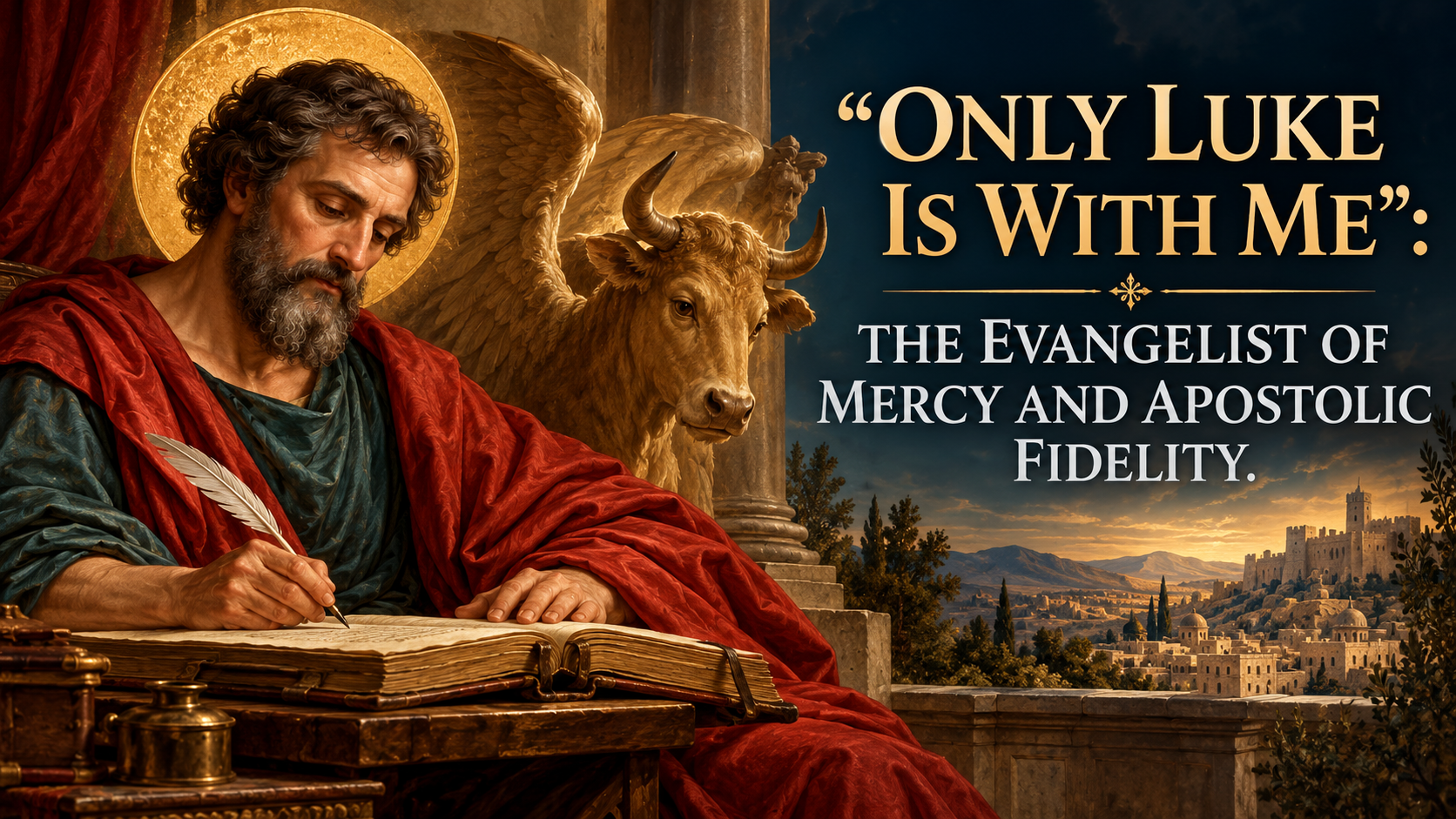
- “ONLY LUKE IS WITH ME”: THE EVANGELIST OF MERCY AND APOSTOLIC FIDELITYThe feast of St Luke, celebrated on 18 October, honours the beloved physician and Evangelist whose writings convey crucial Christian truths. He emphasises the vital link between divine mercy, repentance, and sacrifice. As St Paul’s companion, Luke’s narrative preserves the essence of the Gospel, reminding the Church to uphold and transmit revelation faithfully.
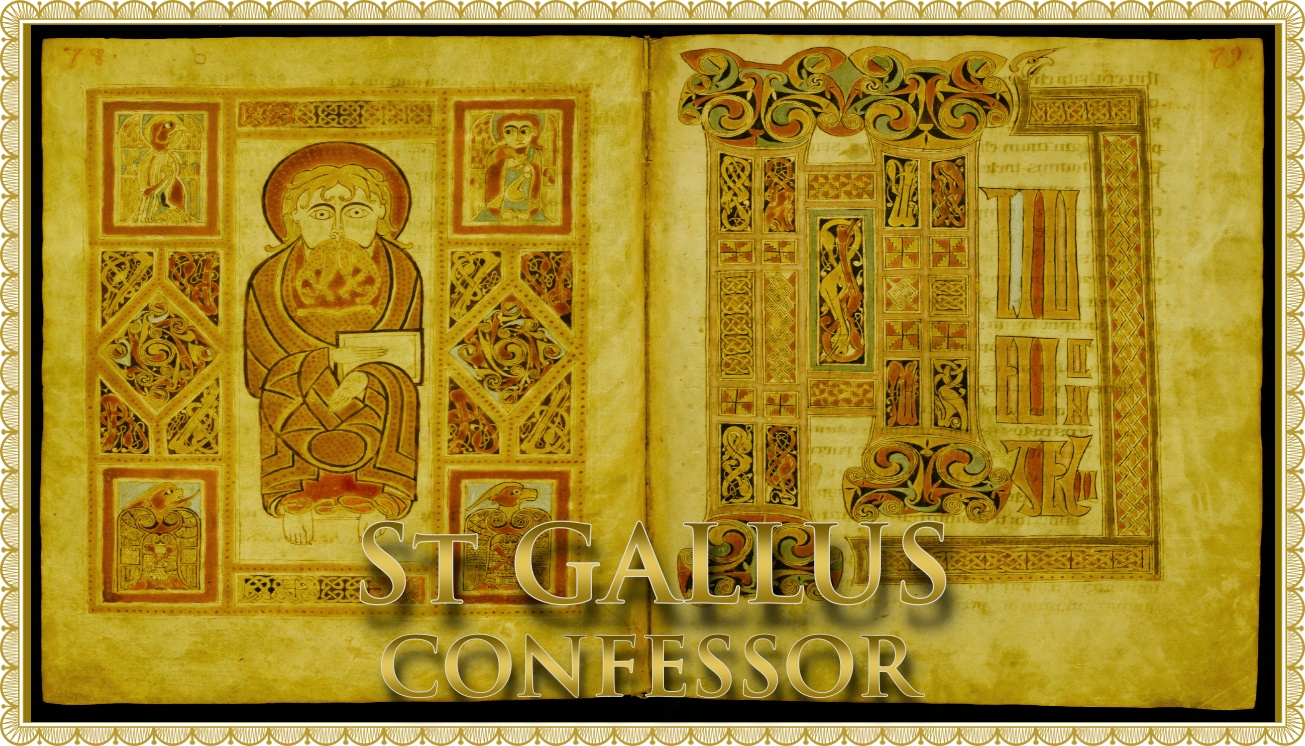
- Today’s Mass: October 17 St Gall, Confessor;Saint Gall, born in Ireland in the sixth century, became a notable confessor after accompanying Saint Columban to France and later Switzerland, where he preached and converted idolaters. Despite his significant contributions, he humbly declined the position of bishop of Constance. He died in 646, leaving a lasting legacy.
- 18.10.26 Nuntiatoria CXXVIII: NON POTEST VERITAS SUBDI POTESTATIThis editorial asserts that truth should not be subjugated to authority, emphasising that legitimate power derives from truth rather than mandates it. It critiques contemporary tendencies in both ecclesiastical and societal contexts where authority prioritises institutional credibility over accountability. Ultimately, it calls for a return to truth as the foundation of authority, urging faithful adherence to moral principles.
- ORDO w/c 18.10.26The liturgical calendar from 18 to 25 October 2026 includes the feast of St Luke the Evangelist, commemorating essential themes of forgiveness and evangelisation. Subsequent days honour St Peter of Alcantara, St John Cantius, St Ursula and St Raphael, culminating in the celebration of Christ the King, affirming His universal sovereignty over all creation.
CURRENT EDITION


Today’s Mass Propers
- Today’s Mass: October 18 St Luke the Evangelist; Commemoration of Sunday XXI Post Pentecost
 Saint Luke was born a Greek and a Gentile in Antioch, Syria. He was a physician and it is believed that he may have also been a slave, as it was not uncommon in his day for slaves to be educated in medicine so the family would have a resident physician.

Leave a Reply