
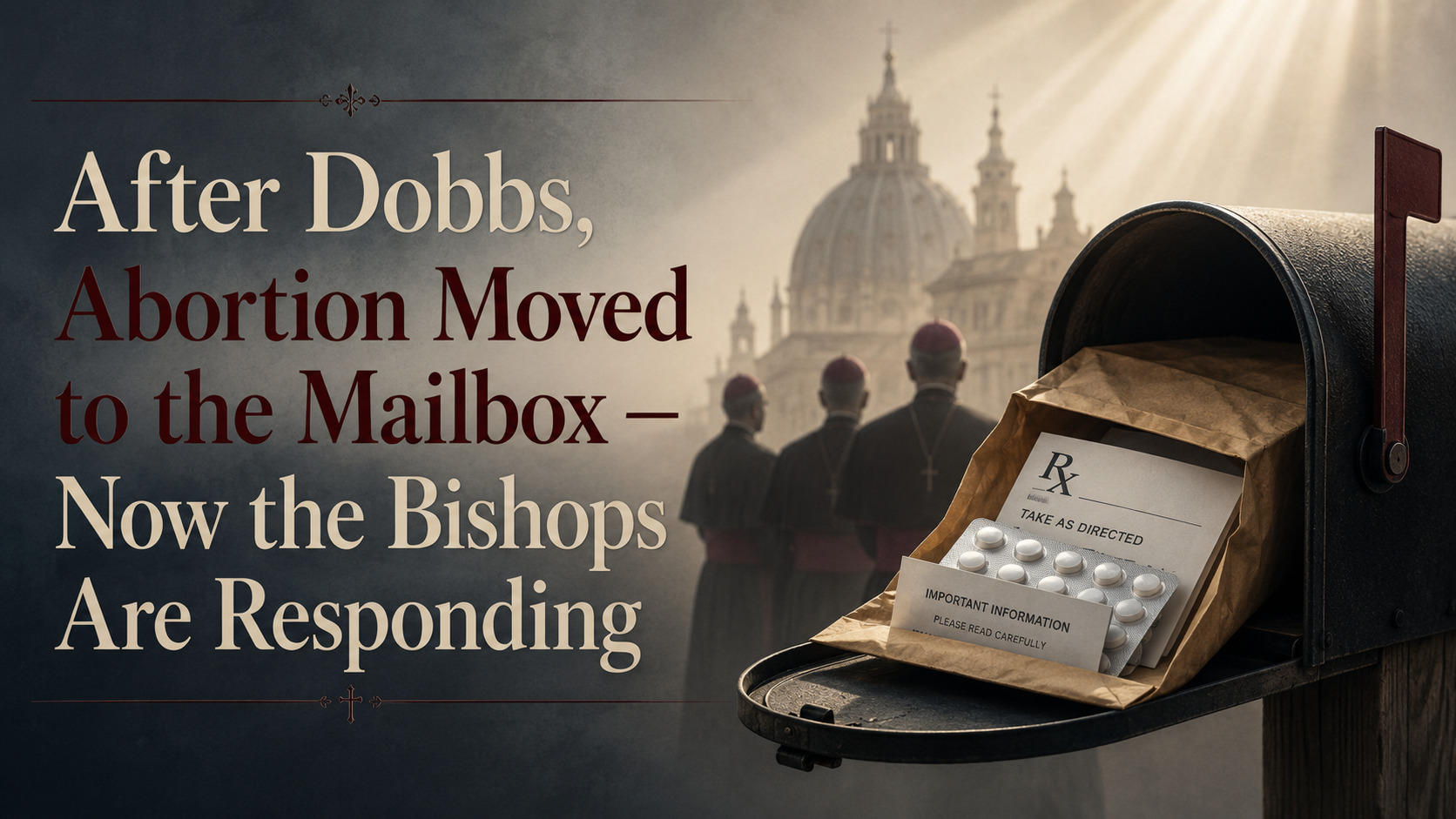
After Dobbs, Abortion Moved to the Mailbox — Now the Bishops Are Responding
The US bishops have launched a nationwide campaign of prayer, education and action against the rapid expansion of chemical abortion. Their intervention recognises a fundamental post-Dobbs reality: abortion has changed its means of delivery. England and Wales offer a sobering parallel. A supposedly temporary COVID-era experiment in remote “pills by post” became permanent law despite acknowledged concerns about coercion, safeguarding and gestational assessment — and Parliament has since removed women themselves from the criminal law governing self-procured abortion at any stage of pregnancy.

The United States Conference of Catholic Bishops has issued a new Nationwide Invitation to Prayer & Action against the spread of abortion drugs. Led by ✠Paul S. Coakley, Archbishop of Oklahoma City and President of the USCCB, and ✠Daniel E. Thomas, Bishop of Toledo and chairman of its Committee on Pro-Life Activities, the initiative calls Catholics to prayer through the intercession of St Joseph, Defender of Life, but deliberately refuses to leave the matter there. The faithful are also being asked to learn about chemical abortion, inform others, and contact pharmacies and pharmaceutical companies involved in distributing abortion drugs. The campaign continues through the end of October, Respect Life Month.¹
Its significance lies precisely in that combination of prayer and practical action. This is not simply another episcopal reiteration of the Church’s settled condemnation of abortion. The bishops are confronting one of the defining features of the post-Dobbs abortion landscape: abortion has changed address.
For half a century the American abortion controversy was visually and politically concentrated around the clinic. There was an identifiable building, an abortion provider, a physical procedure and consequently a recognisable location at which law, politics, medicine and protest encountered one another. The Supreme Court’s judgment in Dobbs v. Jackson Women’s Health Organization in 2022 destroyed the supposed federal constitutional right to abortion established by Roe v. Wade and restored extensive legislative authority to the states. That was an historic victory for the defence of unborn life. But Dobbs could remove a constitutional fiction; it could not remove the abortion culture that had developed beneath it.
Nor did the abortion industry remain stationary while state legislatures began exercising their recovered powers. Increasingly, the centre of gravity has moved from clinic to chemical, appointment to app, consultation room to telemedicine, and abortionist’s premises to the privacy of a woman’s own home.
The scale of that transformation is difficult to overstate. The Guttmacher Institute — an organisation which supports abortion rights and therefore cannot plausibly be accused of constructing statistics for the bishops’ argument — calculated that approximately 1.037 million abortions occurred within the formal US healthcare system in 2023, an increase of 11 per cent since 2020 and the highest number and rate for more than a decade. More significantly still, 63 per cent of all US abortions in 2023 were medication abortions, compared with 53 per cent only three years earlier.² Chemical abortion is not an adjunct to the contemporary American abortion industry. It has become its predominant method.
✠Thomas identified the strategic consequence with unusual clarity on the anniversary of Dobbs in June: “The victory of the Dobbs decision risks being undone by the massive influx of abortion pills.”³ States may prohibit or restrict abortion clinics within their jurisdiction; pills prescribed remotely and dispatched through pharmacies, online suppliers or the postal system create a different regulatory problem altogether. The USCCB now describes the result as a “nationwide mail-order abortion industry”, pointing particularly to telemedicine prescribing and pharmacy and online distribution.¹
In other words, the abortion industry has decentralised.
And Americans do not need to speculate about where such a development can lead. England and Wales have already travelled much further down the same road.
At the outbreak of COVID-19 in March 2020, the British Government introduced what rapidly became known as “pills by post”. From 30 March 2020 in England, women and girls seeking an early medical abortion could take both mifepristone and misoprostol at home following a telephone or electronic consultation, without first attending a hospital or abortion clinic. Wales introduced the corresponding temporary arrangement the following day. Before the pandemic, the second drug could already be taken at home, but attendance at an abortion service had been required for the first. The new arrangement was expressly justified as an emergency public-health measure intended to reduce COVID transmission while maintaining access to abortion. It was temporary by design.⁴
That history matters. The measure was not originally presented to Parliament or the public as a fundamental and permanent restructuring of abortion provision. Its justification was exceptional because the circumstances were exceptional.
When the emergency receded, the Government initially decided that the exceptional measure should recede with it. On 24 February 2022, the Department of Health and Social Care announced that England would return to its pre-pandemic arrangements. The temporary approval was to expire at midnight on 29 August 2022. Ministers expressly connected the decision with the passing of the COVID emergency and the conclusions of the public consultation.⁵
Then Parliament intervened.
On 30 March 2022, following free votes in both Houses, Parliament amended the Health and Care Bill. The resulting section 178 of the Health and Care Act 2022 made provision for remote prescription and home use permanent in England and Wales, permitting a pregnant woman’s home to be an approved place for early medical abortion and a registered medical practitioner to prescribe the drugs remotely, subject to the statutory conditions and the doctor forming the required opinion that the pregnancy would not exceed ten weeks.⁶
The sequence deserves to be remembered: emergency measure, temporary approval, Government decision to terminate it, parliamentary reversal, permanent law.
That does not by itself prove that the policy was medically unsafe. It does demonstrate something politically important, however. Once an emergency measure creates a new expectation of convenience, its original emergency justification can disappear while the measure itself survives. The argument quietly changes from this is necessary because people cannot safely attend clinics during a pandemic to this should continue because requiring people to attend clinics is inconvenient.
More important still, Parliament did not make that choice because safeguarding questions had never been raised. They had been raised explicitly and repeatedly.
The Government consultation received 18,834 responses. Among all respondents, 69 per cent believed the temporary arrangement had negatively affected safety; 78 per cent considered that there were safeguarding benefits in requiring at least one visit for clinical assessment; and 70 per cent wanted the temporary measure to end immediately. Concerns recorded by the Government included women being coerced into abortions when they were not physically seen by a service, pregnancies being inaccurately dated, serious medical conditions being missed, pills being obtained fraudulently, and opportunities to detect domestic abuse being lost. NHS organisations themselves reported particular safeguarding concerns concerning vulnerable patients.⁷
Those statistics require an important qualification, and an intellectually serious pro-life argument should give it. Consultation respondents were self-selecting, nearly half of the individual responses were connected with organised campaigns, and the Government warned that the aggregate figures should not be treated as representative of the wider population. Among women responding who had actually used both pills at home, 83 per cent reported a positive effect on safety, and substantial majorities reported benefits in accessibility, privacy and confidentiality.⁷ Those figures belong in the account because inconvenient evidence does not become irrelevant merely because it is inconvenient.
Yet the qualification does not eliminate the safeguarding problem. Even among women who had themselves used the at-home service, 45 per cent believed there were benefits for safeguarding and women’s safety in requiring at least one clinical visit, while only 22 per cent identified disadvantages. Among responses not affiliated with campaigns, 61 per cent still identified safeguarding benefits from an in-person assessment.⁷ The serious argument, therefore, is not that every woman using telemedicine abortion is endangered. It is that a system deliberately designed to remove physical clinical contact necessarily sacrifices one means by which coercion, incorrect gestational dating, vulnerability and abuse may be discovered.
The case of Carla Foster subsequently demonstrated one particular vulnerability with brutal clarity. During the first COVID lockdown, Foster obtained abortion drugs from the British Pregnancy Advisory Service through the remote system after giving false information about the length of her pregnancy. The Court of Appeal recorded that her own internet searches showed that she knew she was well beyond the lawful limit for early medical abortion. The pregnancy was later estimated to have been approximately 32 to 34 weeks when the abortion occurred. Her original prison sentence was subsequently reduced on appeal to a suspended sentence.⁸
The point is not that Foster’s extraordinary case represents ordinary users of early medical abortion. It plainly does not. Nor does it follow that an in-person appointment would infallibly have prevented every deception. The significance is narrower and stronger: the system depended upon information supplied remotely which, in this case, was false, and there was no physical examination capable of exposing the discrepancy before the drugs were supplied.
That is precisely the kind of distinction a serious discussion of “pills by post” requires. The argument should not depend upon caricaturing medical evidence or pretending that every remote abortion produces a medical catastrophe. The deeper problem is structural. A system in which the abortion provider never physically encounters the pregnant woman necessarily loses information which physical examination or private face-to-face contact might sometimes disclose.
That has implications far beyond gestational age.
The political rhetoric of abortion pills repeatedly treats privacy as an unqualified liberation. But privacy can also become isolation. Where a woman is subject to domestic violence, sexual exploitation, trafficking or coercive control, physical absence works in two directions. It may remove an unwanted journey to a clinic; it may also remove one of the few opportunities for a professional to see her separately from the person controlling her. A technology intended to make abortion easier for a woman freely seeking one can make abortion easier for someone else who wants her pregnancy ended.
The unborn child is therefore not the only human being who risks disappearing from view. The woman herself can disappear with him.
The British trajectory has now moved further still. The Crime and Policing Act 2026, which received Royal Assent this year, makes a profound additional change to abortion law in England and Wales. Section 241 disapplies the existing criminal offences contained in sections 58 and 59 of the Offences Against the Person Act 1861 and the Infant Life (Preservation) Act 1929 where a woman acts in relation to her own pregnancy, at any gestation. The Government’s own explanatory notes state expressly that it is therefore no longer a criminal offence for a pregnant woman herself to act with the intention of procuring her own miscarriage “at any stage of pregnancy”.⁹
Precision is essential here. Parliament has not abolished the Abortion Act 1967, nor has it legalised unrestricted late-term abortion by doctors. The statutory framework governing clinical abortion remains. The ordinary 24-week limit remains subject to the existing statutory exceptions. Medical practitioners and third parties remain bound by the law, and offences continue to apply to others who unlawfully administer drugs, procure abortions or intentionally end the life of a child capable of being born alive. The House of Commons Library is explicit about this distinction.¹⁰
But the significance of section 241 should not consequently be minimised. A woman acting in relation to her own pregnancy has been removed from those criminal provisions at any stage of gestation. That is not a pro-life characterisation of the legislation; it is what the legislation does.
Seen together, the 2020, 2022 and 2026 changes reveal a trajectory which should command American attention. A temporary arrangement introduced during a public-health emergency established remote access to abortion drugs. Parliament subsequently made that arrangement permanent notwithstanding documented safeguarding objections. Four years later, Parliament removed women acting in relation to their own pregnancies from the principal criminal abortion offences regardless of gestational stage.
None of these measures logically compelled the next. Political history is not mathematical inevitability. But neither should Catholics ignore the direction of travel simply because each liberalisation can be defended in isolation.
That makes the US bishops’ present intervention especially timely.
The fundamental Catholic objection to chemical abortion does not, of course, depend upon its side-effect profile, the quality of telemedicine or the adequacy of safeguarding. Even if every abortion pill were dispensed following flawless clinical assessment and produced no complication whatsoever for the woman, its intended consequence would remain the deliberate termination of innocent human life. Mifepristone blocks the progesterone necessary for the pregnancy to continue; misoprostol then induces uterine contractions and expulsion. Technology can change the surroundings of abortion. It cannot change what abortion is.
That is why the bishops are right to resist a vocabulary which permits the human reality to vanish beneath pharmaceutical terminology. Once abortion becomes “medication”, the abortionist a “provider”, the procedure “care” and the unborn child absent altogether from the description, something more than language has been altered. Moral perception itself is being managed.
The Church must insist upon reality before rhetoric. There is a mother. There is an unborn child. There is an act deliberately intended to end that child’s life. Whether the act occurs beneath the lights of an abortion clinic or in a bathroom following the arrival of a padded envelope through the letterbox does not alter its moral species.
Claims concerning danger to the mother, however, must remain exact. The US Food and Drug Administration continues to maintain that mifepristone is safe when used according to its approved conditions. Its current REMS programme nevertheless requires certified prescribers and pharmacies, recognises contraindications including ectopic pregnancy, and requires prescribers to be able to arrange surgical intervention and access to emergency care where necessary. Since the January 2023 modification of the programme, however, the FDA does not require an in-person appointment before mifepristone is obtained. It maintains that appropriate assessment of gestational age, ectopic pregnancy risk and other contraindications can in suitable circumstances be undertaken without direct physical contact.¹¹
The proper criticism is therefore not that the FDA denies that medicine matters. It is that an increasingly remote system places greater dependence upon information obtained without examination and creates circumstances in which some vulnerabilities may be harder to detect. The British experience demonstrates that those concerns are not inventions peculiar to American Catholic bishops; precisely such questions appeared in the British Government’s own consultation.
✠Coakley and ✠Thomas also identify another danger: exploitation by violent partners and human traffickers.¹ The possibility deserves far greater attention than it usually receives. A clinic at least provides the possibility of another human encounter. A drug ordered electronically can be obtained, concealed, supplied or pressured upon someone with far less visibility. The convenience celebrated by the autonomous individual can become a weapon in the hands of the coercive individual.
This is why the bishops’ decision to combine prayer, education and action is sound. Catholic pro-life witness becomes deficient when any one is detached from the others. Prayer without works risks becoming sentimental consolation. Political activity without prayer risks becoming merely another pressure campaign. Education without either can remain sterile information. The defence of human life requires the integration of all three.
The invocation of St Joseph, Defender of Life, is especially appropriate. Joseph’s protection of Mary and the Divine Child was never theoretical. He received them, provided for them, removed them from danger and accepted personal sacrifice for lives entrusted to his care. His example therefore exposes a false choice too often imposed upon the abortion debate. One does not defend the unborn child by ceasing to care about his mother; one defends both precisely because both possess a dignity which forbids abandonment.
The lesson of Dobbs is consequently more demanding than either side sometimes admits. The judgment was a monumental constitutional correction, but a constitutional victory is not the same thing as a cultural conversion. Dobbs could return legislative competence to elected government; it could not make abortion unthinkable. It could permit a state to close an abortion clinic; it could not prevent technological change from transporting abortion beyond the clinic’s walls.
England and Wales provide the warning. When abortion becomes something that can be prescribed remotely, delivered through the post and carried out privately at home, the disappearance of the clinic does not necessarily mean the disappearance of abortion. It may mean the disappearance of abortion from sight.
That invisibility may ultimately prove one of chemical abortion’s greatest cultural dangers. A clinic possesses an unavoidable physicality. One can see the building, identify its purpose and confront what happens there. Chemical abortion disperses the act into thousands of private homes. There need be no operating theatre, no waiting room, no abortionist physically present and perhaps no witness at all to what occurs. Abortion becomes at once more commonplace and less visible.
The pro-life response must therefore become equally decentralised. If abortion has entered pharmacies, homes, telephones and postal systems, Catholic witness must exist in parishes, families, medical professions, pharmacies, legislatures and ordinary conversations. The defence of life cannot remain confined to demonstrations outside buildings when the practice it opposes increasingly requires no building.
Ultimately, however, even that is insufficient. The purpose of Catholic pro-life action cannot merely be to make chemical abortion more difficult to obtain. It must be to build a society in which abortion becomes increasingly unimaginable: a culture in which pregnancy is not treated as an adversary, motherhood is not regarded as a failure of autonomy, fathers understand responsibility rather than escape, women confronting desperate circumstances encounter practical assistance rather than a prescription, and an unborn child is recognised not as a problem to be chemically resolved but as one of us.
The American bishops are therefore right to pray — and right not to stop at prayer. Dobbs changed the constitutional law. The abortion industry changed its method. England and Wales demonstrate how emergency access can become permanent infrastructure, and how subsequent legislation can liberalise the surrounding law still further.
The lesson is not that America is destined to follow Britain. It is that legal victories do not preserve themselves, technological changes are not morally neutral, and concessions introduced as exceptional have a habit of becoming normal.
The clinic may have moved into the mailbox. The obligation of the Church has not moved at all.
It remains with the mother, with the child, and with the truth.
¹ United States Conference of Catholic Bishops, Nationwide Invitation to Prayer & Action, 2026.
² Guttmacher Institute, Impact Report 2024, US abortion incidence and medication-abortion figures for 2023.
³ United States Conference of Catholic Bishops, “Bishop Thomas’ Statement on the Anniversary of the Dobbs Decision”, 22 June 2026.
⁴ Department of Health and Social Care, Home use of both pills for early medical abortion up to 10 weeks gestation; Department of Health and Social Care, Abortion statistics, England and Wales: 2022.
⁵ Department of Health and Social Care, “England to return to pre-pandemic system for early abortions”, 24 February 2022.
⁶ Health and Care Act 2022, s.178; The Abortion (Amendment) Regulations 2022, Explanatory Memorandum.
⁷ Department of Health and Social Care, Home use of both pills for early medical abortion: summary of consultation responses, 2022.
⁸ Court of Appeal (Criminal Division), R v Foster [2023] EWCA Crim 1196.
⁹ Crime and Policing Act 2026, s.241, Explanatory Notes.
¹⁰ House of Commons Library, Changes to the law on abortion in England and Wales, 3 August 2026.
¹¹ United States Food and Drug Administration, Questions and Answers on Mifepristone for Medical Termination of Pregnancy Through Ten Weeks Gestation, current 2026 guidance.


latest
- Today’s Mass: October 07 Pope St Mark, ConfessorSt Mark’s brief pontificate teaches that God measures fidelity, not duration or worldly achievement. Christ alone possesses the everlasting priesthood; His servants are stewards of what they have received. With the commemorated martyrs, St Mark reminds us to persevere faithfully, so that when the Lord comes, He finds us “so doing.”
- Omnia autem probate: quod bonum est tenete ~ Prove all things; hold fast that which is good: Spiritual Conference for Nuntiatoria CXXVIThe conference reflects on St Paul’s assertion to “prove all things” in relation to self-judgement and the Church. It explores themes of synodality, ecumenism, and the importance of discernment, emphasising the need for humility in understanding truth and the challenge of maintaining genuine holiness in the midst of contemporary ecclesiastical crises.
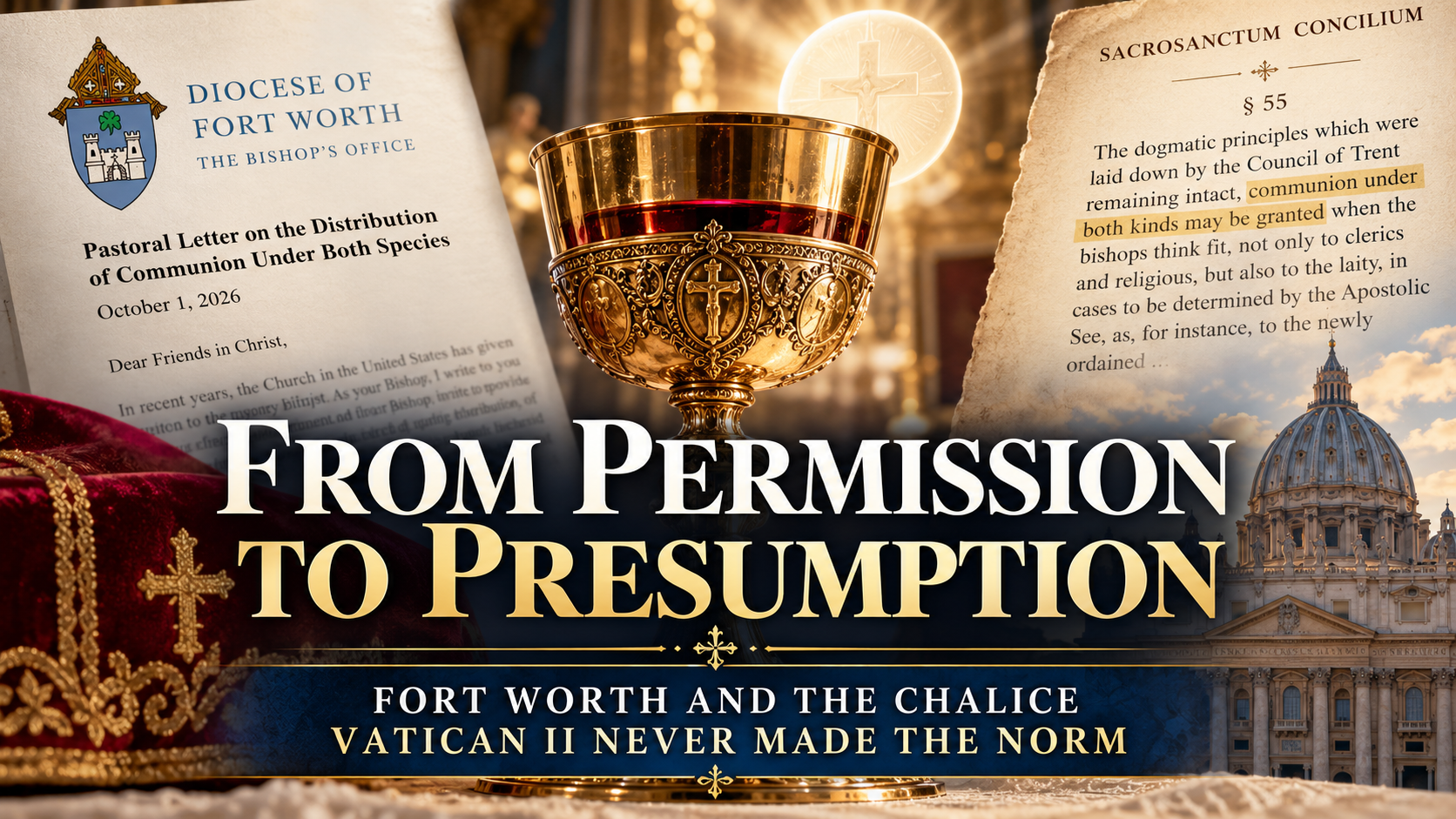
- FROM PERMISSION TO PRESUMPTION: Fort Worth and the Chalice Vatican II never made the NormBishop Michael Olson has implemented strict limitations on the distribution of Communion under both species in the Diocese of Fort Worth, prompting a discussion on the historical evolution of liturgical practices following Vatican II. This decision aims to reaffirm the doctrine of the Eucharist, emphasising that Christ is fully present under either species, while addressing misconceptions surrounding modern practices.
- AUGSBURG 2030: Can Rome commemorate a Confession it once confuted?Pope Leo XIV aims to revitalise the ecumenical spirit of the Augsburg Confession for its 2030 anniversary. However, historical responses from Rome highlight significant doctrinal differences between Catholics and Lutherans. True reconciliation must acknowledge these unresolved issues, as merely celebrating commonality risks glossing over critical theological distinctions that led to the Reformation.
- Today’s homily: St BrunoThe text reflects on Saint Bruno’s journey towards a life of solitude, prayer, and contemplation, emphasising the importance of genuine pursuit of God amidst distractions. It highlights that true spiritual growth requires silence and self-examination, urging believers to reclaim quiet moments for reflection, repentance, and devotion in daily life.



Leave a Reply