
The Quiet Surrender: Peter Hitchens, Women’s Ordination, and the English Religion of Accommodation
Introduction: A Commentator and a Moment
In late March 2026, Peter Hitchens—a man who has spent no small portion of his career rebuking the fashionable orthodoxies of our age—found himself, quite without irony, repeating one of them. Speaking on a Church Times podcast in the wake of the installation of Sarah Mullally as Archbishop of Canterbury, he offered what sounded like a reflective and almost reluctant acceptance of women’s ordination within the Church of England.¹
One almost expects, at such moments, a clearing of the throat, a cautious disclaimer, perhaps even a protest that one has wrestled with the question long and hard. Instead, we are treated to something much more English: a gentle shrug, a mild observation, and the quiet conclusion that since things do not appear to have collapsed immediately, they must therefore be perfectly in order.
It is a curious spectacle. For Mr Hitchens, who has often warned us against the complacencies of modern life, here succumbs to precisely that failing—only this time draped in the respectable garments of Anglican moderation.
Experience as Authority: The Empirical Turn (or, The Dibley Effect)
The essence of his argument, such as it is, rests upon a series of encounters. He met women who had been ordained. They seemed, by all outward appearances, sensible persons. They handled the liturgy competently, even reverently. Some, he assures us, made use of the 1662 Prayer Book, which in certain circles is taken as a sign not merely of orthodoxy but of civilisation itself.²
And so, having observed that the machinery continued to function, Mr Hitchens poses his decisive question: what can possibly be wrong with that?
But one suspects that his “experience” is not quite so innocent as it appears. It has been carefully prepared—cultivated, even—by decades of cultural conditioning. One might call it, without excessive unfairness, the Dibley Effect.
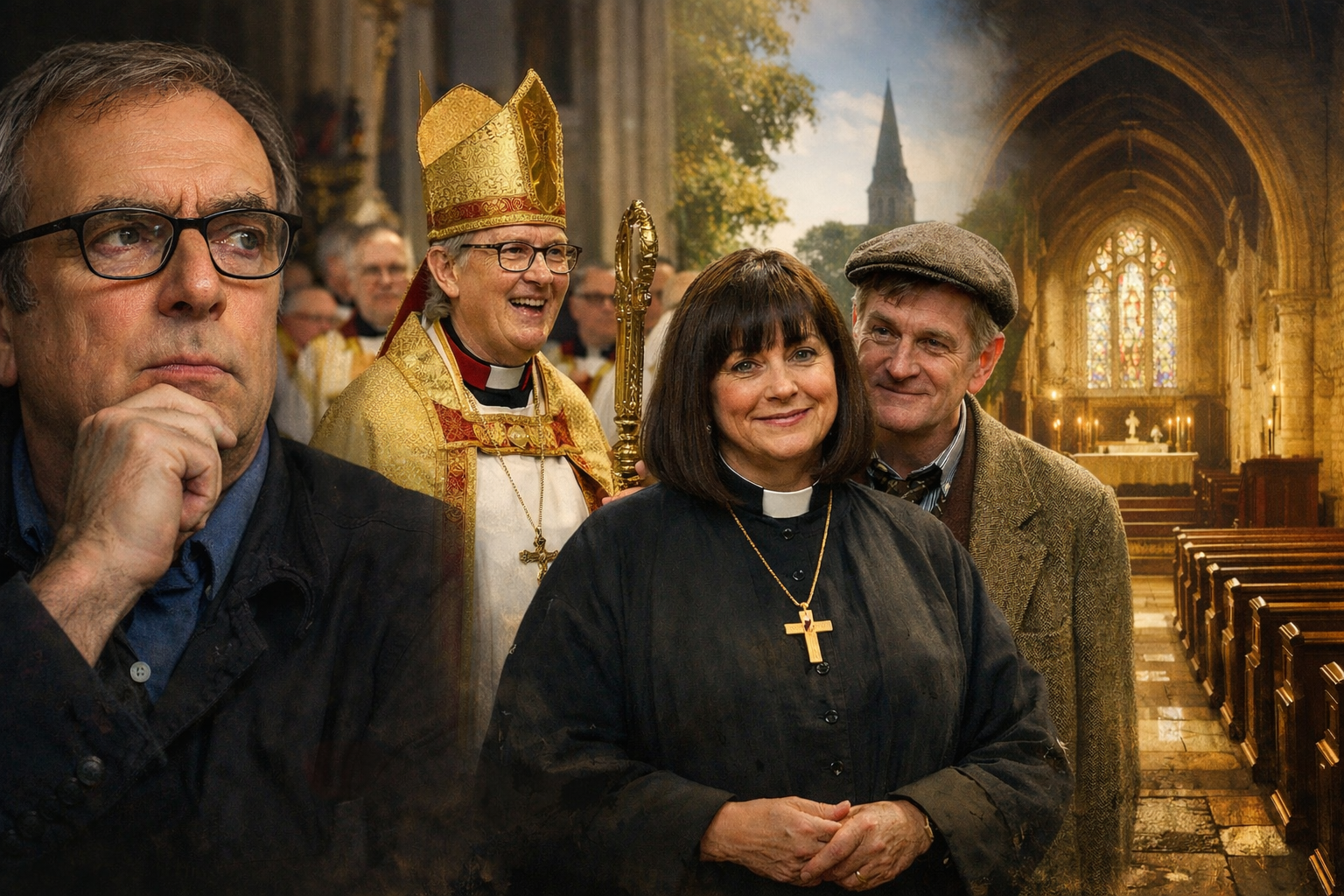
For it is impossible to ignore the role played by the The Vicar of Dibley, that immensely popular BBC comedy starring Dawn French as the cheerfully unconventional Rev. Geraldine Granger. Broadcast in the years following the 1992 decision of the General Synod to permit the ordination of women in the Church of England, the programme achieved something no synodical debate or theological commission could have managed: it made the innovation lovable.
Here was the new priesthood rendered safe, comic, and disarmingly human. The objections—rooted in Scripture, tradition, and sacramental theology—were not refuted; they were gently mocked into irrelevance. Those who hesitated appeared fussy, humourless, faintly ridiculous. Meanwhile, the new dispensation arrived not as rupture, but as inevitability—something one might smile at, adjust to, and eventually embrace.
It is precisely this logic that now reappears, translated into the language of personal reflection. Mr Hitchens has met the real-life equivalents of Geraldine Granger: agreeable, competent, entirely unthreatening. The services proceed. The parish continues. Nothing, at least outwardly, appears to have gone disastrously wrong.
And so the conclusion emerges, almost without effort: if it works, it must be right.
But this is not argument. It is acclimatisation.
The genius of the “Vicar of Dibley” effect was not that it proved anything, but that it rendered proof unnecessary. It habituated the imagination until resistance felt not principled, but peculiar. One did not need to be persuaded; one merely needed to become accustomed.
Mr Hitchens, for all his reputation as a critic of modern illusions, appears here to have succumbed to one of the most effective of them. He has mistaken familiarity for legitimacy, and cultural acceptance for theological resolution.
Yet the underlying question remains untouched. The priesthood is not validated by whether it appears agreeable—whether in a sitcom or a parish—but by whether it is what it claims to be.³
The Misuse of Equality: Scripture Reinterpreted
Having satisfied himself on empirical grounds, Mr Hitchens turns, rather briefly, to Scripture. Christ, he notes, treated women as equals—an observation which is entirely correct, though hardly decisive. From this, he infers that there can be no biblical objection to women’s ordination.⁴
This is rather like observing that all citizens are equal before the law and concluding that anyone may therefore appoint himself a judge.
The difficulty lies in the quiet substitution of one idea for another. Christianity has always affirmed the equal dignity of men and women. It has never asserted their interchangeability in every role.⁵ Christ Himself, who showed little regard for social convention when it conflicted with His mission, nevertheless chose twelve men as Apostles.⁶ This was not because He lacked courage, nor because He was constrained. It was because He was doing something precise.
The priest, in the Christian understanding, does not merely preside. He represents. He stands in the place of Christ—not metaphorically, but sacramentally. The Church, in turn, is described as His Bride.⁷ These are not decorative images. They are structural realities.
Their absence from Mr Hitchens’ account is not accidental. It is necessary.
Crisis and Substitution: The Functionalist Argument
It is when Mr Hitchens turns to the present condition of the Church that his argument becomes most candid. Faced with abuse scandals, declining vocations, and a visibly weakening institution, he suggests that the ordination of women may have “rescued” it.⁸
Here the argument ceases even to pretend to be theological. It becomes managerial.
If there are insufficient men, then women must fill the gap. If the institution is to survive, its requirements must be adjusted. One is reminded less of apostolic succession than of emergency staffing measures.
Yet the facts are stubborn. The Church of England did not halt its decline with the introduction of women’s ordination. It did not experience renewal, clarity, or resurgence.⁹ Instead, the long contraction has continued, accompanied by an increasing uncertainty about what the Church is for.
One cannot cure a crisis of identity by redefining the terms of that identity.
Latitudinarianism and the Refusal of Absolutes
Mr Hitchens himself supplies the explanation. He praises Anglicanism for its breadth, for its reluctance to probe too deeply, and—most tellingly—for avoiding “futile attempts to discover absolutes.”¹⁰
This is the real foundation of his position.
If Christianity is not a body of revealed truths but a moral inheritance, then doctrinal questions become secondary. What matters is that the forms endure, the tone remains civilised, and the institution continues.
Under such conditions, the ordination of women is not a rupture but a minor adjustment.
Interior Religion and the Rejection of Conflict
Mr Hitchens is at his most attractive when he speaks of repentance, of the General Confession, and of the quiet formative power of the Book of Common Prayer.¹¹ These are not trivial things.
But they are here detached from truth claims. Religion becomes inward, therapeutic, and carefully insulated from dispute. He does not wish to quarrel—with other Christians, other religions, or the wider culture. He distances himself, not without reason, from figures such as Tommy Robinson and from the more strident forms of “Christian nationalism.”¹²
Yet in avoiding bad quarrels, he avoids necessary ones.
Christianity is not merely a private discipline. It makes claims about reality—claims which inevitably provoke disagreement. A religion which declines to assert them may be peaceful, but it is also empty.
The Deeper Issue: What Is the Church?
And so we arrive at the question Mr Hitchens does not ask.
What is the Church?
If it is what it has always claimed—a sacramental reality instituted by Christ—then its structure is not negotiable. Its forms are given.
If it is a human institution, valuable for moral and cultural reasons, then adaptation becomes inevitable. Roles may be reassigned. Doctrines softened. The aim becomes continuity, not fidelity.
Mr Hitchens has chosen the latter—quietly, gently, and almost certainly without wishing to admit it.
Conclusion: The English Settlement and Its Limits
There is something undeniably appealing about this position. It is calm, civilised, and avoids unpleasantness. It allows one to remain within the Church without insisting too strongly upon what the Church must be.
But it comes at a cost.
For a Church which no longer seeks truth will, in time, find it has nothing left to say. A priesthood defined by function will be replaced by more efficient functions. A religion which exists only to edify will eventually fail even to do that.
And then the question will no longer be what can possibly be wrong with this—but what, precisely, was left of it at all.
¹ Church Times podcast interview with Peter Hitchens, March 2026.
² Ibid.
³ Thomas Aquinas, Summa Theologiae, III, q.64, a.1.
⁴ Church Times podcast interview, March 2026.
⁵ John Paul II, Mulieris Dignitatem (1988), §§6–7.
⁶ Holy Bible, Luke 6:12–16.
⁷ Holy Bible, Ephesians 5:25–32.
⁸ Church Times podcast interview, March 2026.
⁹ Church of England, Statistics for Mission reports.
¹⁰ Church Times podcast interview, March 2026.
¹¹ Book of Common Prayer.
¹² Church Times podcast interview, March 2026.
RELATED ARTICLES


LATEST ARTICLES
- Today’s homily: Christ the KingThe homily reflects on Christ’s kingship as seen in the Gospel narrative. It contrasts earthly authority with divine truth, emphasising that true allegiance to God requires genuine obedience and transformation. Believers are called to examine their personal commitments and respond to Christ’s demands in everyday life, ultimately recognising their identity as bearers of God’s image.
- Sermon for Christ the KingToday marks the celebration of Christ the King and the Twenty Second Sunday after Pentecost, a feast asserting Christ’s sovereignty against totalitarianism. St. Paul emphasised Christ’s supremacy over power and principalities, challenging early Gnostic beliefs. The early Church’s victory over evil is affirmed in Christ’s resurrection, offering hope and unity amidst contemporary struggles.
- Today’s Mass: October 25 SOVEREIGNTY OF OUR LORD JESUS CHRIST, SUPREME KINGThe Feast of the Sovereignty of Our Lord Jesus Christ celebrates Christ’s dual kingship by birth and conquest. Established by Pius XI, it aims to deepen faith and counter anti-clericalism. The liturgical observance underscores His authority as King, advocating for societal recognition of His reign to bring peace and harmony.
- TRADITION BEHIND THE FENCEThe Vatican’s prohibition of the traditional Ad Petri Sedem pilgrimage to St Peter’s Basilica has sparked controversy, especially among traditional Catholics. While some cite scheduling conflicts, the broader issue lies in the restrictive policies of Traditionis custodes, which may confine traditional liturgical practices to specific enclaves, risking the transmission and recognition of Catholic Tradition within the wider Church.
- Today’s Mass: October 24 St Raphael the ArchangelThe Feast of Saint Raphael the Archangel highlights his healing powers as depicted in the Book of Tobit, where he aids Tobit and his son, Tobiah. Venerated as a protector of travellers and the blind, Raphael is celebrated for his miraculous interventions. His legacy includes support for nurses, matchmakers, and Catholic studies.





Leave a Reply