
St Sebastian Recast: Martyrdom, Identity, and the Dissolution of Sacred Meaning in Contemporary Art
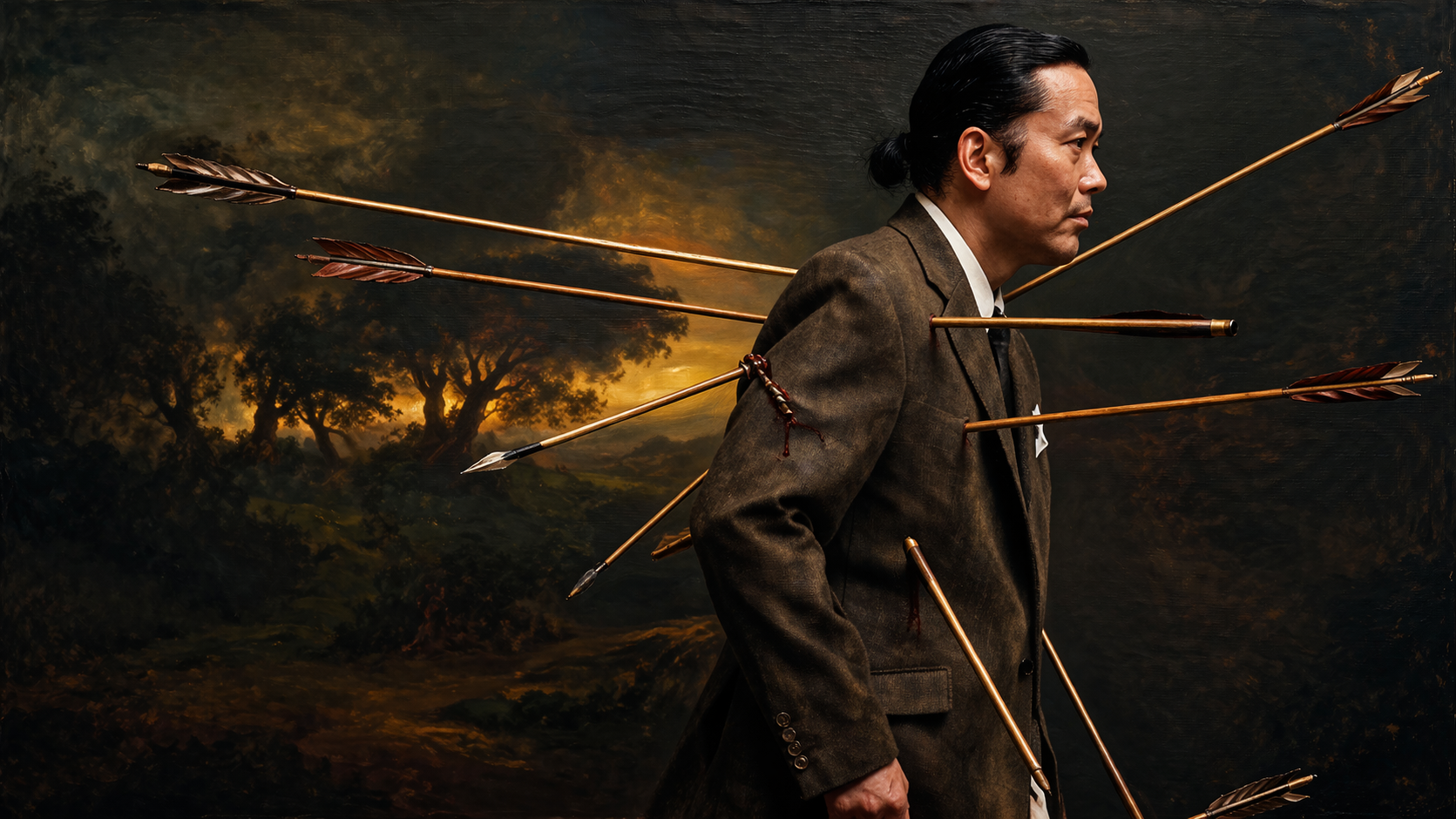
A recent installation at the National Gallery has drawn considerable public attention for its reinterpretation of Saint Sebastian through a contemporary artistic lens. The work, created by Ming Wong under the title Dance of the Sun on the Water / Saltatio Solis in Aqua, forms part of a residency engaging directly with the Gallery’s historic collection of Renaissance and Baroque depictions of the saint.¹ This is not an incidental curatorial exercise, nor merely an example of modern artistic engagement with historical material. Rather, it represents a deliberate and self-conscious intervention into the continuity of Western sacred art, placing contemporary categories of identity, embodiment, and performance into direct tension with the inherited visual theology of Christendom.
The installation consists of multi-screen video projections in which performers embody the figure of Sebastian within a deliberately fluid narrative structure. According to Wong, “there isn’t just one martyr,” and his intention was to “design a martyr figure for today.”² These statements, brief though they are, function as a hermeneutical key to the entire project. They indicate not simply a variation in artistic style, but a reconfiguration of meaning at its root. The saint is no longer approached as a fixed historical subject whose life and death impose interpretive limits, but as a conceptual framework capable of absorbing and reflecting contemporary concerns.
This shift must be carefully understood. It is not merely that the past is being revisited; it is that the past is being re-authored. The authority of tradition is subtly displaced by the authority of interpretation, and what was once received is now constructed. In this sense, the installation is emblematic of a wider cultural disposition: that history is not something to be encountered, but something to be reimagined according to present needs.
The Historical Sebastian: Witness, Not Construct
The historical Saint Sebastian is not an indeterminate symbol open to reinterpretation without remainder. He is a Roman soldier of the late third century, traditionally martyred during the persecutions under Diocletian.³ His identity is inseparable from his confession of Christ and his refusal to renounce that confession under the threat of death.³ To speak of Sebastian is therefore to speak of a man whose life is intelligible only within a specific theological and historical horizon.
This horizon is not incidental but constitutive. Sebastian’s martyrdom belongs to that decisive moment in which the early Church confronted the absolute claims of imperial authority with the higher claim of divine truth. The Roman state demanded outward conformity; the Christian martyr bore inward witness. This is not merely a political or cultural conflict, but a metaphysical one: whether truth is grounded in power or received from beyond it.
As the Epistle to the Hebrews declares, the faithful are “surrounded by so great a cloud of witnesses.”⁴ This formulation is not poetic ornament but theological precision. The martyr is not simply one who suffers, but one who testifies. The unity of the person—body, will, and faith—is essential to this testimony. Martyrdom is not reducible to pain or endurance; it is defined by its object: truth. Remove that object, and the act itself dissolves into mere experience.
Thus Sebastian cannot be understood as a neutral or transferable figure. He is not a symbol awaiting reinterpretation, but a witness whose meaning is given, received, and transmitted.
The Classical Artistic Tradition: The Visibility of the Invisible
In the classical artistic tradition—from Andrea Mantegna to Guido Reni—this theological clarity is rendered visible with remarkable consistency. Sebastian is depicted bound, pierced, exposed, yet inwardly composed. The serenity of his expression is not an aesthetic flourish but a theological statement: the visible body reveals an invisible fidelity.
The arrows, so often emphasised in these depictions, are not the essence of the martyrdom but its sign. They point beyond themselves to an interior act—the will united to God in the face of suffering. Sacred art, in this tradition, does not invent meaning but mediates it. It serves as a visual theology, making perceptible what cannot otherwise be seen: the triumph of grace over fear, of truth over violence, of eternity over time.
This is why the image of Sebastian carries a density of meaning that resists arbitrary reinterpretation. It is not merely an artistic motif but a theological statement. To detach it from that statement is not to expand its meaning but to diminish it.
The Aestheticisation of the Body: From Devotion to Ambiguity
The transformation of Sebastian begins not with overt rejection but with subtle displacement. As Laura Cumming observes in The Observer, the saint’s representation evolved into an “ambiguous experience” in which the exposed and wounded body became an object of aesthetic fascination.⁶ The wound, once understood as a sign of fidelity to Christ, became an object of contemplation in its own right. The body began to eclipse the witness.
This ambiguity did not immediately sever the image from its devotional roots, but it introduced a tension. The viewer could now engage the image on multiple levels, some of which were no longer explicitly theological. The groundwork was laid for reinterpretation.
By the nineteenth century, this process had advanced significantly. Oscar Wilde’s adoption of the name “Sebastian” during his exile reflects a conscious reappropriation of the figure as a symbol of personal suffering and identity.⁷ The saint is no longer encountered as a witness to divine truth, but as a mirror in which the modern self may recognise its own experience.
The shift is subtle but decisive. The direction of meaning is reversed: no longer from the saint to the viewer, but from the viewer to the saint.
Modern Reinterpretation: From Aesthetic to Cultural Symbol
The twentieth century intensifies and formalises this trajectory. The film Sebastiane by Derek Jarman presents a stylised and avant-garde reinterpretation of the martyrdom, in which aesthetic and thematic concerns displace traditional devotional frameworks.⁸ The narrative remains recognisable, but its meaning is reoriented.
This development is further documented by James Saslow, who observes that figures such as Sebastian have increasingly been interpreted in modern visual culture as symbols of identity and experience rather than strictly religious exemplars.⁹ The saint becomes a site of identification rather than veneration.
Such reinterpretations are not without human resonance. They reflect genuine attempts to grapple with suffering, identity, and marginalisation. Yet they also mark a decisive conceptual shift. Martyrdom is no longer defined by its relation to truth, but by its capacity to express experience. The objective gives way to the subjective; the theological to the psychological.
Ming Wong and the Logic of Reconstruction
Ming Wong’s installation must be understood as the culmination of this trajectory. Drawing explicitly on earlier reinterpretations, including Jarman’s work, it presents Sebastian through multiple performers and perspectives.² This approach aligns with Wong’s broader artistic practice, which explores how identity is constructed, reproduced, and performed.
The alternation of roles within the installation is particularly significant. The same performer may embody Sebastian and his executioner, collapsing the distinction between witness and violence. This is not merely a theatrical device but a conceptual statement: identity is fluid, roles are interchangeable, and meaning is contingent.
Yet this fluidity carries a cost. The unity of the person—essential to the classical understanding of martyrdom—is dissolved. If anyone can be Sebastian, and anyone can also be his persecutor, then martyrdom ceases to signify a specific moral and theological reality. It becomes a narrative function, a role within a system of performances.
From Incarnation to Performance
At the heart of this development lies a deeper philosophical shift. In classical Christian theology, the human person is understood as a unity of body and soul, grounded in a given nature and elevated by grace. As Thomas Aquinas writes, grace “does not destroy nature but perfects it.”¹⁰ Identity is not self-generated but received.
By contrast, contemporary frameworks often treat identity as performative—constructed, enacted, and subject to revision. Wong’s work operates explicitly within this paradigm. Identity is not something one is, but something one does.
When this framework is applied to a saint, the consequences are profound. The martyr becomes a performance rather than a witness, an expression rather than a reality. The Incarnation—truth embodied in a concrete person—is replaced by abstraction.
Yet this apparent expansion of possibility introduces a paradox. The more fluid the identity, the less stable the meaning. What is gained in adaptability is lost in substance.
Martyrdom and Meaning
In theological terms, martyrdom is traditionally defined as suffering endured for the sake of faith and truth. Thomas Aquinas classifies martyrdom under the virtue of fortitude, perfected by charity.¹¹ It is an act that presupposes objective truth and is ordered toward God as the highest good.
When detached from this framework, representations of martyrdom may take on broader symbolic meanings. They may reflect cultural, psychological, or experiential interpretations. Yet in doing so, they risk losing the specificity that gives martyrdom its intelligibility.
In Wong’s installation, this tension is fully realised. Martyrdom persists as an image, but its meaning is transformed. The arrows remain, but their significance is no longer anchored in witness to truth. The form endures; the content shifts.
The Curatorial Context
The exhibition at the National Gallery forms part of a wider institutional practice in which contemporary artists engage with historical collections.¹ This approach seeks to create dialogue between past and present, allowing new interpretations to emerge.
Yet such dialogue is not always symmetrical. The risk is that the past becomes subordinate to the present, its meaning reshaped rather than received. The authority of tradition yields to the authority of interpretation.
This raises a fundamental question: is the role of the museum to preserve meaning, or to transform it?
Conclusion
The reinterpretation of Saint Sebastian in contemporary art reflects a broader cultural shift in the understanding of historical and religious figures. From early Christian martyrdom to Renaissance devotion, from aesthetic reinterpretation to performative identity, the figure of Sebastian has undergone a profound transformation.
This transformation is not merely artistic but philosophical. It concerns the nature of meaning itself: whether it is given or constructed, received or imposed.
When the martyr becomes a role, and identity becomes performance, the question is no longer what Sebastian witnessed, but what he can be made to represent.
And in that shift, something essential—something irreducible—stands at risk of being lost.
- National Gallery, “Ming Wong: Artist in Residence,” 2026.
- Vivienne Chow, “Ming Wong Recasts Saint Sebastian as a Modern-Day Queer Icon,” Artnet News, 19 January 2026.
- Jacobus de Voragine, The Golden Legend, pp. 101–105.
- Hebrews 12:1.
- André Grabar, Christian Iconography, pp. 89–94.
- Laura Cumming, “Saint Sebastian: Art History’s Gay Icon,” The Observer, 2026.
- Richard Ellmann, Oscar Wilde, pp. 450–455.
- Derek Jarman, Sebastiane (1976).
- James Saslow, Pictures and Passions, pp. 214–220.
- Thomas Aquinas, Summa Theologiae, I, q.1, a.8.
- Thomas Aquinas, Summa Theologiae, II–II, q.124.
RELATED ARTICLES


LATEST ARTICLES
- Today’s Mass: September 04 Feria of Sunday XIV Post PentecostThe Fourteenth Sunday After Pentecost emphasises the importance of serving one master—God—over the flesh. It urges Christians to focus on spiritual over temporal concerns, warning against anxiety. The readings highlight the contrast between the fruit of the spirit and the works of the flesh, encouraging a pursuit of divine life.
- Today’s homily: St Pius X, PopeThe text reflects on the life and legacy of Pope St Pius X, who was chosen from humble beginnings to reform the Church. His pontificate focused on defending the Catholic Faith, restoring liturgical sanctity, and fostering deeper connections between believers and Christ. Pius X exemplified a balance of truth and pastoral charity.
- Today’s Mass: September 03 Pope St Pius X,Pope St Pius X, born Giuseppe Melchiorre Sarto, was a significant reformer who emphasised preserving the Catholic Faith against Modernism. His pontificate (1903-1914) featured reforms in liturgy, frequent Holy Communion, and seminaries, rooted in a pastoral desire to restore everything in Christ. He died in 1914 and was canonised in 1954.
- Today’s homily: St Stephen of HungaryThe homily reflects on the life of Saint Stephen of Hungary, illustrating his transition from a powerful ruler to a saint. He embraced the responsibilities of kingship guided by faith, understanding his authority as stewardship. His legacy teaches that true governance comes with surrender to God, ultimately placing his kingdom under the protection of the Blessed Virgin Mary.
- Today’s Mass: September 02 St. Stephen the GreatSt. Stephen the Great, King of Hungary (977-1038), was a significant Christian ruler who reinforced the faith throughout Hungary. Anointed king in 1000 by Pope Sylvester II, he fought against paganism and promoted the Church. He was canonised in 1083 and is the patron saint of Hungary, symbolising national identity.



Leave a Reply