
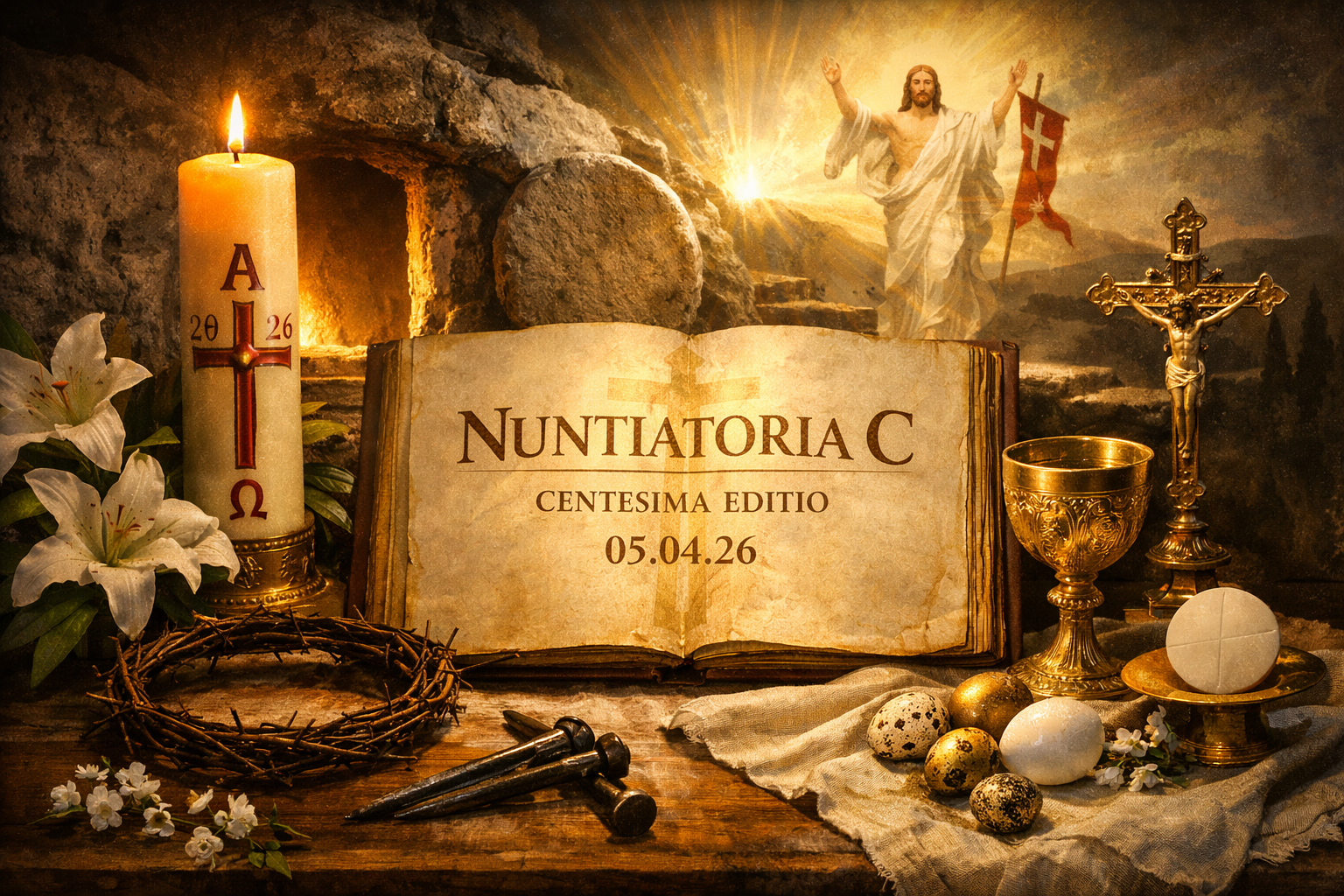
Editorial
At its hundredth edition, Nuntiatoria defines its purpose with precision: to defend truth, uphold tradition, and interpret the crises of Church and society through a coherent theological lens. This editorial marks the transition from commentary to mission—an enduring commitment to clarity, continuity, and the restoration of Christian order.
The Threshold of a Hundred Editions
A hundred editions marks not merely continuation, but consolidation. What began as a response to events has, by necessity rather than design, assumed a more definite character. Nuntiatoria now stands as a publication with a clear voice, a disciplined method, and an unmistakable purpose. It does not exist to mirror the prevailing discourse, still less to accommodate it, but to interpret the present age in light of principles that do not change. In an era defined by instability of meaning and volatility of judgement, such constancy is not a luxury; it is a requirement.
The condition of the age is evident. Institutions once regarded as stable hesitate to speak with clarity. Language itself is increasingly deployed not to illuminate reality but to obscure it. Fundamental questions—concerning the nature of man, the structure of society, and the authority of truth—are treated as matters of preference rather than as realities to be received. This is not a superficial disorder. It is a crisis at the level of first principles.
On Truth in an Age of Evasion
The first obligation, therefore, is truth. Not truth as sentiment or approximation, but truth as correspondence to reality, grounded ultimately in God Himself. The distinctive error of the present age lies in its attempt to detach truth from its source, rendering it contingent, negotiable, and subordinate to will. Against this, Nuntiatoria proceeds from the conviction that truth is neither constructed nor revised by consensus. It is discovered, articulated, and, when necessary, defended.
Such a commitment demands precision. Words must mean what they signify; arguments must follow from premises; contradictions must be recognised as such. In a culture accustomed to equivocation, clarity itself becomes a form of resistance. The refusal to obscure is already an act of witness.
On Tradition and the Refusal of Amnesia
If truth is denied, memory soon follows. The loss of tradition is not merely historical but structural. A society that no longer understands itself as the recipient of an inheritance begins to treat all things as provisional. What was once handed down becomes optional; what was once authoritative becomes negotiable.
Nuntiatoria rejects this amnesia. Tradition is not the preservation of fragments but the transmission of a living whole. It is the continuity by which doctrine, worship, and moral teaching remain intelligible across time. Where this continuity is disrupted, confusion inevitably follows. The attempt to reconstruct the Church or society apart from what has been received produces not renewal but fragmentation.
The pre-1955 Roman Rite, often misunderstood as an artefact, stands as a concrete expression of this continuity: a liturgical theology embodied in form, gesture, and text. Its coherence reveals, by contrast, the disjunction introduced when continuity is treated as expendable.
On the Crisis Within and Without
It would be a failure of honesty to address the present age without acknowledging the crisis within the Church herself. The measurable decline in vocations, the erosion of catechesis, the diminution of sacramental life, and the persistence of doctrinal ambiguity are not isolated developments. They form a pattern, and that pattern corresponds to a broader attempt to reconcile the perennial faith with the assumptions of modernity.
At the same time, the wider culture exhibits parallel disintegration. The redefinition of the family, the weakening of social bonds, and the fragmentation of identity reflect a loss of confidence in any objective account of human nature. These are not separate crises but manifestations of the same underlying rupture: the rejection of an order grounded in truth.
To address either sphere in isolation is insufficient. Theology and culture must be read together, because they are, in fact, inseparable.
On Method and Responsibility
Clarity of purpose entails clarity of method. Nuntiatoria is not a vehicle for assertion but for disciplined analysis. Every claim must be capable of demonstration; every argument must proceed coherently; every source must be verifiable. In an age saturated with opinion, such rigour is not excessive but essential.
This requires the establishment of context before judgement, the careful distinction between fact and interpretation, and the refusal to reduce complex realities to convenient slogans. The reader is not to be carried by rhetoric alone, but persuaded by the cumulative force of evidence and reasoning.
On Restoration and the Work Before Us
The language of restoration must be understood correctly. It does not signify a retreat into the past, nor the mechanical reproduction of historical forms. It signifies the re-ordering of life according to truth. Such re-ordering is necessarily both personal and social. It begins with conversion—with the alignment of mind and will to reality—and extends outward to institutions, culture, and law.
Without this interior foundation, external reform is illusory. Structures may change; language may shift; yet disorder remains if the underlying principles are not restored. Nuntiatoria therefore addresses not only events but meaning, not only structures but souls.
A Work Continued
At its hundredth edition, Nuntiatoria does not declare completion but continuity. The task it has assumed is not finite, because the crisis it addresses is not superficial. If the age is marked by confusion, clarity must be sustained. If it is marked by fragmentation, coherence must be articulated. If truth is obscured, it must be spoken—plainly, precisely, and without concession.
This is not a fashionable undertaking. It is, however, a necessary one.
¹ Pascendi Dominici Gregis: identifies modernism as “the synthesis of all heresies,” diagnosing the dissolution of objective truth.
² Quas Primas: affirms the social kingship of Christ as the necessary foundation of just order.
³ Sacrosanctum Concilium: central to debates on liturgical reform and continuity.
⁴ Dei Verbum: frequently invoked in contemporary reinterpretations of revelation and tradition.

IN THIS EDITION
- Women’s Ordination: The Lawyers at the Sanctuary Rail
- Easter Saturday in the Tridentine Rite: The Consummation of the Paschal Mystery in Ecclesial Life
- Today’s Mass: April 11 Easter Saturday
- Sermon for Easter Saturday
- Silencing the Mother: Rome, Marian Doctrine, and the Limits of What May Be Said
- Easter Friday in the Tridentine Rite: The Eucharistic Presence of the Risen Lord
- Today’s Mass: April 10 Easter Friday
- Sermon for Easter Friday
- Easter Thursday in the Tridentine Rite: The Apostolic Mission of the Risen Christ
- Today’s Mass: April 9 Easter Thursday
- Sermon for Easter Thursday
- Easter Wednesday in the Tridentine Rite: The Manifestation of the Risen Christ in the Breaking of Bread
- Today’s Mass: April 8 Easter Wednesday
- Easter Tuesday in the Tridentine Rite: The Recognition of the Risen Lord
- Today’s homily: Easter Tuesday
- Today’s Mass: April 7 Easter Tuesday
- ORDO w/c 05.04.26
- The Quiet Surrender: Peter Hitchens, Women’s Ordination, and the English Religion of Accommodation
- Recycling Dei Verbum’s Errors: Leo XIV and the Repackaging of Revelation
- The Gamification of Violence: “School Wars” and the Collapse of Moral Formation
- St Sebastian Recast: Martyrdom, Identity, and the Dissolution of Sacred Meaning in Contemporary Art
- The Women’s Institute Fractures: When Legal Clarity Meets Cultural Collapse
- The Infrastructure of Control: Capability Without Crown in an Age of Converging Systems
- The Silence of the King: What the Death of the Organ Reveals About the Church
- The Unity of Scripture and the Mind of God: Beyond Statistical Coincidence
- Easter Monday in the Tridentine Rite: The Continuation of the Resurrection
- Today’s homily: Easter Monday
- Today’s Mass: April 6 Easter Monday
- Sermon for Easter Monday
- Sermon for Easter Sunday
- Easter Sunday in the Tridentine Rite: The Triumph of the Risen Christ and the Foundation of the New Creation
- Paschal Greeting from the Primus
- Today’s Mass: April 5 Easter Sunday
- The Return of the Young Through Tradition: Holy Week in the Philippines as a Sign of Renewal
- Tradition as Concession? Cardinal Roche, Traditionis Custodes, and the Crisis of Liturgical Continuity
- The Free Speech Bill and the Crisis of Liberty: Can Britain Still Speak Freely?
- A Door Closed in Lent: The SSPX Pilgrimage and the Crisis of Catholic Inclusion
- When Authority Fails: The Anglican Crisis and the Future of Synodality
- The Mass That Built Filipino Faith — But History Rarely Shows It
- Broadcasting Ideology: The BBC, Ofcom, and the Failure of Cultural Stewardship
- A Reported Miracle? The Intercession of His Eminence Cardinal George Pell and the Recovery of a Child in Arizona
- A Crisis of Authority and the Last Refuge of Faith: Bishop Anthony Ward’s Passion Sunday Address
- Fr Reid Hennick’s Reception into the Apostolate of Bishop Donald Sanborn: Context, Consequence, and the Unresolved Crisis
- Christian Nationalism in Britain: A False Label and a Misguided Revival
- Caiaphas and the Calculus of War: Just Cause, Disordered Ends, and the Discipline of Constraint
- Emotionalism and the End of Rational Society



Leave a Reply