
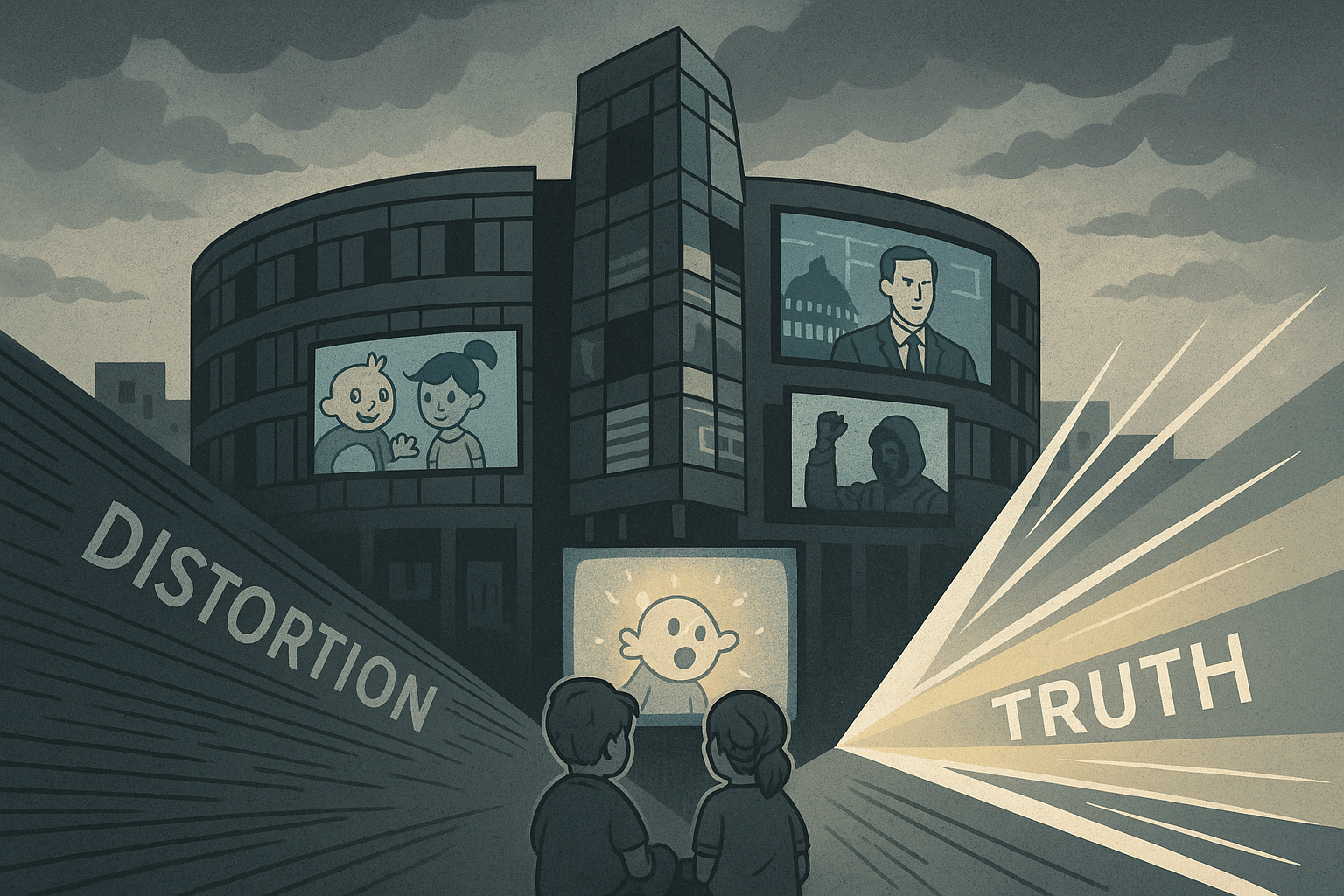
Broadcasting Ideology: The BBC, Ofcom, and the Failure of Cultural Stewardship
In recent years, a growing unease has emerged among parents, educators, and observers of public life concerning the trajectory of children’s programming in the United Kingdom. This concern is neither reactionary nor abstract, but grounded in the observable transformation of media content and its increasing role in shaping the intellectual and moral environment of the young. At the centre of this unease stands the BBC, an institution long regarded as a cultural pillar, entrusted not merely with entertainment but with the far more serious responsibility of forming the imaginative and conceptual horizons of the nation’s children.
This trust, however, rests upon a foundational principle which is both legal and moral in nature: impartiality. As a publicly funded broadcaster operating under Royal Charter, the BBC is bound to maintain due impartiality in its treatment of matters of political or social controversy, particularly where such matters bear directly upon public policy and social formation.¹ This obligation is not incidental but constitutive of its legitimacy, for the public consents to fund the broadcaster precisely because it is not meant to function as an instrument of ideological persuasion.²
Yet it is precisely this obligation that now appears to be under increasing strain. Across a range of programming—from flagship dramas such as Doctor Who to factual and youth-oriented content—there has emerged a discernible pattern in which one interpretative framework is consistently presented as normative, desirable, and beyond dispute.³ The cumulative effect of this pattern is not merely representation, but the quiet establishment of a cultural consensus, in which narratives affirming contemporary gender theory are treated as settled truth, while alternative perspectives—whether grounded in biology, philosophy, or theology—are rendered marginal or invisible.⁴
This pattern is not merely inferred from tone or trend, but can be observed directly within programme content itself. Episodes of The Unshockable Dr Ronx have included segments in which presenters discuss chest binding as something that can be undertaken “safely” with appropriate precautions, thereby situating the practice within a framework of affirmation and risk management rather than critical evaluation.⁴ When such presentations are directed toward younger audiences, the absence of proportionate engagement with medical uncertainty and long-term outcomes becomes not a minor editorial choice, but a substantive omission that shapes understanding at a formative stage.
This concern has not been confined to private reflection, but has been articulated within public discourse by figures across political and professional domains. The Conservative MP Miriam Cates has warned that children are increasingly exposed to “contested ideas presented… as unquestionable truths,”⁵ highlighting the combined influence of education and media in shaping belief formation. In a similar vein, Danny Kruger MP has argued that when state-supported institutions promote a singular vision of the human person, they risk “supplanting the moral authority of the family,”⁶ thereby altering the proper balance between public instruction and parental responsibility.
Clinical voices have reinforced these concerns with a degree of empirical caution that stands in notable contrast to the certainty often conveyed in media narratives. Dr Hilary Cass, in her independent review of paediatric gender services, concluded that the evidence base underpinning current approaches is “remarkably weak,”⁷ and warned against the premature consolidation of clinical pathways in the absence of robust longitudinal data. This caution is echoed by Paul McHugh, who has argued that gender dysphoria represents “a psychological condition… not a physical one,”⁸ thereby warning against exclusively somatic solutions. Her further observation that social transition “should not be considered a neutral act”⁹ underscores the extent to which such interventions may shape developmental trajectories in ways not yet fully understood.
The medical dimension becomes particularly acute when one considers practices such as chest binding. The NHS acknowledges that such practices may cause “breathing difficulties, skin irritation, and back pain,”¹⁰ while academic studies have identified additional concerns including “negative physical symptoms… including pain… and shortness of breath.”¹¹ In light of these findings, the ethical question is not whether such practices should ever be discussed, but whether they can be responsibly presented to minors without a full and proportionate account of their risks and contested clinical status.
The Safeguarding Contradiction
A decisive clarification emerges when one turns from media representation to the framework of safeguarding itself. Guidance issued by Sussex Police on breast ironing—also referred to as breast flattening—defines the practice as one in which “young girls’ breasts are damaged over time to flatten them and delay their development,” noting that “an elastic belt, or binder, is used to stop them from growing.”¹² The same guidance categorises such practices unequivocally as “a form of child abuse… [that] causes significant physical and psychological harm,”¹² thereby grounding its assessment not in subjective motive but in objective harm.
The consequences identified within this guidance are neither speculative nor trivial, but include infection, tissue damage, deformity, and long-term physical harm. Moreover, safeguarding policy explicitly recognises that those responsible often believe themselves to be acting in the child’s best interests, thereby introducing a crucial distinction between intention and outcome, a principle strongly affirmed by Margaret Somerville, who emphasises the ethical necessity of protecting “the vulnerable from well-intentioned harm.”¹³
It is precisely at this point that the contradiction becomes unavoidable. A practice involving the restriction or suppression of natural bodily development in minors is, in one context, classified by policing and safeguarding authorities as abuse, while in another it is presented within media discourse e.g. the BBC as a legitimate and even affirming response to identity. This divergence is not merely a matter of differing emphasis, but reflects a deeper inconsistency in the criteria by which harm is defined and evaluated.
Such a contradiction cannot be sustained without consequence. Safeguarding frameworks exist precisely to provide a consistent standard rooted in the welfare of the child, and where that standard becomes contingent upon ideological framing, it ceases to function as a safeguard at all. The result is not clarity but confusion, in which the same act may be simultaneously condemned and affirmed depending upon the narrative through which it is interpreted.
At this juncture, the legal framework reinforces the seriousness of the issue. Under the Communications Act 2003 and the Ofcom Broadcasting Code, matters relating to gender identity clearly fall within the category of major public policy issues requiring due impartiality.¹⁴ The Ofcom Code further mandates that broadcasters must “ensure that people under eighteen are protected,”¹⁵ thereby establishing a dual requirement of balance and safeguarding that is directly relevant to the present discussion.
The Equality Act 2010, while providing important protections against discrimination, does not mandate the uncritical promotion of any particular ideological framework, nor does it override the duty to safeguard children.¹⁶ Meanwhile, Section 11 of the Children Act 2004 places a broader obligation upon public-facing institutions to “safeguard and promote the welfare of children,”¹⁷ thereby reinforcing the primacy of safeguarding considerations.
Public criticism has accordingly extended into legal and policy discourse. Reports in The Telegraph have documented preparations by parents to pursue legal challenge, alleging that current BBC output fails to meet the required standards of impartiality and safeguarding.¹⁸ The The Christian Institute has similarly warned of “unbalanced and potentially harmful messaging to young audiences,”¹⁹ underscoring the growing concern among advocacy groups and civil society actors.
At its deepest level, however, this is not merely a legal or policy issue, but an anthropological one. Every society operates, whether explicitly or implicitly, with a vision of the human person, and it is this vision that ultimately shapes its institutions and its modes of formation. As Carl R. Trueman observes, modern identity is increasingly rooted in “expressive individualism… where authenticity is inwardly defined,”²⁰ while classical Christian anthropology affirms the unity of body and soul as a given rather than a construct. In a similar vein, Leon Kass insists that “the body is not mere property but integral to personal identity,”²¹ thereby grounding ethical reflection in the integrity of the human person rather than the fluidity of subjective desire. As Oliver O’Donovan further argues, moral order itself is grounded in “the givenness of created nature,”²² rather than subjective redefinition.
To privilege one account while excluding the other is not an act of neutrality, but the quiet establishment of a metaphysical position under the guise of consensus, a condition that Alasdair MacIntyre describes as the fragmentation of moral discourse following the loss of a shared telos.²³ For children, this is of decisive importance, for formation is not merely informational but teleological, directing them toward a particular understanding of what it means to flourish as human beings. As Erik Erikson observed, adolescence involves the “integration of identity… under conditions of uncertainty and influence,”²⁴ a vulnerability which contemporary observers such as Abigail Shrier argue is intensified by peer and media dynamics that “can shape identity formation.”²⁵
A Call to Action: Restoring Impartiality and Safeguarding
In light of the foregoing, the responsibility now extends beyond observation to action. Where public institutions are perceived to have departed from their statutory obligations—particularly in matters concerning the formation and safeguarding of children—it is both legitimate and necessary for citizens to seek accountability through the appropriate regulatory channels.
A formal petition has therefore been advanced calling upon Ofcom to undertake an independent and comprehensive investigation into the BBC’s treatment of gender-related content, with particular regard to its duties of due impartiality under the Broadcasting Code and its responsibility to protect under-18s from harm. This request does not seek to curtail legitimate discussion, nor to impose ideological constraints, but rather to ensure that the standards governing publicly funded broadcasting are applied consistently, transparently, and in accordance with the law.
Readers who share these concerns—whether as parents, educators, or citizens—are encouraged to lend their voice to this effort. The integrity of public discourse, and the safeguarding of those most vulnerable to its influence, depend not only upon institutional compliance, but upon the willingness of the public to insist upon it.
To that end, the petition may be supported here:
¹ UK Government, BBC Royal Charter and Framework Agreement (2016), Art. 6(1), https://www.gov.uk/government/publications/bbc-charter-and-framework-agreement: “the BBC must be independent… particularly as regards editorial and creative decisions.”
² BBC, Editorial Guidelines: Impartiality, §§4.1–4.4, https://www.bbc.com/editorialguidelines/guidelines/impartiality: “The BBC is committed to achieving due impartiality in all its output.”
³ BBC, BBC programming trends (2023–2025), thematic analysis of identity representation across drama and youth content.
⁴ BBC, The Unshockable Dr Ronx (BBC Three/iPlayer), segments discussing chest binding framed as “safe” practice (2023–2024 episodes).
⁵ Miriam Cates, UK Parliament, Hansard (2023–2025), https://hansard.parliament.uk: warnings regarding “contested ideas presented… as unquestionable truths.”
⁶ Danny Kruger, UK Parliament, Hansard, 17 July 2025, https://hansard.parliament.uk: concern over “state institutions supplanting the moral authority of the family.”
⁷ Hilary Cass, Independent Review of Gender Identity Services for Children and Young People: Interim Report (London: NHS England, 2022), 9: “the evidence base… is remarkably weak.”
⁸ Paul McHugh, “Transgender Surgery Isn’t the Solution,” Wall Street Journal, May 13, 2016: gender dysphoria “a psychological condition… not a physical one.”
⁹ Cass, Interim Report, 29: social transition “should not be considered a neutral act” and may have “significant effects on developmental trajectory.”
¹⁰ NHS, “Gender dysphoria: Treatment,” https://www.nhs.uk/conditions/gender-dysphoria/treatment/: “binding may cause breathing difficulties, skin irritation, and back pain.”
¹¹ S. Peitzmeier et al., “Health Impact of Chest Binding Among Transgender Adults,” Culture, Health & Sexuality 19, no. 1 (2017): 64–75, esp. 70: “negative physical symptoms… including pain… and shortness of breath.”
¹² Sussex Police, “Breast ironing (flattening),” https://www.sussex.police.uk/advice/advice-and-information/caa/child-abuse/breast-ironing-flattening/: “a form of child abuse… causes significant physical and psychological harm.”
¹³ Margaret Somerville, The Ethical Imagination (Montreal: McGill-Queen’s University Press, 2006), 63–70: need to “protect the vulnerable from well-intentioned harm.”
¹⁴ Ofcom, The Ofcom Broadcasting Code (London: Ofcom, 2023), Section 5.1–5.3: “due impartiality must be preserved on matters… of public policy.”
¹⁵ Ofcom, Broadcasting Code, Section 1: “to ensure that people under eighteen are protected.”
¹⁶ Equality Act 2010, c.15, Part 2, https://www.legislation.gov.uk/ukpga/2010/15/contents: protection applies to “gender reassignment.”
¹⁷ UK Parliament, Children Act 2004, c.31, s.11, https://www.legislation.gov.uk/ukpga/2004/31/section/11: duty to “safeguard and promote the welfare of children.”
¹⁸ The Telegraph, reporting on BBC coverage dispute (2025–2026), https://www.telegraph.co.uk: parents allege “one-sided… narrative presented to children.”
¹⁹ The Christian Institute, public statements, https://www.christian.org.uk: warning of “unbalanced and potentially harmful messaging to young audiences.”
²⁰ Carl R. Trueman, The Rise and Triumph of the Modern Self (Wheaton: Crossway, 2020), 45–52: identity shaped by “expressive individualism.”
²¹ Leon Kass, Life, Liberty and the Defense of Dignity (San Francisco: Encounter Books, 2002), 305–312: “the body is not mere property but integral to personal identity.”
²² Oliver O’Donovan, Resurrection and Moral Order (Grand Rapids: Eerdmans, 1986), 17–25: moral order grounded in “the givenness of created nature.”
²³ Alasdair MacIntyre, After Virtue (Notre Dame: University of Notre Dame Press, 1981), 204–225: modern ethics marked by “fragmentation.”
²⁴ Erik Erikson, Identity: Youth and Crisis (New York: Norton, 1968), 128–135: identity forms “under conditions of uncertainty and influence.”
²⁵ Abigail Shrier, Irreversible Damage (Washington, DC: Regnery, 2020), 89–105: peer and media influence “can shape identity formation.”
RELATED ARTICLES


LATEST ARTICLES
- Today’s homily: St Pius X, PopeThe text reflects on the life and legacy of Pope St Pius X, who was chosen from humble beginnings to reform the Church. His pontificate focused on defending the Catholic Faith, restoring liturgical sanctity, and fostering deeper connections between believers and Christ. Pius X exemplified a balance of truth and pastoral charity.
- Today’s Mass: September 03 Pope St Pius X,Pope St Pius X, born Giuseppe Melchiorre Sarto, was a significant reformer who emphasised preserving the Catholic Faith against Modernism. His pontificate (1903-1914) featured reforms in liturgy, frequent Holy Communion, and seminaries, rooted in a pastoral desire to restore everything in Christ. He died in 1914 and was canonised in 1954.
- Today’s homily: St Stephen of HungaryThe homily reflects on the life of Saint Stephen of Hungary, illustrating his transition from a powerful ruler to a saint. He embraced the responsibilities of kingship guided by faith, understanding his authority as stewardship. His legacy teaches that true governance comes with surrender to God, ultimately placing his kingdom under the protection of the Blessed Virgin Mary.
- Today’s Mass: September 02 St. Stephen the GreatSt. Stephen the Great, King of Hungary (977-1038), was a significant Christian ruler who reinforced the faith throughout Hungary. Anointed king in 1000 by Pope Sylvester II, he fought against paganism and promoted the Church. He was canonised in 1083 and is the patron saint of Hungary, symbolising national identity.
- QUAERITE PRIMUM REGNUM DEI – Seek First the Kingdom: Spiritual Conference for Nuntiatoria CXXIA spiritual conference, “Seek First the Kingdom,” emphasises prioritising God’s reign within individuals over earthly concerns. It explores the necessity of internalising Christ’s teachings, the importance of discernment, and the critical evaluation of the faith in relation to contemporary issues. A genuine Catholic life centres on Christ, fostering holiness and transformation.



Leave a Reply