
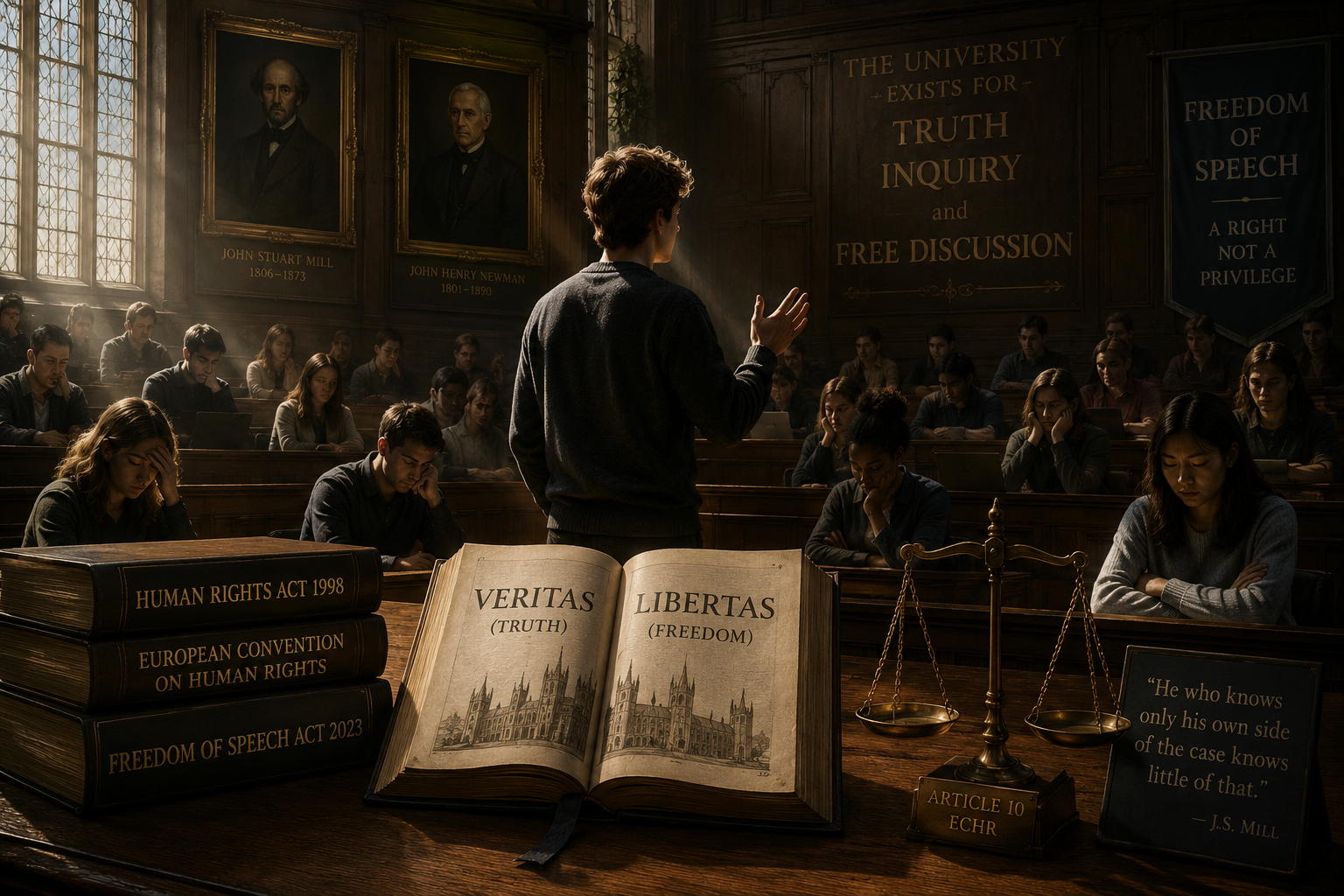
The Quieting of the Academy: Fear, Conformity, and the Future of British Freedom
As Parliament strengthens legal protections for free speech, a growing body of evidence suggests that many students remain reluctant to speak openly about the most important questions facing modern Britain. The problem is no longer principally one of law. It is one of culture. And the implications extend far beyond the university campus.

The most revealing finding in the latest Office for Students research is not that students are self-censoring. That has been evident for years. Nor is it that controversial subjects provoke discomfort. Universities have always been places where difficult questions produce tension, disagreement, and occasionally offence. The truly alarming finding is that a generation raised in one of the freest societies in human history increasingly appears uncertain whether it can speak openly about some of the defining questions of its age.
That uncertainty should concern far more than university administrators.
The Office for Students survey, drawing upon independent YouGov research among students at English universities, found substantial levels of self-censorship across both lectures and seminars. Significant minorities reported feeling unable to discuss subjects such as immigration, race, religion, and sex and gender. More revealing still were the reasons. The dominant concern was not disciplinary action, academic sanction, or institutional punishment. It was social fear. Students worried about being judged, ostracised, labelled, reported, misunderstood, or morally condemned by their peers.¹
This distinction is of immense significance because it reveals that the contemporary crisis of free speech is no longer primarily legal. It is cultural.
Britain has spent centuries constructing constitutional, political, and legal protections for liberty. From Magna Carta to the Bill of Rights, from the development of parliamentary government to the modern human rights framework, the nation gradually established a public order in which citizens could express opinions without fear of imprisonment or persecution. The great battles of free speech were historically fought against kings, governments, established churches, and state censors.
The modern challenge is different.
Today, many citizens possess legal freedom yet lack social confidence. They enjoy rights in theory while fearing consequences in practice. The danger no longer comes principally from the magistrate, the policeman, or the censor. It comes from reputational punishment, public shaming, social exclusion, professional jeopardy, and moral denunciation. The mechanism has changed, but the effect can be remarkably similar. People begin to calculate the cost of speaking honestly and conclude that silence is the safer course.
This is precisely what makes the Office for Students findings so important. They reveal not simply the condition of universities but the condition of the wider culture reflected within them.
Universities have always served as mirrors of the societies that create them. They are not detached intellectual islands floating above national life. They absorb prevailing assumptions, moral fashions, political anxieties, and cultural orthodoxies. What appears in the seminar room today frequently appears in the boardroom, newsroom, courtroom, parliament, and civil service tomorrow.
That reality gives the findings a significance extending far beyond higher education policy.
Today’s students are tomorrow’s journalists deciding which stories deserve investigation. They are tomorrow’s teachers shaping the minds of children, tomorrow’s lawyers interpreting legislation, tomorrow’s judges applying the law, tomorrow’s civil servants advising ministers, and tomorrow’s politicians making decisions affecting millions. If they learn during their formative years that certain questions are simply too dangerous to ask, they will carry that instinct with them into every institution they later inhabit.
The consequences are difficult to overstate.
A democratic society depends upon the existence of citizens willing to discuss difficult subjects openly and rationally. Complex problems cannot be solved if they cannot first be described. Public policy cannot be improved if criticism becomes socially hazardous. Error cannot be corrected if disagreement itself becomes suspect. The health of a free society rests not upon unanimity but upon confidence in the process of open debate.
This was the central insight of John Stuart Mill. Writing in On Liberty, Mill argued that the suppression of opinion impoverishes society whether the opinion is true or false. If true, society loses access to truth. If false, society loses the opportunity to test and strengthen truth through contestation.² The principle remains as relevant today as when it was first articulated. A belief that cannot withstand scrutiny eventually becomes dogma rather than conviction.
Nor was Mill alone. The Catholic educational tradition reached a remarkably similar conclusion through different reasoning. In The Idea of a University, John Henry Newman argued that intellectual formation requires exposure to the whole field of knowledge. A university worthy of the name does not shield students from competing ideas but equips them to evaluate those ideas rationally.³ Truth, whether approached through faith or reason, has nothing to fear from honest inquiry.
Yet contemporary universities increasingly appear uncertain about this inheritance.
Over the past decade, the language of higher education has undergone a subtle but significant transformation. Terms such as resilience, intellectual challenge, rigorous debate, and robust disagreement have gradually ceded ground to a vocabulary centred upon safety, wellbeing, inclusion, emotional harm, and protection. Again, these concerns are not inherently illegitimate. Universities possess genuine responsibilities towards their students. No serious advocate of free speech argues otherwise.
The difficulty arises when protection becomes the dominant organising principle of academic life.
A university exists for a purpose fundamentally different from that of a therapeutic institution. Its primary task is not to shield individuals from difficult ideas but to equip them to engage with them. Much of higher education involves confronting uncomfortable realities. History exposes human cruelty. Economics challenges cherished assumptions. Philosophy interrogates beliefs. Theology examines ultimate questions. Law grapples with competing rights and obligations. Political science studies conflict and power. Serious scholarship is rarely comfortable.
Indeed, intellectual growth often begins precisely where comfort ends.
The findings of the Office for Students suggest that many students have not acquired that confidence.
Particularly striking are the subjects identified as most difficult to discuss. Immigration. Race. Religion. Sex and gender. These are not fringe concerns occupying obscure corners of academic discourse. They are among the central political, moral, and social questions of contemporary Britain. They shape elections, legislation, public spending, social cohesion, national identity, educational policy, and international relations. If students feel unable to discuss such matters openly within institutions specifically designed for intellectual inquiry, what hope exists for healthier debate elsewhere?
The irony is sharpened by the timing of the research itself.
The survey was conducted after the commencement of major provisions of the Higher Education (Freedom of Speech) Act 2023, legislation introduced precisely because Parliament had become concerned about the state of free inquiry within universities. During parliamentary debates, ministers repeatedly argued that a culture of self-censorship had developed within parts of higher education and that lawful speech required stronger protection.⁴ The legislation therefore imposed new duties upon universities, strengthened protections for academic freedom, required institutions to maintain free speech codes of practice, and established mechanisms through which infringements might be challenged.⁵
Yet the Office for Students findings reveal a remarkable disconnect. A substantial proportion of students either remain unaware of those rights or possess only the vaguest understanding of them. Here lies another lesson. Rights cannot defend themselves. A freedom that exists only within legislation but not within institutional culture remains fragile. The law may create protections, but culture determines whether individuals feel sufficiently secure to rely upon them.
The qualitative responses concerning discussion of Palestine are especially illuminating. Students repeatedly expressed anxiety that expressing certain views might result in accusations of antisemitism, extremism, or sympathy for terrorism. Whether particular concerns are justified in specific circumstances is ultimately secondary to the larger phenomenon being revealed. Once people become convinced that expressing certain views may trigger severe moral condemnation, many cease speaking altogether.
The result is not healthier discourse.
It is less discourse.
The tragedy of self-censorship is that it leaves no visible trace. Banned books can be counted. Cancelled speakers can be listed. Formal disciplinary actions can be documented. But the conversation never begun, the question never asked, the concern never voiced, and the argument never made leave no record behind. Entire realms of inquiry can gradually disappear without a single prohibition ever being issued.
This is why self-censorship represents one of the most serious threats to intellectual freedom. It achieves silently what censorship seeks openly. It narrows the boundaries of permissible thought without the inconvenience of explicit coercion.
History offers abundant warnings. Societies rarely lose intellectual freedom all at once. More often, they lose it incrementally through the accumulation of caution. People learn which views are acceptable, which questions are risky, and which conclusions carry social penalties. Over time, the habit of self-restraint becomes second nature. The boundaries of discussion contract not because authority demands it, but because fear encourages it.
The Office for Students report should therefore be read as more than a survey of student attitudes. It is a diagnostic report on the condition of British public culture itself.
Parliament has acted. Regulators have acted. Universities have produced codes, policies, guidance, training programmes, and compliance frameworks. All of these have their place. Yet the deeper challenge remains unresolved because it cannot be legislated away.
A culture of free inquiry ultimately depends upon virtues rather than regulations. It requires courage among those who speak, humility among those who listen, and confidence among institutions that truth benefits from examination rather than protection. It requires citizens capable of distinguishing disagreement from hostility, argument from harm, and intellectual challenge from personal attack.
Most of all, it requires a society that remembers a simple but indispensable truth: freedom of speech is not tested when everyone agrees. It is tested when they do not.
The greatest danger facing British universities is therefore not that students will be forbidden to speak. It is that they will gradually lose the habit of speaking at all. A generation trained to calculate the social risks of every opinion may eventually conclude that silence is preferable to honesty. When that happens, the university ceases to be a place of inquiry and becomes merely a place of instruction.
And when a civilisation’s institutions of learning become afraid of open argument, the issue is no longer academic freedom.
It is freedom itself.
¹ Office for Students, Student Perceptions of Free Speech and Academic Freedom in Higher Education, research conducted by YouGov, December 2025, published June 2026.
² On Liberty (London: John W. Parker and Son, 1859), Chapter II.
³ The Idea of a University (1852), Discourses V–VII.
⁴ UK Parliament, House of Commons Debates on the Higher Education (Freedom of Speech) Bill, 2021–2023.
⁵ Higher Education (Freedom of Speech) Act 2023, c.16; Office for Students, Guidance on Freedom of Speech and Academic Freedom Duties (2025).
⁶ European Convention on Human Rights, Article 10; incorporated into UK law through the Human Rights Act 1998.
⁷ Committee for Academic Freedom, public submissions and casework concerning academic freedom, harassment frameworks, speaker restrictions, and Prevent guidance in UK higher education, 2024–2026.
RELATED ARTiCLES


LATEST ARTICLES
- Today’s Mass: October 24 St Raphael the ArchangelThe Feast of Saint Raphael the Archangel highlights his healing powers as depicted in the Book of Tobit, where he aids Tobit and his son, Tobiah. Venerated as a protector of travellers and the blind, Raphael is celebrated for his miraculous interventions. His legacy includes support for nurses, matchmakers, and Catholic studies.
- 25.10.26 Nuntiatoria CXXIX: CHRISTUS REXThe text discusses the relationship between Christ’s kingship and authority within the Church amidst contemporary challenges. It contrasts ecclesiastical power with genuine faith, emphasising that authority must protect divine truth rather than alter it. The witness of imprisoned priests illustrates the enduring significance of fidelity to Christ over institutional conformity.
- THE DOMESTIC CHURCH: 25 October – 2 November 2026 A Home with Room for Heaven: Preparing for All Saints and All SoulsThe content outlines a week’s plan for traditional Catholic families to prepare for the feasts of All Saints and All Souls. Emphasising daily prayers, remembrance of the deceased, and engagement with children’s activities, it aims to integrate Catholic customs into family life, enriching spiritual practices and fostering a shared faith experience.
- ORDO w/c 25.10.26The text outlines the liturgical calendar for the last week of October and the beginning of November, highlighting key celebrations. Notable events include the Feast of Christ the King, St Evaristus, the Vigil of Saints Simon and Jude, and the Feast of All Saints, emphasising themes of holiness, unity in faith, and the Church’s teachings.
- Christ the King: The Sovereignty of the Crucified RedeemerThe Mass of Christ the King articulates core Catholic beliefs about Jesus’ divine authority, redemptive sacrifice, and the essence of His Kingdom. It emphasises Christ as Prophet, Priest, and King, whose sovereignty is inseparable from His mission of reconciliation, calling the faithful to acknowledge His authority and embrace moral duties rooted in divine truth.
CURRENT EDITION


DAILY MASS ONLINE
One of the earliest online apostolates dedicated to the Traditional Latin Mass, Old Roman TV began broadcasting the Holy Sacrifice on the Feast of the Assumption, 15 August 2008. During the COVID-19 pandemic, additional programming — devotions, catechesis, and conferences — was added to support the faithful in prayer and formation.
Support the daily Holy Mass on Old Roman TV by offering a Mass intention — for loved ones, thanksgiving, or the repose of souls. Your intention helps sustain the sacred liturgy and brings grace to those you remember before God’s altar.
SUPPORT THE DAILY MASS ONLINE
Likely the world’s longest-running daily online broadcast of the
Traditional Latin Mass, streaming faithfully since the
Feast of the Assumption 2008.

This apostolate cannot continue without immediate help
Please support us with a contribution toward
chapel rent, sacristy supplies, operating costs, and web-hosting.
Our essential monthly costs reach £1,000.
MASS INTENTIONS
If your offering is for a Mass Intention, kindly complete the form below in full so we may correctly match it to your donation. For anniversary intentions — birthdays, wedding anniversaries, anniversaries of death — please be sure to include the relevant date.


Today’s Mass Propers
- Today’s Mass: October 24 St Raphael the Archangel
 The Feast of Saint Raphael the Archangel highlights his healing powers as depicted in the Book of Tobit, where he aids Tobit and his son, Tobiah. Venerated as a protector of travellers and the blind, Raphael is celebrated for his miraculous interventions. His legacy includes support for nurses, matchmakers, and Catholic studies.



Leave a Reply