
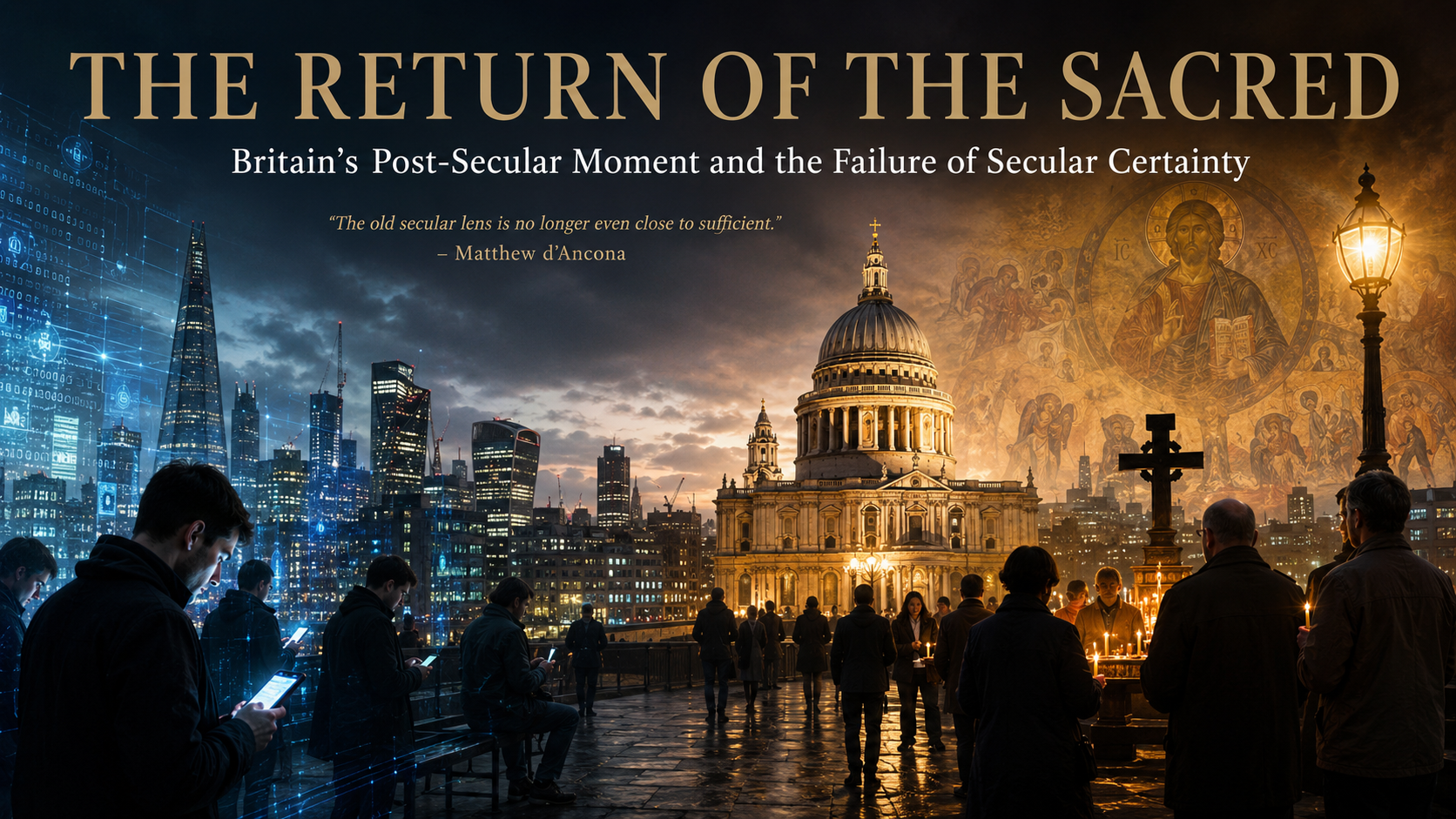
The Return of the Sacred: Britain’s Post-Secular Moment and the Failure of Secular Certainty
Matthew d’Ancona’s unexpected admission signals not merely a cultural shift, but the collapse of an entire civilisational assumption

There are moments when a civilisation realises, almost against its will, that it has been proceeding on false premises. Not with revolution, nor even with crisis alone, but with the slow and inescapable recognition that the categories by which it has interpreted itself no longer explain the world it inhabits. Such a moment is now unmistakably upon us. When a seasoned political commentator such as Matthew d’Ancona concedes that “the old secular lens is no longer even close to sufficient,” the significance lies not merely in the observation, but in the voice that utters it.
For this is not the language of revivalism, nor of confessional apologetics, but of late modern liberalism recognising its own intellectual exhaustion.
D’Ancona’s thesis is framed as an empirical observation rather than a theological claim: religion, spirituality, and metaphysical searching have re-entered the public square with a force that can no longer be ignored. Politics, he argues, cannot be understood without them. Indeed, he goes further, noting that “everywhere one looks, the sacred, the numinous, and the mystical are reasserting themselves.” This is not an isolated curiosity, but a pattern—visible in political rhetoric, intellectual discourse, technological anxiety, and cultural production alike.
The importance of this admission becomes clearer when situated within the intellectual arc he himself outlines. His “three phases” offer a useful, if incomplete, map of recent history.
The first, the post-Cold War moment, was defined by the optimism of Francis Fukuyama and the illusion that liberal democracy represented the final stage of ideological development. This was, as d’Ancona perceptively observes, “a secular version of providentialism”—a transposition of theological teleology into a rationalist key. History retained direction and purpose; only God had been excised from the narrative.
The second phase emerged in reaction: the era of the “New Atheists,” in which religion was not merely sidelined but aggressively contested. Figures such as Richard Dawkins sought to reduce belief to superstition, while public discourse shifted toward the now-familiar terrain of culture wars, identity politics, and moral contestation. Yet this phase proved unstable. The confidence of militant secularism dissipated as quickly as it had arisen, leaving behind not clarity but fragmentation.
Now, according to d’Ancona, we enter a third phase: not a return to institutional religion as such, but the emergence of a pervasive “religious sensibility.” The language is cautious, even hesitant. He does not speak of conversion, but of atmosphere; not of doctrine, but of mood. Yet the evidence he marshals points to something far more substantial.
He notes the global anticipation surrounding the AI encyclical of Pope Leo XIV as a moral intervention “on behalf of humanity as a whole.” He observes that the most compelling analysis of polarisation he has encountered is not secular, but theological, in the work of Rowan Williams. He confesses to reading Rod Dreher not out of agreement, but because of his ability to navigate the frontier between faith, identity, and politics. He even acknowledges that the evolution of Englishness is more intelligible through the spiritual imagination of Malcolm Guite than through narrowly secular analysis.
More striking still is his recognition of developments that would once have seemed implausible: the public conversion of Ayaan Hirsi Ali to Christianity; the apocalyptic language of Silicon Valley elites such as Peter Thiel; and the renewed candour with which British political figures now speak of their faith. The old Blairite dictum—“we don’t do God”—has quietly expired.
These are not anomalies. They are indicators.
D’Ancona’s diagnosis of the causes is, in many respects, compelling. The collapse of trust in institutions, the atomisation of communities, the erosion of shared moral frameworks, and the prevalence of what he terms “deaths of despair” have generated a crisis that is not merely political or economic, but existential. In such conditions, he argues, human beings instinctively return to “ancient forms of metaphysical explanation which offer transcendence, communion, and wisdom.”
Here, the analysis touches bedrock. The modern West has attempted to construct a civilisation on the basis of procedural rationality, economic expansion, and individual autonomy. It has achieved extraordinary material success. It has failed to provide meaning. The result is not neutrality, but vacuum.
And vacuum, in human affairs, is never stable.
Yet for all its perceptiveness, this account remains incomplete. For what is returning is not, in the first instance, Christianity in its fullness, but a diffuse and often disordered spiritual searching. The phenomenon identified by Tara Isabella Burton as “Remixed Religions” captures the mood of the age: belief systems assembled from fragments, shaped by preference rather than submission, and oriented toward experience rather than truth.
This is not a restoration. It is a reversion.
It bears, in many respects, the marks not of Christendom, but of pre-Christian religiosity: a world in which the sacred is acknowledged, but not rightly understood; in which symbols abound, but doctrine is absent; in which transcendence is sought, but without the discipline of truth. It is spirituality without authority, meaning without obligation, and ultimately, religion without God as He has revealed Himself.
Such a condition cannot endure. As Augustine of Hippo observed with enduring clarity, “our heart is restless until it rests in Thee.”¹ The restlessness of the present age is therefore not a sign of failure alone, but of misdirection. Man continues to seek what he was made for, even when he no longer knows its name.
This is why the attempt to treat Christianity as a cultural resource—useful for cohesion, identity, or moral language, but detachable from its truth claims—is ultimately self-defeating. Christianity is not a toolkit for civilisational repair. It is a revelation. It does not offer merely a narrative, but a reality: the Incarnation of the Word in history, the binding authority of doctrine, and the sacramental life of grace. To abstract its benefits from its claims is not to preserve it, but to dissolve it.
At this point, the deeper implication of d’Ancona’s analysis emerges. The return of the sacred is not, in itself, a solution. It is a symptom. It reveals that the secular settlement has failed to satisfy the conditions of human flourishing, but it does not determine what will replace it.
For the re-sacralisation of public life is already underway—and it is not neutral. As John Gray has argued, modern ideologies frequently replicate the structure of religious belief while discarding its foundation. Concepts of sin, redemption, orthodoxy, and eschatology reappear in secular guise, often with greater intensity and less restraint. The result is not a rational public square, but a contested theological arena in which rival visions of the good compete for dominance.
In such a world, the absence of truth does not produce freedom. It produces instability.
The present moment, therefore, is not merely one of cultural transition, but of civilisational decision. The collapse of the secular myth has opened a space that will not remain unfilled. Into that space will flow competing claims upon the human soul: some rooted in the perennial wisdom of the Christian tradition, others shaped by ideology, power, and desire.
The Church must not mistake this moment. A hunger for the sacred is not yet a return to God. It is an invitation—but also a warning. For a civilisation that rediscovers religion without rediscovering truth will not be renewed; it will be confused.
Yet the opportunity is immense. For the first time in generations, the self-confidence of secular modernity has been decisively shaken. Its inability to sustain meaning, cohesion, and moral clarity is no longer the claim of its critics alone, but the admission of its own interpreters. The ground is shifting. The question is whether the Church will meet this moment with clarity and conviction, or whether it will dilute its message in an attempt to accommodate a world that is already passing away.
There is no stable middle ground.
Man will worship. He cannot do otherwise. The only question is whether he will worship the living God—or the idols he constructs in His absence. A civilisation that abandons truth does not become secular. It becomes unstable.
The secular age, as it understood itself, is over. What follows will not be less religious, but more so.
The only question that remains is whether that religion will be true.
- Augustine of Hippo, Confessions, I.1, trans. Henry Chadwick (Oxford: Oxford University Press, 1991), 3.
- Matthew d’Ancona, “Analysis: The rise of a new religious sensibility,” Church Times, 22 May 2026.
- Francis Fukuyama, The End of History and the Last Man (New York: Free Press, 1992), xi–xii.
- Richard Dawkins, The God Delusion (London: Bantam Press, 2006).
- Rowan Williams, Solidarity: The Work of Recognition (London: Bloomsbury Continuum, 2025).
- Rod Dreher, The Benedict Option (New York: Sentinel, 2017).
- Malcolm Guite, Galahad and the Grail (Cambridge: Canterbury Press, 2025).
- Ayaan Hirsi Ali, “Why I am now a Christian,” UnHerd, 2023.
- Peter Thiel, public lectures and interviews on technology and eschatology, 2022–2025.
- Tara Isabella Burton, Strange Rites: New Religions for a Godless World (New York: PublicAffairs, 2020), 10–12.
- John Gray, Black Mass: Apocalyptic Religion and the Death of Utopia (London: Allen Lane, 2007), 1–5.
RELATED ARTiCLES


LATEST ARTICLES
- SEPTEMBER EMBERTIDEThe September Ember Days, rooted in ancient Roman liturgy, are a time of reflection, fasting, and thanksgiving, coinciding with the autumn harvest. Marked by communal penance and prayers for clergy sanctification, these observances connect biblical themes of creation and sacrifice, urging Christians to evaluate their spiritual fruitfulness.
- Today’s homily: Seven Sorrows of the Blessed Virgin MaryOn the Feast of the Seven Sorrows, the Church contemplates not merely Mary’s grief but her fidelity beneath the Cross. Through the liturgy, St Bernard, St John Damascene and St Thomas Aquinas, the homily shows that Christian resignation does not mean calling suffering good, but remaining faithful to God when suffering cannot be removed or understood. Mary’s stabat becomes the model of a faith which the sword can pierce, but cannot conquer.
- Today’s Mass: September 15 The Seven Sorrows of the Blessed Virgin MaryThe Feast of the Exaltation of the Holy Cross, celebrated on September 14, commemorates the historical finding of the True Cross by Saint Helena, the dedication of churches by Constantine, and its restoration by Heraclius II. It honours the cross as the symbol of salvation, transforming a method of execution into a source of life and hope.
- Sermon for Blessed Virgin Mary/Octave of the Nativity of the Blessed Virgin MaryToday is the feast of the Seven Sorrows of the Blessed Virgin Mary, as well as the Octave of her Nativity. Today’s feast, the Seven Sorrows, shows Mary not only as the theotokos, the God bearer, but also as the Mater Dolorosa, the Mother of Sorrows.
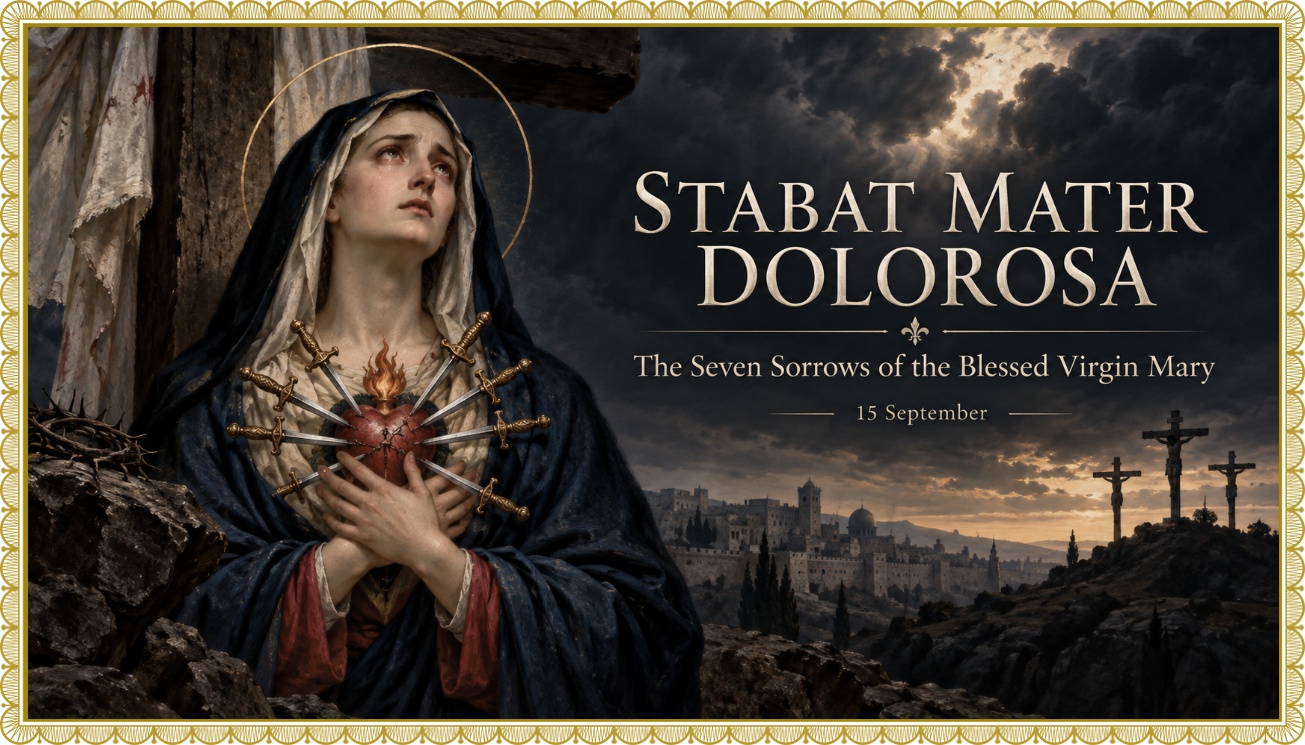
- STABAT MATER DOLOROSA: The Seven Sorrows of the Blessed Virgin MaryThe traditional feast of the Seven Sorrows on 15 September contemplates Mary’s spiritual martyrdom from Simeon’s prophecy to the Burial of Christ. Distinct in origin from the Passion Friday feast of the Compassion, the September observance came especially through the Servite tradition and was extended to the Latin Church by Pius VII before being raised in rank and fixed to 15 September under St Pius X. Its Mass, Stabant juxta Crucem, presents Mary’s sorrow not as sentimental grief but as perfect faith, charity and conformity to Divine Providence, wholly dependent upon and ordered to the unique redemptive Sacrifice of Christ.
CURRENT EDITION


DAILY MASS ONLINE
One of the earliest online apostolates dedicated to the Traditional Latin Mass, Old Roman TV began broadcasting the Holy Sacrifice on the Feast of the Assumption, 15 August 2008. During the COVID-19 pandemic, additional programming — devotions, catechesis, and conferences — was added to support the faithful in prayer and formation.
Support the daily Holy Mass on Old Roman TV by offering a Mass intention — for loved ones, thanksgiving, or the repose of souls. Your intention helps sustain the sacred liturgy and brings grace to those you remember before God’s altar.
SUPPORT THE DAILY MASS ONLINE
Likely the world’s longest-running daily online broadcast of the
Traditional Latin Mass, streaming faithfully since the
Feast of the Assumption 2008.

This apostolate cannot continue without immediate help
Please support us with a contribution toward
chapel rent, sacristy supplies, operating costs, and web-hosting.
Our essential monthly costs reach £1,000.
MASS INTENTIONS
If your offering is for a Mass Intention, kindly complete the form below in full so we may correctly match it to your donation. For anniversary intentions — birthdays, wedding anniversaries, anniversaries of death — please be sure to include the relevant date.


Today’s Mass Propers
- Today’s Mass: September 15 The Seven Sorrows of the Blessed Virgin Mary
 The Feast of the Exaltation of the Holy Cross, celebrated on September 14, commemorates the historical finding of the True Cross by Saint Helena, the dedication of churches by Constantine, and its restoration by Heraclius II. It honours the cross as the symbol of salvation, transforming a method of execution into a source of life and hope.



Leave a Reply