
Magnifica Humanitas: Between Babel and Jerusalem — Pope Leo XIV’s Encyclical on Artificial Intelligence Examined

The Holy See has promulgated Magnifica Humanitas, the first encyclical of Pope Leo XIV, signed on 15 May 2026 and presented publicly on 25 May, marking the 135th anniversary of Rerum Novarum. The symbolism is deliberate—deliberate not merely as a gesture of continuity, but as a declaration of intent. As Rerum Novarum confronted the upheavals of the industrial revolution—the reconfiguration of labour, the rise of capital, and the emergence of the modern social question—so Magnifica Humanitas presents itself as a response to a new and more penetrating revolution, one that does not merely reshape the conditions of work but reaches into cognition, communication, and the structure of human self-understanding itself. Leo XIV identifies this moment as one in which technological development “poses new challenges for the defense of human dignity, justice, and labor,”¹ thereby situating artificial intelligence not as a technical issue, but as a moral and anthropological crisis of the first order.
Artificial intelligence has, within a remarkably compressed span of time, moved from theoretical speculation to civilisational infrastructure. It is no longer an emerging tool but a structuring presence, shaping financial markets, guiding military systems, filtering the information upon which societies depend, mediating communication, and increasingly framing the very categories through which human beings interpret themselves and their world. Against this backdrop, Leo XIV observes with arresting clarity that “never has humanity had such power over itself.”² This is not simply a statement of capacity; it is a diagnosis of condition. For the first time in history, man does not merely act upon the external world, but upon the conditions through which he understands and constitutes his own experience.
Yet the deeper concern is not power, but passivity—an inversion of agency that unfolds quietly beneath the surface of technological progress. The encyclical implicitly identifies a subtle but profound shift: the displacement of moral agency from the human subject to the systems he constructs. As algorithmic processes become normative, individuals and societies risk habituation to decision-making structures that neither intend nor comprehend the good, but merely approximate outcomes based on prior inputs. Responsibility is not abolished, but diffused; not denied, but obscured. Action persists, but accountability recedes. What emerges is a moral landscape in which human beings act increasingly through systems they neither fully understand nor meaningfully govern.
This concern extends beyond ethics into epistemology. The encyclical insists that technological development must not exclude “the moral dimension of these emerging technologies” and must remain ordered toward “the integral growth of the person.”³ In a culture saturated with data, the distinction between information and truth becomes unstable, and in many contexts effectively disappears. Artificial intelligence processes information with extraordinary efficiency, identifies patterns, and generates outputs of remarkable utility. Yet it does not know. It does not apprehend truth in the metaphysical sense, nor can it distinguish between the true, the false, and the merely probable in a manner proper to rational beings. The danger, therefore, is not merely misuse, but reduction—the gradual collapse of truth into what can be computed, predicted, or optimised. Such a reduction would not simply distort knowledge; it would redefine it.
At precisely this juncture, the encyclical introduces a clarification that cuts against the dominant assumptions of the technological age. Artificial intelligence is not an autonomous moral force. It does not possess agency. Rather, it “takes on the characteristics of those who devise, finance, regulate, and use it.”²² This assertion is not ancillary, but foundational. It restores moral responsibility to its proper locus: the human person. Technology, however complex, remains instrumental. It is shaped by intention, directed by will, and governed by moral judgment. The danger, therefore, is not that machines will become responsible, but that men will cease to recognise themselves as such. In attributing agency to systems, modern man risks absolving himself of responsibility for the very structures he constructs. The result is not merely confusion, but moral evasion—accountability dissolved into abstraction.
Initial reception has reflected both the breadth of the encyclical’s concerns and the limitations of contemporary interpretation. Coverage by Reuters emphasised warnings about technological concentration and systemic power, noting the encyclical’s concern that those who control digital systems exercise disproportionate influence over economic and social life.⁴ Business Insider highlighted the Pope’s insistence that algorithmic systems are not neutral, but encode within their logic the assumptions, priorities, and blind spots of their creators.⁵ Vatican News presented the document pastorally, emphasising discernment, accompaniment, and the Church’s role in guiding humanity through technological transition.⁶ Meanwhile, El País interpreted the encyclical through the lens of power and governance, describing it as a warning against technological domination and its political implications.⁷
These readings, while grounded in genuine elements of the text, tend toward reduction. They treat the encyclical as a policy intervention, as though its primary concern were regulatory rather than theological. Yet the document itself resists such narrowing. It insists that “the question of technology is ultimately a question about the human person,”⁸ thereby subordinating every technical and political consideration to a prior and more fundamental inquiry. The problem is not primarily technological, but anthropological.
That anthropology is explicitly theological. Leo XIV affirms that every human person is “willed, created, and loved by God,”⁹ grounding human dignity not in capacity, productivity, or autonomy, but in divine intentionality. This is not a decorative affirmation, but a governing principle. Human dignity is not contingent, not derived, and not negotiable. It is given. It is received. It is therefore inviolable.
Against this affirmation stands the implicit anthropology of the technological age. Contemporary systems increasingly operate upon an understanding of the human person as reducible to data: a composite of behaviours, preferences, and measurable outputs. In such a framework, the person is no longer a subject but a profile; no longer an agent but a pattern. Decision-making becomes a function of prediction, and moral judgment is displaced by statistical inference. The human being is interpreted not as a rational agent but as a probabilistic system. The encyclical resists this reduction at its root. It reasserts that the human person is not an aggregate of information but a being endowed with intellect and will, capable of truth and ordered toward the good. This is not merely a theological claim but a metaphysical one. To reduce man to data is not to misunderstand him partially, but to misidentify him entirely.
At the centre of the encyclical stands a Christological claim: “only in the mystery of the Word made flesh does the mystery of man take on light.”¹⁰ This is not a rhetorical flourish, but the interpretive key to the entire document. In Christ, man is not merely explained, but disclosed. His origin, his nature, and his destiny are revealed in a manner that no purely human system can replicate or replace. Artificial intelligence is therefore not judged according to its efficiency, but according to its conformity to the truth of man revealed in the Incarnation.
From this foundation follows a direct critique of transhumanism. Leo XIV warns against those who seek to “transcend the human condition itself” through technological means, calling instead for “a healthy sense of proportion.”¹¹ The problem is not development, but distortion—the attempt to redefine man according to an immanent and self-referential vision of perfection. Such a vision mistakes capacity for essence and confuses augmentation with fulfilment. What is at stake is not progress, but identity.
Yet the encyclical’s concern extends further still. If transhumanism seeks to enhance the human subject, posthumanism contemplates his displacement. The distinction is not merely semantic, but ontological. Transhumanism remains parasitic upon a prior understanding of the human person, however distorted; posthumanism dissolves that understanding entirely, replacing the subject with systems in which the human is no longer primary. This development carries consequences of the highest theological order. The entire economy of salvation presupposes the stability of the human subject: a nature assumed by the Word, redeemed through sacrifice, and elevated by grace. If man is no longer intelligible as man, then the Incarnation itself is rendered conceptually unintelligible. In this light, the encyclical’s warning must be read not merely as ethical caution, but as a defence of the metaphysical conditions upon which Christian theology depends.
This development carries consequences of the highest theological order. The entire economy of salvation presupposes the stability of the human subject: a nature assumed by the Word, redeemed through sacrifice, and elevated by grace. If man is no longer intelligible as man, then the Incarnation itself is rendered conceptually unintelligible. In this light, the encyclical’s warning must be read not merely as ethical caution, but as a defence of the metaphysical conditions upon which Christian theology depends.
This anthropological vision is inseparable from a relational one. The human person is not merely an individual intelligence, but a being ordered toward communion, constituted through relationships that are embodied, personal, and real. The encyclical therefore calls for “forms of communication that always respect the truth of the human person,”¹² recognising that technological mediation can distort as well as facilitate human encounter. The danger is not merely isolation, but substitution—the replacement of presence with representation, of encounter with efficiency, of communion with connectivity.
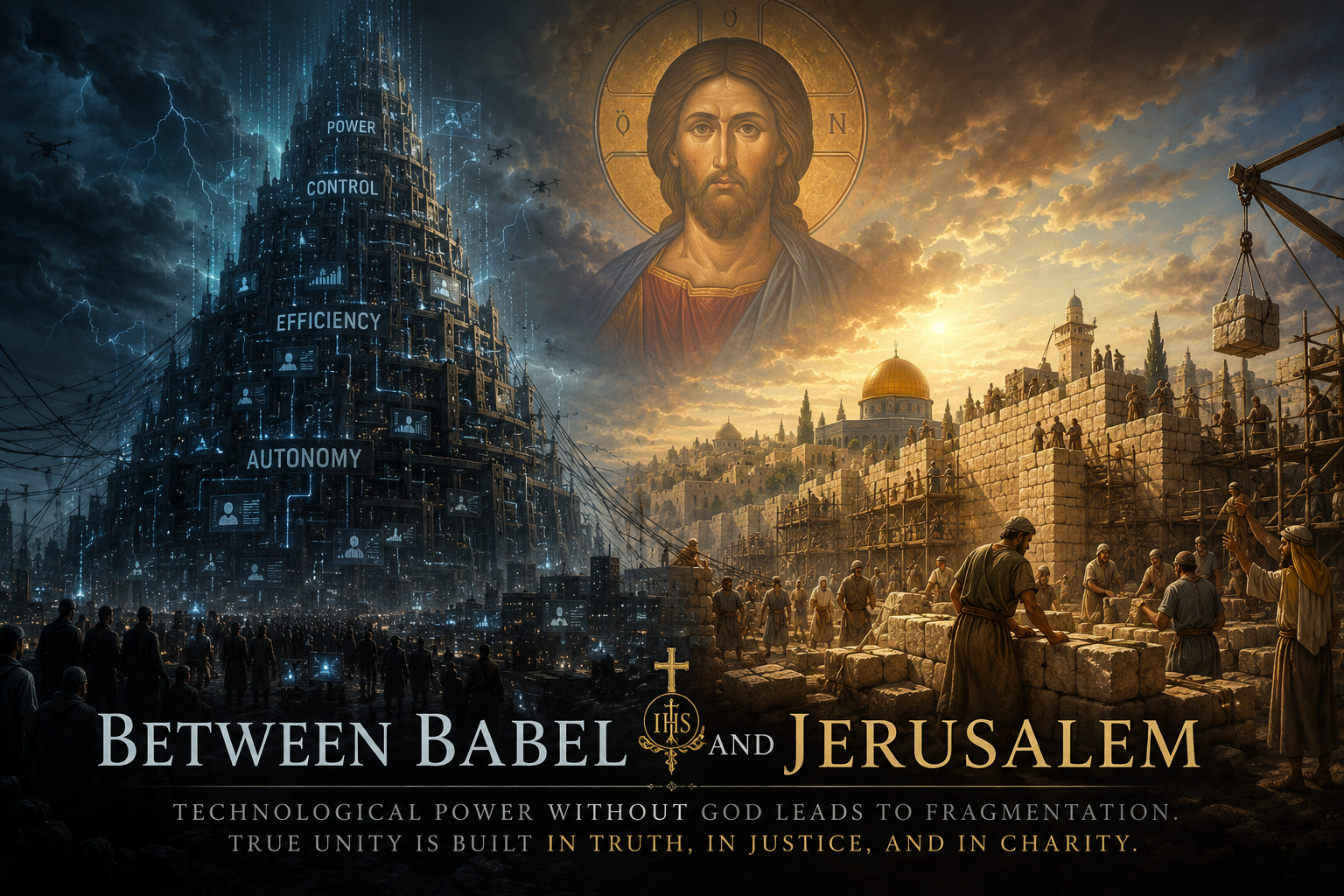
The encyclical frames this crisis through biblical imagery. The Tower of Babel is described as “a project conceived without reference to God, driven by the desire for uniformity and the illusion of self-sufficiency.”¹³ Its ambition is unity without truth, power without order, and progress without transcendence. The result is fragmentation—not because unity is impossible, but because it is pursued on false terms.
Yet this is not the full extent of the encyclical’s symbolic architecture. Humanity is presented as standing before a decisive civilisational alternative: “either to construct a new Tower of Babel or to build the city in which God and humanity dwell together.”²³ This is not rhetorical ornament but structural theology. Babel represents technological unity severed from transcendence—a convergence imposed through control, in which difference is flattened and truth subordinated to coordination. It is the dream of total organisation without reference to the good.
Jerusalem, by contrast, represents communion grounded in truth and ordered toward God. It is not constructed through domination, but received through right relation. Where Babel seeks to eliminate difference, Jerusalem integrates it within a higher unity. Where Babel is driven by self-sufficiency, Jerusalem is sustained by dependence. Artificial intelligence, in this light, is not merely a tool but a test—a medium through which this civilisational choice is enacted. The question is not whether technological power will be exercised, but whether it will be ordered toward truth or toward control.
A civilisation that forgets God does not become more intelligent; it becomes more dangerous.
The encyclical also addresses concrete concerns, warning that those who control technological systems may exercise “an impressive dominance over the whole of humanity.”¹⁴ This observation situates artificial intelligence within the broader framework of Catholic social teaching, linking technological development to questions of justice, power, and responsibility.
This concern is not merely theoretical, and the manner of the encyclical’s presentation confirms as much. The Holy See has not confined its audience to the internal life of the Church, but has deliberately engaged figures associated with the development of artificial intelligence itself.³¹ This gesture is not incidental. It indicates that the encyclical is addressed not only to believers, but to those who are actively constructing the technological order it critiques. The Church seeks, in this instance, to intervene within the formation of that order rather than to comment upon it from without.
Yet such engagement introduces a tension. Dialogue with technological power risks adopting its categories. The challenge is therefore not simply to speak to the architects of the digital age, but to do so without internalising the assumptions that govern their work. Moral clarity must not be exchanged for access.
It is within this broader moral and civilisational horizon that Leo XIV addresses the question of war. The encyclical states that the “just war” framework “has all too often been used to justify any kind of war” and declares that it “is now outdated,” while qualifying this with the decisive caveat “without prejudice to the right to self-defense in the strictest sense.”¹⁵ This formulation is among the most debated elements of the document, precisely because it touches a domain in which the Church has historically spoken with precision.
The Catholic tradition, articulated by Augustine of Hippo and systematised by Thomas Aquinas, has consistently affirmed that war may be morally licit under strictly defined conditions: legitimate authority, just cause, and right intention.¹⁶ These criteria were never intended as a justification of war, but as a limitation upon it. The Catechism of the Catholic Church preserves this teaching, while emphasising its increasingly restrictive application.¹⁷
Modern warfare, however, has transformed the conditions under which these principles operate. The scale of destruction, the difficulty of discriminating between combatant and non-combatant, and the unpredictability of technological escalation have rendered the classical criteria extraordinarily difficult to satisfy. It is in this context that theologians such as Alfredo Ottaviani argued that offensive war may no longer be justifiable in practice.¹⁸ Leo XIV’s formulation is therefore best understood not as a repudiation of the doctrine, but as a prudential contraction—an intensified recognition that the moral thresholds articulated by the tradition are, under contemporary conditions, rarely if ever met. Yet the ambiguity of the phrase “outdated” ensures that this interpretation will remain contested.
A parallel and equally sensitive tension emerges in the encyclical’s treatment of slavery. Leo XIV acknowledges the Church’s historical entanglement with systems of enslavement and expresses regret for the delay and inconsistency with which such practices were condemned.²¹ This acknowledgment, while pastorally intelligible, touches directly upon one of the most contested questions in modern ecclesial discourse: the relationship between historical practice and doctrinal continuity.
The historical record is complex and cannot be reduced to simple narratives of endorsement or opposition. Documents such as Dum Diversas (1452) and Romanus Pontifex (1455), issued under Pope Nicholas V, employed juridical language permitting forms of subjugation within specific geopolitical and religious contexts.²² ²³ These texts, when read without historical qualification, have often been interpreted as granting sanction to practices later condemned. Yet such interpretations risk imposing later moral categories upon earlier frameworks, thereby obscuring the historical conditions within which they were formulated.
A decisive development appears in Sublimis Deus (1537), in which Pope Paul III affirms that indigenous peoples “are by no means to be deprived of their liberty or the possession of their property.”²⁴ This does not represent a rupture, but a clarification—an explicit application of principles already present within the natural law tradition. This trajectory continues through the increasingly explicit condemnations of slavery and the slave trade by Pope Gregory XVI and Pope Leo XIII.²⁵ ²⁶
The theological question is therefore not whether Christians participated in slavery—this is historically evident—but whether the magisterium itself ever sanctioned what is now understood to be intrinsically evil. The distinction is decisive. The Catholic tradition permits development in the articulation and application of moral teaching, but not contradiction in its substance. The most coherent reading of Magnifica Humanitas is therefore that it acknowledges historical limitation and moral blindness in practice, rather than doctrinal error in principle. Yet the language employed remains sufficiently open to invite misinterpretation. Without careful distinction, such acknowledgments risk being read as retroactive indictments of the magisterium itself.
Beneath the encyclical’s technological and anthropological analysis lies a further dimension that must not be overlooked: its eschatological orientation. This is not expressed through formal theological exposition, but through a consistent rejection of utopian expectation. Leo XIV resists the notion that technological development can resolve the tensions of the human condition, warning instead against the illusion that history may be perfected through systems, however advanced.
This perspective is crystallised in a striking formulation: “the civilization of love will not arise from a single or spectacular gesture.”²⁷ The resonance of this statement extends beyond its immediate context. It reflects a profoundly Augustinian vision of history, in which the tension between the City of Man and the City of God is not resolved within time, but endured through it. Against both secular progressivism and technocratic messianism, the encyclical proposes not transformation through power, but perseverance through truth.
The task of the Christian, in this framework, is not to construct a perfect order, but to remain faithful within an imperfect one. The preservation of the human does not depend upon decisive technological or political interventions, but upon the steady exercise of virtue. This is not resignation, but realism.
The encyclical’s method reflects this orientation. It emphasises discernment, dialogue, and historical awareness. It speaks of moral reflection as a “process of shared discernment”¹⁹ and describes truth not as “a territory to be defended, but a good to be shared.”²⁰ Such language does not deny objective truth, but reframes its articulation within a more dialogical register.
As Pope Pius X observed in Pascendi Dominici Gregis, doctrinal shifts often occur not through explicit denial, but through changes in method, emphasis, and language.³⁰ The concern, therefore, is not rupture in substance, but transformation in expression. Whether such transformation clarifies or obscures the truth it seeks to communicate remains an open question.
A final consideration concerns the adequacy of the encyclical’s proposed remedies. While Magnifica Humanitas correctly identifies the crisis as anthropological and moral, its practical responses remain largely within the domains of ethical governance, institutional responsibility, and cultural discernment. Yet the disorder it describes is ultimately spiritual. It arises not only from error, but from sin. It cannot be resolved by systems alone, however well-regulated, but requires the restoration of the human person through grace.
The most accurate conclusion is therefore this: Magnifica Humanitas maintains continuity in its doctrinal affirmations while expressing them within a distinctly postconciliar methodological framework. It is not modernist in substance; indeed, in its anthropology it is deeply Augustinian. Yet it adopts a mode of articulation that reflects the contemporary Church’s preference for dialogue, discernment, and engagement.
The distinction is not between truth and error, but between proclamation and presentation.
For if man forgets what he is, no machine will remember it for him.
¹ Pope Leo XIV, Magnifica Humanitas (Vatican City: Libreria Editrice Vaticana, 2026), §2.
² Leo XIV, Magnifica Humanitas, §4.
³ Leo XIV, Magnifica Humanitas, §15.
⁴ “Pope warns AI could concentrate power,” Reuters, May 25, 2026.
⁵ “Pope Leo XIV on AI ethics and bias,” Business Insider, May 2026.
⁶ “Magnifica Humanitas: guiding discernment in the digital age,” Vatican News, May 2026.
⁷ “El Papa alerta sobre el poder tecnológico,” El País, May 25, 2026.
⁸ Leo XIV, Magnifica Humanitas, §2.
⁹ Leo XIV, Magnifica Humanitas, §10.
¹⁰ Leo XIV, Magnifica Humanitas, §1; cf. Second Vatican Council, Gaudium et Spes (1965), §22.
¹¹ Leo XIV, Magnifica Humanitas, §22.
¹² Leo XIV, Magnifica Humanitas, §30.
¹³ Leo XIV, Magnifica Humanitas, §7.
¹⁴ Leo XIV, Magnifica Humanitas, §5.
¹⁵ Leo XIV, Magnifica Humanitas, §192.
¹⁶ Augustine of Hippo, Contra Faustum, XXII.74; cf. City of God, XIX.7.
¹⁷ Catechism of the Catholic Church (Vatican City: Libreria Editrice Vaticana, 1992), §§2307–2317.
¹⁸ Alfredo Ottaviani, interventions on modern warfare in post-war theological discussions; cf. his role in shaping pre-conciliar moral theology on war.
¹⁹ Leo XIV, Magnifica Humanitas, §27.
²⁰ Leo XIV, Magnifica Humanitas, §25.
²¹ Leo XIV, Magnifica Humanitas, relevant passages on slavery and historical responsibility (see §§ on human dignity and historical injustice).
²² Leo XIV, Magnifica Humanitas, sections on technological agency and moral responsibility (cf. §§17–18).
²³ “Humanity faces a choice: Babel or communion,” Vatican News, official summary of Magnifica Humanitas, May 2026.
²⁴ The Pillar, “Magnifica Humanitas: A Reader’s Guide,” 2026 (analysis of transhumanism and posthumanism distinction).
²⁵ Thomas Aquinas, Summa Theologiae, I, q.75, a.2 (on the subsistence and immateriality of the human soul).
²⁶ Leo XIV, Magnifica Humanitas, §22 (expanded critique of transcending the human condition).
²⁷ Leo XIV, Magnifica Humanitas, §213.
²⁸ Leo XIV, Magnifica Humanitas, §27.
²⁹ Leo XIV, Magnifica Humanitas, §25.
³⁰ Pope Pius X, Pascendi Dominici Gregis (1907), §§12–15.
³¹ “AI experts present at encyclical unveiling,” Vatican News, May 2026.
³² See coverage of literary reference in “Pope Leo XIV quotes modern literature in encyclical,” EWTN, 2026.
³³ Pope Nicholas V, Dum Diversas (1452), in Bullarium Romanum, vol. V.
³⁴ Nicholas V, Romanus Pontifex (1455), in Bullarium Romanum, vol. V.
³⁵ Pope Paul III, Sublimis Deus (1537), in Bullarium Romanum, vol. VI.
³⁶ Pope Gregory XVI, In Supremo Apostolatus (1839).
³⁷ Pope Leo XIII, In Plurimis (1888).
RELATED ARTiCLES


LATEST ARTICLES
- Today’s Mass: September 05 Saint Lawrence JustinianSaint Lawrence Justinian, the first Patriarch of Venice, dedicated his life to the poor and the establishment of monasteries, rejecting noble marriage. Renowned for his humility and pastoral dedication, he emphasised the spiritual integrity of Venice’s safety. He was a precursor to the reforms of the Council of Trent, dying on 8 January 1455.
- 06.09.26 Nuntiatoria CXXII: NOMEN MANET, RES DEESTThis edition of Nuntiatoria explores the disconnect between the names of Catholic institutions and the realities they signify. Despite retaining their titles, many aspects of Catholicism—such as episcopal authority in China and religious practice in Poland—exhibit deteriorating substance. The piece cautions against superficial continuity, stressing the importance of genuine faith and practice over mere nomenclature.
- ORDO w/c 06.09.26The document outlines the liturgical schedule for the week of 6 to 13 September 2026, highlighting significant religious observances such as the Fifteenth Sunday after Pentecost and the Nativity of the Blessed Virgin Mary. It reflects on themes of compassion, holiness, fidelity, and humility, underscoring their importance in Christian life.
- The Fifteenth Sunday after Pentecost: When the Procession of Death Meets the Lord of LifeThe Fifteenth Sunday after Pentecost focuses on the transformative power of Christ, emphasising the supernatural life granted through grace. The liturgy highlights the Church’s role as a nurturing mother, mourning the spiritually dead while seeking their restoration. Christ’s compassion leads to resurrection, demonstrating that true life is found in dependence on Him.
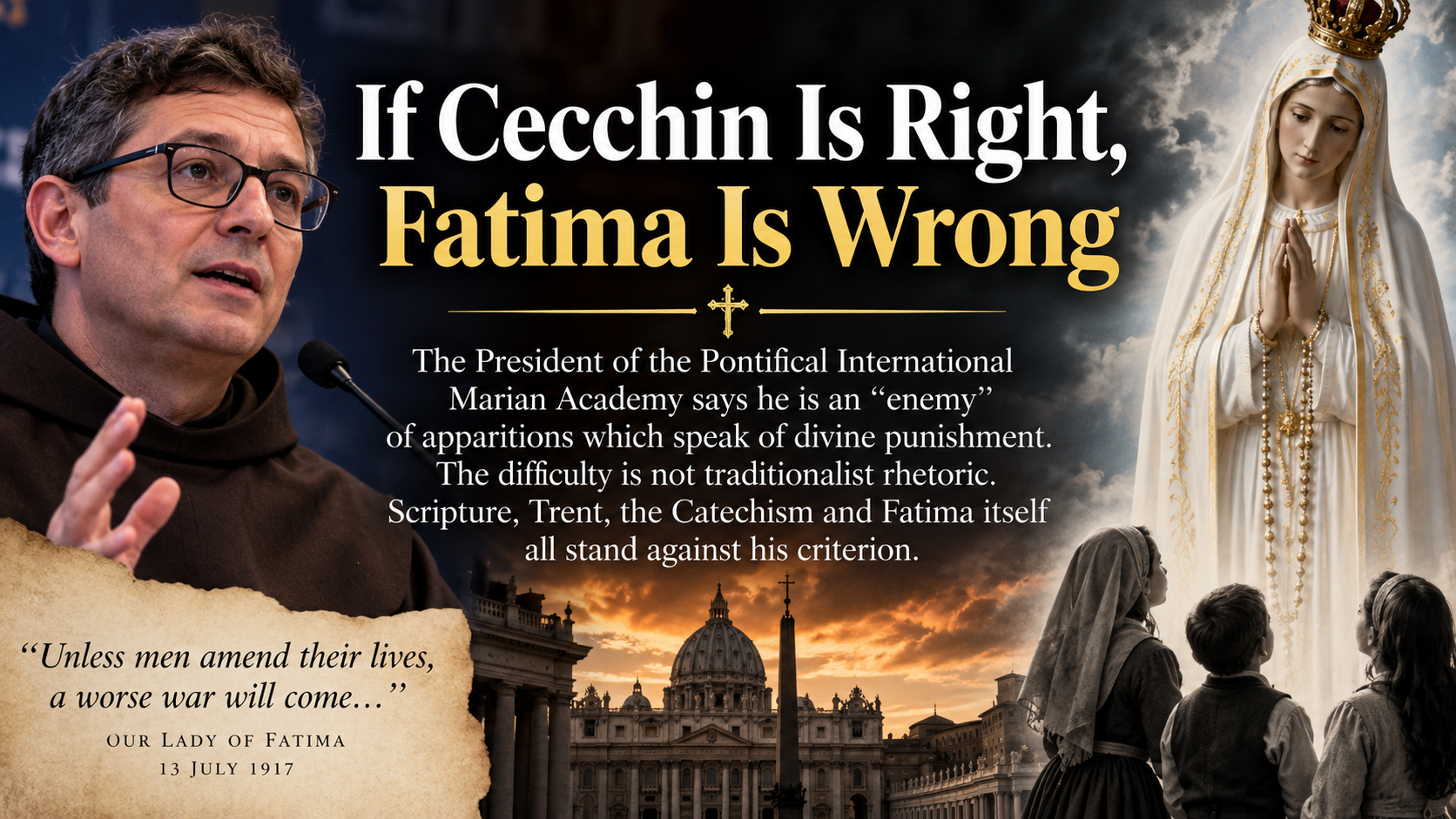
- If Cecchin Is Right, Fatima Is WrongFr Stefano Cecchin, President of the Pontifical International Marian Academy, has declared opposition to apparitions that speak of divine punishment, suggesting they are false. This stance contradicts fundamental Catholic doctrine, including teachings from Scripture, the Catechism, and specifically the Message of Fatima, which warns of divine consequences for sin.
CURRENT EDITION


DAILY MASS ONLINE
One of the earliest online apostolates dedicated to the Traditional Latin Mass, Old Roman TV began broadcasting the Holy Sacrifice on the Feast of the Assumption, 15 August 2008. During the COVID-19 pandemic, additional programming — devotions, catechesis, and conferences — was added to support the faithful in prayer and formation.
Support the daily Holy Mass on Old Roman TV by offering a Mass intention — for loved ones, thanksgiving, or the repose of souls. Your intention helps sustain the sacred liturgy and brings grace to those you remember before God’s altar.
SUPPORT THE DAILY MASS ONLINE
Likely the world’s longest-running daily online broadcast of the
Traditional Latin Mass, streaming faithfully since the
Feast of the Assumption 2008.

This apostolate cannot continue without immediate help
Please support us with a contribution toward
chapel rent, sacristy supplies, operating costs, and web-hosting.
Our essential monthly costs reach £1,000.
MASS INTENTIONS
If your offering is for a Mass Intention, kindly complete the form below in full so we may correctly match it to your donation. For anniversary intentions — birthdays, wedding anniversaries, anniversaries of death — please be sure to include the relevant date.


Today’s Mass Propers
- Today’s Mass: September 05 Saint Lawrence Justinian
 Saint Lawrence Justinian, the first Patriarch of Venice, dedicated his life to the poor and the establishment of monasteries, rejecting noble marriage. Renowned for his humility and pastoral dedication, he emphasised the spiritual integrity of Venice’s safety. He was a precursor to the reforms of the Council of Trent, dying on 8 January 1455.



Leave a Reply