
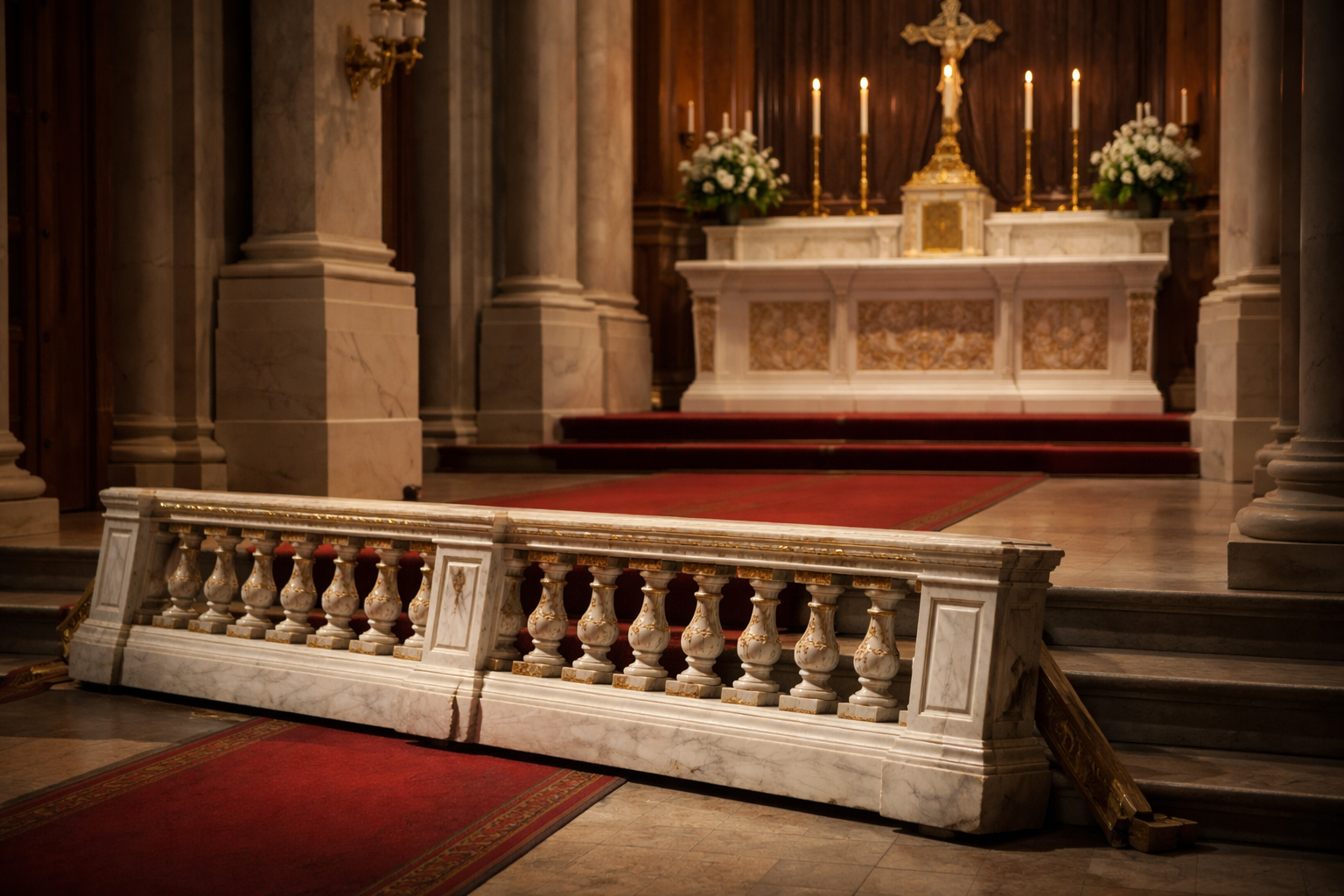
Rome Opens the File on Charlotte — A Test Case for Liturgical Authority
A formal response from the Dicastery for Divine Worship and the Discipline of the Sacraments, signed by Fr Pierre Paul, O.M.V., Head of Office, and dated 16 February 2026 under protocol number 369/25, confirms that a hierarchical recourse has been received and docketed concerning liturgical directives issued by Bishop Michael T. Martin of Charlotte. The letter, issued at the level of a Head of Office and therefore clearly procedural rather than determinative, states unambiguously: “The Dicastery will proceed to examine the Acta… in accordance with the timeframes and modalities established.” This is not commentary. It is juridical initiation. Rome has accepted the case for review.
The object of the recourse, as the letter itself specifies, is not merely the policy in abstract but “the apparent refusal… to respond to your requests concerning liturgical matters.” That distinction is not incidental. It situates the case within the canonical framework governing administrative silence and response, even as it inevitably draws the underlying liturgical directives into scrutiny. What began as a pastoral and practical dispute has therefore been translated into a formal question of administrative accountability under canon law.¹
This marks a decisive transition. What had hitherto been a localised controversy—documented across a series of Nuntiatoria analyses tracing the restriction, removal, and theological re-interpretation of altar rails—has now entered the juridical life of the Church.² The recourse mechanism is not an instrument of dissent but of order: it presumes that authority is real, but not unbounded; that governance exists within law; and that the faithful possess not only obligations, but rights capable of vindication.

The Charlotte directives, as previously established, form part of a broader attempt to standardise liturgical practice within the diocese, including the restriction of altar rails and the promotion of uniform posture in the reception of Holy Communion.³ The stated rationale emphasises unity, visibility, and the symbolism of a pilgrim people approaching the Eucharist together. Yet this programme has consistently encountered a theological and juridical counterpoint: that gestures of kneeling, and the architectural forms that support them, are not accidental survivals but embodied expressions of Eucharistic faith. As one prior analysis put it, “a right preserved in theory while rendered impracticable in fact is not preserved but displaced.”⁴
Universal liturgical law is explicit on this point. The faithful may not be denied Holy Communion because they choose to kneel.⁵ This norm is neither ambiguous nor advisory; it is binding. The question raised by the Charlotte policy is therefore not whether kneeling is permitted—it unquestionably is—but whether the systematic removal of altar rails and kneelers constitutes a practical circumvention of that right. A right that cannot be exercised without obstruction ceases to function as a right in any meaningful sense.
It is precisely this tension—between juridical permission and functional suppression—that now stands before Rome.
The role of the diocesan bishop must be stated with equal clarity. As moderator, promoter, and guardian of the liturgical life of his diocese, Bishop Martin exercises genuine authority.⁶ Yet that authority is not absolute. It is circumscribed by universal law, by the rights of the faithful, and by the objective nature of the liturgy as the public worship of the Church. The altar rail controversy is therefore not about furnishings but about limits: the point at which governance gives way to overreach.
The Dicastery will examine the Acta: the diocesan directives, the arguments advanced in recourse, and the response—or absence of response—by the Bishop. The process is characteristically Roman: cumulative, documentary, and juridical. It will not adjudicate sentiment. It will weigh acts. And in doing so, it will necessarily confront the broader pattern already identified across the Charlotte case: the progressive restriction of traditional forms under the justification of unity, and the resulting friction between local policy and universal norms.⁷
In the meantime, developments within the Diocese of Charlotte acquire heightened significance. Any enforcement of the contested policy—particularly where it involves disciplinary measures or coercive implementation—does not merely advance a local directive. It becomes part of the evidentiary record. Authority exercised under recourse is no longer insulated; it is exposed to evaluation. The practical outworking of the policy will, in effect, help define the case Rome is now examining.
Charlotte has therefore become more than a diocesan dispute. It is a test case within the postconciliar Church: a concentrated instance in which questions of liturgical theology, canonical rights, and episcopal competence converge. The altar rail is not an incidental object in this dispute; it is the concrete point at which law, theology, and authority meet—and clash.
Rome has not yet judged. The present letter offers no indication of outcome, no suggestion of sympathy, no preliminary conclusion. But it has done something far more consequential than issue a procedural acknowledgment: it has compelled the question of limits into the open and subjected it to formal judgment. The implications extend well beyond one diocese. If a bishop may preserve a right in principle while eliminating its exercise in practice, then the category of rights itself becomes unstable. If, however, Rome reasserts that rights must be real in their exercise as well as in their formulation, then Charlotte will stand as the moment at which the boundary between authority and arbitrariness was decisively drawn.
¹ Codex Iuris Canonici (1983), cann. 57, 1732–1739.
² Nuntiatoria, “Reverence Restricted: Charlotte Bishop Bans Altar Rails in School Liturgies,” 12 September 2025; “The Vanishing of the Altar Rail: Bishop Martin’s Decree and the Battle for Eucharistic Reverence in Charlotte,” 14 November 2025; “Kneeling Without Rails: How Charlotte Preserves a Right by Destroying Its Practice,” 19 December 2025; “A Priest’s Testimony from the Edge: The Charlotte Letter in Ecclesial Context,” 3 October 2025.
³ Diocese of Charlotte, Pastoral Letter on the Celebration of the Sacred Liturgy, 2025.
⁴ Nuntiatoria, “Kneeling Without Rails…,” 19 December 2025.
⁵ Congregation for Divine Worship and the Discipline of the Sacraments, Redemptionis Sacramentum (2004), n. 91: “It is not licit to deny Holy Communion… solely on the grounds… that the person wishes to receive the Eucharist kneeling.”
⁶ Second Vatican Council, Sacrosanctum Concilium (1963), n. 41; General Instruction of the Roman Missal, n. 387.
⁷ Joseph Ratzinger, The Spirit of the Liturgy (San Francisco: Ignatius Press, 2000), 89–94.
RELATED ARTICLES


Latest ARTICLES
- Today’s Mass: September 26 SS. Cyprian and Justina, MartyrsThe persecution of Diocletian broke out at that time, and Cyprian and Justina were seized and presented to Diocletian himself, who judged them. Justina was scourged and Cyprian was torn with iron hooks. After this they were both sent back to Diocletian in chains. He commanded that their heads be cut off, and they died; martyrs for the Faith!
- 27.09.26 Nuntiatoria CXXV: VERITAS NON MUTATUR CONSENSUThis edition emphasises that truth remains constant, regardless of institutional consensus. It explores how authority should serve existing realities rather than define them, stressing the importance of preserving the Church’s traditions and teachings. The Church’s role is to guard and transmit truth, not to create it through agreement or procedure.
- ORDO w/c 27.09.26The week begins with the Eighteenth Sunday after Pentecost, honouring various saints, culminating in the feast of St Francis of Assisi. Key celebrations include St Wenceslaus, St Michael the Archangel, St Jerome, and St Thérèse of the Child Jesus. The period highlights the call to surrender worldly attachments in devotion to God.
- Rupnik’s accusers appeal to Leo XIV: the women are still outside the doorThe text explores the concept of “spiritual denial” within the Catholic Church regarding serious allegations against church leaders. It argues that this denial, often perceived as loyalty, leads to evasion of uncomfortable truths. The piece emphasises that acknowledging these failures does not undermine the Church’s integrity, urging faithful confrontation of wrongdoing while maintaining justice for all involved.
- TRADITIONIS CUSTODES BY THE NUMBERS: WHAT ROME’S 2025 DECREE REGISTER ACTUALLY SHOWSThe Vatican’s 2025 decree register clarifies the status of the Traditional Roman Mass, detailing 34 decrees concerning 33 jurisdictions and 55 parish churches. While 41 locations have renewed permissions, this system requires repeated authorisation from Rome, indicating administrative dependency on continuous approval for traditional practices rather than expanding opportunities.





Leave a Reply