
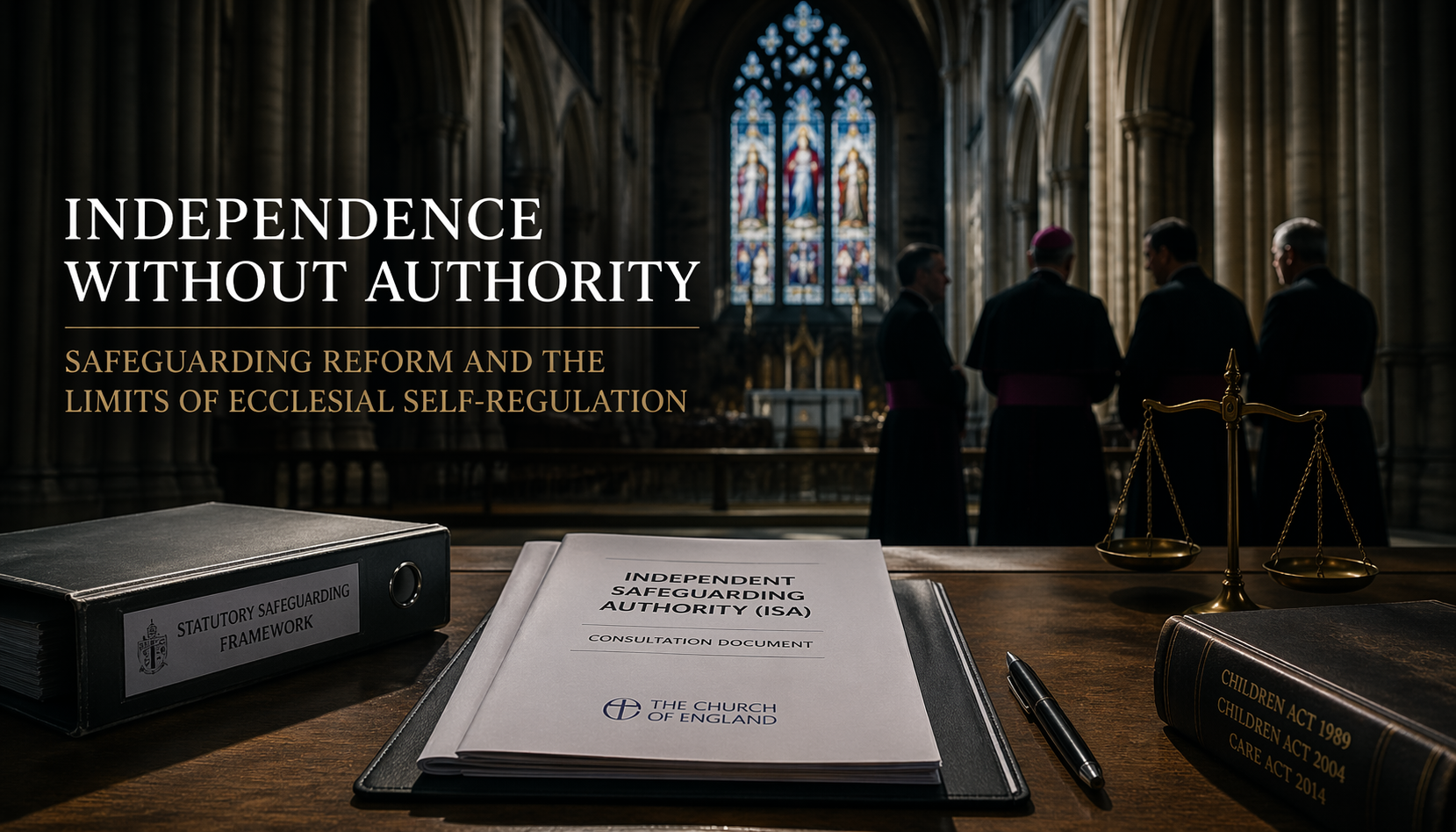
Independence Without Authority: CofE Safeguarding Reform and the Limits of Ecclesial Self-Regulation

The Church of England now confronts a crisis not merely of administration, but of credibility. Following the February 2026 vote of the General Synod, and with a public consultation open until 17 May, the proposal to establish a new national safeguarding charity—provisionally titled the Independent Safeguarding Authority (ISA)—has entered its decisive phase. The language accompanying the consultation is striking in its candour: it seeks to address “long-standing concerns regarding complexity, inconsistency, and real or perceived institutional pressure in professional safeguarding decisions.”¹ This is not reform born of prudence, but of necessity. The failure has been named. The question is whether it is being remedied. What is proposed is not a transfer of authority, but a redistribution of responsibility without equivalent power.
The proposed Authority is structurally ambitious. It is to be constituted as a single national body, governed by a majority-independent non-executive board, led by a Chief Safeguarding Officer accountable both to that board and to an external regulator. It will assume responsibility for complex and senior-level cases, develop safeguarding policy and standards, conduct regular audits of dioceses and cathedrals, and intervene where serious failures are identified.² The programme overseeing its implementation, chaired by Dame Christine Ryan, signals the seriousness with which the reform is being advanced at the level of governance. A standardised complaints process, culminating in an external ombudsman-style mechanism, is also envisaged.³ Taken together, these measures suggest a deliberate attempt to construct something analogous to a public regulatory system within an ecclesial framework.
Yet it is precisely at this point—where analogy meets reality—that the proposal begins to fracture. The safeguarding architecture of England, established through the Children Act 1989, the Children Act 2004, and the Care Act 2014, is not merely procedural but juridical. It imposes duties, defines responsibilities, and—most importantly—enforces compliance. Public bodies do not merely aspire to safeguarding; they are compelled to it. Their failures are not managed internally but exposed, inspected, and, where necessary, sanctioned by external authorities such as Ofsted and the Care Quality Commission. Authority in these systems is not advisory; it is coercive.⁴
The ISA, by contrast, remains a body whose authority is asserted but not yet secured. It may audit, review, and recommend, but it is not clear that it can compel. It may identify failure, but it does not evidently possess the power to enforce correction. An authority that cannot compel is not an authority in law or in practice, but an advisory body with elevated visibility. This distinction is not technical; it is determinative. Without the capacity to impose compliance, independence becomes observational rather than operational—a vantage point from which failure may be seen, but not prevented.
The question of accountability deepens the concern. In the statutory model, the locus of decision-making and the locus of responsibility coincide. In the proposed ecclesial model, they diverge. The ISA will oversee safeguarding processes and, in certain cases, direct them, yet legal responsibility remains dispersed among dioceses, bishops, and national Church bodies.⁵ Such diffusion is not neutral. It introduces ambiguity at precisely the point where clarity is most required. When safeguarding fails—and history offers little reason to assume otherwise—the immediate question will not be how the system was designed, but who is answerable. If the answer is uncertain, the reform will have failed in its most basic purpose.
Nor can the problem be reduced to governance alone. The consultation material leaves unresolved the status of safeguarding personnel. If diocesan safeguarding officers remain embedded within local Church employment structures, then the very “institutional pressure” the reform seeks to eliminate may persist in subtler, more informal forms. Independence, in such circumstances, is procedural rather than structural: a matter of guidelines and assurances, rather than of real separation. The lesson of past failures is that culture follows structure; where the latter is compromised, the former rarely reforms.
Even the financial architecture reflects this tension. The Authority is to be funded by Church bodies—initially the Archbishops’ Council, and ultimately the Church Commissioners—yet those bodies are expressly prohibited from directing its work.⁶ This creates a carefully engineered separation between funding and control, but it is a separation that must be actively maintained. Financial dependence without governance authority is a fragile equilibrium, one that historically has required strong external oversight to sustain.
And it is here that the final deficiency becomes apparent. While the ISA model gestures toward external accountability, it does not yet replicate the robust regulatory environment that governs statutory safeguarding. The Chief Safeguarding Officer is said to be accountable to an external regulator, but the nature, powers, and scope of that regulator remain indistinct. Without an authority equivalent in force to Ofsted or the Care Quality Commission, the system risks becoming self-referential: independent in structure, yet insufficiently accountable in practice.
What, then, is being proposed is not a statutory safeguarding system, but a hybrid—an attempt to reconcile the demands of public accountability with the preservation of ecclesial autonomy. It is, in effect, a controlled decoupling: sufficient independence to restore confidence, but not so much as to relinquish institutional sovereignty. Whether such a balance can be sustained is an open question.
The deeper issue, however, is not structural but moral. Safeguarding failures within the Church have not been merely the result of inadequate systems, but of compromised priorities: the protection of reputation over the protection of the vulnerable, the preservation of authority over the exercise of justice. Structures may constrain such tendencies, but they cannot abolish them unless they are endowed with real authority—authority that is recognised, enforceable, and, where necessary, external.
The consultation now underway is therefore no procedural exercise. It is the moment at which the limits of reform will be set. If the Independent Safeguarding Authority emerges with genuine power—over personnel, over process, and over enforcement—it may mark a turning point of real consequence. If, however, it remains bound by the very structures it is meant to scrutinise, it will risk becoming yet another layer of administration masking an unchanged reality.
If the Church will not submit its safeguarding to authority beyond itself, then it has not solved the problem it now so clearly names—it has merely reorganised it.
- Madeleine Davies, “Public consultation opens on new national organisation for Church of England safeguarding,” Church Times, 24 April 2026, quoting consultation language on “complexity, inconsistency… and institutional pressure.”
- Church of England, Safeguarding Structures Reform Programme: Design of the Independent Safeguarding Authority (Consultation Document, April 2026), sections on governance model and scope of functions.
- Church of England, General Synod Paper GS 2328: Future of Church Safeguarding (February 2026), paras. 45–62, outlining proposed complaints and ombudsman framework.
- HM Government, Working Together to Safeguard Children (London: Department for Education, 2018), ch. 2, paras. 7–10: “Local authorities have a duty to… safeguard and promote the welfare of children”; see also Care and Support Statutory Guidance under the Care Act 2014, ch. 14 (Safeguarding).
- Charity Commission for England and Wales, Safeguarding and Protecting People for Charities and Trustees (CC30, updated 2022), section 6: trustees retain ultimate responsibility for safeguarding within their charity.
- Church of England, Safeguarding Structures Reform Programme: Funding and Governance Proposals (April 2026), section on funding arrangements and prohibition on funder control.
RELATED ARTICLES


LATEST ARTICLES
- Today’s homily: St Nicholas TolentinoThe reflection celebrates Saint Nicholas of Tolentino, emphasising that holiness is achieved not through personal efforts but through grace. It highlights his life of service, prayer, and self-discipline, suggesting that his true sanctity stems from dependence on God. The message reinforces the importance of a single-hearted focus on God in one’s spiritual journey.
- Today’s Mass: September 10 St Nicholas of TolentinoSaint Nicholas of Tolentino, born around 1246 in Italy, became a devout Augustinian hermit known for his piety and dedication to preaching. He spent his later years in Tolentino, promoting virtue, and maintaining his chastity until his death in 1306. Canonised in 1446, his tomb is revered by the faithful.
- Sermon for St. Nicholas of TolentinoToday we honour St. Nicholas of Tolentino, who lived from 1245 to 1305. Abiding in Tolentino, he dedicated his life to ministry, healing, and reconciliation amidst societal discord. A member of the Augustinian order, he exemplified service without seeking fame, inspiring others to witness their faith in everyday life.
- Today’s Mass: September 09 Day II in the Octave of The Nativity of the Blessed Virgin MaryThe feast of Our Lady’s Nativity, of ancient Eastern origin and established at Rome by the time of Pope St Sergius I, celebrates Mary as the immaculate New Eve and the dawn of salvation, the chosen tabernacle from whom the Redeemer would take His flesh. Today the Church also commemorates St Gorgonius, an officer of the imperial household at Nicomedia who, with his companion Dorotheus, embraced the Faith and suffered martyrdom under Diocletian in A.D. 303; his relics were later translated to Rome.
- NOMEN MANET, RES DEEST ~ The Name Remains; the Reality Is Lacking: Spiritual Conference for Nuntiatoria CXXIIThe content emphasises the disconnect between the names associated with Catholicism and the actual practices of faith. It highlights the importance of embodying belief through genuine actions, urging self-examination rather than mere external observance. Ultimately, it advocates for a restoration of sincerity in faith, calling individuals to authentically reflect their beliefs through their lives and worship.




Leave a Reply