
The Traditional Roman Rite of Ash Wednesday: Dust, Discipline, and the Beginning of Combat
Ash Wednesday—Feria IV Cinerum, once known as in capite jejunii (“at the head of the fast”)—stands at the solemn threshold of Lent in the traditional Roman Rite. Its rites unite austere anthropology, ancient penitential discipline, and organic liturgical development reaching back to the age of Gregory the Great. The blessing and imposition of ashes are not a pious ornament to the season; they are its juridical and ascetical inauguration.
The Church does not begin Lent with sentiment but with realism: Memento, homo, quia pulvis es, et in pulverem reverteris.
The Roman Calculation of the Forty Days
From the earliest centuries, Christians universally refrained from fasting on Sunday, the day of the Resurrection. Even in Lent and Holy Week, the Lord’s Day retained its paschal dignity. The original Roman Lent therefore comprised six weeks—forty-two calendar days—but only thirty-six days of fasting.
Gregory the Great described these thirty-six days as “the tithe of the year.”¹ In offering a tenth of the annual cycle in penitential discipline, the Church rendered to God a sacred proportion of time. The Roman Missal preserves a trace of this earlier structure in the Secret of the First Sunday of Lent, which refers to the Eucharistic oblation as the *“sacrifice of the beginning of Lent.”*²
Shortly thereafter—perhaps under Gregory himself—the four days preceding the First Sunday were added so that the number of fasting days would equal forty exactly, conforming to Christ’s fast in the desert (Matthew 4:1–11), Moses’ forty days on Sinai (Exodus 34:28), and Elijah’s forty-day journey to Horeb (3 Kings 19:8). This extension of Lent back to Ash Wednesday is a distinctive custom of the Roman Rite. It was later imitated by the Mozarabic liturgy but never adopted by the Ambrosian Rite; Milan still begins Lent on the following Sunday.³ In the Eastern rites, Great Lent commences on Clean Monday, two days before Roman Ash Wednesday.⁴
A Later Addition Preserved in the Office
The Roman Breviary preserves memory of this historical development. Although the fast begins on Ash Wednesday, the proper Lenten hymns, chapters, and versicles begin only at First Vespers of the First Sunday. The three days following Ash Wednesday are traditionally designated post cineres (“after the ashes”), rather than the first Thursday, Friday, and Saturday of Lent.
Even the formal use of the word Quadragesima begins on the First Sunday. A notable textual witness occurs in the Secret of the Friday post cineres, where later Tridentine editors altered the older reading observantiae paschalis to observantiae quadragesimalis.⁵ Such details testify to organic development without rupture.
From Public Penance to Universal Imposition
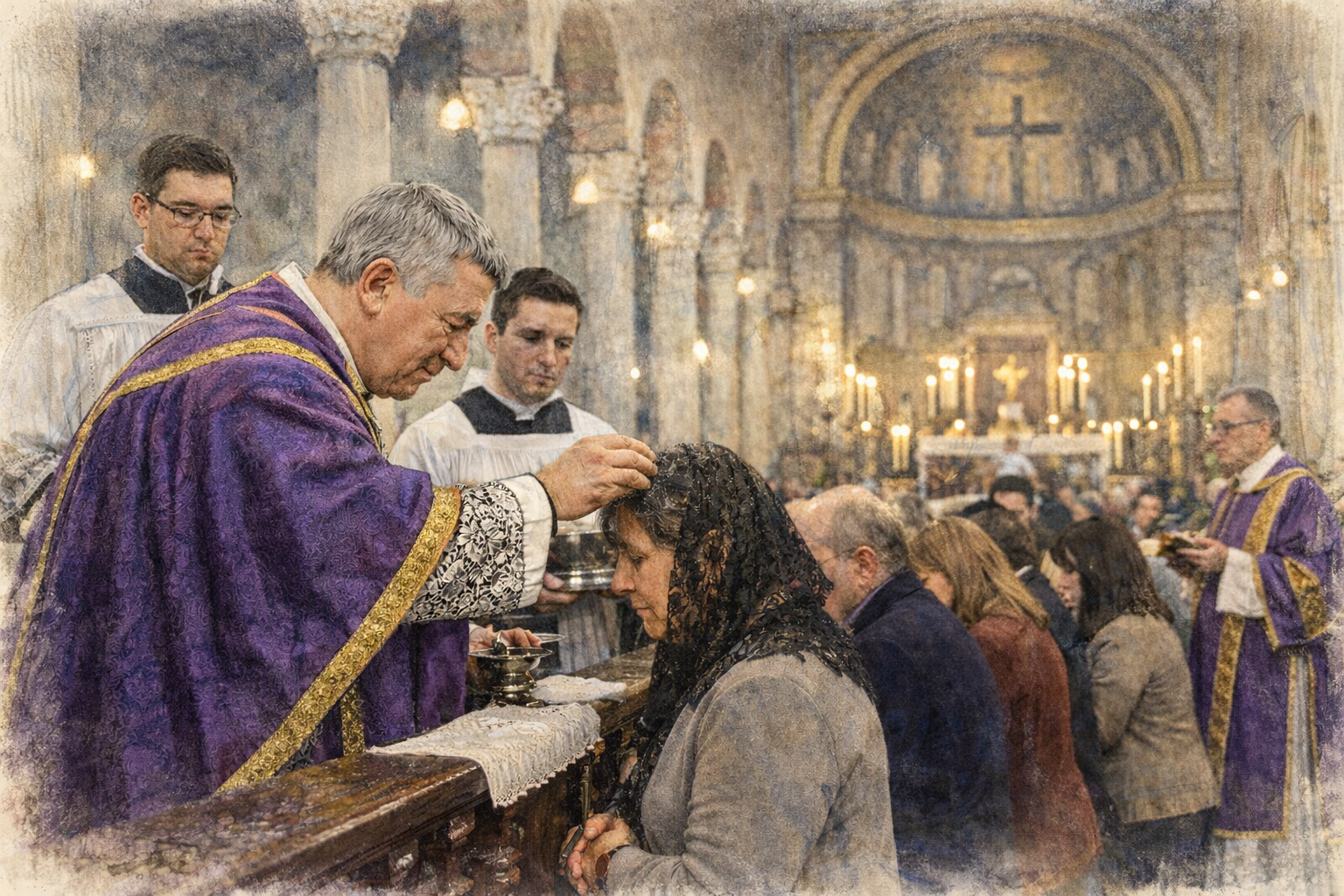
The imposition of ashes originated as a rite for public penitents—those assigned canonical penance for grave and notorious sins. These penitents were formally enrolled at the beginning of Lent and reconciled on Maundy Thursday. The rite once included their ritual expulsion from the church after receiving ashes, symbolising exclusion from Eucharistic communion during their penitential discipline.
By the later tenth century, the custom was extended to all the faithful. This development was definitively mandated at the Council of Benevento (1091) under Urban II.⁶ The Roman Pontifical retained the dramatic rite of expelling penitents for centuries after the discipline itself had fallen into disuse, and vestiges remain in the penitential Preces of the Divine Office.
Thus, what once marked canonical sinners came to mark every Christian. All stand beneath Genesis 3:19.
The Ashes: From Triumph to Dust
The ashes are traditionally made by burning the blessed palms from the previous Palm Sunday—palms once waved in triumph. Glory is reduced to dust. Victory passes. Scripture associates ashes with repentance:
“Therefore I reprehend myself, and do penance in dust and ashes.” (Job 42:6)
The priest traces the ashes in the form of a Cross upon the forehead—or sprinkles them upon the crown—saying:
Memento, homo, quia pulvis es, et in pulverem reverteris.
No response is given. Silence completes the admonition.
Structure of the Blessing in the Tridentine Missal
In the Missal codified following the Council of Trent, the blessing of ashes precedes the Mass and unfolds in a compact yet theologically dense sequence:
– An introductory chant, rubricated as an antiphon but structured like an Introit.
– Four solemn prayers asking that the ashes may bring pardon, contrition, spiritual fortitude, and effective penance.
– Sprinkling with holy water.
– Incensation.
– Imposition on clergy and faithful during the singing of two antiphons and a responsory.
– A concluding prayer before Mass begins.
Historically, the ceremony often included a penitential procession. Ash Wednesday is one of the ancient Roman stational days, with the principal station at Santa Sabina on the Aventine Hill. Twelfth-century sources describe the Pope and clergy assembling first at St Anastasia, receiving ashes, and proceeding barefoot in procession to Santa Sabina while chanting penitential antiphons and the Litany of the Saints.⁷
Processions in the Roman tradition were intrinsically penitential acts. The ancient obligatory Roman processions were those of Candlemas, Ash Wednesday, Palm Sunday, and the Rogation Days. Only the later Corpus Christi procession bears a purely celebratory character and takes place after Mass.
Anthropology, Mortality, and Hope
Ash Wednesday confronts the faithful with mortality in an age that prefers to conceal it. Modern funeral practice softens decay; the liturgy does not. It proclaims the inevitability of death, the certainty of judgment, and the transience of earthly glory—sic transit gloria mundi.
Yet the ashes are traced in the sign of the Cross. Nature will have her way; dust will return to dust. But the tomb is not sovereign. The One who entered it rose from it.
Thus Ash Wednesday is not morbid; it is lucid. It is not despairing; it is preparatory. It inaugurates not merely abstinence but combat.
The final prayer of the rite petitions divine protection in the coming struggle. Lent begins under arms.
The ashes are therefore both accusation and promise:
Dust thou art.
Dust marked with the Cross shall rise.
- Gregory the Great, Homiliae in Evangelia, Homily XVI (PL 76:1139).
- Missale Romanum (1570), Secret of the First Sunday of Lent: “Sacrificium quadragesimalis initii.”
- On the Ambrosian practice, see Ambrosian Rite liturgical calendars and traditional Milanese observance.
- See Byzantine liturgical practice for Clean Monday as the beginning of Great Lent.
- Editorial alteration noted in the Tridentine revision of the Secret for Friday post cineres; earlier manuscript readings attest observantiae paschalis.
- Urban II, Council of Benevento (1091), mandating universal imposition of ashes.
- Ordo Romanus XI; medieval descriptions of the papal Ash Wednesday procession to Santa Sabina.
related articles


Latest articles
- Today’s Mass: October 24 St Raphael the ArchangelThe Feast of Saint Raphael the Archangel highlights his healing powers as depicted in the Book of Tobit, where he aids Tobit and his son, Tobiah. Venerated as a protector of travellers and the blind, Raphael is celebrated for his miraculous interventions. His legacy includes support for nurses, matchmakers, and Catholic studies.
- 25.10.26 Nuntiatoria CXXIX: CHRISTUS REXThe text discusses the relationship between Christ’s kingship and authority within the Church amidst contemporary challenges. It contrasts ecclesiastical power with genuine faith, emphasising that authority must protect divine truth rather than alter it. The witness of imprisoned priests illustrates the enduring significance of fidelity to Christ over institutional conformity.
- THE DOMESTIC CHURCH: 25 October – 2 November 2026 A Home with Room for Heaven: Preparing for All Saints and All SoulsThe content outlines a week’s plan for traditional Catholic families to prepare for the feasts of All Saints and All Souls. Emphasising daily prayers, remembrance of the deceased, and engagement with children’s activities, it aims to integrate Catholic customs into family life, enriching spiritual practices and fostering a shared faith experience.
- ORDO w/c 25.10.26The text outlines the liturgical calendar for the last week of October and the beginning of November, highlighting key celebrations. Notable events include the Feast of Christ the King, St Evaristus, the Vigil of Saints Simon and Jude, and the Feast of All Saints, emphasising themes of holiness, unity in faith, and the Church’s teachings.
- Christ the King: The Sovereignty of the Crucified RedeemerThe Mass of Christ the King articulates core Catholic beliefs about Jesus’ divine authority, redemptive sacrifice, and the essence of His Kingdom. It emphasises Christ as Prophet, Priest, and King, whose sovereignty is inseparable from His mission of reconciliation, calling the faithful to acknowledge His authority and embrace moral duties rooted in divine truth.




Leave a Reply