
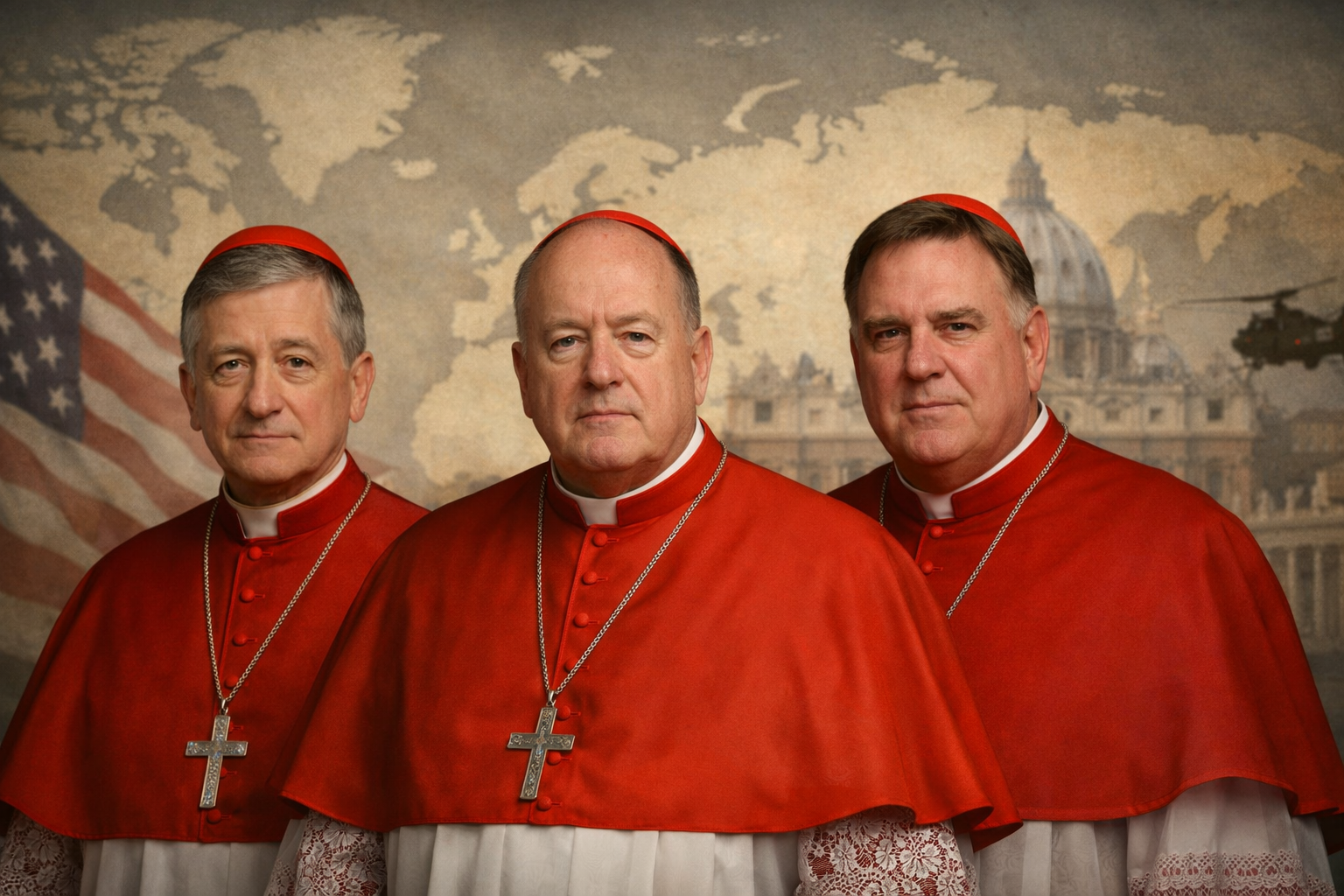
A Selective Moral Vision: Three U.S. Cardinals, Foreign Policy, and the Limits of Episcopal Advocacy
Introduction and Context
On 19 January 2026, Cardinal Blase J. Cupich, Cardinal Robert W. McElroy, and Cardinal Joseph W. Tobin issued a rare joint statement assessing United States foreign policy against principles articulated by Pope Leo XIV in his 9 January 2026 address to the diplomatic corps accredited to the Holy See. The cardinals presented their intervention as a pastoral duty, insisting that “as pastors entrusted with the teaching of our people, we cannot stand by while decisions are made that condemn millions to lives trapped permanently at the edge of existence.”
The gravity of the claims and the authority invoked demand close scrutiny. While the statement is rhetorically polished and selectively orthodox in its language, its underlying moral reasoning reveals significant theological and prudential deficiencies.
Abstraction and the Collapse of Moral Distinction
The statement situates contemporary foreign policy within what it calls “the most profound and searing debate about the moral foundation for America’s actions in the world since the end of the Cold War,” citing Venezuela, Ukraine, and Greenland as emblematic cases. Yet these conflicts are presented without moral differentiation. Instead, they are subsumed under a generalised concern that “the sovereign rights of nations to self-determination appear all too fragile in a world of ever greater conflagrations.”
This rhetorical move effectively collapses aggressor and defender into a single moral category. By avoiding any distinction between unjust aggression and legitimate defence, the statement departs from the Church’s settled moral tradition. Catholic teaching has never treated all uses of force as morally equivalent. The Catechism explicitly affirms that “the legitimate defense of peoples and nations is not to be equated with a refusal of peace,” while St Thomas Aquinas insists that war may be just if waged by legitimate authority, for a just cause, and with right intention.¹ The cardinals’ silence on these distinctions is not neutral; it tacitly reconfigures Catholic moral reasoning toward a functional pacifism.
Papal Teaching as Political Mandate
Central to the document is the claim that “Pope Leo has given us clear direction.” The cardinals repeatedly present his diplomatic address as the decisive interpretive key for American foreign policy. They quote Pope Leo’s warning that “a diplomacy that promotes dialogue and seeks consensus among all parties is being replaced by a diplomacy based on force,” and that “peace is no longer sought as a gift and desirable good in itself … instead, peace is sought through weapons as a condition for asserting one’s own dominion.”
These words rightly critique the idolatry of power and the illusion of security through domination. Yet the cardinals treat them as prescriptive conclusions rather than prudential principles. A papal address to diplomats is not a magisterial act determining concrete policy choices. Catholic doctrine has long distinguished between the Church’s role in forming consciences and the laity’s responsibility for political judgment. As Gaudium et Spes states, “the Church does not place her trust in the privileges offered by civil authority; indeed she will even give up the exercise of certain legitimately acquired rights if it becomes clear that their use will cast doubt on the sincerity of her witness.”²
By pledging to “preach, teach, and advocate” for a specific vision of foreign policy, the cardinals risk crossing this boundary—substituting episcopal authority for prudential discernment rather than illuminating it.
Life Issues and Rhetorical Asymmetry
The statement does affirm that “the protection of the right to life constitutes the indispensable foundation for every other human right,” adding that “abortion and euthanasia are destructive of that right.” In isolation, this is an unambiguous articulation of Catholic teaching. Yet the placement and function of this affirmation are telling. It appears briefly, before the document moves swiftly to its principal concerns: reductions in international aid, the weakening of multilateral institutions, and the dangers of military force.
Absent is any sustained engagement with the role of U.S. foreign policy in promoting abortion and population-control programmes abroad—often as explicit conditions of aid. This omission creates a moral asymmetry. Intrinsic evils are acknowledged formally, while prudential matters are treated as the primary locus of urgency. John Paul II warned against precisely this inversion when he taught that laws permitting abortion are “radically opposed not only to the good of the individual but also to the common good.”³ A Catholic moral vision cannot relegate such evils to the margins while elevating contested policy judgments to centre stage.
Peace Reduced to Process
Peace is a recurring theme. The cardinals declare their desire to “build a truly just and lasting peace, that peace which Jesus proclaimed in the Gospel,” and they “renounce war as an instrument for narrow national interests.” Yet peace is implicitly defined as the product of dialogue, consensus, and international cooperation. What is missing is the Church’s classical definition of peace as tranquillitas ordinis—the tranquillity of order.
St Augustine is explicit: “Peace is the tranquillity of order,” an order rooted in justice and truth.⁴ When peace is reduced to process rather than moral order, it risks becoming indistinguishable from mere stability. Dialogue detached from truth, and consensus divorced from justice, can entrench injustice rather than resolve it. The statement’s failure to articulate this moral content leaves its vision of peace thin and procedural.
Episcopal Authority and Ideological Alignment
Finally, the statement’s reception cannot be separated from the public record of its signatories. The document reads less like a universal pastoral exhortation than a coordinated intervention aligned with a particular ideological current within American Catholic discourse. Cardinal McElroy’s assertion that ignoring this vision comes “at the cost of our country’s truest interests and the best traditions of this land that we love” exemplifies the conflation of theological judgment with contested political narratives.
Such alignment matters. Leo XIII cautioned that the Church must not bind herself to particular political forms lest she “be suspected of preferring one kind of government to another.”⁵ Episcopal authority is strengthened by theological clarity and proportionality; it is weakened when it appears indistinguishable from partisan critique.
Conclusion
The joint statement by Cardinals Cupich, McElroy, and Tobin aspires to offer a moral compass for American foreign policy. In practice, it advances a selectively moralised vision that abstracts from concrete realities, treats papal prudential teaching as political mandate, and reorders Catholic social priorities in a way that obscures the Church’s full moral tradition.
A genuinely Catholic intervention would have reaffirmed just war doctrine in its integrity, clearly distinguished intrinsic evils from prudential judgments, and focused on forming consciences rather than directing outcomes. The failure to do so leaves the statement less a durable contribution to Catholic moral theology than a document firmly embedded in the ideological contours of the present moment.
- Catechism of the Catholic Church, §§2307–2317; St Thomas Aquinas, Summa Theologiae, II–II, q.40.
- Second Vatican Council, Gaudium et Spes, §76; Congregation for the Doctrine of the Faith, Doctrinal Note on Some Questions Regarding the Participation of Catholics in Political Life (2002).
- John Paul II, Evangelium Vitae, §72.
- St Augustine, De Civitate Dei, XIX.13; cf. St Thomas Aquinas, Summa Theologiae, II–II, q.29, a.1.
- Leo XIII, Immortale Dei, §§6–9; Pius XI, Quas Primas, §§18–19.
Related articles


Latest
- What takes priority? Leo XIV, Sexual Morality and the Synodal Reordering of Moral EmphasisPope Leo XIV has not rejected Catholic sexual morality, but his remarks hint at a pastoral shift prioritising issues such as justice and equality over sexual ethics. As the Amoris Laetitia synod approaches, concerns arise about whether moral teachings will remain authoritative as pastoral priorities evolve. The Church’s foundational beliefs may risk being undermined in this reordering.
- After the Mistrial: The Lindsay Clancy Spectacle DeepensThe mistrial concerning Lindsay Clancy’s case revealed a split jury regarding her criminal responsibility for the deaths of her three children. Although eleven jurors seemed to lean towards a lack of guilt due to mental illness, the incident highlights the complex interplay between compassion, public perception, and accountability in tragic cases.
- Today’s homily: Feria II of the Fifteenth Sunday Post PentecostSt Paul urges us not to grow weary in doing good: every prayer, sacrifice, act of charity and fidelity is seed sown for eternity. Our task is to persevere in the sowing and trust God for the harvest.
- Today’s Mass: September 07 Feria of Sunday XV Post PentecostThe Sunday XV Post Pentecost Mass emphasises the importance of living a life governed by the Holy Spirit, encouraging Christians to act with grace, charity, and humility. St Paul’s teachings remind believers to bear one another’s burdens and avoid self-deceit, ultimately striving for spiritual growth and communion with God through the Eucharist.
- Crisis is the Cause; Necessity is the EffectThe SSPX has clarified its rationale for episcopal consecrations, arguing that a crisis in the Church has led to a “state of necessity” for preserving the Catholic Faith. This distinction stresses the need to prove the necessity and proportionality of their measures against church law, highlighting a significant theological and canonical issue that requires serious examination from both SSPX and Rome.




Leave a Reply