
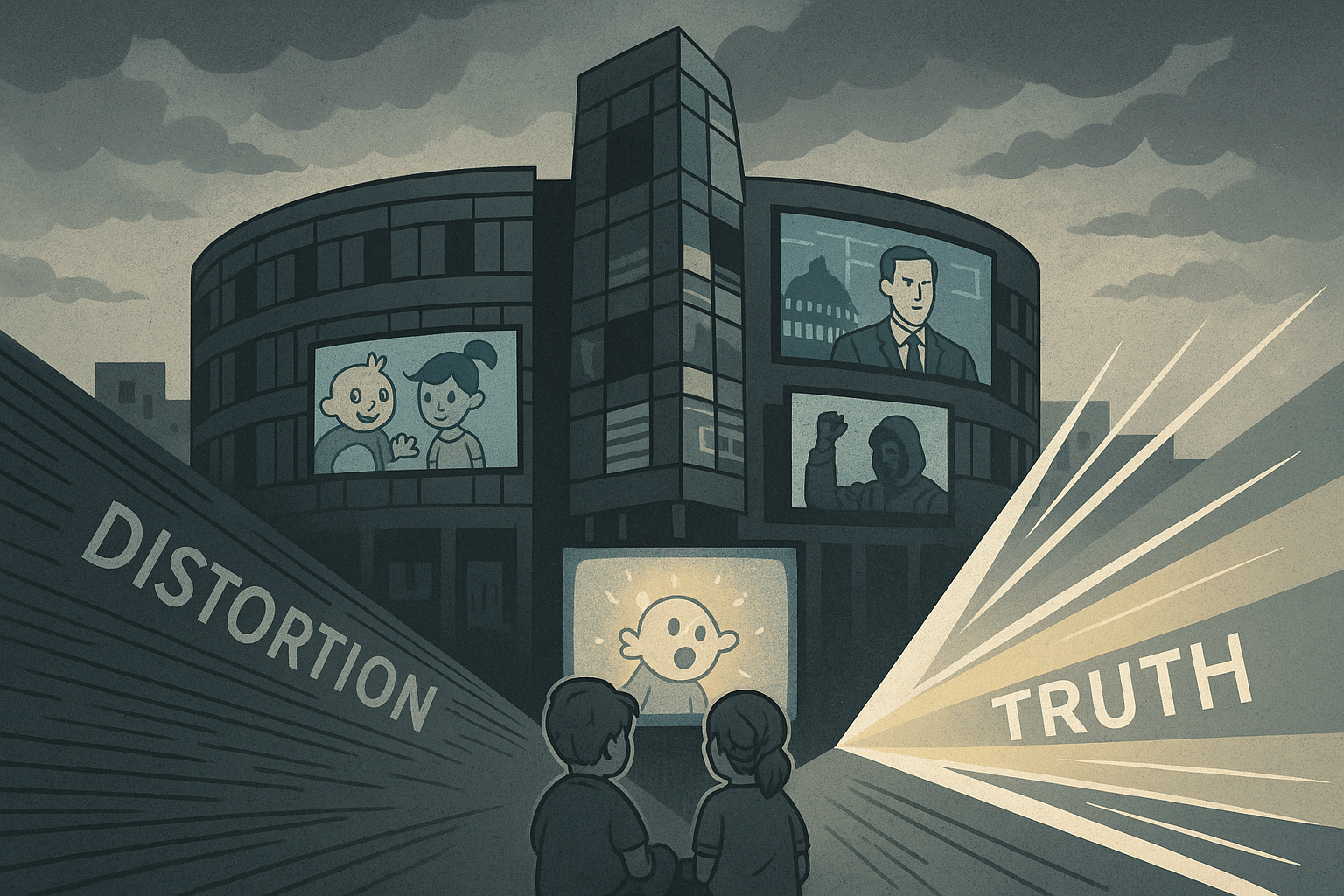
THE BBC, PUBLIC TRUST, AND THE QUESTION OF COMPENSATION
An Institution Under Strain
For more than a century, the British Broadcasting Corporation has stood as one of Britain’s most recognisable institutions, projecting culture, news, education, and creative excellence to the world. Yet affection for the BBC has always been twinned with frustration: accusations of bias, London-centric insularity, opaque governance, and a paternalistic stance toward the public it serves. The recent controversy surrounding the editing of Donald J. Trump’s 6 January 2021 speech in Panorama and earlier in Newsnight has once again raised the question of institutional trust. In a polarised world, the BBC’s prestige is no longer an impregnable shield. Its credibility must now be defended by integrity, not assumed by precedent.
The Editorial Breach
The editing error in question was not a minor slip of the newsroom. It was a substantive alteration of a presidential address—an intervention which changed both tone and meaning. For a public broadcaster funded by law, bound by charter, and entrusted with preserving the public record, such distortion is not merely regrettable. It is serious. An apology was necessary, but not sufficient. Institutions that demand transparency and accuracy from others must accept the same standard in their own work. This is not about defending Donald Trump. It is about defending the principle that the public record must not be moulded to narrative convenience.
Why Compensation Is Justified
If a court concludes that reputational or material harm has been caused, the BBC should pay compensation. This is neither vengeful nor extreme. It is the normal operation of a society governed by law. Public institutions do not forfeit their duty of accountability simply because they enjoy national affection. In fact, the opposite is true: the more trusted the institution, the higher the standard to which it must be held.
Why Licence-Fee Payers Must Not Be Penalised
Some have argued that compensation would ultimately fall upon the licence-fee payer. That must not happen. British households did not make the erroneous editorial choice and should not be subjected to financial penalty for it. Fortunately, this is a false dilemma. The BBC itself operates a large commercial empire, legally separate from the public-service core, and these commercial subsidiaries exist precisely to generate income and absorb financial risk.
The BBC’s Commercial Subsidiaries
Under the Charter and Agreement, the BBC may conduct commercial activities only through subsidiary companies. Ofcom and the National Audit Office have repeatedly confirmed that this network is extensive. One NAO review identified 110 subsidiary companies under BBC Commercial Holdings, ranging from technical service providers to global distribution networks. Their purpose is twofold: to generate profit and to shield the public-service arm from commercial exposure.
The financial scale of these operations is often overlooked. In the 2023–24 reporting year, the BBC’s commercial group generated £2.2 billion in revenue, with £228 million in EBITDA—a profit margin of roughly 10 percent. BBC Studios alone recorded £1.837 billion in income and £202 million in profits. Over a seven-year period, BBC Studios has returned approximately £1.906 billion to the BBC through dividends and payments. These figures plainly demonstrate that the BBC possesses ample commercial capacity from which to satisfy any liability arising from misconduct.
The Wider Cultural Moment
This incident forms part of a broader decline in institutional trust across the Western world. Citizens today expect competence, transparency, and humility from public institutions. The BBC cannot assume trust; it must earn it continually. The correct posture toward criticism is not defensiveness but reform. The challenge facing the BBC is not only to defend its legitimacy but to deserve it.
What Real Accountability Requires
To require compensation from the BBC’s commercial subsidiaries is not an act of hostility toward the institution. It is an act of respect for its public-service mission and a defence of the people who fund it. Properly handled, accountability strengthens institutions. It does not destroy them. If the BBC accepts responsibility through the correct financial channels, it signals that it is capable of learning, reforming, and renewing its public trust.
Conclusion
The BBC’s editorial error was serious. If compensation is warranted, it must be paid. But the licence-fee payer should not bear the burden. The BBC’s commercial subsidiaries—purpose-built to generate revenue and carry financial risk—must shoulder any such cost. This is the path of institutional integrity: allowing the BBC to remain both accountable and trusted, both humbled and renewed.
- Ofcom, The BBC’s Commercial and Trading Activities: Requirements and Guidance, April 2023.
- Ibid., affirming that all commercial operations must be undertaken through subsidiary companies at arm’s length.
- National Audit Office, The BBC’s Commercial Activities: A Landscape Review, March 2018, identifying approximately 110 BBC subsidiary companies.
- BBC Commercial Group Financial Summary, 2023–24: revenue £2.2 billion; EBITDA £228 million.
- BBC Studios Financial Overview, 2023–24: income £1.837 billion; profit £202 million; £1.906 billion returned to the BBC core over seven years.


Latest
- Mary Is Co-Redemptrix: Cardinal Burke Reopens Rome’s Marian ControversyCardinal Raymond Leo Burke has declared the Virgin Mary as “Co-Redemptrix” amidst controversy over the Vatican’s restriction on this title. The debate revolves around the appropriateness of certain theological language and whether terminology historically used can still accurately express Marian cooperation in Redemption without compromising Christ’s unique role.
- When Politics Defines Doctrine: Edmund Waldstein, Integralism and the New Boundary at HeiligenkreuzThe ongoing exclusion of Father Edmund Waldstein from teaching at Heiligenkreuz has sparked debate on the limits of acceptable Catholic thought, particularly regarding integralism and its relationship to Church doctrine. Critics argue that Waldstein and similar positions challenge both Catholic teachings and democratic values, raising questions about the intersection of faith and politics.
- Christianity Is Right ~ Not Right WingThe article discusses the distinction between Catholic orthodoxy and modern political ideologies, particularly the Right and Christian nationalism. It argues that Catholic beliefs about family, morality, and authority predate contemporary political classifications and should not be conflated with right-wing politics. The ordo amoris framework is presented as a guiding principle for evaluating political alliances while maintaining a focus on the common good and the Social Kingship of Christ.
- Today’s homily: The Nativity of the Blessed Virgin MaryThe Nativity of the Blessed Virgin Mary marks a significant moment in salvation history, representing the dawn of the Incarnation. Mary’s birth, unnoticed by the world, was part of God’s providential plan leading to Christ. This feast invites reflection on humility, obedience, and trust in God’s will, emphasising Mary’s role as the Mother of the Redeemer.
- Today’s Mass: September 08 The Nativity of the Blessed Virgin MaryThe Nativity of the Blessed Virgin Mary celebrates her birth, symbolising a new beginning tied to salvation. Originating in the East, it gained recognition in Rome under Pope Sergius I. Additionally, the feast commemorates Saint Hadrian, a martyr who converted to Christianity, underscoring themes of faith and redemption.



Leave a Reply