
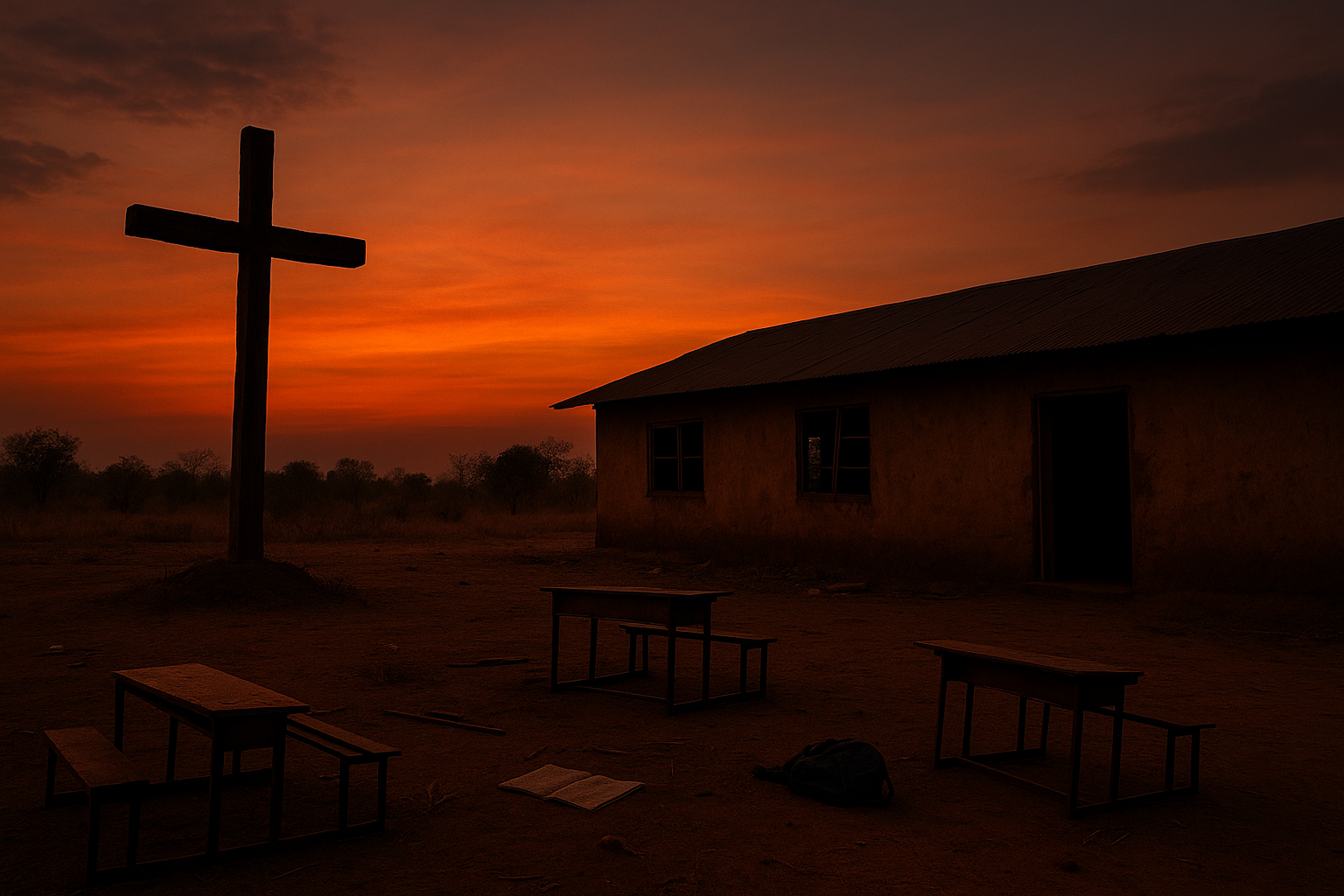
Night Falls on Papiri: The Continuing Persecution of Catholics in Northern Nigeria
The attack and mass kidnapping at St Mary’s Catholic Primary and Secondary Schools in Papiri, Niger State, in the early hours of 21 November 2025, marks yet another chapter in the long and escalating persecution of Christians in northern and central Nigeria. In its official communiqué of the same date, the Diocese of Kontagora confirmed that armed assailants invaded the schools between 1:00 a.m. and 3:00 a.m., abducting pupils, students, and teachers, and severely injuring a security worker. The Diocese denounced the atrocity, called for calm, and pledged cooperation with security agencies to secure the safe return of all abducted.

Historical Context: A Prolonged Assault on the Church
The Papiri kidnapping must be understood within a broader landscape of sustained violence against Christian communities. Since the onset of Boko Haram’s insurgency in 2009, Catholic and Protestant populations have endured massacres, church burnings, forced conversions, village depopulations, and targeted killings of clergy and seminarians. Boko Haram’s terror was soon joined by splinter groups, jihadist affiliates, and heavily armed bandit networks operating in the north and the Middle Belt. By 2015, these forces had entrenched themselves across Kaduna, Plateau, Benue, Zamfara, and Niger states, inflicting systematic and often unreported devastation upon rural Christian communities.¹
Why Schools Are Targeted
Catholic schools, missions, and seminaries are struck not at random but with strategic intent. Armed groups view mass abductions of students as profitable ransom opportunities; schools function as stabilising institutions whose destruction accelerates community flight; and the Church’s infrastructure represents a moral and social bulwark that militants seek to erode. The Papiri kidnapping follows the grim trail of Chibok, Dapchi, Tegina, and Birnin Yauri. Each case exposes the fragility of rural safety and the vulnerability of Christian educational institutions.²
The Expanding Crisis in Niger State
Niger State, once regarded as marginal to the insurgencies ravaging the northeast, has become a major operational corridor for jihadist-linked elements and heavily armed bandit gangs. Throughout 2023–2025, communities in Agwara, Rafi, and Mariga LGAs suffered raids, kidnappings, and destruction of property. The Diocese of Kontagora has repeatedly warned of an expanding security vacuum in outlying villages, exacerbated by porous borders, weak intelligence coordination, and delays in security deployment. Reports indicate that armed groups in the Niger–Kaduna–Zamfara forest zone now possess sophisticated weaponry, often superior to that available to rural security personnel.³
State Failure and the Disputed Security Advisory
One of the most troubling aspects emerging from today’s incident is the conflict between state authorities and the Diocese concerning prior warnings. State officials claim that boarding schools were instructed to suspend activities due to intelligence on impending attacks. The Diocese denies receiving any such directive.⁴ This contradiction underscores longstanding concerns among Church leaders: inadequate communication, inconsistent threat assessments, and the absence of reliable protective measures for vulnerable Christian communities. For many, the state’s response is not merely insufficient but structurally incapable of preventing mass violence in rural areas.
Persecution and Impunity
The greatest burden borne by Nigerian Christians is not only the violence itself, but the near-total impunity granted to its perpetrators. Arrests are rare, prosecutions rarer still. Villages routinely report delayed or absent security intervention, with victims’ families forced to negotiate directly with abductors. Displaced Catholic communities frequently receive minimal support. As international agencies have repeatedly observed, the Nigerian state has struggled for over a decade to assert effective territorial control over key regions, leaving the Church to absorb the consequences.⁵
A Faithful Church Under Siege
Despite these trials, the Catholic Church in Nigeria remains among the most vibrant in the world, marked by overflowing seminaries, zealous missionary activity, and profound fidelity to the Faith. Yet its clergy, religious, teachers, and schoolchildren live under a shadow of danger unimaginable in Western dioceses. The Papiri abductions remind the world that Nigerian Catholics continue to carry the cross in a deeply literal sense. Their steadfastness stands as a rebuke to complacency elsewhere and a summons to prayer, solidarity, and advocacy.
- Human Rights Watch, World Report: Nigeria 2022; International Crisis Group, Stopping Nigeria’s Spiralling Farmer-Herder Violence, 2021.
- Reuters, What’s Behind Nigeria’s Latest School Abductions?, 21 November 2025.
- Amnesty International, Nigeria: Surge in Rural Attacks Highlights Security Collapse, 2023.
- FIJ (Foundation for Investigative Journalism), Diocese Denies Getting Security Alert Before St Mary’s Abduction, 21 November 2025; ThisDay, Niger Govt Says School Ignored Security Advisory, 21 November 2025.
- Amnesty International, Nigeria: Still No Justice for Victims of Bandit Attacks, 2023.


Latest
- Today’s Mass: October 24 St Raphael the ArchangelThe Feast of Saint Raphael the Archangel highlights his healing powers as depicted in the Book of Tobit, where he aids Tobit and his son, Tobiah. Venerated as a protector of travellers and the blind, Raphael is celebrated for his miraculous interventions. His legacy includes support for nurses, matchmakers, and Catholic studies.
- 25.10.26 Nuntiatoria CXXIX: CHRISTUS REXThe text discusses the relationship between Christ’s kingship and authority within the Church amidst contemporary challenges. It contrasts ecclesiastical power with genuine faith, emphasising that authority must protect divine truth rather than alter it. The witness of imprisoned priests illustrates the enduring significance of fidelity to Christ over institutional conformity.
- THE DOMESTIC CHURCH: 25 October – 2 November 2026 A Home with Room for Heaven: Preparing for All Saints and All SoulsThe content outlines a week’s plan for traditional Catholic families to prepare for the feasts of All Saints and All Souls. Emphasising daily prayers, remembrance of the deceased, and engagement with children’s activities, it aims to integrate Catholic customs into family life, enriching spiritual practices and fostering a shared faith experience.
- ORDO w/c 25.10.26The text outlines the liturgical calendar for the last week of October and the beginning of November, highlighting key celebrations. Notable events include the Feast of Christ the King, St Evaristus, the Vigil of Saints Simon and Jude, and the Feast of All Saints, emphasising themes of holiness, unity in faith, and the Church’s teachings.
- Christ the King: The Sovereignty of the Crucified RedeemerThe Mass of Christ the King articulates core Catholic beliefs about Jesus’ divine authority, redemptive sacrifice, and the essence of His Kingdom. It emphasises Christ as Prophet, Priest, and King, whose sovereignty is inseparable from His mission of reconciliation, calling the faithful to acknowledge His authority and embrace moral duties rooted in divine truth.





Leave a Reply