
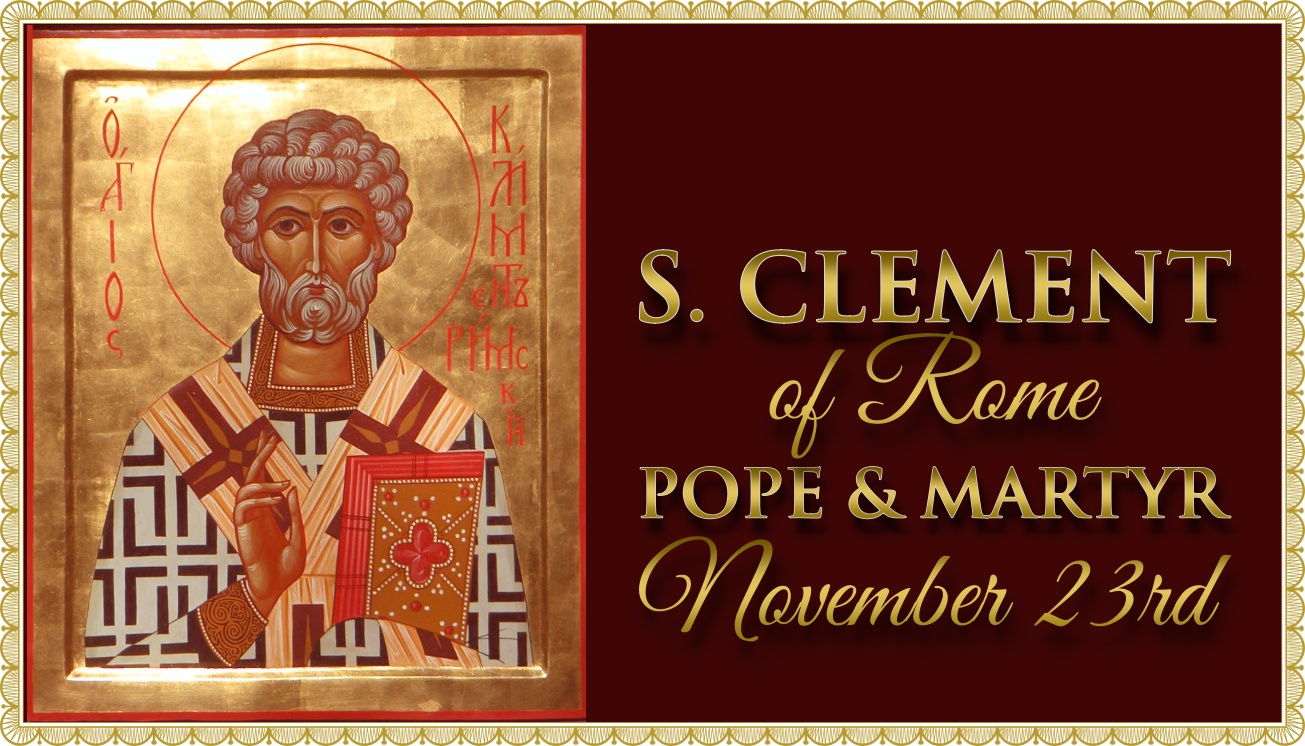
St. Clement of Rome/Twenty Fourth Sunday after Pentecost (Nov 23)
by the Revd Dr Robert Wilson PhD (Cantab), Old Roman Apostolate UK

Today we celebrate the feast of St. Clement of Rome, as well as commemorating the Twenty Fourth Sunday after Pentecost. St. Clement is listed after Linus and Cletus as Bishop of Rome in the succession of St. Peter. Little is known about his life, but much can be learnt about the early Church from his epistle to the Corinthians. This is one of the most important documents of the so called Apostolic Fathers, those writings that have been preserved for us from the period following the close of the apostolic age and the writings of the New Testament.
St. Clement wrote to the Corinthians in response to the deposition of certain presbyters by a faction in the Church. Since Corinth had been refounded as a Roman colony in 44BC there was a natural link between Corinth and Rome, but it is difficult to avoid seeing this as an early example of the pastoral concern for the faithful exercised by what St. Ignatius of Antioch in the early second century called the “Church that presides in love”. St. Clement’s epistle is the earliest witness of what has been described as the most characteristic features of the early Roman Church. He is not interested in theological speculation, but in the preservation of the faith once delivered to the saints. The Church is marked out by the divinely instituted hierarchy in succession to the apostles. He appeals to the importance of the maintenance of good order in society as a whole. This is a reflection of the order in creation. Like the Epistle to the Hebrews he draws attention to examples from those who in past ages had lived by faith. They serve as an encouragement to persevere in the face of adversity in the present.
Above all he appeals to the example of the two pillars of the Roman Church, St. Peter and St. Paul. “Let us have the good apostles before our eyes. Peter through wicked jealousy endured not one or two hardships but many, and after thus having borne witness went on to the place of glory which is his due. On account of envy and strife Paul gave an example of the price of endurance: seven times imprisoned, driven into exile, stoned; he preached in the East and in the West and won noble renown for his faith. He taught righteousness to the whole world and went to the western limit of the earth. He bore witness to the rulers and then passed out of the world and went on to the holy place, having proved himself the greatest pattern of endurance.”
St. Clement explains how the ministry of the Church stands in succession to the apostles. “The apostles received for us the gospel from our Lord Jesus Christ. Jesus the Christ was sent from God, the apostles from Christ: in both cases the process was orderly and derived from the will of God. The apostles received their instructions; they were filled with conviction through the resurrection of our Lord Jesus Christ, and with faith by the Word of God; and they went out full of confidence in the Holy Spirit, preaching the gospel that the Kingdom of God was about to come. They preached in country and town, and appointed their first fruits, after testing them by the Spirit, to be bishops and deacons of those who were going to believe.”
Later, he continued that “our apostles also knew, through our Lord Jesus Christ, that there would be strife over the question of the bishop’s office. Therefore, for this reason, since they had complete foreknowledge, they appointed the aforesaid persons and later made further provision that if they should fall asleep other tested men should succeed to their ministry. Therefore, when men who were appointed by the apostles, or afterwards by other men of repute, with the approval of the whole Church, have done their service blamelessly to the flock of Christ with humility of heart, in a peaceful and gentlemanly way, and have had a good report from all sides for a long period, we consider it unjust to depose them from their ministry. For it will be no trivial sin on our part if we depose from the bishop’s office those who have in a blameless and holy manner offered the gifts. Happy the presbyters who have gone on their way before this, for they obtained a ripe and fruitful departure; since they need not fear that anyone should remove them from their appointed place. For we see that you have replaced men of honourable behaviour from a ministry that they had honoured without reproach.”
St. Clement also appeals to the sacrificial worship in the Old Testament as an example of liturgical order. “The Lord has commanded that the offerings and services should be performed with care, and done at fixed times and seasons, and not in a haphazard and irregular fashion… The high priest has been given his own special services, the priests have been assigned their own place, and the levites have their special ministrations enjoined on them. The layman is bound by the ordinances of the laity… Let each one of you, my brothers, give thanks to God in his own order, with a good conscience, not transgressing the fixed rule of his service, and with solemn reverence.”
Though there are some uncertainties surrounding the correct interpretation of these passages, overall they provide the clearest account we have from the early Church about the development of the Christian ministry. The ministry of the apostle was of one who was the divinely authorised emissary of the Saviour, in accordance with the principle that a man’s agent is as it were himself. As the only begotten Son of the Father, Christ was sent from God. The apostles had been commissioned to preach the gospel of the life, death and resurrection of Christ from him. They exercised a universal ministry, but they appointed a local ministry of bishops and deacons in the places where they successfully evangelised. In each Church there were presbyters who governed as they did in the synagogues, but the Christian Eucharist required in addition two further orders, those bishops or overseers who presided and deacons who served or assisted. It would seem that this different role in the liturgy is the origin of the distinct ministries of the bishops and deacons. It is not clear either from the writings of the New Testament or from St. Clement’s epistle whether the bishops were at this early stage clearly distinct from the presbyters. In some places they seem to be synonymous, in others distinguished. Most probably this is a reflection of the transitional period that continued in the sub-apostolic era until the threefold order of bishops, presbyters and deacons was clearly formed in each Church. By the time of St. Ignatius of Antioch, writing early in the second century, they are clearly distinguished.
St. Clement explains that the apostles were aware of the danger that disputes could arise and so made provision that their ministry should be perpetuated. Unfortunately, it is not clear from the passage whether he means to refer to the continuance of a ministry like that of the apostles themselves, or to the local Church. Either way the point is that the hierarchy of the Church was divinely ordained and ministers should not be deposed without good reason. In the sacrifices of the old covenant there had been high priests, priests and levites, each of whom had their own distinct roles. In the same way the faithful of the new covenant should each give thanks to God in the liturgy according to his own order. It is important also to emphasise that in the early Church, although the laity were clearly distinguished from the clergy, they were still seen as a distinct and important order with their own role and responsibilities.
Let us therefore continue to read, mark, learn and inwardly digest St. Clement’s important epistle today, and above all give thanks in the liturgy each according to his own order.



Leave a Reply