
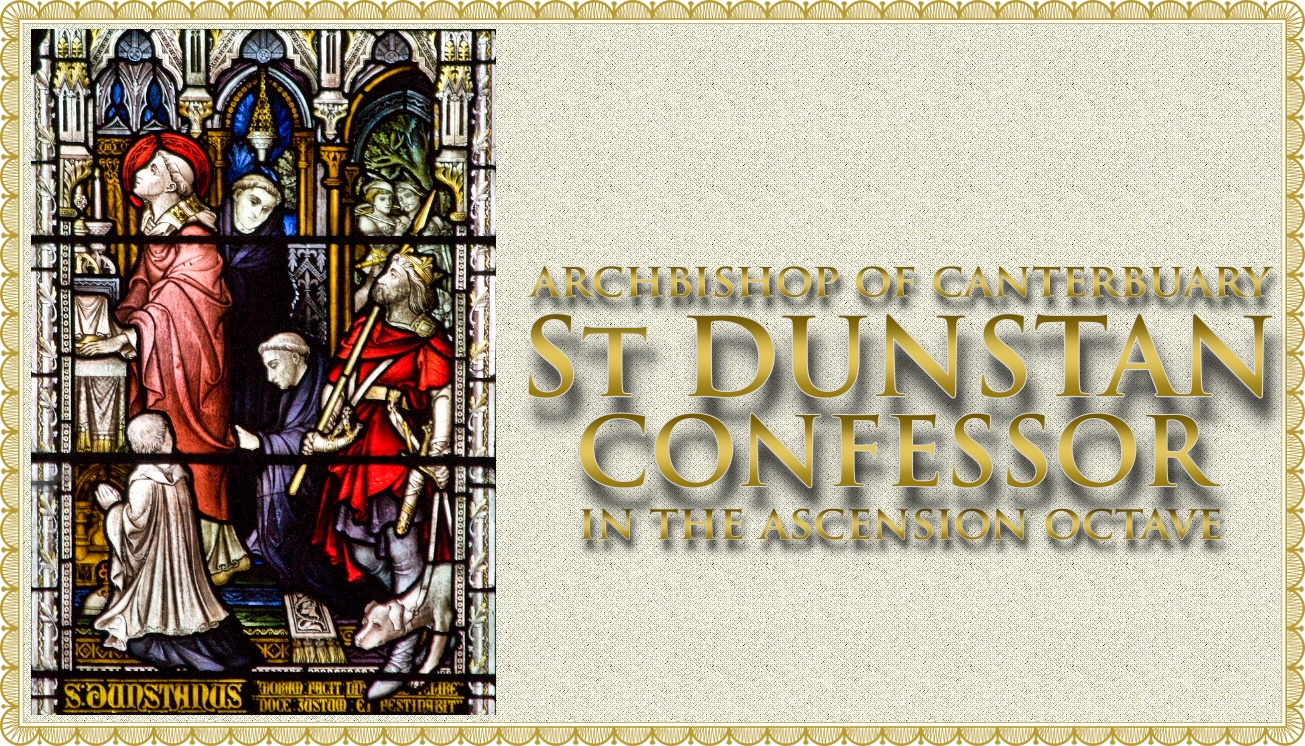
St. Dunstan
by the Revd Dr Robert Wilson PhD (Cantab), Old Roman Apostolate UK
Today marks the feast of St. Dunstan. He was one of the most popular saints in late Anglo-Saxon England before the Norman Conquest. He was born near Glastonbury around 910. He was from a noble family and received his early education at Glastonbury before being sent to the court of King Athelstan. He discerned a religious vocation from an early age and returned to Glastonbury where he pursued a life of prayer, study and manual labour. King Edmund, Athelstan’s successor, recalled him to court and appointed him abbot of Glastonbury. He made Glastonbury a great school of learning and a model for other monasteries. King Edmund was murdered after a reign of six and a half years and replaced by Edred, who made St. Dunstan practically his chief advisor. He was a stedfast upholder of the monastic rule of St. Benedict, and had no hesitation in speaking truth to power. There is an old saying that “truth purchaseth hatred”, and this certainly proved true in the case of St. Dunstan. When Edred died in 955 and was replaced by his brother Edwy, St. Dunstan was forced into exile for a time due to his opposition to the king’s dissolute lifestyle. He found refuge in Flanders, where he came into contact with continental monasticism, which provided a clear model for his later reforms.
When Edwy was replaced as king by his brother Edgar, St. Dunstan was recalled and was made Bishop of Worcester and subsequently Bishop of London. He later became Archbishop of Canterbury. This enabled him to fully implement his reforming agenda, assisted by St. Oswald of Worcester and St. Ethelwold of Winchester. They restored most of the monasteries that had been destroyed during the Danish invasions. They also sought to revitalise the secular clergy, many of whom led scandalous lives. St. Dunstan remained the chief advisor to King Edgar throughout his sixteen year reign and continued in this role during the brief rule of his martyred successor Edward. St. Dunstan crowned Edward’s half brother Ethelred, foretelling the calamities that would later mark his long reign. He no longer took any part in state matters and retired to Canterbury, where he finally died in 988.
The England in which St. Dunstan grew up was one that had attained identity as a nation from the Christian faith. The pagan tribes of Angles, Saxons and Jutes had conquered the land in the context of the power vacuum that had emerged after the Roman withdrawal from Britain. They were not only aggressive and warlike towards outsiders, but also towards each other. Gradually they were converted to Christianity, but the country still lacked political unity. This deficiency made them vulnerable to Viking invaders from Scandinavia. The tribal kingdoms fell and only that of Wessex remained. The Kings of Wessex were able to defeat the invaders and become the first kings of all England. It was at Bath Abbey that King Edgar had been crowned by St. Dunstan. But the political situation was never really stable and St. Dunstan rightly foresaw the disaster that would befall the country under King Ethelred, whose weak rule would reinvigorate the Danish menace. In time the Danes would themselves be gradually Christianised and the faith finally tamed their savagery, as it had previously done to the English.
St. Dunstan was a rigorous upholder of the discipline of the Church, and a great champion of the celibacy of the clergy. In speaking truth to power he stood in the tradition of the Old Testament prophets and St. John the Baptist, who constantly preached the truth, boldly rebuked vice and patiently suffered rather than compromise in the face of injustice.
In the Old Testament there is a constant tension between the kings who exercised power, and the prophets who preached righteousness. While the authority of the civil power in the person of the monarch ultimately came from God, with power came responsibility. It was the role of the prophet to be a watchman to the house of Israel, to exhort the people and their rulers to follow the old paths and not to follow the multitude to do evil. Then as now there were false prophets who prophesised smooth things, who told the people and their rulers what they wanted to hear. By contrast, the true prophet was often an uncomfortable and disturbing figure, a voice crying in the wilderness, whether they will hear or whether they will forbear, as Ezekiel put it. The prophet Nathan confronted the King David over his adultery with Bathsheba. The prophet Elijah confronted King Ahab over the murder of Naboth to acquire his vineyard for the king..
All of us are constantly tempted to water down the Christian faith to make it more palatable to our audience, and to reduce it to something that people feel comfortable with. But the truth is more important than diplomacy. The peace that Jesus promised his followers was one that this world could not give. We cannot ultimately win the world by the world’s own methods.
Let us pray that we will follow the example of St. Dunstan and be prepared to speak truth to power, whether they will hear or whether they will forbear, in our own time and place.





Leave a Reply