
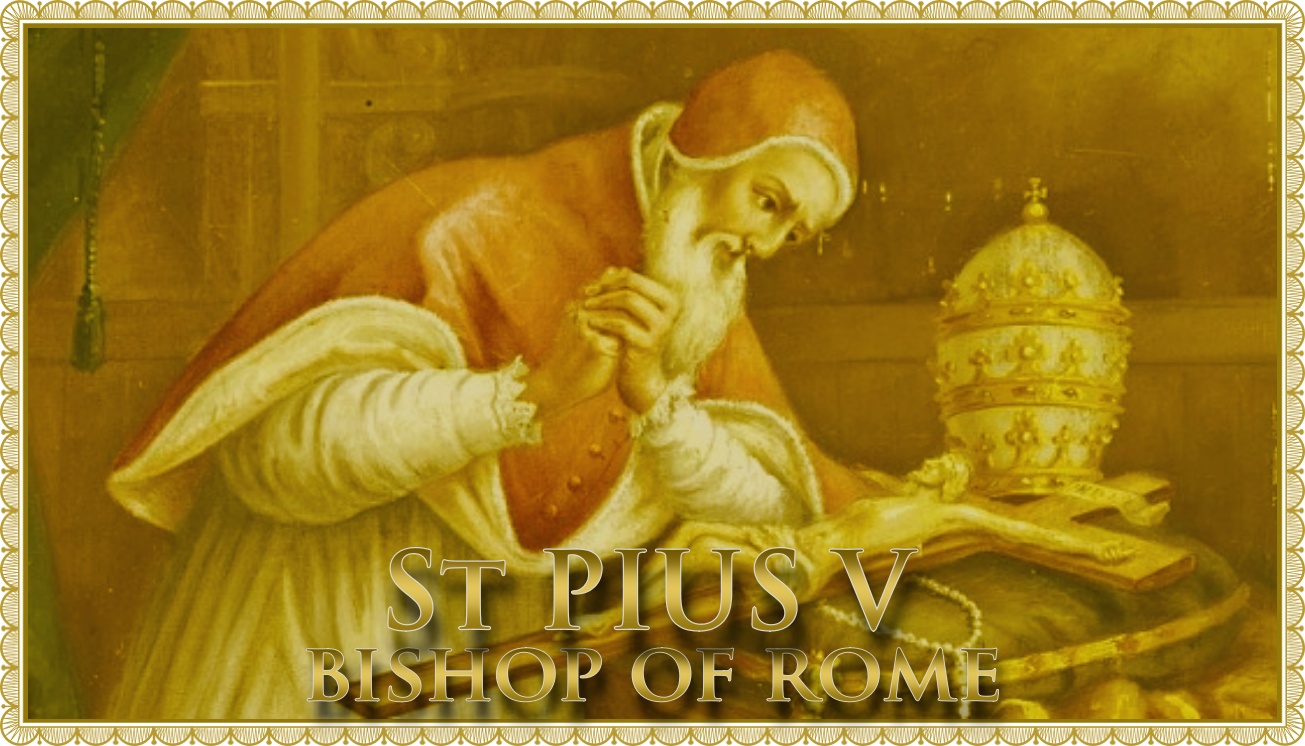
St. Pius V
by the Revd Dr Robert Wilson PhD (Cantab), Old Roman Apostolate UK
Today we celebrate the feast of St Pius V. Michael Ghislieri was born in 1504. From early on he discerned a vocation to the religious life and became a Dominican at the age of fourteen. He played a prominent role in promoting the strict observance of the order. In 1556 he became Bishop of Nepi and Sutri and the following year became a cardinal. He later became bishop of Mondovi. In 1565 Pope Pius IV died and Michael Ghislieri was chosen as his successor, taking the name of Pius V. This was largely due to the influence of the great reforming bishop of Milan, St. Charles Borromeo, who believed that he would be the right man to revitalise the Church. These hopes were certainly fulfilled and Pius V continued to live frugally and devoted all his energies to the reform of the Church.
He was determined to uproot the decadent culture of Renaissance Rome and implement the decrees of the recently completed Council of Trent. In 1568 an edition of the Breviary was published, omitting some of the more extravagant legends about the saints. In 1570 a standard edition of the Missal was published. A catechism was also published to ensure that the faithful were properly instructed. It should also be said that in his zeal for reform Pius V was not always wise and realistic in his actions. He clung to the medieval belief in the Papal supremacy over temporal princes. In 1570 he formally excommunicated Elizabeth I of England and absolved her subjects from allegiance to her. The decree was a bad mistake, and had exactly the opposite effect from the one he intended. Elizabeth I increased her persecution of the English Catholics, who became associated after that with treason against the Crown. It would not be until 1829 that they finally achieved emancipation. Pius V had greater success in 1571 when he supported Don John of Austria and Marcantonio Colonna in winning a decisive victory against the Turks on 7th October of that year at Lepanto. Pius V instituted the feast of the Holy Rosary in thanksgiving of that victory. He died the following year in 1572.
St. Pius V’s most lasting achievement was the standard edition of the Breviary in 1568 and the Missal in 1570. It is important to emphasise that this was not a new liturgy, but a standard edition of the existing liturgy. The liturgy itself dated back to the early centuries of the Church and was especially associated with the names of some of Pius V’s greatest predecessors, Leo, Gelasius and Gregory. Over the course of time the liturgy of the Roman Church had spread to other countries. It was brought by missionaries to England and subsequently to Germany. It had been adopted by Charlemange, though with adaptations to the existing Gallican liturgy. It was this that became the classical Roman rite which we continue to use today. In an age before the advent of printing there was no one standard edition and hence different areas and religious orders followed their own uses of the common Roman rite. In medieval England the Sarum usage (the liturgical use followed in Salisbury Cathedral) was the one most commonly followed, while religious orders such as the Dominicans followed their own usages. In the sixteenth century, the advent of printing made the publication of a standard text possible. It was this that Pius V achieved in 1570. While this was now decreed to be the edition to be used, an exception was made for practices that could clearly show themselves to be two hundred years older. The tendency towards greater uniformity and standardisation was partly a consequence of the advent of printing and also a response to the new practices being developed by the Protestant Reformers. It was therefore deemed necessary to produce a standard edition of the Roman rite in fulfilment of the reforming aims decreed by the Council of Trent.
It is important to emphasise this point today because it is often supposed that Pius V decreed the use of a new liturgy, the so called Tridentine rite, which has since been replaced by a new rite after the Second Vatican Council. This widely held viewpoint is based on a complete misunderstanding of the situation. The so called Tridentine rite of Pius V was not a completely new liturgy like the 1970 Missal, but rather a standard edition of the existing Roman rite which dated back over a thousand years to the early centuries of the Church. Pius V in his decree Quo Primum actually anathemised anyone who deviated from the standard edition of the Missal he had imposed. It remained the standard edition of the liturgy for the next four hundred years. Pius V, whatever his personal limitations, was fulfilling the traditional role of the Bishops of Rome as guardians of the deposit of faith. It was only with the triumph of Ultramontanism at the First Vatican Council of 1870 that a new conception of the role of the Bishops of Rome as liturgical innovators emerged and the traditional Roman rite was gradually abandoned by Pius X, Pius XII and Paul VI. Hence, it is not the case that the 1970 Missal is merely a modern substitute for the so called Tridentine rite of Pius V four hundred years earlier. The so called Tridentine rite represents a standard edition of the traditional Roman rite, but the 1970 Missal is a new liturgy that is fundamentally different from the traditional Roman rite. It therefore follows that it cannot be classified as a legitimate edition of the Roman rite. It is rather a product of a new conception of the authority of the Bishops of Rome as innovators rather than guardians of the deposit of faith.
All of this being said, it is important also to emphasise that the Tridentine reforms of Pius V do have their own limitations. Though Pius V decreed that practices that could be shown to be two hundred years older should be allowed to continue, in practice his decree led to many older perfectly legitimate practices dying out. This led to a certain narrowness of outlook and the Church after the Council of Trent tended to be less flexible in adapting the liturgy to a given context than the Church of middle ages. Contrary to a common misconception, the medieval Church was not a monolithic system and there were a wide diversity of liturgical uses. It was only after the Council of Trent that it was felt that a standard edition of the Missal and Breviary was necessary to combat the Protestant Reformation and further the reform of the Church. Thus, the Church after the Council of Trent was more rigid and less flexible than its medieval predecessor. But what we must continue to maintain today is that, whatever the limitations of the outlook of Pius V, the 1570 Missal was not a new liturgy, but rather a standard edition of the existing liturgy. It therefore follows that the 1970 Missal cannot be classified as a modern edition of the 1570 Missal and is not compatible with it.
Let us therefore take heed to the example of Pius V in our own time and place, and continue to uphold the traditional Roman rite.





Leave a Reply